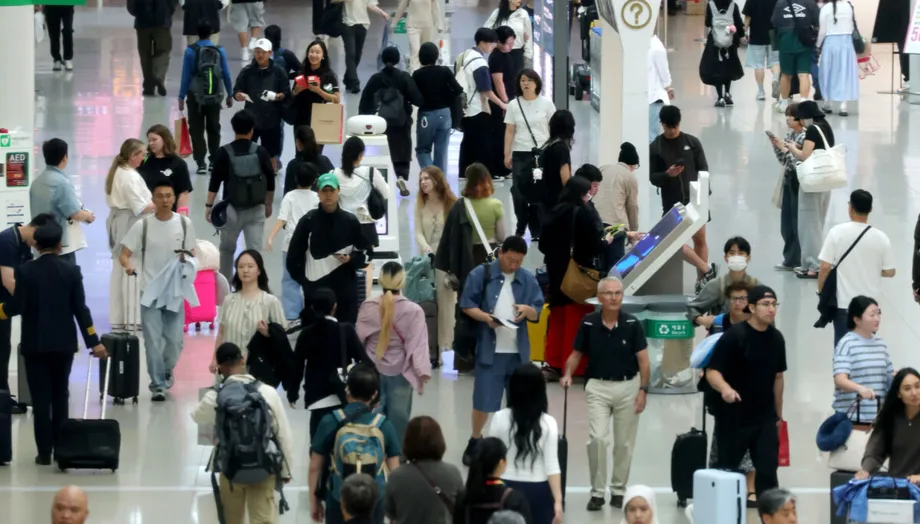
September leaves Korea 1.83 million arrivals short of last year's total
South Korea welcomed 17.11 million foreign visitors between January and September 2026, putting it within 1.83 million arrivals of the 18.94 million recorded during all of 2025. Foreign visitors' tourism card spending grew even faster, reaching 15.94 trillion won, about US$12 billion, as more travelers entered through airports and ports outside the Seoul metropolitan area.
Contents
- September leaves Korea 1.83 million arrivals short of last year's total
- A strong year builds across several months
- China leads, while Taiwan grows faster
- Card spending outpaces visitor growth
- Regional gateways take a larger role
- Visa changes help widen the visitor base
- Culture campaigns meet higher travel costs
- Korea grows faster than regional competitors
- Complaints expose pressure on visitor services
- Key Points
The Ministry of Culture, Sports and Tourism said on October 22 that arrivals increased 21.5 percent from 14.08 million during the same nine months of 2025. The country had already reached 90.3 percent of last year's annual total, and the ministry expected that total to be exceeded during October.
September brought 2.06 million visitors, up 21.1 percent from a year earlier. It was the third consecutive month above two million, following 2.09 million in July and 2.25 million in August. The sustained summer and early autumn traffic puts South Korea close to its previous annual benchmark with three months still to count.
The gains also bring a practical challenge: providing a better experience for a larger number of visitors. Tourism complaints filed through July had already exceeded the total for all of 2025. Accommodation, shopping and taxi services are among the areas drawing complaints, even as the government credits easier entry procedures and tourism promotion for attracting more travelers.
A strong year builds across several months
South Korea's growth has extended beyond a single holiday or major event. Monthly arrivals exceeded two million five times through September, including March and April as well as the three months from July.
The main milestones show how the year developed:
- March: approximately 2.05 million foreign visitors arrived.
- April: arrivals reached 2.03 million.
- July: arrivals reached 2.09 million.
- August: 2.25 million arrivals brought the cumulative total to 15.05 million.
- September: 2.06 million arrivals lifted the cumulative total to 17.11 million.
The ministry's September 28 tourism arrivals statement, drawing on Korea Tourism Organization statistics, said both August arrivals and the total through August had reached their highest levels in 30 years. Arrivals through August were up 21.6 percent, almost the same growth rate maintained through September.
The year began with a record first quarter, when South Korea received 4.76 million foreign visitors, up 23 percent. Officials linked March's surge to the BTS comeback, including the group's March 21 concert at Gwanghwamun Square in central Seoul.
The government's annual target is 23 million visitors. Reaching it would require another 5.89 million arrivals during October through December, or an average of about 1.96 million each month. That is below September's 2.06 million, although the ministry's October announcement focused on passing the 2025 total rather than confirming that the annual target would be reached.
China leads, while Taiwan grows faster
China remained South Korea's largest visitor market, contributing 5.47 million arrivals through September, up 29.2 percent from a year earlier. Chinese visitors represented about 32 percent of the 17.11 million total, making the market central to the country's tourism growth.
Japan followed with 3.12 million visitors, up 16.9 percent, in the ministry figures cited across several published accounts; another published tally gives Japan's total as 3.99 million. Taiwan supplied 1.86 million visitors, an increase of 32.4 percent, while Hong Kong contributed about 550,000, up 18.6 percent.
China, Taiwan and Hong Kong together accounted for approximately 7.88 million arrivals, or 46 percent of the total. Taiwan's percentage growth exceeded China's, showing that the increase across these nearby markets was broader than the recovery of the largest market alone.
Travel from farther away also expanded. Arrivals from the Americas reached 1.62 million, up 12 percent, while Europe contributed 1.19 million, up 20 percent. Together, those two regions supplied 2.81 million visitors.
Card spending outpaces visitor growth
Foreign visitors' tourism card spending rose 47.7 percent to 15.94 trillion won through September, compared with 10.79 trillion won during the same period of 2025. The increase amounted to approximately 5.15 trillion won, with spending growing at more than twice the percentage rate of arrivals.
The card figures include online purchases as well as transactions made in person. They track a substantial part of tourism commerce, while travelers also use other payment methods, including cash.
Dividing the card total by arrivals gives roughly 932,000 won per arrival in 2026, compared with approximately 766,000 won during the same period of 2025. That is an increase of about 22 percent. This is a simple comparison between two totals; individual travelers' bills vary with their purchases and length of stay.
The ministry had already recorded 14.018 trillion won in tourism card spending through August, up 48.5 percent from 9.4396 trillion won a year earlier. Subtracting that cumulative figure from September's rounded total suggests roughly 1.92 trillion won in additional card spending during September.
For businesses serving international travelers, the combination matters: more arrivals are being accompanied by more card spending per arrival. Hotels, shops, restaurants and other tourism businesses therefore face growing commercial opportunities alongside greater pressure on service capacity.
Regional gateways take a larger role
Airports outside the capital region handled 3.24 million foreign arrivals through September, up 37.4 percent. Those airports, including Gimhae, Jeju, Cheongju and Daegu, accounted for 19 percent of all international arrivals.
Seaports outside the capital region received another 1.58 million visitors, up 14.5 percent. Busan, Jeju, Seogwipo, Yeosu and Gunsan were among the gateways included. Together, regional airports and ports handled 4.82 million arrivals, or 28.2 percent of the national total.
The regional share increased from 27.8 percent through August to 28.2 percent through September. For places such as Busan and Jeju, direct international entry gives visitors a starting point outside Seoul and puts local transport, accommodation and other services closer to arriving passengers.
Airports in the capital region still handled the largest volume, approximately 11.79 million arrivals, with growth of 17.3 percent. Regional airport growth was more than twice that rate. Seaports near Seoul recorded a much faster 70.4 percent increase, reaching approximately 500,000 arrivals from a smaller starting total.
Visa changes help widen the visitor base
The Culture Ministry identified easier entry as one part of its tourism strategy. Working with the Ministry of Justice, it relaxed requirements for multiple entry visas for nationals of 11 Southeast Asian countries, including the Philippines, Vietnam and Indonesia, from March 30, 2026.
A multiple entry visa allows its holder to make repeated visits during the visa's validity rather than apply for permission for each trip. A temporary pilot allowing visa free entry for Indonesian group tourists began on May 28.
The Korea Tourism Organization also worked through its overseas offices to support faster visa processing. Measures included a support center in New Delhi and simpler application documents in Manila. In the Philippines, premium customers of major local credit card companies were exempted from submitting certain financial documents, including bank balance certificates and income tax returns.
Through August, arrivals from the Philippines reached approximately 454,000, up 16.1 percent, while Vietnam supplied 407,000, up 10.5 percent. Indonesia contributed 295,000, an increase of 22.5 percent. Singapore, Thailand and Malaysia also recorded increases, reaching about 243,000, 230,000 and 207,000 visitors respectively.
These figures cover January through August, rather than the nine months used for the latest national total. They show the markets the ministry was seeking to expand alongside the much larger flows from China, Japan and Taiwan.
Culture campaigns meet higher travel costs
The Culture Ministry and Korea Tourism Organization sought to turn overseas interest in Korean entertainment, food and everyday life into travel bookings. Their campaigns used local content creators, social media and promotional events tailored to individual markets.
A Korea Travel Fair in central Singapore attracted 120,000 visitors over three days. Events were also held in Vietnam, the Philippines and Malaysia. The agencies worked mainly with local creators who had more than one million followers and groups already interested in Korea.
Higher oil prices and fuel surcharges had made travel to South Korea more expensive since March, according to the ministry. It responded by supporting airfare promotions with airlines and online travel agencies. Flights from Indonesia increased from 3,651 one way operations during January through August 2025 to 3,974 during the same period of 2026, a rise of 8.8 percent.
Kang Jung-won, deputy minister for tourism policy, described the government's approach in the September statement:
Improved entry procedures and tailored marketing are bringing a more diverse range of visitors to Korea.
Kang said the ministry would manage visa issuance and immigration processing at airports and seaports while continuing marketing linked to Korean culture during the fourth quarter. He identified October, when the Travel Month campaign takes place, as the busiest period for international arrivals.
Korea grows faster than regional competitors
The ministry's comparison of international arrivals through August showed South Korea growing faster than Japan, Thailand and Vietnam. Korea's arrivals increased 21.6 percent, while Vietnam recorded growth of 14.4 percent. Japan's total fell 2.7 percent and Thailand's declined 3.1 percent.
The visitor totals put those rates in perspective. South Korea received approximately 15.05 million arrivals through August, compared with 27.63 million in Japan, 20.94 million in Thailand and 15.91 million in Vietnam.
Japan therefore still welcomed roughly 12.58 million more international arrivals than South Korea during those eight months. Vietnam's lead over Korea was much smaller, at approximately 860,000 arrivals.
For South Korea, the comparison shows rapid expansion alongside destinations that still receive more visitors. The ministry's focus on broader entry routes, simpler visas and market specific promotions addresses several practical parts of attracting travelers, from securing permission to travel to finding a suitable flight.
Complaints expose pressure on visitor services
The Korea Tourism Organization received 1,753 tourism complaints between January and July, already above the 1,744 submitted during all of 2025. Foreign nationals filed 84.3 percent of the complaints.
Accommodation accounted for 500 complaints and shopping for 376. Airport and airline services drew 186, taxis 182, and hotels, listed separately from accommodation in the complaint breakdown, 146.
Taxi overcharging presents a longer running enforcement problem. Seoul Metropolitan Government data obtained by lawmaker Mo Kyung-jong recorded 6,481 reports of excessive taxi fares involving foreign tourists from 2021 through August 2026. Administrative sanctions followed in 204 cases, or 3.1 percent. Most cases were closed without further action or ended with warnings and guidance.
Seoul offers a reward of 500,000 won for reports of taxi overcharging against foreign visitors that lead to administrative action. No reward applications or payments were recorded during that period.
The complaint figures make service quality a concrete issue as arrivals rise. Visitors need dependable accommodation, transparent shopping prices and fair transport charges. The ministry plans a press conference to explain the year's tourism results and its policy direction for 2027, but no date was announced.
Key Points
- South Korea received 17.11 million foreign visitors through September 2026, up 21.5 percent from a year earlier.
- The ministry expected October arrivals to push the total past the 18.94 million recorded during all of 2025.
- Tourism card spending rose 47.7 percent to 15.94 trillion won, including online purchases.
- China supplied 5.47 million visitors, while Taiwan's arrivals grew 32.4 percent to 1.86 million.
- Regional airports and seaports handled 4.82 million arrivals, representing 28.2 percent of the total.
- Visa changes and targeted promotions accompanied growth, while tourism complaints through July exceeded the total for all of 2025.