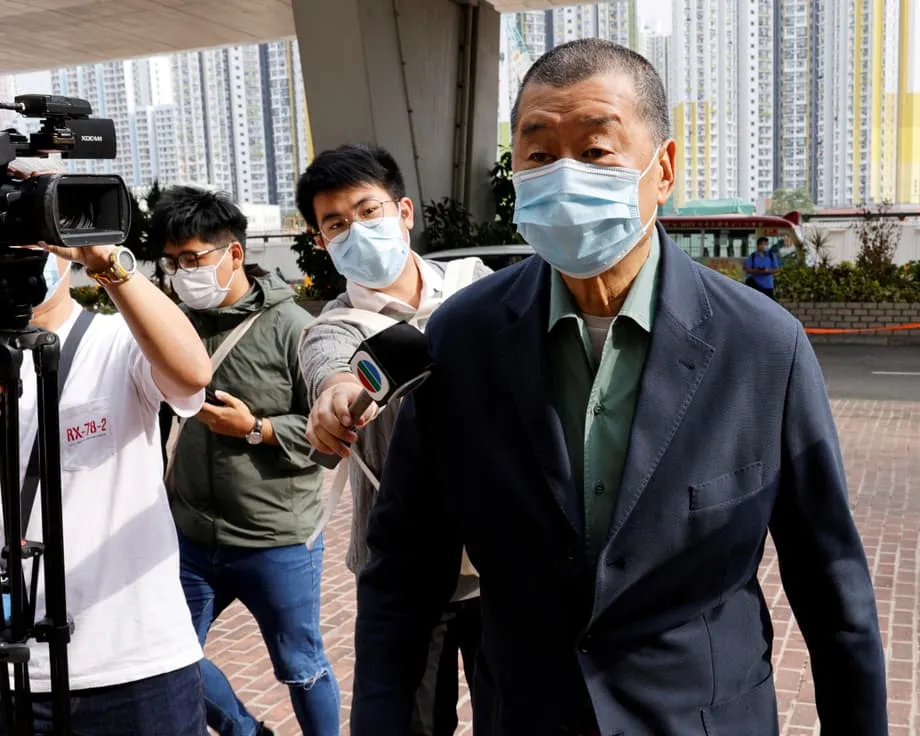
A lease case overturned, a prison term still standing
Hong Kong's Court of Appeal has overturned the 2022 fraud convictions of Jimmy Lai and former Next Digital executive Wong Wai-keung, finding errors in the way the trial court treated a newspaper company's lease obligations and the evidence needed for criminal fraud.
Contents
- A lease case overturned, a prison term still standing
- What the Apple Daily lease dispute involved
- Why the appeal judges rejected the convictions
- The separate case carrying a 20-year sentence
- How the cases reached this point
- His family warns that time is running out
- Britain and the United States face calls to act
- An activist's father receives eight months
- Authorities defend the courts and consider an appeal
- What changes for Lai now
- Key Points
The ruling on Thursday removed Lai's sentence of five years and nine months in the case. Wong, 61, had already served his sentence of 21 months. Neither man attended the decision, with their absence approved by Chief Judge Jeremy Poon.
For Lai, the 78-year-old billionaire founder of the now closed Apple Daily newspaper, the victory leaves the central reason for his continued imprisonment unchanged. Earlier in February 2026, a separate court sentenced him to 20 years for national security offenses, the harshest punishment imposed under the Beijing-imposed national security law since its introduction in June 2020.
Lai, who has described himself as a "political prisoner," has spent the past five years in maximum security solitary confinement. His family says the fraud ruling brings no practical relief from the prospect of spending the rest of his life in prison.
As of February 27, the Department of Justice was considering whether to challenge the appeal decision. His family and international lawyers were continuing to press for his release, citing declining health, while looking toward planned talks between US President Donald Trump and Chinese President Xi Jinping from March 31 to April 2.
The two cases now have different outcomes: the fraud convictions have been quashed, while the separate national security convictions and sentence remain in force. The precise effect on the calculation of Lai's imprisonment has not yet been settled.
What the Apple Daily lease dispute involved
The fraud prosecution concerned Apple Daily's headquarters and printing facilities in Tseung Kwan O. The premises were leased from the Hong Kong Industrial Estates Corporation for newspaper printing and publication.
Prosecutors argued that Lai and Wong concealed the presence of Dico Consultants Ltd, Lai's private consultancy firm, at the premises. They treated that alleged concealment as fraud under Section 16A of the Theft Ordinance, rather than simply a dispute over whether the tenant had followed its lease.
District Judge Stanley Chan convicted the two men in 2022. He found that allowing Dico to operate there breached restrictions on how the property could be used. The case also involved clauses limiting the transfer or sharing of rights to the premises, known as non-alienation clauses.
Dico's role was contested. Defense counsel Derek Chan argued at the original trial that it supported newspaper publishing operations as well as dealing with Lai's personal affairs. The company held a 49 percent stake in Apple Daily at the beginning of the relevant period and had connections to Next Animation, which produced material for the newspaper's online platforms.
The defense also pointed to Dico's small physical presence: it occupied 0.16 percent of the premises. Judge Chan rejected the argument that this made its presence trivial, holding that the tenant remained responsible for licensing compliance regardless of the space involved.
Hong Kong's government has continued to describe Dico's occupancy as the use of public resources for Lai's personal purposes over more than two decades. The appeal turned on the legal obligations arising from that arrangement and whether the prosecution had established criminal responsibility.
Why the appeal judges rejected the convictions
Chief Judge Jeremy Poon and judges Anthea Pang and Derek Pang found that the original judgment rested on an unsound interpretation of commercial tenancy law. Their reasoning focused on whether Apple Daily Printing had a duty to tell its landlord that it was breaching restrictions in the lease.
The judges said established common law principles, meaning legal rules developed through court decisions, imposed no such duty in this case. Their judgment stated:
We hold that Apple Daily Printing did not owe a duty to the Corporation to disclose its breach of the user restrictions or the non-alienation clauses occasioned by Dico's occupation and use of the said Premises,
The court also found that, even if a disclosure duty had existed, criminal liability could not legally be attributed to Lai and Wong personally. A company's contractual duties and an individual's responsibility for a crime require separate legal reasoning.
The prosecution faced another problem: it had not proved beyond reasonable doubt that the defendants made false representations about the use of the premises. That standard requires a criminal court to be sure of guilt after considering the evidence.
The appeal judges rejected the trial court's reasoning on alleged concealment. The judgment described the trial judge's "reasoning in concluding that the applicants were liable for the concealment as the prosecution contended is unsupportable."
The decision quashed both men's fraud convictions and removed those convictions from their criminal records. Wong had already completed his punishment, while Lai remained detained under the separate security case. The judges confined their ruling to the lease dispute, leaving the national security proceedings untouched.
The separate case carrying a 20-year sentence
The Court of First Instance convicted Lai in February 2026 following a trial lasting 156 days. He was found guilty of two counts of conspiracy to collude with foreign forces and one count of conspiracy to publish seditious materials.
The three judges described Lai as the "mastermind" of a conspiracy to lobby foreign governments, including the United States and United Kingdom, to impose sanctions, blockades or other hostile measures against China and Hong Kong. Sanctions are restrictions used to put pressure on a government or particular people and organizations.
The prosecution centered on Apple Daily's editorial positions, including articles calling for international pressure on Beijing and interviews with foreign politicians. Lai maintained his innocence, arguing that his conduct was ordinary journalism and political expression protected under Hong Kong's Basic Law before the security law took effect.
Western governments and human rights organizations have criticized the case as criminalizing legitimate journalistic work and political advocacy. Chinese and Hong Kong officials defend it as necessary to maintain stability and as reflecting the "spirit of the rule of law." They reject international criticism as interference in domestic affairs.
The sentence is the longest imposed under the national security law introduced after the mass democracy protests of 2019. At sentencing, the court allowed only two years of the security sentence to run concurrently with the fraud sentence. Concurrent terms are served at the same time; consecutive terms are served one after another. The remaining 18 years were to follow the fraud punishment.
Removing the fraud sentence complicates that calculation. The earlier schedule would have kept Lai imprisoned until at least 2042, when he would be 95. With the fraud convictions overturned, the treatment of the overlapping two years and the consecutive portion requires further legal clarification. The security sentence itself remains 20 years.
How the cases reached this point
Lai's prosecutions unfolded alongside the closure of the newspaper he founded. Apple Daily began publishing in 1995, combining celebrity gossip with forceful political reporting and open criticism of Beijing. It became Hong Kong's largest newspaper supporting democracy and a rare independent voice as the media environment grew more restrictive.
The major dates show how a dispute over premises came to sit beside a much larger national security prosecution:
- 1995: Lai founded Apple Daily.
- 2019: Hong Kong experienced mass protests supporting democracy.
- June 2020: Beijing imposed the national security law.
- June 2021: Apple Daily closed after police raids and the freezing of company assets under that law.
- 2022: District Judge Stanley Chan convicted Lai and Wong in the fraud case.
- February 2026: The Court of First Instance convicted Lai after a trial lasting 156 days and sentenced him to 20 years.
- Thursday, before publication on February 27, 2026: The Court of Appeal overturned both fraud convictions.
- March 31 to April 2: Trump is scheduled to visit Beijing for meetings with Xi.
Apple Daily's closure removed a major outlet for independent journalism reaching a mass audience. Other independent outlets have also closed since the security law took effect, journalists have been arrested, and foreign correspondents have faced visa difficulties.
The fraud ruling restores neither the newspaper nor its operations. Lai's continued imprisonment remains a warning to other media owners about the risks surrounding editorial independence, even as Hong Kong authorities point to the appeal as an example of courts correcting legal errors.
His family warns that time is running out
Sebastien Lai, Jimmy Lai's son, said after Thursday's ruling that it "does not change anything" for his father. He described the continuing security sentence and prolonged solitary confinement as the urgent issues.
He still has a sentence of 20 years in prison and has spent the last half a decade in solitary confinement in maximum security. The right thing is to release him immediately before it is too late,
The family and Lai's legal representatives have cited retinal vein occlusion in his right eye, high blood pressure, heart palpitations and progressive hearing loss. Retinal vein occlusion involves a blockage in a vein carrying blood away from the retina, the part of the eye that detects light.
His daughter Claire said in December that his teeth were rotting and his fingernails "sometimes fall off." Those descriptions have raised concerns about nutrition and the adequacy of medical care. Caoilfhionn Gallagher KC, who leads Lai's international legal team, has warned that the combined health problems put him at risk of dying in prison.
Claire Lai described the fraud ruling as "nothing more than a PR move by the Hong Kong authorities." She said her father's continuing imprisonment left the family without meaningful relief.
No one should be fooled into thinking.. [it] is anything more. The rule of law is broken there, and my father is still unjustly imprisoned and will remain so for nearly 20 years unless urgent action is taken to secure his release,
The family's campaign has gained attention in Western capitals, where Lai's imprisonment has become a focus of concern about the loss of Hong Kong's promised autonomy and civil liberties. Their immediate demand is release before his health deteriorates further.
Britain and the United States face calls to act
Lai's British citizenship has made his treatment a particular diplomatic issue for the United Kingdom. Following the national security sentence, Foreign Secretary Yvette Cooper said he had been imprisoned "for exercising his right to freedom of expression" and called for his release on humanitarian grounds.
Conservative and Liberal Democrat parliamentarians have urged the British government to take stronger measures, including possible sanctions against Hong Kong officials responsible for the prosecutions.
In the United States, Lai's case has attracted support across party lines and the attention of Trump, who has publicly pledged to secure his release. The White House confirmed that the president would travel to Beijing from March 31 through April 2 to meet Xi. Lai's children hope their father's case will be raised during those discussions.
Claire Lai attended Trump's recent State of the Union address as a guest of House Speaker Mike Johnson. Johnson praised Jimmy Lai for "championing democracy" and "fighting for the freedoms we too often take for granted in America."
John Moolenaar, chair of the US House of Representatives' select committee on China, called the overturned fraud charge an "illusion" intended to present an appearance of judicial independence. He said:
The Chinese Communist Party wants the world to believe there is a fair and equal justice system in Hong Kong, but it's all controlled by Beijing,
Amnesty International and Reporters Without Borders have also rejected the fraud acquittal as an adequate response to what they describe as a wider pattern of political persecution. International observers and Lai's family view the appeal victory as a limited legal correction amid continuing detention on politically charged offenses.
Lai's international lawyers continue advocacy at the United Nations and in foreign capitals. They argue that his detention violates international human rights standards protecting freedom of expression and humane treatment of prisoners. The planned Trump-Xi meeting is the nearest scheduled opportunity for diplomatic intervention, although Chinese officials have historically resisted connecting human rights cases with negotiations on trade and strategic issues.
An activist's father receives eight months
On the same Thursday, a Hong Kong court sentenced Kwok Yin-sang, the 69-year-old father of activist Anna Kwok, to eight months in prison for trying to terminate an education savings insurance policy and withdraw approximately HK$88,609, or US$11,400.
The conviction was for "attempting to deal with" funds belonging to an "absconder" under Hong Kong's domestic national security law. The provision criminalizes handling financial resources belonging to activists who have fled overseas.
Anna Kwok, based in Washington, is executive director of the Hong Kong Democracy Council. She is among 34 overseas activists subject to police bounties of up to HK$1 million, or US$128,000, for alleged national security violations.
Her father bought the policy when she was two years old. Acting Principal Magistrate Cheng Lim-chi ruled that, because Anna Kwok was a fugitive, handling her assets was a criminal offense even when the person involved was a parent managing money he had originally contributed.
Kwok Yin-sang became the first person convicted under this specific provision targeting relatives of activists living abroad. The case extends the law's reach to financial arrangements involving overseas dissidents while imposing punishment on family members still in Hong Kong.
Before the sentencing, Anna Kwok described the prosecution of her father as "utterly despicable." She said using family ties against her would not end her advocacy:
The Hong Kong government's retaliation does not and will not discourage me from my ongoing activism,
Rights groups condemn the use of family relationships to pressure overseas activists as collective punishment. The insurance case shows how a parent's attempt to manage a longstanding family financial arrangement can lead to imprisonment under the domestic security provisions.
Authorities defend the courts and consider an appeal
Hong Kong's government presented the fraud decision as evidence that the courts exercise judicial power "independently." A spokesperson said both the original trial and the appeal had been conducted "openly and transparently."
The Department of Justice said it would "study the judgment thoroughly and consider whether to appeal." A further challenge could take the case to the Court of Final Appeal, extending proceedings even though the fraud acquittals currently stand.
The government also maintained that the ruling did not change its account of the underlying conduct. It said Lai had "exploited public resources for personal purposes" by allowing Dico to occupy the premises for more than two decades.
That response preserves the government's allegation of improper use while the Court of Appeal has rejected the legal basis for criminal fraud. The appellate judgment examined contractual duties, personal criminal responsibility and whether false representations had been proved.
Lai's family and international critics see a sharp gap between that correction and his continued punishment under the security law. Their concerns about judicial independence include the belief that political cases face predetermined outcomes in national security courts. The Court of Appeal has also upheld other disputed national security convictions.
For investors and international observers, the fraud judgment offers a limited indication that courts can correct errors involving commercial arrangements. The continuing security case remains at the center of concerns about political prosecutions. The appeal judges' decision was confined to the particular lease dispute.
What changes for Lai now
Lai has secured one of his few legal victories in Hong Kong's increasingly restrictive environment. His fraud conviction and its sentence have been removed, and Wong's conviction has been overturned after he completed his prison term.
The prison calculation is the immediate unresolved legal issue. The removal of the fraud punishment may reduce Lai's total time in custody, but its effect depends on how the concurrent and consecutive parts of the security sentence are applied. The possible remaining period has been described as approximately 18 to 20 years.
Release through a successful security appeal, diplomatic intervention, early release or a pardon remains a prospect rather than an announced outcome. A pardon would involve executive clemency, a decision by the relevant authority to forgive or reduce punishment. No such decision has been announced.
The fraud judgment gives Lai's lawyers an example of an appeal correcting errors in a lower court, although challenging the national security convictions involves different charges and much greater political stakes. Authorities must also decide whether to seek a further appeal in the fraud case.
For Hong Kong's democracy movement, the two outcomes capture both the personal cost of resistance and the persistence of international attention. A court has removed one conviction, yet a 78-year-old publisher remains imprisoned under a sentence tied to newspaper articles, interviews and efforts to secure foreign pressure on Beijing.
The next scheduled diplomatic date is the March 31 to April 2 visit to Beijing. Until a legal or political decision changes his position, Lai remains in custody, his family continues to warn about his health, and the 20-year security sentence remains the controlling fact of his future.
Key Points
- The Court of Appeal overturned the 2022 fraud convictions of Jimmy Lai and Wong Wai-keung, rejecting the trial court's reasoning on lease disclosure duties and criminal responsibility.
- Lai's sentence of five years and nine months was quashed. Wong had already served 21 months.
- Lai remains imprisoned under a separate sentence of 20 years for two foreign collusion conspiracies and a conspiracy to publish seditious materials.
- The effect of the fraud acquittal on the calculation of Lai's imprisonment remains unresolved.
- The Department of Justice is studying whether to appeal the fraud decision.
- Lai's family and international lawyers are seeking urgent release because of his health and prolonged solitary confinement.
- UK Foreign Secretary Yvette Cooper has called for humanitarian release. Trump is scheduled to meet Xi in Beijing from March 31 to April 2.
- On the same Thursday, Anna Kwok's father received eight months in prison for trying to withdraw money from her education savings insurance policy.