Luxury Disappears From View Before Nepal Votes
Nepal votes on March 5, 2026, nearly six months after protests against corruption and a social media ban forced Prime Minister KP Sharma Oli from office. At least 76 people died during the unrest. As the election approaches, some children and grandchildren of powerful politicians have withdrawn the public displays of wealth that helped turn resentment into a national revolt.
Contents
- Luxury Disappears From View Before Nepal Votes
- How Political Families Became Symbols of Inequality
- A Platform Ban Turns Into a Deadly Uprising
- Discord Helps Shape an Interim Government
- Established Parties Promise to Change
- Three Contenders Offer Jobs and Clean Government
- Injured Protesters Want More Than Promises
- Young Workers Are Still Preparing to Leave
- A Revolt With Echoes Across the Region
- The Essentials
Shrinkhala Khatiwada, a former Miss Nepal and the daughter of a former health minister, has closed the Instagram account where she had more than a million followers. Her last YouTube upload is a 34 minute video defending herself against the "nepo kid" label, posted months before the September uprising.
Smita Dahal, granddaughter of a former Maoist guerrilla leader who served three times as prime minister, has made her account private. Her last public Facebook update dates to late August. Her expensive handbags had become part of a wider online argument about political privilege, with individual purchases costing the equivalent of years of average Nepali wages.
Designer labels, luxury resorts and foreign holidays once filled these feeds. Their disappearance comes as parties promise jobs and investigations into corruption, while young voters weigh whether September's deaths will produce lasting changes.
Nepal's youth unemployment rate stands at 20.6 percent, and about three million citizens work overseas, often in dangerous construction jobs in Gulf countries. For many young people, the contrast was visible on the same phones they used to look for work, communicate with relatives abroad and watch the lives of political families.
How Political Families Became Symbols of Inequality
Satish Kumar Yadav, a 25 year old laboratory technician, described the anger before the protests erupted. He contrasted the holidays available to political families with the journeys ordinary workers make out of necessity.
The kids of big politicians celebrate special occasions in places like Thailand and Switzerland," he observed. "But, the children of the general public are forced to go to Gulf countries to find jobs.
Saugat Thapa, the son of a former minister, appeared beside boxes from Louis Vuitton, Cartier and Gucci arranged like a Christmas tree. The image spread widely among young people already angry about inequality. He has continued posting photographs from Hong Kong, London, Istanbul and Marrakech to his 14,000 followers, defending his family's wealth by saying his father had "returned to the community".
Jaiveer Singh Deuba, the son of Sher Bahadur Deuba, who served five times as prime minister, became another focus of resentment. His lavish wedding to singer Shivana Shrestha, followed by images of designer clothes and foreign holidays, offered a visible example of the spending that angered protesters. The couple's accounts and those images have since disappeared.
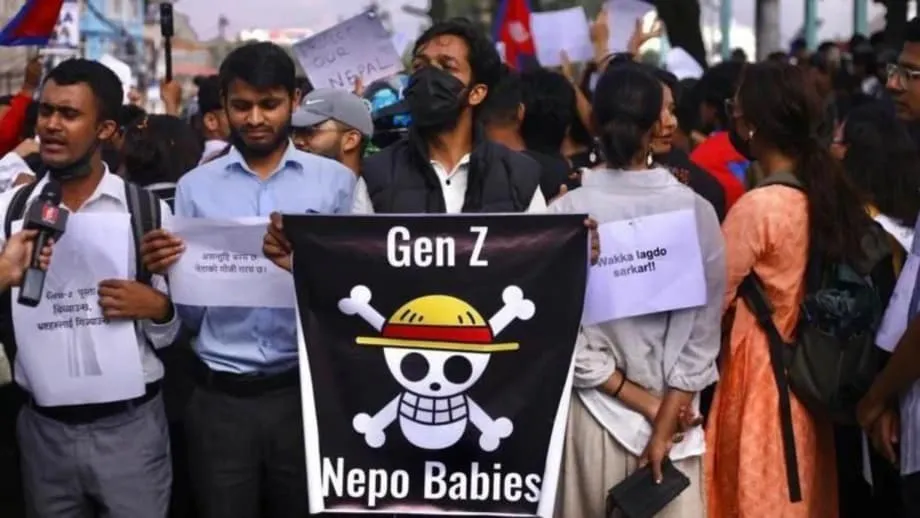
The label "nepo kids" refers to children whose opportunities or status are associated with powerful parents. In Nepal, the online campaign brought together two grievances: frustration about inherited access to influence and anger at the distance between the lifestyles of political families and those of ordinary workers. The #NepoBaby campaign gave that frustration a shared name before the government restricted social media.
A Platform Ban Turns Into a Deadly Uprising
On September 4, 2025, the government banned 26 social media platforms, including Facebook, WhatsApp, YouTube and Instagram. Its stated reason was that unregistered platforms were violating new digital service tax rules. Critics argued that the restrictions were intended to silence the campaign exposing the wealth gap around political dynasties.
On September 8, thousands of Gen Z protesters gathered in Kathmandu, many wearing school uniforms. Youth groups, including Hami Nepal, helped organize the demonstrations. The initially peaceful protests turned violent when security forces opened fire. By nightfall, 19 protesters were dead, many killed by live ammunition.
Violence spread over the following days. Mobs set fire to Parliament, the Supreme Court, the Prime Minister's Office and the homes of former ministers. Former prime minister Sher Bahadur Deuba and his wife, the foreign minister, were beaten inside their burning residence.
At least 76 people died during the unrest. The reported total included 22 protesters, three police officers and 10 prisoners shot during jailbreaks. The figure of 19 protesters killed on September 8 describes the first day of demonstrations, while 22 is the protester toll given for the wider unrest.
Within 48 hours of the protests beginning, Oli resigned and fled to an army barracks, eventually leaving by helicopter. Government authority had broken down as major institutions burned and the army imposed curfews.
The key dates show how quickly a dispute over online restrictions became a change of government:
- September 4, 2025: The government banned 26 social media platforms.
- September 8: Thousands demonstrated in Kathmandu, and 19 protesters were killed that day.
- Within the following 48 hours: Oli resigned as violence spread.
- September 12: President Ram Chandra Poudel appointed former chief justice Sushila Karki as interim prime minister.
- March 5, 2026: Nepal is scheduled to hold the election intended to end the interim administration.
Discord Helps Shape an Interim Government
More than 100,000 young Nepalis gathered on Discord servers while soldiers patrolled streets under curfew. Discord, a platform widely used for gaming conversations, became a place to coordinate protests, debate candidates and discuss who should lead the country.
The Youths Against Corruption server, established by Hami Nepal activist Sudan Gurung, became a virtual meeting chamber. Participants debated and voted before settling on Sushila Karki, a former chief justice known for her stance against corruption, as their preferred interim leader.
The process was presented as potentially the first instance in modern history of citizens choosing a head of government through an online vote rather than through political parties. The formal appointment came from President Poudel on September 12. With little credibility among protesters, he invoked the "doctrine of necessity", an argument used to justify exceptional action during a crisis.
Karki, 73, became Nepal's first female prime minister. Her task was to guide the country to the March 5 election. Her interim cabinet brought in technocrats, including former finance secretaries and former heads of the power authority, rather than politicians.
Karki described her appointment as a response to demands from the streets, rather than a position she had pursued.
"I did not come to this position because I had sought it but because there were voices from the streets demanding that Sushila Karki should be given the responsibility," she said upon taking office.
Karki announced compensation of 1 million rupees for families of protesters who were killed, alongside medical care for injured people. The amount was described as approximately $7,000 to $11,330, depending on the exchange rate used. She pledged that her administration would last no longer than six months, enough time to organize the vote.
Established Parties Promise to Change
Nepali Congress removed Sher Bahadur Deuba as party president and replaced him with Gagan Thapa, 49, presenting a younger leader within an aging organization. The party has proposed investigating the assets of public office holders going back to 1991 and limiting how long individuals can serve as prime minister or party president.
The Communist Party of Nepal UML, which held power during the September crackdown, has promised to involve young people in "political transformation". The Rastriya Swatantra Party, established only a few years ago, has pledged greater accountability for constitutional bodies, the institutions assigned duties under Nepal's constitution.
Rakshya Bam, one of the most prominent leaders of the Gen Z movement, acknowledged changes inside the parties. She pointed to proposed limits on holding senior positions as a useful response to pressure from protesters.
They forced it and made reforms within the party," she said. "They have also stipulated the time frame for which any candidate can serve as a prime minister or party president. They have also qualified how many times an individual can be a minister. I think this is a good practice and can be helpful to dismantle policy corruption.
Bam nevertheless considers the changes insufficient. For young people who witnessed the September violence, new leaders and internal rules leave the larger demand for accountability unfinished. Policy corruption, the concern she identified, involves decisions and rules being shaped to benefit those with influence.
Three Contenders Offer Jobs and Clean Government
Balendra Shah, 35, has emerged as the leading contender. A rapper and engineer who became Kathmandu's independent mayor, he is contesting the election with the Rastriya Swatantra Party. His black clothes and sunglasses have become recognizable symbols of resistance to the established political class.
Shah has pledged to create 1.2 million jobs and to "raise strong voices against irregularities and corruption". His appeal connects the demand for honest government with the shortage of work that has pushed so many young Nepalis abroad.
Gagan Thapa, leading Nepali Congress, promises 1.5 million jobs, half as much outward migration for work within five years, and an end to corruption within the same period. His jobs target is 300,000 higher than Shah's, a quarter more than the 1.2 million Shah has promised.
Khadga Prasad Oli, the prime minister forced out in September, is also seeking a return. He promises "zero tolerance" for corruption, despite having led the government during the crackdown that killed dozens.
The three campaigns offer different political identities: a figure associated with resistance to established parties, a younger leader within a traditional party, and the former prime minister seeking another chance. Each must answer the same immediate demands for employment and action against corruption.
Injured Protesters Want More Than Promises
Rakesh Kumar Mahato was shot in the spine during the demonstrations and remains paralyzed. His doubts about the election focus on whether promises of corruption investigations will lead to action.
"They say they will investigate corruption, but we aren't sure if they will totally implement this," he said.
Dipika Saru Mugar, who traveled 16 hours to cast her first vote, sees public attention moving away from the social media campaign that helped ignite the protests. She described the fading visibility of the political heirs whose photographs once dominated the debate.
I think many people have forgotten the nepo babies trend," she said. "That trend is over and there is a shift in focus. Our attention spans these days is very short.
Mugar still wants voters to remember the suffering behind the revolt when they make their choice.
The revolt was the result of a pain and I think that people should remember that while casting their votes.
Transparency International Nepal has warned that changing entrenched practices will take more than campaign pledges. A representative of the organization described the scale of the task.
"Since this is a structural problem, it won't be quick and easy," the representative said.
The organization points to two dozen commissions established over 70 years whose reports were buried without action. That history helps explain the skepticism facing fresh promises of investigations. Whether the parties will carry out their pledges after the election is not yet known.
Young Workers Are Still Preparing to Leave
About 1,500 young Nepalis continue to leave the country each day. At training centers in Kathmandu, young men practice construction skills for jobs overseas rather than for work at home.
Rahul Pariyar, 21, is preparing for employment in the United Arab Emirates. Wages in Dubai are roughly four times those available in Nepal, making departure a financial necessity even when workers would prefer to stay with their families.
"I am not happy to leave my family back and go for work in a foreign country. But what to do?" Pariyar said.
Money sent home by Nepal's roughly three million overseas workers accounts for approximately 25 to 33 percent of gross domestic product, one of the highest shares in the world. Gross domestic product, or GDP, measures the value of goods and services produced in a country. The remittance figures amount to roughly one quarter to one third of that value.
Those payments support households, but the flow of money has not produced enough domestic jobs. Manufacturing remains underdeveloped because of changing policies, gaps in infrastructure and weak governance. Agriculture employs more than 60 percent of the workforce while contributing a much smaller share of economic output.
Ramesh Bahadur B.K. Nimaile is preparing to leave for Romania to repay family debts exceeding $17,000. His immediate concerns are prices, debt and the absence of work at home.
Will this election give me a job? No, right?" he asked. "Inflation is soaring, everything is expensive. What option do I really have except to migrate for work?
The contrast with political families extends beyond expensive purchases. Some Nepalis travel abroad for holidays, while others leave to repay debts or support relatives. September changed the government and brought an interim female leader to office. The economic pressures driving migration continue.
A Revolt With Echoes Across the Region
Nepal's uprising followed other movements led by young people against governments in South Asia. In Bangladesh, demonstrations against government job quotas in July 2024 expanded into a mass movement that forced Prime Minister Sheikh Hasina to flee the country.
In Sri Lanka, the 2022 Aragalaya protests against economic collapse brought down President Gotabaya Rajapaksa. Indonesian youth also mobilized against corruption and a lack of opportunity, displaying the Jolly Roger flag from the One Piece manga that later appeared in Kathmandu.
These movements used platforms such as Discord, TikTok and Instagram rather than relying on traditional party organizations. Leadership was often shared or dispersed, and participants resisted being absorbed by existing parties. Their demands reached beyond individual policies to challenge governments they viewed as serving powerful groups rather than ordinary citizens.
Richard Bownas, a professor at the University of Northern Colorado, identified a difficult issue for democratic politics. Unlike the Arab Spring movements against authoritarian regimes, these South Asian protests challenged elected governments.
"What's happening with democracy if people are protesting nepotism and corruption revolutionary-style against people who've been elected in, probably, free and fair elections?" he asked.
Nepal's March 5 vote brings that concern into focus. Younger candidates and promises of reform are competing for the support of people who recently rejected the political order in the streets. A return to the same practices, even under younger leaders, carries the risk of renewed unrest.
The retreat of prominent political heirs from public social media has removed some of the images that fueled anger. The grievances behind those images remain part of the election: unequal opportunity, suspected corruption, the treatment of protesters and an economy that sends young workers overseas.
The Essentials
- Nepal votes on March 5, 2026, after the September 2025 uprising forced Prime Minister KP Sharma Oli to resign.
- The unrest followed a ban on 26 social media platforms and anger over corruption and political privilege. At least 76 people died.
- Several prominent members of political families have closed accounts or restricted access to photographs once associated with lavish spending.
- Youth debates and votes on Discord backed Sushila Karki. President Ram Chandra Poudel formally appointed her interim prime minister on September 12.
- Karki, Nepal's first female prime minister, pledged an administration lasting no more than six months to oversee elections.
- Balendra Shah promises 1.2 million jobs, Gagan Thapa promises 1.5 million, and Oli is seeking a return with a pledge of zero tolerance for corruption.
- Youth unemployment stands at 20.6 percent, and about 1,500 young Nepalis leave daily. Roughly three million citizens work overseas.
- Remittances account for approximately 25 to 33 percent of GDP, while injured protesters and young voters continue to demand accountability and work at home.