A New Era for Singapore’s Space Ambitions
Singapore will establish its first national space agency on April 1, 2026, marking a decisive shift from being a consumer of satellite services to becoming a credible operator and developer of space capabilities. The National Space Agency of Singapore (NSAS) will consolidate decades of scattered efforts across government, industry, and academia under a single autonomous agency overseen by the Ministry of Trade and Industry (MTI).
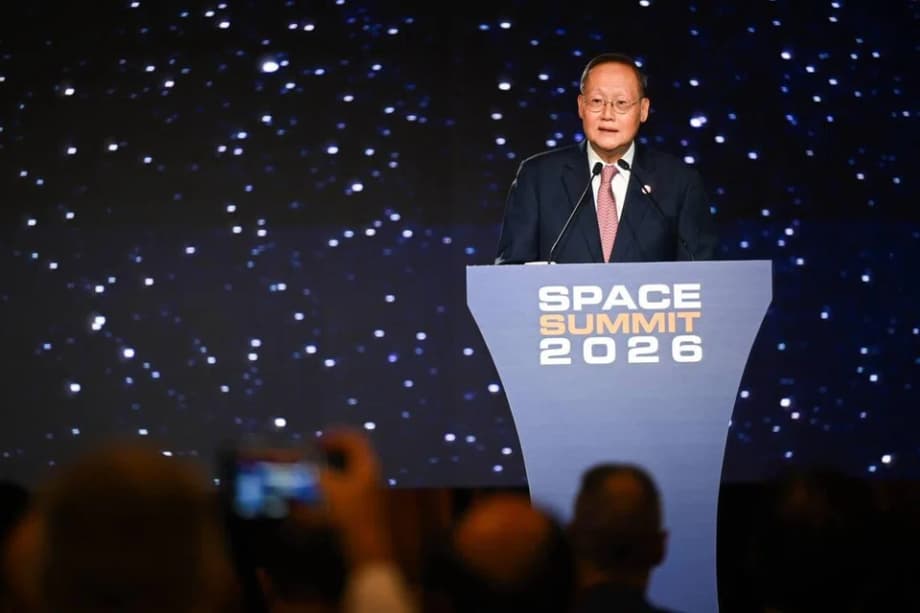
Minister-in-charge of Energy and Science and Technology Tan See Leng announced the formation at the inaugural Space Summit on February 2, held alongside the Singapore Airshow. The agency will be led by veteran public servant Ngiam Le Na, currently deputy chief executive of DSO National Laboratories, Singapore’s largest defence research and development organization. With 25 years of public service experience including previous roles at the Defence Science and Technology Agency, Ngiam oversaw the acquisition and development of earth observation satellites for environmental monitoring, maritime security, and disaster relief.
The timing reflects urgent economic imperatives. The global space economy reached approximately US$630 billion in 2023 and is projected to soar to US$1.8 trillion by 2035, according to World Economic Forum estimates cited by government officials. Singapore currently hosts roughly 70 space companies employing about 2,000 professionals, but the government believes the city-state can capture significantly more value by developing sovereign capabilities rather than merely purchasing foreign services.
Five Decades of Quiet Progress
Singapore’s journey into space technology stretches back over half a century, though much of it occurred without the fanfare associated with major spacefaring nations. The country established its first satellite ground station in 1971, launched its first communications satellite in 1998, and sent its first locally built satellite into orbit in 2011. Over the past 20 years, government, industry, and academic partnerships have produced more than 30 satellites.
The Centre for Remote Imaging, Sensing and Processing (CRISP) was established at the National University of Singapore in 1992, providing foundational research capabilities. In 2011, X-SAT became the first satellite designed and built entirely in Singapore, demonstrating that the small city-state could develop indigenous hardware despite having no domestic launch facilities.
Until now, Singapore’s space activities were coordinated through the Office for Space Technology and Industry (OSTIn), established in 2013 under the Economic Development Board. NSAS represents an elevation of these functions to full agency status, with expanded mandates for legislation, operations, and international diplomacy. As Jacqueline Poh, a senior official involved in the transition, noted on LinkedIn, the establishment of NSAS represented the “last OKR item from 2025,” indicating it was a planned strategic objective.
Inside the National Space Agency
NSAS will operate a multi-agency operations centre designed to support government agencies with satellite tasking, the process of requesting specific satellite imagery of targeted locations, and bespoke geospatial data analytics. These capabilities will serve practical national needs including port operations, urban planning, environmental monitoring, and food security.
The government currently co-owns three earth observation satellites with ST Engineering, a home-grown technology, defence, and engineering group. These existing assets provide the foundation for expanded constellations tailored to the equatorial region, where Singapore’s geographical position offers unique advantages for monitoring weather patterns, maritime traffic, and environmental changes.
Beyond operational support, the agency will develop and enforce national legislation and regulations for the space sector. Dr Tan emphasized that this regulatory framework aims to be “pro-innovation and pro-business, while meeting high standards for space safety and sustainability.” The agency builds upon Guidelines For Singapore-Related Space Activities established in 2024, which covered registration of space objects and baseline safety requirements.
Yi Jun Mock, a public servant who took a concurrent appointment with OSTIn in January 2025 to help with the transition, described the establishment as a “historic day” on LinkedIn. He noted that space technologies already underpin core sectors of Singapore’s open economy, including finance, maritime, and aviation, through global communications, navigation, and earth observation capabilities.
Navigating the Crowded Orbit
A critical function of NSAS involves space situational awareness, the tracking and monitoring of objects in orbit to prevent collisions and protect assets. With thousands of satellites currently operational and tens of thousands more planned by various nations and companies, low Earth orbit is becoming increasingly congested. The risk of collisions creating debris clouds that could cascade into further impacts, known as the Kessler Syndrome, poses existential threats to satellite infrastructure.
Dr Tan announced that Singapore will “progressively build up and operate space situational awareness capabilities, to ensure the safety of our space assets in the increasingly congested space domain.” This includes developing approaches to debris remediation and mitigation technologies.
The agency will also invest in emerging areas including climate and sustainability technologies, particularly satellite remote sensing for carbon monitoring. As nations and corporations face increasing pressure to verify emissions reductions and carbon offset projects, satellite-based verification offers a scalable solution. Additionally, NSAS will fund microgravity research in space to advance human health sciences, including the development of novel therapeutics that benefit from the unique physics of orbital laboratories.
Singapore’s space ambitions reflect more than a technological aspiration, we want to translate innovation into real solutions that strengthen our economy, improve lives, and address global challenges with precision and foresight.
Since 2022, the government has allocated more than S$200 million for space research and development projects through the Space Technology Development Programme, supporting research institutes and companies in developing and testing space technologies. Future investments will target artificial intelligence, robotics, and advanced manufacturing techniques applicable to space systems.
Private Sector Pushes Forward
While the government establishes the national agency, Singapore’s private sector is simultaneously advancing ambitious hardware programs. ST Engineering announced plans to launch four new satellites between 2027 and 2030 as part of its NeuSAR-2 constellation, designed to provide high-resolution synthetic aperture radar (SAR) imaging for the equatorial region. SAR technology can capture images at night and through clouds, making it invaluable for environmental monitoring and disaster response planning.
By the second half of 2026, ST Engineering will launch NEBULA, Singapore’s first test satellite for inter-satellite laser communications. This system will test gigabit-per-second data transfers between satellites, an essential capability for developing ultra-fast space networks to support global broadband coverage, earth observation data relay, and secure exchange of information. The company is also developing POLARIS, an AI-powered optical satellite, alongside software platforms for space-traffic monitoring and carbon project verification.
The technical specifications reveal significant advances in miniaturization. Each NeuSAR-2 satellite will weigh less than 280 kilograms, roughly one-third the weight of TeLEOS-2, while maintaining the capability to revisit the same location up to 16 times daily once fully operational. This reduction in size and mass lowers launch costs while increasing deployment flexibility.
Market reaction to these announcements was measured. ST Engineering shares slipped 1.3% in afternoon trading following the news, with investors digesting the long development timelines and capital requirements associated with satellite hardware. The company has not disclosed specific costs or revenue targets for the space program, and analysts note that satellite ventures require years to mature before generating returns.
Building a Global Presence
Preparations for the agency’s public launch extend beyond technical capabilities into branding and communications. Following a competitive public tender in 2025, global brand practice Anak has been appointed to develop the brand strategy, visual identity, and launch campaign for NSAS. Hanyi Lee, creative partner at Anak, stated that the firm is “thrilled to work with NSAS in defining and articulating the story of Singapore’s space efforts and ambitions.”
International partnerships form another pillar of the strategy. Singapore has established collaborations with major space agencies including the European Space Agency, India’s National Space Promotion and Authorization Centre (IN-SPACe), and the UAE Space Agency. These relationships provide access to launch infrastructure, since Singapore lacks domestic launch facilities, and facilitate technology transfer in areas where partner nations have developed expertise.
The agency will specifically deepen collaboration across the Equatorial Belt and within ASEAN, positioning Singapore as a hub for space services in a region experiencing rapid economic growth and increasing demand for connectivity and observation data. The city-state’s strengths in advanced manufacturing, microelectronics, precision engineering, and artificial intelligence provide industrial foundations for attracting global space firms to establish regional headquarters.
Massimo Claudio Comparini, managing director of Italian firm Leonardo’s Space Division, told Fortune that Singapore represents a “very important R&D hub” that is growing significantly in the space sector. He noted that Asia represents a growing region where space infrastructure, connectivity, and geospatial technology are becoming increasingly critical for economic development.
Leck Chet Lam, who heads Experia Events, the organizer of the Space Summit, expressed hope that companies would use the summit as a platform to springboard into opportunities across the Asia-Pacific and globally. The inaugural event drew over 330 participating organizations and has already been renewed for a second iteration.
What to Know
- Singapore’s National Space Agency (NSAS) will officially launch on April 1, 2026, under the Ministry of Trade and Industry, expanding the functions of the existing Office for Space Technology and Industry (OSTIn).
- Veteran public servant Ngiam Le Na, formerly deputy CEO of DSO National Laboratories, will serve as the agency’s founding chief executive.
- The global space economy is projected to reach US$1.8 trillion by 2035, up from approximately US$630 billion in 2023.
- NSAS will operate a multi-agency centre for satellite tasking and geospatial analytics, supporting applications in port operations, urban planning, environmental monitoring, and food security.
- The agency will develop national space legislation and space situational awareness capabilities to protect assets in increasingly congested orbital environments.
- Singapore currently co-owns three earth observation satellites with ST Engineering and has launched over 30 satellites in the past 20 years through government, industry, and academic partnerships.
- ST Engineering plans to launch four new NeuSAR-2 satellites between 2027 and 2030, plus the NEBULA laser communications test satellite in late 2026.
- The government has invested over S$200 million in space R&D since 2022 and will focus future funding on climate technologies, AI, robotics, and microgravity health research.
- Brand agency Anak has been appointed to develop the NSAS brand strategy and launch campaign following a competitive tender in 2025.
- Singapore hosts approximately 70 space companies employing 2,000 professionals, with the sector spanning satellite design, component manufacturing, and space-based services.