From Desert Wasteland to Strategic Resource
In the arid expanse of the Gobi Desert, where temperatures swing between scorching days and freezing nights, an unlikely forest has taken root. What began as a scientific gamble in 2016 has transformed 14 hectares of barren Xinjiang wasteland into a thriving plantation of Duzhong trees, producing high grade natural rubber for military applications. This artificial forest represents more than an agricultural curiosity. It signals a strategic shift in how China addresses one of its most critical supply chain vulnerabilities while reclaiming land previously considered useless for agriculture.
The project sits at the intersection of resource security, defense preparedness, and environmental transformation. By converting desert into productive farmland, Chinese scientists are demonstrating that extreme environments can yield strategic resources previously thought impossible to cultivate locally. The success has already triggered expansion plans that could reshape domestic rubber production and reduce China’s exposure to international supply chain disruptions. The Gobi project serves as a template for converting other marginal lands into productive agricultural zones.
Breaking the Rubber Stranglehold
China stands as the largest global consumer and importer of natural rubber, driven by the demands of its massive automotive sector and industrial base. Last year, domestic consumption exceeded 7 million tonnes, yet over 85 percent arrived from foreign suppliers, primarily Southeast Asian nations where the Hevea brasiliensis rubber tree thrives in tropical climates. This dependency creates acute strategic vulnerability for the second largest global economy, particularly as vehicle production continues to scale up to meet both domestic and export demand.
Natural rubber serves as the backbone of modern transportation and defense systems, with applications ranging from civilian vehicle tires to advanced military hardware. Geopolitical tensions and supply chain disruptions have exposed the risks of relying on distant plantations and maritime shipping lanes. Any interruption to these flows could paralyze manufacturing sectors that employ millions of workers. The COVID-19 pandemic and subsequent global logistics crises highlighted how quickly essential material shortages can cascade through industrial ecosystems. The search for a domestic alternative led scientists to reconsider an ancient native species that had previously been overlooked for industrial applications.
The Medicinal Marvel Repurposed
Duzhong, scientifically known as Eucommia ulmoides, has served traditional Chinese medicine for millennia. Practitioners have long valued its bark for treating ailments related to the kidneys and liver, considering it a fundamental herb for strengthening bones and muscles. Historical texts document its use dating back over two thousand years, with emperors and physicians alike praising its restorative properties. Yet this deciduous tree harbors a lesser known secret that makes it strategically priceless: it produces natural rubber through a unique biological process distinct from tropical rubber trees.
As China’s only native source of natural rubber and the second largest global rubber resource after the Brazilian rubber tree, Duzhong offers unique properties that synthetic alternatives cannot replicate. The rubber accumulates throughout the plant, with fruit peels containing 15 to 18 percent rubber, bark holding 8 to 10 percent, and leaves carrying 2 to 3 percent natural rubber content. This distribution allows for multiple harvest points throughout the year, unlike traditional rubber trees that require careful tapping of bark latex.
Unlike tropical rubber trees that demand humid climates, Duzhong demonstrates remarkable hardiness. Native to central and southern China, particularly the Yangtze Plain, the species has survived for millions of years through diverse environmental conditions. This resilience provided the genetic foundation for adapting the tree to desert environments, though previous cultivation efforts yielded limited results due to modest harvests and difficult extraction processes that made commercial viability challenging.
Science in the Sand
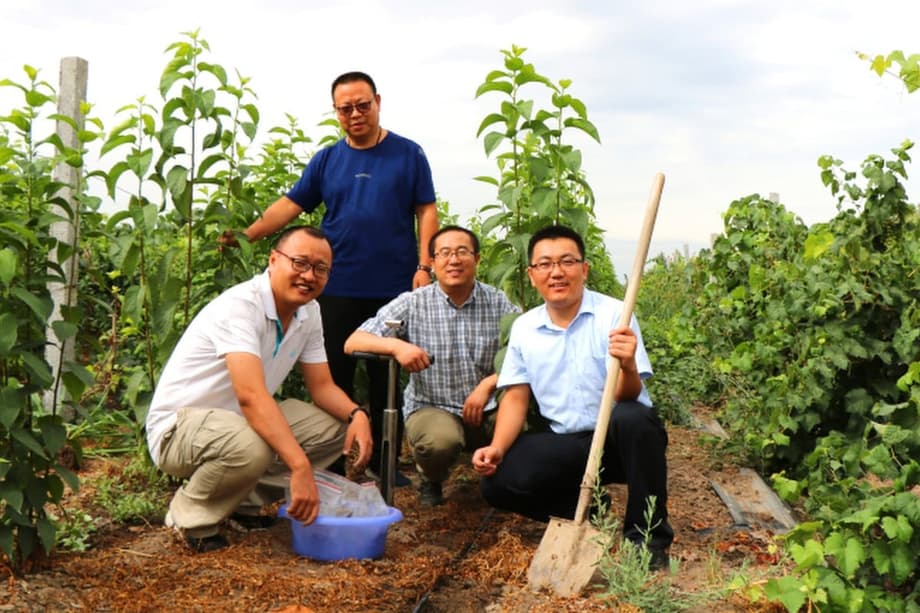
The transformation of Duzhong from medicinal crop to desert survivor began in 2016 when Su Yinquan, dean of forestry at Northwest A&F University, secured a lease on 14 hectares of barren Gobi land in Xinjiang. The location presented extreme challenges: limited water, intense solar radiation, and temperature extremes that would kill less hardy species. No one had previously attempted to cultivate Duzhong in this region, making the experiment a high stakes venture that could have resulted in total failure.
Su and his team approached the project methodically, recognizing that simply transplanting existing varieties would not suffice. They established a dedicated breeding base in Lueyang County, Shaanxi, screening more than 50 elite Duzhong germplasms collected from across China. Using systematic breeding programs focused on medicinal value and rubber yield indicators, they developed strains specifically adapted to arid, desert conditions. The selection process prioritized drought resistance, cold tolerance, and rubber concentration.
By 2025, the experimental plot had evolved into a dense, productive forest exceeding all growth projections. Zhu Mingqiang, a Northwest A&F professor who worked on the project from its inception, announced earlier this month that the Duzhong industry is flourishing. The success has catalyzed massive expansion plans that extend far beyond the original pilot site. China currently cultivates Duzhong across approximately 300,000 hectares, with targets set to reach 3.3 million hectares by 2030. Xinjiang alone is slated to add another 300,000 hectares of Duzhong plantations, potentially creating a new agricultural economy in the desert region.
Unlocking Industrial Potential
For decades, Duzhong rubber remained a laboratory curiosity rather than an industrial resource. Traditional extraction methods proved labor intensive and inefficient, limiting yields and economic viability. Farmers could harvest the bark for medicine or collect leaves for tea, but accessing the rubber required complex processing that consumed more value than it created. The 2016-2030 National Duzhong Industry Development Plan identified whole plant extraction as essential to making the crop economically competitive against imported Hevea rubber.
In November, Zhu announced a breakthrough extraction process published in ACS Sustainable Chemistry & Engineering. The “rubber priority” method combines low melting point, environmentally friendly solvents with biological treatment for initial gum separation. Subsequent targeted steps isolate the rubber with unprecedented efficiency. The technique specifically addresses the challenge of extracting rubber from fruit peels, which contain the highest concentration of the valuable polymer.
This innovation addresses multiple barriers simultaneously. The process reduces energy consumption and solvent use while delivering higher yields and exceptional purity. By making large scale Duzhong rubber production practical and sustainable, the technique transforms a niche medicinal crop into a viable industrial feedstock capable of supporting military and civilian manufacturing needs. The method also preserves other valuable compounds for pharmaceutical use, creating a waste free utilization model.
Defense Applications and Strategic Value
The military value of Duzhong rubber extends beyond simple substitution for imported materials. Adding just 3 to 5 percent Duzhong rubber to a compound improves durability and wear resistance in high performance, puncture resistant tires. This property proves essential for military vehicles operating in harsh terrain where tire failure could compromise missions or endanger personnel. The material maintains flexibility in extreme temperatures, performing reliably in both desert heat and arctic cold.
Beyond tires, Duzhong rubber serves in advanced electromagnetic shielding composites. Modern military hardware requires protection against electronic warfare and electromagnetic pulse threats. The unique molecular structure of Duzhong rubber provides effective shielding properties while maintaining flexibility and durability under extreme conditions. Aircraft, naval vessels, and ground vehicles all require such materials to protect sensitive electronic systems from interference or damage.
These applications align with broader Chinese defense modernization efforts. As geopolitical competition intensifies, securing domestic supply chains for critical materials reduces vulnerability to sanctions or supply disruptions. The Gobi Desert plantations offer a hedge against the volatility of international rubber markets while providing a material with superior performance characteristics for specific defense applications. The project represents a convergence of agricultural innovation and national security planning.
The Bottom Line
- China has transformed 14 hectares of Gobi Desert wasteland into a productive Duzhong rubber forest, with plans to expand to 3.3 million hectares nationally by 2030
- The project addresses China’s critical dependency on imported natural rubber, which currently supplies over 85 percent of the nation’s 7 million tonne annual consumption
- Duzhong (Eucommia ulmoides), traditionally used in Chinese medicine, produces rubber with superior military applications including high performance tires and electromagnetic shielding
- Scientists led by Northwest A&F University developed desert adapted strains through systematic breeding of over 50 germplasms and created an environmentally friendly “rubber priority” extraction process
- The breakthrough enables whole plant utilization, with fruit peels containing 15-18 percent rubber, bark 8-10 percent, and leaves 2-3 percent
- Xinjiang is positioned to become a major rubber production region, with 300,000 hectares planned for Duzhong cultivation