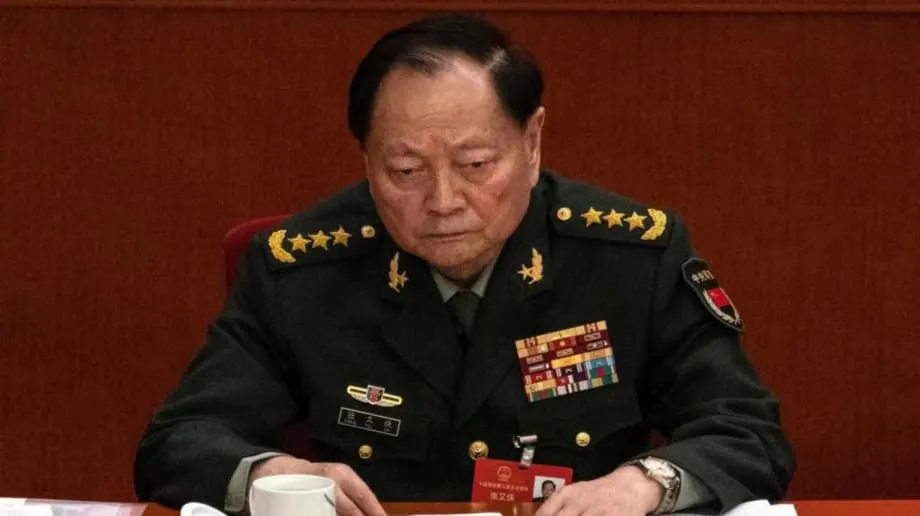
Two Generals Fall as China's Military Leadership Shrinks
China's Central Military Commission began its current term in 2022 with seven members. By January 28, 2026, the investigation of General Zhang Youxia and General Liu Zhenli had left just two serving at the top: President Xi Jinping, the chairman, and General Zhang Shengmin, an officer whose career centered on political work and military discipline.
Contents
- Two Generals Fall as China's Military Leadership Shrinks
- An Investigation With a Strong Political Message
- What Remains of the Central Military Commission?
- Family Connections No Longer Offer Protection
- Nuclear Secrets, Promotions and a Disputed Taiwan Timetable
- The Combat Experience Lost at the Top
- Fear Can Slow Decisions Throughout the Ranks
- Why Taiwan Faces Risks in Both Directions
- Foreign Contacts and the Sequence of Events
- The Bottom Line
The Defense Ministry announced on Saturday that Zhang Youxia, 75, and Liu Zhenli were under investigation for serious violations of discipline and law. Zhang was the commission's senior vice chairman and China's highest ranking uniformed officer. Liu headed its Joint Staff Department, which helps direct military operations. Their removal from the leadership marks a sharp escalation in a campaign that had already brought down two defense ministers and dozens of senior officers over the previous three years.
Zhang's fall is especially striking because of his longstanding family connections to Xi, his survival through earlier purges and his experience fighting in China's conflicts with Vietnam. Xi had kept him in office beyond the usual retirement age of 70 and renewed his vice chairmanship in 2022.
The ministry gave no details of the alleged misconduct. The phrase serious violations of discipline and law commonly accompanies investigations involving corruption and political disloyalty. Allegations concerning nuclear secrets, payments for promotions and disagreements over preparations for a Taiwan conflict remain publicly unsubstantiated. The announcement nevertheless puts the future leadership of a military with two million active duty personnel at the center of China's political and security debate.
An Investigation With a Strong Political Message
The Liberation Army Daily reinforced the ministry's announcement with a front page editorial accusing Zhang and Liu of seriously betraying the trust of the Communist Party Central Committee and trampling upon the authority of the Central Military Commission. It also accused them of creating political problems that weakened the party's absolute leadership over the military.
China's armed forces answer to the Communist Party through the commission. Its authority reaches across military strategy, equipment purchasing and operations. An accusation of weakening that authority therefore concerns obedience within the command structure as well as possible financial misconduct.
The editorial's language is particularly severe. In China's political system, accusations of this kind typically precede criminal prosecution and lengthy prison sentences, and such investigations almost never end in exoneration. Zhang had appeared at official functions as recently as a month before the announcement, with no outward indication that his position was in danger.
The speed of his removal, after surviving years of investigations around him, suggests that Xi's campaign has entered a more aggressive phase. The political language also places loyalty alongside corruption as a central concern, even while the precise charges remain undisclosed.
What Remains of the Central Military Commission?
The commission appointed at the 2022 Party Congress had seven members responsible for overseeing the armed forces. With only Xi and Zhang Shengmin still active, its leadership has been reduced by five members. That leaves fewer than one third of the original group at the top of the military.
Zhang Shengmin previously managed corruption investigations within the armed forces. A career political commissar, he built his experience in discipline inspection and political work, rather than combat command. He is now the sole remaining vice chairman alongside Xi.
The contraction is described as the most severe institutional weakening since the Cultural Revolution, when the commission effectively ceased functioning after Marshal Lin Biao's mysterious death in 1971. The historical comparison concerns the disruption of the highest command body, while today's military continues to have forces and commanders below that level.
Lyle Morris, a senior fellow at the Asia Society Policy Institute, described the scale of the leadership crisis:
The PLA is in disarray. The military of China now has a major leadership void. This move is unprecedented in the history of the Chinese military and represents the total annihilation of the high command.
Deng Xiaoping's position in the 1980s illustrates the commission's political importance. He maintained control over the country by retaining its chairmanship, demonstrating how command of the military can sustain authority within China's political structure. Xi now leads that body with only one other voting member, who has limited operational command experience.
Family Connections No Longer Offer Protection
Zhang Youxia belongs to the group often called princelings, the children of revolutionary leaders who fought alongside Mao Zedong to establish the People's Republic. His father was a senior officer in the Northwest Army and worked closely with Xi Zhongxun, Xi Jinping's father, during the civil war years of the 1930s and 1940s.
The families' relationship extended across generations, and Zhang and Xi likely knew each other from childhood. Such revolutionary family connections have traditionally carried considerable weight in Chinese politics and helped protect members of the party elite.
Xi's decision to retain Zhang past 70 and renew his position in 2022 appeared to demonstrate unusual trust. At the time, many analysts regarded Zhang as the president's most important military ally, a professional officer able to offer advice informed by actual combat. Xi could have allowed him to retire at the next Party Congress. Removing him through an investigation instead sends a much harsher signal.
Jonathan Czin, a former senior CIA analyst specializing in Chinese elite politics, described the rupture in their relationship:
Zhang's removal means that truly nobody in the leadership is safe now. This is really almost Shakespearean. This is somebody that Xi has had a decadeslong relationship with.
Senior commanders now face the possibility that neither personal history nor family standing will shield them from scrutiny. Zhang's case also recalls other fallen allies of Xi, including former Foreign Minister Qin Gang and Liu Yuan, the son of former president Liu Shaoqi. Liu Yuan was a childhood friend of Xi and supported early efforts against corruption, yet was forced into retirement.
Nuclear Secrets, Promotions and a Disputed Taiwan Timetable
Intelligence briefings and diplomatic sources have suggested several possible reasons for Zhang's removal. The Wall Street Journal reported an accusation that he leaked classified information about China's nuclear weapons program to American officials, allegedly during a 2024 meeting with former United States National Security Advisor Jake Sullivan.
Other allegations concern substantial bribes paid in return for promotions to senior military positions. The procurement system, which handles the purchase of weapons and equipment, has been a particular focus of earlier investigations. The wider campaign described in connection with these inquiries has involved hundreds of thousands of officials.
A different explanation concerns military strategy. Analysis from the Pacific Forum suggested that Zhang regarded Xi's goal of achieving full readiness for a Taiwan invasion by 2027 as unrealistic and dangerous. Zhang allegedly favored extending the timetable to 2035, giving the armed forces more time to modernize and practice joint operations.
Joint operations require different branches of the military to work together, rather than conduct separate campaigns. A complex operation depends on commanders coordinating forces, information and decisions. Zhang's reported preference would have allowed eight more years beyond 2027 for those preparations.
If accurate, that disagreement would have challenged Xi in an area where absolute obedience is expected. Zhang's judgment carried particular weight because he had experienced warfare firsthand, unlike most current commanders whose careers have involved preparation for conflicts rather than fighting a major war.
The dates described in the allegations concern military readiness. The immediate issue is whether the armed forces can meet Xi's expectations while their highest command is being rebuilt. Zhang's reported objections, the nuclear allegation and the claims about promotions offer different possible explanations for his fall, all against the ministry's broader accusation of disciplinary and legal violations.
The Combat Experience Lost at the Top
Zhang and Liu were the last senior commanders in the Chinese military with genuine battlefield experience. Their removal leaves the highest leadership without that direct experience of combat, at a time when the People's Liberation Army, or PLA, has not fought a major war in more than four decades.
Zhang earned his commission during the bloody 1979 border war with Vietnam. China suffered heavy casualties during that brief but intense campaign. He subsequently distinguished himself in further clashes in 1984, showing tactical ability that helped him rise through the ranks.
Liu brought a different set of operational credentials. He had commanded special operations forces and led the PLA Ground Force before taking charge of the Joint Staff Department. In that position, he oversaw command, control, communications, computer, intelligence, surveillance and reconnaissance systems.
Those systems form the information and decision making backbone of modern warfare. They allow commanders to communicate, gather information about an opponent and coordinate forces across different areas of a campaign. Liu's departure therefore removes technical and operational experience relevant to complex military operations.
Christopher Johnson, a former CIA analyst who now leads the China Strategies Group consulting firm, assessed that Xi appeared to have concluded that the military's problems ran so deep that he could no longer trust its existing command to correct them.
The remaining commission leadership is centered on political authority and discipline. Zhang Shengmin's background illustrates that shift. Greater reliance on political reliability could weaken planning and execution, especially in campaigns where commanders must adapt quickly as conditions change. Much of the wider officer corps has advanced through bureaucratic and political channels, rather than through wartime command.
Fear Can Slow Decisions Throughout the Ranks
Senior officers watching Zhang's fall must now judge their own vulnerability. When even an experienced commander with longstanding ties to Xi can be removed, taking initiative becomes more dangerous. Commanders may wait for explicit instructions instead of making decisions that could later be treated as mistakes or disloyalty.
Alessandro Arduino, a China security expert at the Royal United Services Institute in London, described the priority conveyed by the purge:
This is a reminder coming directly from President Xi Jinping that political loyalty stands well before combat readiness. Political disloyalty is a cardinal sin inside the party. And the message is clear: No one is safe.
The effects can extend beyond the officers under investigation. Fear can discourage decisions throughout the chain of command, while the removal of senior figures disrupts relationships used to coordinate different military branches. Equipment purchasing and training schedules may also slow as investigations continue.
Neil Thomas, a fellow at the Asia Society Policy Institute, predicted that the turmoil would persist for years as Xi rebuilt the command structure with officers meeting strict standards of absolute loyalty. Replacing individuals is only part of that task. The new leadership must also establish working relationships and restore the ability to coordinate operations.
Why Taiwan Faces Risks in Both Directions
Taiwan faces two different potential effects from the upheaval. In the immediate period, a depleted leadership and continuing investigations make a major Chinese military operation less likely. Xi needs time to identify replacements who combine technical competence with political reliability and to rebuild the command structure.
Ming-Shih Shen, a researcher at Taiwan's Institute for National Defense and Security Research, believes China remains unlikely to use force against Taiwan before 2027. His assessment rests on the time needed to reorganize the armed forces and consolidate control.
The longer term concern is about the advice Xi receives. Zhang reportedly urged caution over the Taiwan timetable and was capable of assessing American military capabilities objectively. His departure could leave fewer senior officers willing to challenge an optimistic assessment of China's readiness.
Steve Tsang, director of the China Institute at SOAS University of London, warned that this could increase the danger of a mistaken decision:
Removing generals like Zhang means that there will not be any general who would dare to advise Xi against a military adventure when the time comes, and this increases the risk of a miscalculation. Xi will not order an invasion unless he is certain of victory, but no general will now dare to advise caution if Xi asks whether the PLA is now ready to liberate Taiwan for the greater glory of China.
Shen's assessment and Tsang's warning concern different stages of the same disruption. Rebuilding a damaged command can delay military action, while a leadership less willing to offer caution can make later decisions more hazardous.
Foreign Contacts and the Sequence of Events
Zhang also maintained relatively open communication with foreign military officials. His meetings with American and other counterparts helped reduce the risk of miscalculation. Replacing him with officers who have less international experience could make communication during a crisis in the Taiwan Strait or South China Sea more difficult.
The Trump administration's recent National Defense Strategy adds another element to the regional picture. It shifts attention toward the Western Hemisphere while identifying China as a power to be deterred. That change arrives as Beijing's military leadership is being disrupted, adding uncertainty to the balance between the two countries.
The events leading to the current leadership crisis stretch across Zhang's military career and Xi's latest term:
- 1979: Zhang gained combat experience during China's border war with Vietnam, in which Chinese forces suffered heavy casualties.
- 1984: Zhang distinguished himself during further clashes with Vietnam, helping his rise through the ranks.
- 2022: The Party Congress appointed a Central Military Commission with seven members, and Zhang's vice chairmanship was renewed despite his being beyond the usual retirement age of 70.
- 2024: Zhang met Jake Sullivan, a meeting later associated with the reported allegation about disclosure of nuclear information.
- The past three years: Investigations brought down two defense ministers and dozens of senior officers.
- About a month before the announcement: Zhang continued to appear at official functions.
- Saturday, before January 28, 2026: The Defense Ministry announced investigations into Zhang and Liu.
- 2027 and 2035: These are the competing readiness dates described in the analysis of Zhang's alleged disagreement with Xi over Taiwan preparations.
Xi's immediate challenge is to restore an effective command while demanding unwavering political loyalty. The removal of Zhang and Liu concentrates authority, strips the commission of experienced military leaders and leaves the rebuilding of its highest ranks as a central issue for China's armed forces and regional security.
The Bottom Line
- Zhang Youxia, 75, and Joint Staff Department chief Liu Zhenli are under investigation for serious violations of discipline and law.
- The Central Military Commission has fallen from seven members appointed in 2022 to two active members: Xi Jinping and Zhang Shengmin.
- Publicly unsubstantiated allegations concern nuclear secrets, bribes for promotions and disagreement over readiness for a Taiwan invasion by 2027 rather than 2035.
- The removals take combat experience and operational expertise out of the highest command while strengthening the focus on political loyalty.
- Leadership disruption may reduce the immediate likelihood of military action against Taiwan, while the loss of cautionary advice could increase the risk of later miscalculation.
- The purge follows the fall of two defense ministers and dozens of senior officers over three years, and reaches an officer once regarded as one of Xi's most trusted military allies.