Beijing asks how Myanmar sees its role
A Chinese Communist Party delegation has met nine political parties in Yangon to ask how people in Myanmar view China, as Beijing seeks to protect its influence amid renewed direct contact between Washington and Myanmar's military leadership.
Contents
- Beijing asks how Myanmar sees its role
- Who attended the Yangon talks?
- Party diplomacy has an established history
- Washington opens another channel
- A blocked highway connects diplomacy to daily business
- Large investments face a divided country
- Why China deals with opposing armed forces
- Scam compounds add a security demand
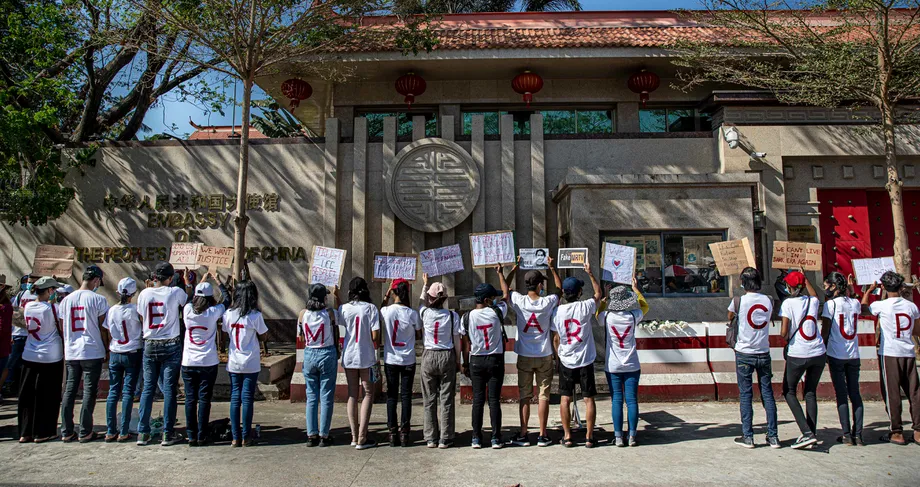
- Public resentment challenges official friendship
- Key Points
The delegation, led by International Liaison Department official Peng Xiubin, asked about public attitudes toward China, difficulties in bilateral relations and priorities for cooperation. Participants also discussed peace, the economy, agricultural assistance and reopening the Muse–Mandalay highway, a crucial route connecting Myanmar's commercial centers with the Chinese border.
The meeting brings together three pressures shaping Beijing's approach: resentment over its support for the military, disruption to trade and investments, and the possibility of greater American engagement. China has access to military leaders, political parties and ethnic armed organizations, giving it several ways to influence events in a country where authority is divided by war.
Beijing's commitments extend beyond these party contacts. A joint statement dated June 17, published by Myanmar's Foreign Ministry, describes Min Aung Hlaing as president during a state visit to China running from June 15 to 19, 2026. It records Chinese support for Myanmar's general election and agreements to advance major transport, energy and security projects.
The Yangon discussions put a more immediate concern beside those formal promises: whether people in Myanmar believe Chinese engagement benefits them. Participants said some parties told the delegation that sections of the public were skeptical or hostile and urged Beijing to make its assistance more visible. No exact date for the Yangon meeting or deadline for reopening the highway was given.
Who attended the Yangon talks?
The nine parties included the military's proxy Union Solidarity and Development Party, or USDP, alongside the National Unity Party, People's Party, People's Pioneer Party, Shan and Nationalities Democratic Party, Arakan Front Party, Kayin People's Party, Unity and Development Party, and New Chinland Congress Party.
Most had participated in the military's recent election process, widely condemned as a means of preserving military power. Their participation makes them useful contacts for Beijing as the authorities seek to turn an election into a more durable governing arrangement.
Htet Aung Kyaw of the National Democratic Force and Sai Kyaw Nyunt of the Shan Nationalities League for Democracy also attended. Both parties had been dissolved after rejecting the military's electoral roadmap. A party leader said the two men received individual invitations and attended personally, rather than representing their dissolved organizations.
The delegation raised five broad areas of discussion, according to participants. Alongside public attitudes and bilateral difficulties, it sought views on cooperation, peace, economic conditions and domestic affairs. Those exchanges gave Beijing access to political perspectives beyond its formal meetings with government officials, although the gathering remained centered on a narrow group of political figures.
Party diplomacy has an established history
China's International Department has maintained relationships with several of these parties for years. Its July 2024 meeting record, published on July 29, describes Vice Minister Sun Haiyan receiving a Myanmar party delegation in Beijing on July 25.
The named participants included the USDP, People's Party, Arakan Front Party, and Shan and Ethnic Democratic Party. Sun discussed the third plenary session of the Chinese Communist Party's 20th Central Committee, a senior party gathering, and called for closer cooperation and peace along the border.
The Myanmar delegates supported cooperation under the Belt and Road Initiative, China's international infrastructure program, and thanked Beijing for its role in Myanmar's peace process. The repeated involvement of several parties shows that the Yangon meeting belongs to a continuing channel of political contact.
Washington opens another channel
American officials held a second round of talks with representatives of Myanmar's military authorities in Tokyo earlier in the month of the Yangon gathering. Those discussions followed a September visit to Naypyitaw by Michael Vance, identified as the US assistant secretary of state for intelligence and research, for talks with Min Aung Hlaing.
Participants said the Chinese delegation did not mention the American talks. Some party representatives nevertheless expressed a preference for engagement with China because it is Myanmar's neighbor. Geography gives Beijing a constant role in border commerce and security, whatever changes occur in Washington's policy.
Concern about American influence has accompanied previous Chinese diplomatic activity. During an earlier round of visits, Peng met former military ruler Than Shwe and former president Thein Sein in Naypyitaw on April 16, 2023. Chinese envoy Deng Xijun had met Min Aung Hlaing in February and March that year, after bringing ethnic armed organizations together in Yunnan.
Thein Tun Oo, executive director of the Thayninga Institute for Strategic Studies, an organization composed of former military officers, described those earlier contacts in terms of competition with Washington:
The bottom line is that China-Myanmar relations will continue to develop based on this.
His assessment followed US legislation authorizing technology and assistance excluding lethal weapons for democratic forces, including the opposition National Unity Government and ethnic armed organizations. The recent American contacts add a different element: direct engagement with the military leadership itself.
A blocked highway connects diplomacy to daily business
The Muse–Mandalay highway was a concrete priority at the Yangon meeting. Party leaders asked China to help reopen the route and discussed trade policy and technical assistance for agriculture.
Saw Han Aye, chair of the People's Pioneer Party, described the request and Beijing's response:
We asked the Chinese to increase investment and reopen trade routes as soon as possible, and Beijing affirmed it wants more frequent exchanges.
Myanmar's military authorities imposed a near total blockade on Chinese imports after losing control of major northern Shan trade routes. The restrictions seek to deprive ethnic armed organizations of taxes collected on goods moving through their territory. Traders and customers also face the loss of access to supplies.
The route illustrates why control of a border crossing alone cannot restore commerce. Goods must travel through territory held by different armed forces, with security and permission needed along the journey. Earlier developments included military recaptures of strategic towns, including Kyaukme and Hsipaw, after Chinese pressure on ethnic armed organizations through border closures.
The June 2026 joint statement also commits both governments to advancing the Mandalay–Muse Railway. Reopening a highway would address an immediate trade problem; building the railway would require sustained cooperation over a much longer period.
Large investments face a divided country
The Institute for Strategy and Policy–Myanmar, known as ISP-Myanmar, counted 35 China–Myanmar Economic Corridor projects underway in its earlier research. They included roads, railways, ports, special economic zones and urban development projects.
ISP-Myanmar also recorded more than $4 billion in foreign investment between February 2021 and April 2022, with Chinese investment accounting for more than two thirds. A later Stimson Center assessment identified a $2.5 billion Chinese investment in May 2021 as the last major inflow and said no notable Chinese investment had followed for more than three years. The early figures show China's large share of investment after the coup; the later assessment describes how the flow of major new commitments subsequently slowed.
The Stimson Center analysis, published on August 26, 2024, was written by Myanmar scholar Thant Aung, also known as Victor Paing. It argued that civil war, declining trade and uncertainty over territorial control made investment increasingly difficult.
Projects at stake include the Kyaukpyu port and special economic zone in Rakhine State, the Letpadaung copper mine in Sagaing, the Mee Lin Gyaing energy project in Ayeyarwady and New Yangon City. Kyaukpyu is especially valuable to Beijing because it provides access to the Indian Ocean.
The June 2026 statement renews support for the port and economic corridor, alongside oil and gas pipelines, electricity connections, mining and agriculture. It also proposes wider use of direct yuan–kyat settlement, allowing trade payments in the two countries' currencies. Turning those commitments into operating infrastructure depends on conditions across areas affected by fighting.
Why China deals with opposing armed forces
Myanmar's military controls important state infrastructure even after losing extensive territory. The Stimson analysis identified international airports, seaports, Yangon and other economically important areas as reasons Beijing maintained senior contact with the authorities.
Ethnic armed organizations and other resistance forces control territory important to China's border security and commerce. Citing a Special Advisory Council for Myanmar report dated May 30, 2024, the analysis said resistance forces fully controlled 11 of the 18 townships along the Chinese border. That was about 61 percent of those townships at the time.
Beijing therefore has practical reasons to speak to both sides. Military leaders retain institutions through which international agreements operate, while armed groups can influence whether roads, crossings and nearby businesses function.
China's pressure has also affected military outcomes. General Yawd Serk, chairman of the Restoration Council of Shan State, spoke about civilian suffering amid continuing airstrikes and elections in February 2026. His concerns reflect the stakes for communities living through a war that persists alongside diplomatic meetings and new political arrangements.
Scam compounds add a security demand
Online fraud operations have made Myanmar's instability a direct concern for Chinese citizens. Criminal networks have recruited or trafficked people into guarded compounds, where workers deceive victims through fake investments, online relationships and gambling schemes.
The Stimson analysis cited estimates that 120,000 people worked in Myanmar's scam operations in 2023 and that the industry generated $15.3 billion annually, roughly a quarter of Myanmar's gross domestic product that year. GDP measures the value of goods and services produced in an economy; the comparison conveys the estimated scale of the criminal business.
China asked the military authorities to eradicate scam centers in May 2023. Later that year, the Three Brotherhood Alliance named eliminating those operations among the objectives of Operation 1027, its major offensive in northern Myanmar.
Pressure in the north pushed operations toward other locations, including Shwe Kokko on the Thai border. The area is controlled by the Karen National Army led by Colonel Saw Chit Thu. Its military and commercial importance complicated efforts to close the compounds.
China subsequently carried the campaign into its courts. The execution of scam leaders between January 29 and February 2, 2026, involved 15 members of the Ming and Bai criminal groups. The June joint statement promises further cooperation against online fraud, trafficking, illegal gambling and other crimes, alongside protection for Chinese nationals and projects.
Public resentment challenges official friendship
China's support for successive military governments, including weapons, technology and diplomatic backing, has fueled anger in Myanmar since the February 2021 coup. Resentment grew in 2024 when Beijing pressed ethnic armed organizations to halt northern Shan offensives threatening the military's position.
Deng Xijun's call for ethnic autonomy at a ceremony marking the Nationwide Ceasefire Agreement's anniversary drew criticism from people who pointed to China's influence over armed organizations already controlling northern Shan territory. Beijing rejects accusations of interference and describes its role as supporting peace and cooperation.
The opposition National Unity Government presents a different explanation for the continuing instability. Kyaw Zaw, spokesman for its presidential office, argued that China's economic ambitions require an end to military rule:
As long as there is a junta, Myanmar will not be at peace.
The parties in Yangon offered Beijing another response: more visible assistance, investment and reopened trade. Their requests connect public opinion to results people can experience, such as access to goods, opportunities to sell agricultural products and safer transport.
Several dates show how these economic, political and security concerns have developed together:
- February 2021: The military seized power, triggering a widening national conflict.
- May 2023: China asked the military authorities to eradicate scam centers.
- Late 2023: Operation 1027 changed control of important northern border areas.
- July 25, 2024: Sun Haiyan met Myanmar political parties in Beijing.
- Late 2025 and early 2026: The military conducted elections in areas where voting could be organized.
- June 17, 2026: China and Myanmar issued commitments covering infrastructure, security and political cooperation.
Beijing now faces connected demands from its Myanmar relationships: the authorities seek investment and recognition, political parties want trade restored, and communities want security and livelihoods. China's ability to reach many actors gives it influence, while the continuing conflict makes satisfying those demands difficult.
Key Points
- A Chinese delegation met nine Myanmar political parties in Yangon and asked about public attitudes, cooperation and domestic affairs.
- Party leaders requested investment, agricultural assistance and reopening of the Muse–Mandalay highway.
- Renewed US contact with military representatives adds another diplomatic channel alongside China's longstanding relationships.
- A June 2026 joint statement backs major corridor projects, trade cooperation and stronger action against border crime.
- China maintains contact with both military authorities and armed organizations controlling territory important to its interests.
- Public resentment over Beijing's military support remains a challenge to its promises of friendship and development.