A stock market crash with deeper roots
Nearly $80 billion in market value disappeared during Indonesia's late January selloff, as investors confronted concerns about share ownership, government intervention and the independence of the central bank. On January 28, the Jakarta Composite Index (JCI) fell nearly 9 percent during trading before closing down 7.4 percent.
Contents
- A stock market crash with deeper roots
- Why MSCI's warning mattered
- Martabe brings property rights into focus
- A family appointment at Bank Indonesia
- The budget approaches its legal limit
- Meal delivery falls short of its promise
- Regulatory resignations and a wider governance record
- A timeline of mounting pressure
- The government's proposed market repairs
- The Essentials
The immediate trigger was a warning from MSCI, the index provider whose classifications guide trillions of dollars in global investment. Indonesia faced a possible downgrade from emerging market status to frontier market status, threatening its place in portfolios that invest according to MSCI benchmarks.
Investors dumped 45.5 trillion rupiah, described as approximately $3.4 billion, in shares that day. The upheaval followed months of anxiety about governance standards, fiscal discipline and the weakening independence of institutions in Southeast Asia's largest economy.
The rupiah was already under pressure. About a week before the stock market crash, it had touched historic lows against the US dollar, breaching 17,000 rupiah per dollar for the first time since the Asian financial crisis of 1998.
Several developments brought those concerns together: a threatened change in Indonesia's market classification, the announced forced transfer of the Martabe gold mine, and Parliament's appointment of President Prabowo Subianto's nephew to a senior central bank position. By January 30, three leading financial officials had resigned and the government was promising changes to stock market rules.
The central issue was confidence. Investors needed to assess whether shares were genuinely available to trade, whether contracts would be respected and whether economic institutions could make decisions independently of political demands.
Why MSCI's warning mattered
MSCI's warning focused on the investability of Indonesian shares, particularly the accuracy of free float calculations. Free float means the proportion of a company's shares available for ordinary investors to buy and sell, excluding holdings kept by insiders, controlling families or strategic partners who rarely trade their stakes.
Indonesian listed companies were required to maintain a free float of only 7.5 percent, among the lowest thresholds in major emerging markets. Critics have long alleged that some companies meet that requirement through nominee arrangements and opaque ownership structures. A nominee holds shares in a name different from that of the person who ultimately controls them.
Under such arrangements, shares can appear publicly available while remaining effectively controlled by a small group of wealthy individuals. Concentrated control can leave fewer shares genuinely available for trading, increasing vulnerability to price manipulation and sudden swings. Those were the risks behind MSCI's concerns.
An emerging market classification gives Indonesian companies access to large pools of investment money that follow MSCI's benchmark indices. Frontier markets belong to a category generally considered riskier and harder to trade, with greater reliance on specialized investors.
A downgrade would require selling by exchange traded funds and institutional portfolios whose mandates restrict them to emerging markets. Passive funds follow a specified index rather than choosing companies individually, so a change in index membership can lead them to sell even without a new judgment about a particular company's business.
The feared result was a wave of automatic selling and a potentially prolonged loss of access to global investment flows. Indonesia's classification had not been changed as of February 1, and no date for a final decision was given.
Martabe brings property rights into focus
On January 28, Indonesia's sovereign wealth fund, Danantara, announced the forced transfer of the Martabe gold mine to a state owned entity. The mine was a flagship asset of PT United Tractors, a subsidiary of PT Astra International, one of Indonesia's largest and most diversified conglomerates.
Astra is a bellwether stock, meaning investors often regard it as a guide to the wider market, and foreign portfolio managers hold substantial exposure to it. The announced transfer therefore carried consequences beyond the mining business itself.
The action appeared to bypass standard legal procedures, prompting concerns about contracts and property rights. A business consultant based in Jakarta, who regularly deals with state owned enterprises and spoke anonymously because of the matter's sensitivity, described the transfer as an attack on legal certainty.
Such a move is a unilateral expropriation without due process. This is like shattering Indonesia's reputation for legal certainty.
Maurice Maulana Situmorang, a senior lawyer and partner at Dentons HPRP, warned of a high probability of litigation and international arbitration over Martabe. He said contractual terms, legal provisions and procedural safeguards must be observed before rights can legally be revoked. International arbitration is a process in which a dispute is submitted to arbitrators for a decision outside ordinary national court proceedings.
The mine's unresolved status became a concrete concern for investors assessing increasing state intervention in strategic industries. Resource nationalism, in this setting, means the state asserting greater control over natural resources and the businesses that extract them.
Martabe linked the market's concerns about concentrated ownership and weak institutional checks to a direct question about business assets: how securely could a company expect to retain rights granted under existing contracts?
A family appointment at Bank Indonesia
Parliament appointed Thomas Djiwandono, the deputy finance minister and President Prabowo's nephew, as senior deputy governor of Bank Indonesia on January 27. Prabowo had advanced his nomination earlier in January.
Critics feared the appointment would weaken central bank independence and encourage premature policies aimed at faster growth. Prabowo wants annual economic growth to reach 8 percent before his presidential term ends in 2029.
A central bank's independence gives it room to make decisions about interest rates and money according to inflation and financial stability needs, even when elected officials want quicker growth. The concern surrounding Djiwandono's appointment was that political priorities could gain greater influence over those decisions.
The nomination was followed by a sharp rupiah decline between January 19 and 20, when the currency approached 17,000 per dollar. During the 1998 Asian financial crisis, the exchange rate had peaked at around 16,800 rupiah per dollar.
Administration officials argued that the rupiah had depreciated by only about 4 percent against the dollar over the preceding year. Wijayanto Samirin, a senior economist at Paramadina University, pointed out that the dollar itself had weakened by roughly 10 percent against major global currencies over the same period.
Wijayanto argued that this put the rupiah's effective loss of value against a basket of trading partners at approximately 14 percent. His comparison explained why measuring the currency only against the dollar could make its weakness look smaller.
Wijayanto tied confidence in the currency directly to confidence in the central bank.
The credibility of the rupiah is highly dependent on Bank Indonesia. If Bank Indonesia is neither credible nor independent, the same will be true for the rupiah.
Criticism of Bank Indonesia also concerned recent policy decisions. Critics described interest rate cuts as coming earlier than economic conditions warranted and monetary financing through money printing as a response to government funding needs. Those shifts were presented as a reversal of two decades of monetary policy that had placed inflation control and stability ahead of immediate growth stimulation.
The budget approaches its legal limit
Indonesia's 2025 budget deficit had risen to nearly 3 percent of gross domestic product, close to the legal limit, while state revenue continued to fall short of targets. A deficit occurs when the government spends more than it receives; measuring it against gross domestic product shows its size relative to the economy.
Prabowo's free nutritious meal program was a major source of pressure. Launched in January 2025, the initiative carried a first year cost of approximately 50 trillion rupiah and was designed to provide meals for students and pregnant women.
The program sought to combat stunting, which affected more than 20 percent of Indonesian children. Stunting means a child is too short for their age, commonly reflecting prolonged problems with nutrition and health.
The government's spending commitments extended beyond meals. Large defense purchases intended to modernize military equipment and continued construction of Nusantara, the planned new capital city, also placed demands on public finances.
Nusantara required substantial investment despite limited interest from private investors. Taken together, social spending, military procurement and construction commitments left the government with little fiscal flexibility to respond to the market shock.
The connection between the budget and monetary policy made institutional confidence particularly important. A government close to its borrowing limit faced pressure to sustain ambitious programs, while investors were already questioning whether Bank Indonesia would remain focused on currency and price stability.
Meal delivery falls short of its promise
The free meal program's rollout faced funding delays, logistical failures and food poisoning incidents at schools. Finance ministry data showed that by the middle of 2025 it had reached only five million students against a target of 17.5 million children.
Those figures put its reach at about 29 percent of the target, leaving a gap of 12.5 million children. The shortfall illustrated the distance between the scale of the promise and the capacity to deliver it.
Several schools reported students suffering stomach ailments, diarrhea and vomiting after eating government supplied meals. Investigative findings also indicated that several catering partners selected to provide meals had supported Prabowo during his election campaign, prompting allegations of nepotism.
Agus Pambagio, a public policy expert based in Jakarta, described the initiative as rushed and poorly planned. He compared Indonesia's pace with the longer experience of meal programs in Japan and India.
Japan and India have been doing it for decades. If we want to do it just like them within a few months, it's suicide. We can't let fatalities happen.
The program brought together two kinds of pressure on the government: the financial cost of expanding a major social commitment and the practical responsibility to deliver safe meals. Funding gaps, uneven coverage and concerns about partner selection added to the wider debate over competence and accountability.
Regulatory resignations and a wider governance record
On January 30, Financial Services Authority chairman Mahendra Siregar, his deputy Mirza Adityaswara and Indonesia Stock Exchange chief Iman Rachman simultaneously tendered their resignations. Their departures exposed distress within the institutions responsible for market integrity and investor protection.
The resignations took place against a longer record of declining governance standards that began before Prabowo's administration and had accelerated in recent years. Concerns included the weakening of mechanisms intended to prevent corruption and limit political favoritism.
The Organized Crime and Corruption Reporting Project shortlisted former president Joko Widodo for its 2024 Corrupt Person of the Year award, citing the systematic dismantling of anticorruption mechanisms and the normalization of nepotism.
A People's Tribunal held at the University of Indonesia in the middle of 2024 indicted the previous government on nine charges, including corruption, collusion and the commercialization of natural resources through poorly regulated mining permits.
Environmental advocates described another cost of weak oversight. The Indonesian Forum for the Environment, known as Walhi, said approximately 283,000 hectares of forest disappeared during 2025 to make way for extractive businesses. It compared that area with four times the size of Jakarta.
The forest losses and financial turmoil formed part of the same governance debate: whether narrow groups could exercise extensive control over resources and institutions with limited transparency or accountability. The Martabe dispute brought that debate directly into the portfolios of major investors.
A timeline of mounting pressure
Indonesia's market crisis developed over several dates, with fiscal commitments and governance concerns preceding the January trading shock. The sequence shows how pressures in different parts of the economy accumulated.
- Middle of 2024: A People's Tribunal at the University of Indonesia brought nine charges against the previous government, including corruption and collusion.
- 2024: The Organized Crime and Corruption Reporting Project shortlisted Joko Widodo for its Corrupt Person of the Year award.
- January 2025: Prabowo's free nutritious meal program began, with a first year cost of approximately 50 trillion rupiah.
- Middle of 2025: The meal program had reached five million students against a target of 17.5 million children.
- 2025: The budget deficit approached 3 percent of gross domestic product, while Walhi recorded approximately 283,000 hectares of forest loss linked to extractive businesses.
- Early January 2026: Prabowo advanced Thomas Djiwandono's nomination to Bank Indonesia.
- January 19 to 20: The rupiah fell sharply toward 17,000 per US dollar.
- January 27: Parliament appointed Djiwandono senior deputy governor of Bank Indonesia.
- January 28: MSCI's warning triggered a stock market plunge, while Danantara announced the forced transfer of Martabe.
- January 30: Three leading financial officials resigned and the government announced proposed market reforms.
March was the next stated deadline, with the government promising to raise the minimum proportion of listed shares available for public trading. Prabowo's longer economic target remained annual growth of 8 percent before his term ends in 2029.
The government's proposed market repairs
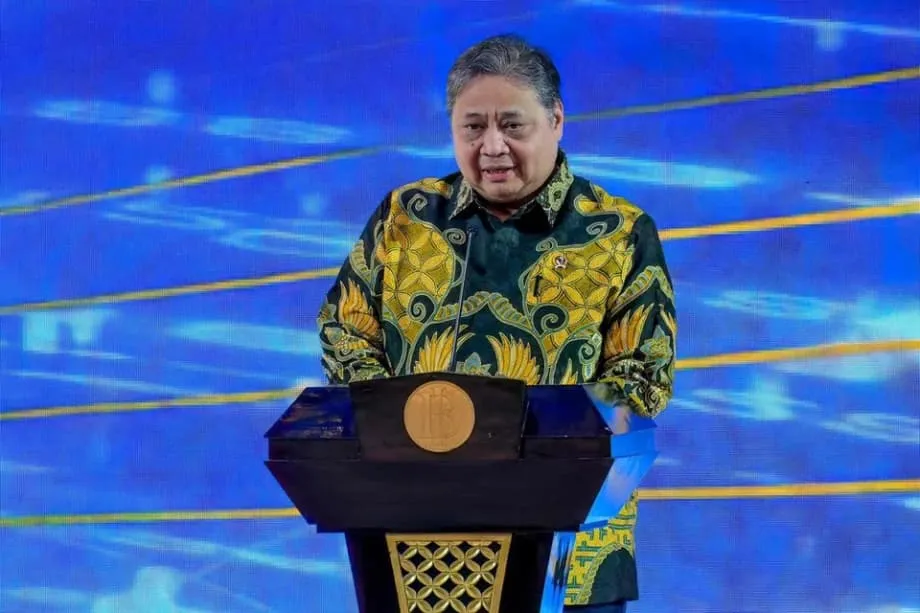
Coordinating Minister for Economic Affairs Airlangga Hartarto held an emergency media briefing on January 30. He promised measures to deepen the stock market and highlighted a rebound in the JCI that day.
The government proposed doubling the minimum free float requirement from 7.5 percent to 15 percent by March. In practical terms, that would require a larger portion of each listed company's shares to be available to public investors.
Airlangga also outlined plans to let pension and insurance funds invest up to 20 percent of their portfolios in equities, compared with the existing 8 percent cap. The proposed ceiling was 2.5 times the current limit and could direct billions in domestic institutional capital toward listed shares.
Pension and insurance funds manage money needed for future retirement payments and insurance claims. Allowing them to hold more shares could expand domestic demand at a time when foreign investors were selling.
Airlangga defended Indonesia's economic fundamentals, stressed the government's commitment to market stability and said coordination between fiscal and monetary authorities remained functional.
Investor skepticism centered on whether changes to trading rules could address the wider concerns. More shares available for trading could help answer MSCI's ownership questions, while greater domestic investment could support demand. Legal certainty at Martabe, confidence in central bank independence and the departure of regulatory leaders involved separate decisions about how institutions exercise power.
The nearly $80 billion loss in market value captured the severity of the shock. A lasting recovery in confidence depended on credible commitments to transparent ownership, respect for property rights and an independent central bank. Without those commitments, sustained capital flight risked weakening Indonesia's ambitions for faster growth and development.
The Essentials
- The JCI fell nearly 9 percent during January 28 trading and closed down 7.4 percent, amid a late January rout that erased nearly $80 billion in market value.
- MSCI warned of a possible downgrade from emerging market to frontier market status over concerns about investability and share ownership transparency.
- Danantara announced the forced transfer of the Martabe gold mine, raising concerns about contracts, legal procedures and possible arbitration.
- Parliament appointed Prabowo's nephew, Thomas Djiwandono, senior deputy governor of Bank Indonesia on January 27, amid concerns about central bank independence.
- The rupiah reached historic lows around 17,000 per dollar, while the 2025 budget deficit approached the legal limit of 3 percent of gross domestic product.
- The meal program cost approximately 50 trillion rupiah in its first year and faced delivery failures, food poisoning incidents and nepotism allegations.
- Mahendra Siregar, Mirza Adityaswara and Iman Rachman tendered their resignations on January 30.
- The government proposed a 15 percent minimum free float by March and a rise in the equity investment ceiling for pension and insurance funds from 8 percent to 20 percent.