A lower jobless rate meets a tougher search for work
Indonesia's open unemployment rate has fallen to 4.65% in 2026, according to Statistics Indonesia (BPS) figures cited by the Coordinating Ministry for Economic Affairs on October 27. The rate is just 0.29 percentage points above the 4.36% recorded in 1994, even as the country's labor force has grown to 155.41 million people.
Contents
- A lower jobless rate meets a tougher search for work
- What the 4.65% figure measures
- How close is Indonesia to its earlier low?
- Millions remain without work
- When experience meets an age limit
- A permanent job replaced by uncertain earnings
- Why returning to formal employment is difficult
- Support during the gap between jobs
- The government's next employment test
- Key Points
The government credits programs supporting investment and the real sector, the businesses that produce goods and services. Ministry spokesperson Haryo Limanseto said the figures reflected stronger demand for workers and pledged further efforts to improve skills and the quality of employment.
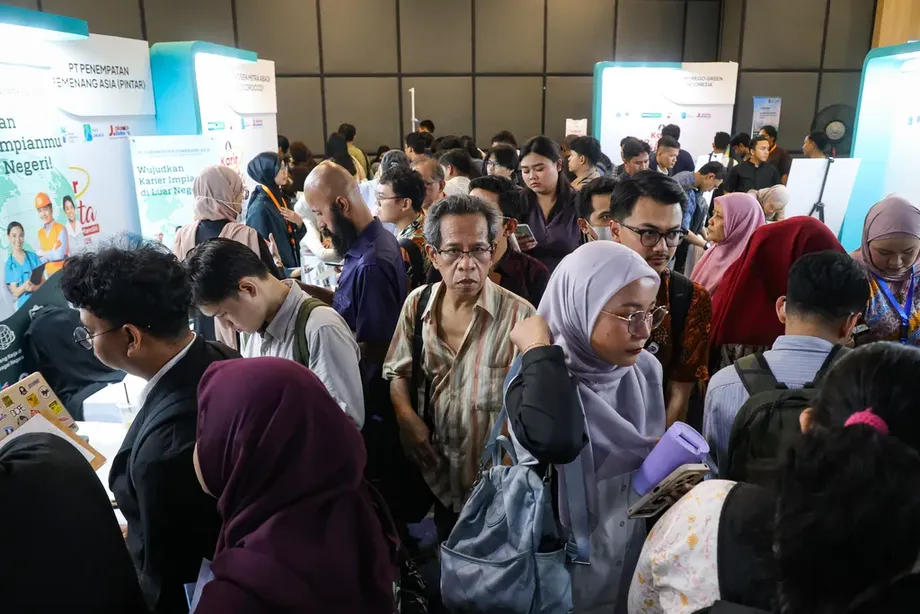
For people seeking a stable income, however, the national improvement sits alongside a difficult daily reality. February 2026 figures from the National Labor Force Survey, known as Sakernas, recorded 7,243,605 unemployed people. At a Jakarta career fair in October, job seekers in their 40s described vacancies with age limits, salaries below their expectations and few openings suited to their experience.
The central issue is therefore both the number of people finding work and the kind of work they can obtain. A former permanent employee earning barely enough to cover fuel as a driver faces a different household situation from someone receiving a dependable monthly salary, even when both have work.
What the 4.65% figure measures
BPS uses the open unemployment rate, or TPT, to express unemployed people as a share of the labor force. The labor force consists of people who are employed plus those classified as unemployed under the survey's rules.
A rate of 4.65% means roughly 4.65 out of every 100 people in that labor force are unemployed. The denominator matters: students, people managing households and others outside the labor force are counted separately in the population statistics.
The February figures processed by the Ministry of Manpower's Data and Information Technology Center put Indonesia's working age population at 219.54 million. They listed 147.67 million people as employed, 16.86 million mainly attending school, 39.28 million managing households and 8.49 million in other activities.
Those February employment and unemployment figures add up to a labor force of about 154.91 million, compared with the 155.41 million cited alongside the government's 4.65% announcement. The published accounts give no explanation for that difference. Each set of figures needs its own denominator when calculating a rate.
How close is Indonesia to its earlier low?
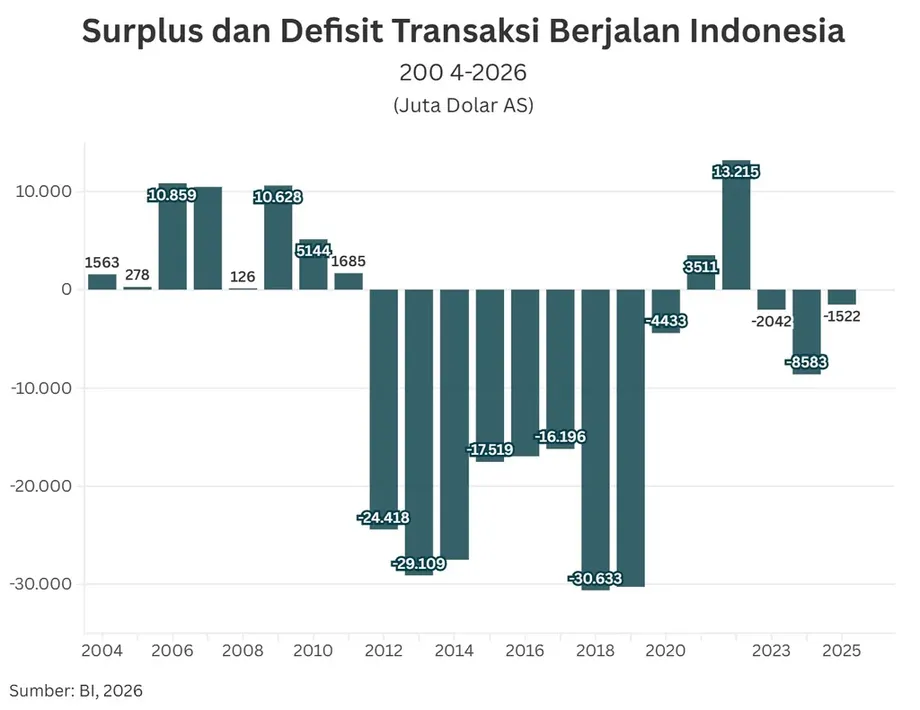
The historical comparison shows a large decline from periods of greater economic stress. Indonesia's unemployment rate reached 11.24% in 2005, amid weak hiring and domestic economic pressures following the financial crisis, and 7.07% in 2020 during the COVID-19 pandemic.
The 2026 rate is 6.59 percentage points below the 2005 figure and 2.42 percentage points below the pandemic figure. A percentage point measures the direct gap between two rates: subtracting 4.65 from 7.07 gives 2.42.
- 1994: Open unemployment stood at 4.36%, the historical benchmark cited in the government's comparison.
- 2005: The rate reached 11.24% during a period of economic pressure and weak hiring.
- 2020: Unemployment rose to 7.07% as COVID-19 disrupted economic activity.
- February 2026: Sakernas recorded about 7.24 million unemployed people.
- October 23, 2026: Job seekers at a South Jakarta career fair described barriers to returning to stable employment.
- October 27, 2026: The government highlighted the 4.65% rate and its plans for skills and employment.
Indonesia is approaching its 1994 rate with a much larger workforce. The 155.41 million labor force cited for 2026 is 72.09 million larger than the approximately 83.32 million cited for the 1990s, an increase of about 86.5%. That comparison describes the growth of the labor force across decades, rather than the number of jobs created in a single year.
Millions remain without work
The February unemployment total included 4,556,224 men and 2,687,381 women. Men accounted for 62.9% of unemployed people and women for 37.1%, according to the Sakernas figures processed by the Ministry of Manpower and cited on October 21.
The same figures recorded 88.75 million employed men and 58.92 million employed women. Calculating unemployment rates for men and women requires comparing each group's unemployed population with its own labor force, rather than comparing the two unemployment counts alone.
Age also shapes the picture. People aged 35 to 44 accounted for 10.13% of unemployed people in February, while those aged 45 to 54 accounted for 7.46%. Together, those groups represented 17.59% of unemployment, or approximately 1.27 million people when applied to the total of 7.24 million.
People aged 15 to 24 made up the largest share of unemployed people. The substantial number in the older groups shows that finding work is also a pressing concern for people with years of experience and families to support.
When experience meets an age limit
Samuel Arthur, 45, attended the Jakarta Independent Workforce Career Expo 2026 at the Smesco Indonesia building in South Jakarta on October 23. His banking career ended with a layoff at the end of 2023, leaving him searching for another position nearly three years later.
Samuel, a resident of Ceger in East Jakarta, described vacancies with maximum ages of 35 or even 25. At those employers, an age requirement could stop his application before his financial industry experience received consideration. He explained what he needed from a vacancy:
I'm looking for a job that fits my experience and skills. But most importantly, it's also one that's appropriate for my age,
Samuel has explored starting a small business and selling online to support his household. He said the income was lower than what he had earned in formal employment. For him, finding an activity that brings in some money and rebuilding a dependable livelihood are separate stages of recovery.
A permanent job replaced by uncertain earnings
Ananto, 43, traveled from East Bekasi to the same career fair after losing his permanent position at a logistics company in December 2025. He had spent more than nine years with the company in Penjaringan, North Jakarta, working as a procurement coordinator and auditing operations across Indonesia.
The company dismissed him during an annual efficiency drive. After roughly two decades in the workforce, he turned to driving for a ride hailing service. He described days when his earnings covered little beyond fuel, leaving his household without the reliable contribution his former salary had provided.
Ananto found few procurement vacancies suitable for applicants in their 40s. Some salary offers also fell below what he considered appropriate for his experience and qualifications. Although his wife works, he said he continued seeking a steady job to help support the family.
Sarif Saipul, 45, faced a similar search after losing his warehouse job at an eyewear company in June 2026. He relied for about four months on savings and a small business selling glasses. With a wife and two children to support, he wanted a stable monthly income, but said many openings available to people his age were concentrated in sales and driving.
Why returning to formal employment is difficult
Deni Friawan, an economics researcher at the Centre for Strategic and International Studies (CSIS), described workers in middle age as facing pressure from both company restructuring and competition for new jobs. He linked efficiency measures to weaker purchasing power, stronger industry competition and technological change.
Senior employees can be exposed when employers seek to reduce wage costs, Deni said. Once dismissed, they may compete with younger applicants whom companies regard as cheaper to hire, easier to train and more comfortable with new technology.
Deni said removing age restrictions would still leave older applicants facing those recruitment preferences. In an interview on October 23, he described the difficulty of returning to employment without a distinct skill:
When someone leaves the formal job market in their 30s or 40s, it becomes difficult to find new employment. This is especially true if they lack specialized skills, as their jobs can be replaced by anyone,
His assessment connects two problems visible at the career fair: getting an application considered and finding a role that rewards previous experience. Training addresses the skills side, while recruitment decisions determine whether those skills receive a fair opportunity.
Support during the gap between jobs
Deni recommended social protection for workers affected by layoffs, including Job Loss Guarantee, known as JKP. He said income support gives people time to search for another job while maintaining their livelihoods.
Samuel's smaller business income, Ananto's fuel costs and Sarif's reliance on savings show why that transition matters. A household still has expenses while an application is being reviewed, and accepting irregular work may bring in money without restoring the security of a former salary.
Retraining and updated skills were also central to Deni's recommendations. He argued that displaced workers need competencies suited to changing technology and employer demand. For experienced applicants, that means connecting what they already know with the requirements of vacancies they can realistically fill.
The government's next employment test
Haryo, the coordinating ministry spokesperson, said the government would continue vocational training, programs to update workers' skills and efforts to increase industrial utilization. Vocational training teaches practical skills for particular occupations; greater industrial utilization means making more use of factories and other production capacity.
The ministry's stated goal extends to employment that improves living standards. For the workers described at the Jakarta fair, that would mean vacancies open to their age group, earnings sufficient for household expenses and a more dependable route back to regular work.
The 4.65% rate gives the government a stronger national employment figure than during the pandemic or the pressures of 2005. The experiences of displaced workers show where its employment policies must also deliver: in the search between losing a job and securing another one that can sustain a family.
Key Points
- Indonesia's 2026 open unemployment rate of 4.65% is 0.29 percentage points above the 4.36% recorded in 1994.
- The government cited a labor force of 155.41 million, compared with approximately 83.32 million in the 1990s.
- February 2026 Sakernas figures recorded 7,243,605 unemployed people.
- People aged 35 to 54 accounted for 17.59% of unemployed people, approximately 1.27 million.
- Job seekers in their 40s described age limits, limited suitable vacancies and uncertain earnings after layoffs.
- The government pledged skills training and better employment, while CSIS researcher Deni Friawan urged income protection and retraining for displaced workers.