A bigger energy bill puts pressure on the rupiah
Indonesia's current account deficit widened to US$12.49 billion in the second quarter of 2026, up from US$3.58 billion in the first quarter, as more expensive energy imports increased the country's need for foreign currency. The deficit reached 3.34% of gross domestic product, compared with 0.97% three months earlier.
Contents
- A bigger energy bill puts pressure on the rupiah
- How quickly did the deficit grow?
- Oil and gas erode the goods surplus
- Services and investment income add to the bill
- Foreign investment covers much of the gap
- Reserves provide a buffer, while debt needs watching
- Bank Indonesia manages currency and interest rate pressures
- Energy substitution and exports become central
- A wider gap between forecasts
- Key Points
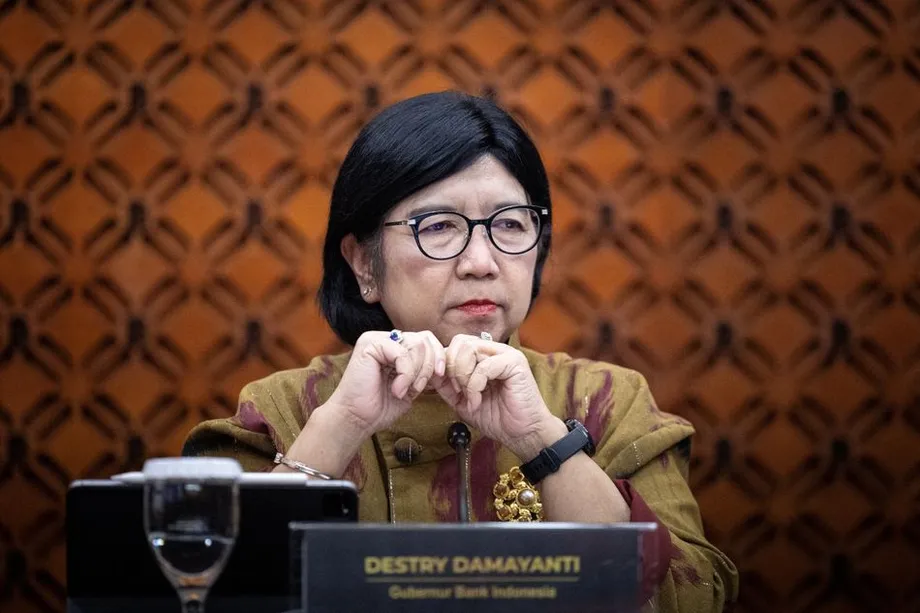
Bank Indonesia Governor Destry Damayanti identified the large energy import requirement as a main cause of the shortfall. The pressure extends beyond oil: a smaller surplus in other goods, payments for services and earnings sent to foreign investors also weighed on Indonesia's external accounts.
The rupiah closed at 18,110 per US dollar on Monday, October 26, its weakest closing level since early June. Higher oil prices, tensions in the Middle East and foreign money leaving domestic shares added to demand for dollars.
The closing account put the currency's daily decline at 0.39%. An intraday market update used a previous close of 18,080, against which the closing rate of 18,110 represents a decline of about 0.17%. At 2:12 p.m. Jakarta time, the rupiah had traded at 18,133 before recovering some ground.
Indonesia now faces two connected tasks: reducing the foreign currency needed to buy energy and other imports, while attracting enough stable investment to finance the gap. Bank Indonesia can manage abrupt currency movements, but the export and production changes proposed by Destry require action across government and industry.
How quickly did the deficit grow?
Bank Indonesia's quarterly figures show the deficit increased by US$8.91 billion between the first and second quarters, making it about 3.5 times as large. Its share of GDP rose by 2.37 percentage points.
The current account tracks trade in goods and services, income crossing borders and transfers such as money sent home by overseas workers. A deficit means payments abroad in those categories exceed receipts from abroad. The difference must be financed through investment, borrowing or other external resources.
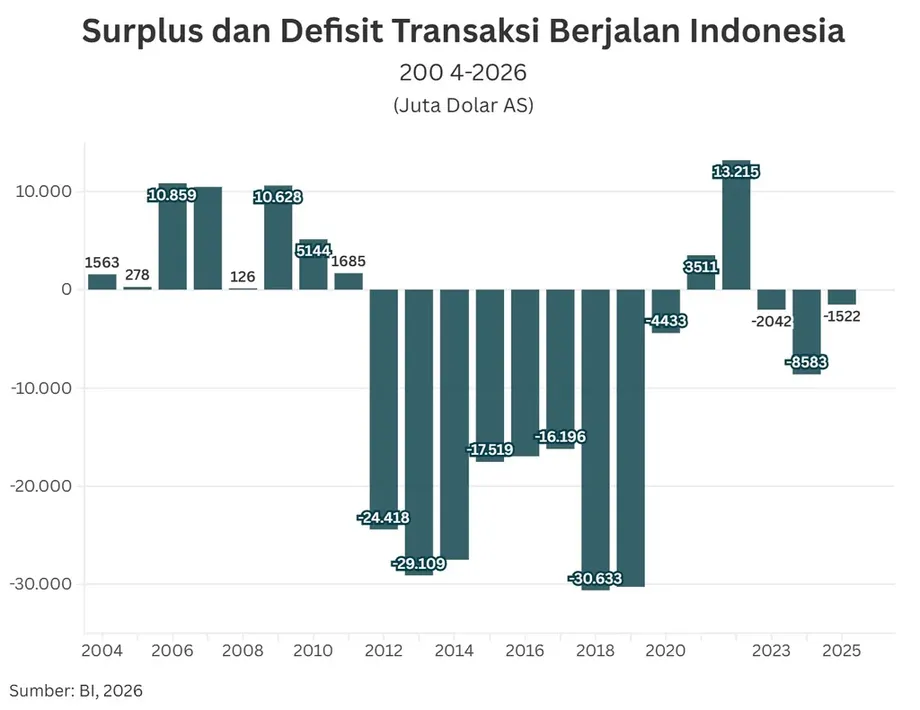
The deterioration was also steep compared with a year earlier. The second quarter of 2025 recorded a deficit of about US$3 billion, or 0.8% of GDP. Across all of 2025, the deficit was much smaller, at about US$1.5 billion, or 0.1% of GDP, as a strong surplus in goods other than oil and gas supported the balance.
The sequence shows how the external pressure developed alongside changes in central bank leadership and policy:
- First quarter of 2026: the current account deficit stood at US$3.58 billion, or 0.97% of GDP.
- Second quarter of 2026: the deficit widened to US$12.49 billion, or 3.34% of GDP.
- June 2026: foreign exchange reserves stood at US$145.6 billion.
- July 25, 2026: Destry became acting governor after Perry Warjiyo resigned for personal reasons.
- August 2026: Bank Indonesia held interest rates steady for a second consecutive month after increases totaling one percentage point since May.
- October 26, 2026: the rupiah closed at 18,110 per dollar.
Oil and gas erode the goods surplus
Indonesia's oil and gas trade deficit doubled from US$5.09 billion in the first quarter to US$10.18 billion in the second, according to Bank Indonesia's balance of payments figures. Higher global oil prices made imported energy more expensive.
The surplus from trade in all goods fell from US$8.2 billion to US$1.3 billion over the same period, a drop of US$6.9 billion, or about 84%. Indonesia still earned more from goods exports than it spent on goods imports, but that cushion became much thinner.
Imports outside oil and gas also increased as domestic demand supported purchases of raw materials, machinery and consumer products. These purchases serve different purposes: machinery can expand future production, while raw materials keep factories operating. All require payment to overseas suppliers.
Bank Indonesia described the quarterly deterioration as driven by temporary factors, including expensive oil and stronger imports. Bank Permata chief economist Josua Pardede focused on the composition of that growth and the capacity of domestic businesses to meet demand.
Josua explained why stronger spending can increase reliance on imports when local production falls short:
"This means that when domestic demand strengthens, domestic production capacity has not yet fully been able to meet the additional demand, resulting in some of the growth leaking into imports," he stated.
Services and investment income add to the bill
Indonesia's services deficit widened during the second quarter, partly because of the pilgrimage season. Travel and related services purchased abroad create foreign payments even when no physical goods enter the country.
The primary income deficit also increased, reflecting payments such as dividends to foreign shareholders, interest owed to overseas lenders and profits transferred abroad by multinational companies. Seasonal corporate dividend payments contributed to the quarterly rise.
Foreign investment therefore appears in the accounts in two ways over time. New investment brings money into Indonesia, while the returns earned by its foreign owners can later generate payments abroad. A larger goods surplus helps cover those recurring obligations.
Money sent home by Indonesian workers overseas provided a steadier source of foreign receipts. Bank Indonesia said the secondary income surplus, which includes remittances and other transfers, remained relatively stable compared with the first quarter. Remittances were its largest component.
Foreign investment covers much of the gap
Indonesia's capital and financial account recorded a surplus of US$11.95 billion in the second quarter. This account records financing flows, including foreign purchases of securities and investment in businesses. Those inflows covered much of the current account shortfall.
The balance of payments deficit narrowed to about US$0.9 billion from US$9.1 billion in the first quarter. That broader balance includes the current account, financing transactions and statistical adjustments. Indonesia's external financing position therefore improved during the quarter even as its current account worsened.
The type of incoming money matters. Portfolio investment inflows reached US$9.95 billion, compared with US$2.78 billion in direct investment. Portfolio inflows were about 3.6 times direct investment. These categories sit within a wider financial account that also includes other transactions, so their sum differs from the account's total surplus.
Portfolio investors buy tradable assets such as bonds and shares. Direct investors typically acquire lasting business interests, such as a factory or a substantial ownership stake. Securities can usually be sold more quickly, leaving financing more exposed to changes in investor sentiment.
Josua warned that funds attracted by yields could leave if global confidence weakened, US interest rates rose or concerns about Indonesia's public finances increased. The resulting pressure could appear in a weaker rupiah, higher government borrowing costs and declining foreign exchange reserves.
Reserves provide a buffer, while debt needs watching
Indonesia held US$145.6 billion in foreign exchange reserves in June. Those reserves provide resources for external payments and central bank operations during periods of market strain.
External debt stood at about 30.6% of GDP in the second quarter. Short term external debt measured by remaining maturity reached 7.2% of GDP. Remaining maturity counts debt coming due within a year, including borrowing originally arranged for a longer period.
The ratio of short term external debt to reserves rose to 72.8%, from 55.8% in the previous quarter, an increase of 17 percentage points. A larger share of the reserve stock was therefore matched by obligations approaching repayment.
Syafruddin Karimi, a professor at Andalas University's Faculty of Economics and Business, described the widening deficit as a reason for caution. He warned that tighter global funding conditions or another rise in oil prices could increase pressure on both the rupiah and Indonesia's financing needs.
Bank Indonesia manages currency and interest rate pressures
Destry said on October 26 that Bank Indonesia remained in the market, monitoring currency movements and the balance between demand and supply. The central bank had not changed its intervention strategy.
Bank Indonesia uses spot transactions, which involve currency purchases or sales for near immediate settlement, alongside non-deliverable forward contracts abroad and domestic non-deliverable forwards. These contracts allow participants to manage exchange rate exposure through later cash settlement.
The central bank must also consider domestic financing conditions. At her August parliamentary assessment as the sole candidate nominated by President Prabowo Subianto for governor, Destry said rates on Bank Indonesia Rupiah Securities, known as SRBI, were declining. Outstanding SRBI had fallen from a peak near 1,100 trillion rupiah to around 1,050 trillion rupiah.
That reduction of roughly 50 trillion rupiah was intended to add liquidity and bring market rates closer to the central bank's overnight rate. Liquidity is money readily available for lending and transactions. Adjusting it affects the rates financial institutions charge one another and, eventually, borrowing conditions in the wider economy.
Destry also distinguished between lasting support for the currency, such as stronger external accounts, and shorter movements driven by market sentiment. On October 26, the US dollar index was marginally lower, down 0.01% at 101.802 at 3 p.m. Jakarta time, while the rupiah weakened.
Energy substitution and exports become central
The government is seeking to reduce energy imports through changes to the fuel mix, including B50 and E50. These labels generally refer to blends containing 50% biodiesel and 50% ethanol respectively, with petroleum fuel making up the remainder.
The approach aims to replace part of the imported petroleum requirement with alternative fuel supplies. Destry also identified export promotion and import substitution as key responses to the current account deficit. No implementation dates or estimates of foreign currency savings for B50 and E50 were specified.
Import substitution means producing goods domestically that would otherwise be bought overseas. For energy, that targets a major source of dollar demand. For manufacturing, greater local supplies of materials and equipment could allow production to expand with fewer additional imports.
Syafruddin urged energy import substitution alongside manufacturing exports with greater added value. Processing goods into more valuable products before selling them abroad could increase export earnings, while reducing reliance on energy imports would lower a major category of foreign payments.
For households, a weaker rupiah can raise the local cost of imported products and goods made with foreign materials. Businesses paying suppliers in dollars need more rupiah to meet the same dollar invoice. Companies earning dollars from exports receive more rupiah for each dollar, although those using imported inputs also face higher costs.
A wider gap between forecasts
The Permata Institute for Economic Research projected a current account deficit of 2.5% to 3% of GDP for all of 2026. Bank Indonesia's annual projection cited alongside the quarterly release was lower, at 0.5% to 1.3% of GDP.
The full year result will depend on the remaining quarters, including oil costs, export receipts, import demand and income payments. Indonesia's earlier annual balances show how much commodity earnings can affect the result: a US$13.2 billion current account surplus in 2022 became a US$1.6 billion deficit in 2023 as global energy and agricultural commodity prices returned toward more usual levels.
Government borrowing requirements add another pressure to monitor. The budget deficit was 0.76% of GDP in the first half of 2026, while the government's full year outlook was 2.85%. A budget deficit concerns government spending exceeding revenue; the current account deficit concerns Indonesia's transactions with the rest of the world.
When both require financing, government and private borrowers can face stronger competition for funds, particularly if international investors become less willing to lend. The immediate currency response rests with Bank Indonesia, while a more durable improvement depends on export earnings, energy costs, domestic production and the stability of incoming investment.
Key Points
- Indonesia's current account deficit widened to US$12.49 billion, or 3.34% of GDP, in the second quarter of 2026.
- The oil and gas trade deficit doubled to US$10.18 billion, while the total goods surplus fell to US$1.3 billion.
- The rupiah closed at 18,110 per dollar on October 26, its weakest close since early June.
- Portfolio investment inflows of US$9.95 billion exceeded direct investment of US$2.78 billion.
- June foreign exchange reserves stood at US$145.6 billion, while debt approaching repayment increased relative to reserves.
- Bank Indonesia continued currency intervention as the government pursued energy substitution and stronger exports.