Three penalties expose a wider market problem
Indonesia's Financial Services Authority, OJK, has imposed record fines totaling 2.1 trillion rupiah, about $117 million, over manipulation of Dian Swastatika Sentosa shares and concealed share allocations in the stock market debuts of Barito Renewables Energy and Petrindo Jaya Kreasi.
Contents
- Three penalties expose a wider market problem
- What investigators found in Dian Swastatika trading
- How concealed IPO allocations restricted public supply
- Why ownership transparency matters to share prices
- A record penalty compared with earlier enforcement
- What reforms were promised, and what followed
- Companies say operations remain normal
- A steep selloff and a presidential response
- The dates investors now face
- Key Points
The penalties were determined on October 16, 2026, and formal notices were handed to the sanctioned parties at OJK's Jakarta headquarters on October 21. OJK chair Friderica Widyasari Dewi described the fines as the largest the regulator had imposed.
The biggest penalty, 1.5 trillion rupiah, went to an entity identified as SMT over trading in Dian Swastatika, part of the Widjaja family's Sinar Mas group. AH Ltd received a 500 billion rupiah fine over the initial public offering of Barito Renewables, while TC Pte Ltd received a 100 billion rupiah fine over Petrindo's offering. Both energy companies are controlled by businessman Prajogo Pangestu.
The named recipients matter for investors assessing who must pay. Petrindo chief executive Michael said the fine connected with its offering was not imposed directly on the listed company. The detailed enforcement breakdown identifies outside entities, alongside separate penalties for brokers and individuals.
The action comes as global index provider MSCI considers moving Indonesia from its emerging market classification into its standalone category. That would put Indonesian shares outside its emerging and frontier market groupings, threatening access to money invested through funds that follow those benchmarks.
OJK said the cases arose from investigations already underway before MSCI's latest announcement. Their findings nevertheless reach the same central issue: whether investors can identify who controls shares and trust the prices produced by trading.
What investigators found in Dian Swastatika trading
OJK said individual and institutional investors used several brokerages to conduct planned, coordinated transactions that sharply increased Dian Swastatika's share price. Investigators requested trading records, traced money movements and summoned at least 12 securities company directors, 15 individuals and 11 foreign legal entities.
Coordinated trading can make a share appear more popular than it is among independent buyers. If connected accounts repeatedly buy and sell through different brokers, other investors may see rising prices and busy trading without seeing the relationships behind those transactions.
SMT's 1.5 trillion rupiah penalty accounts for about 71% of the three principal fines. OJK also fined nine brokerages identified as SSI, SS, ALS, BS, AMS, TSI, BCS, WSI and RSI. Eight sales personnel received written warnings for handling client orders connected with the trading.
A director at SS, identified as R, had their securities underwriter representative license suspended for one year. That license authorizes work connected with arranging securities offerings. The enforcement proceedings cited Articles 91 and 92 of Indonesia's Capital Market Law, which address market manipulation.
How concealed IPO allocations restricted public supply
Barito Renewables and Petrindo faced a different kind of investigation. OJK examined how shares were allocated during their initial public offerings, or IPOs, when companies first sell shares to public investors.
The regulator found that groups connected with controlling shareholders had been positioned to receive substantial allocations while concealing the identities and relationships of the subscribers. This concentrated ownership among connected parties and reduced the shares genuinely available for public trading.
Investigators sought information from securities firms, underwriters and custodian banks, which hold securities for investors. They also summoned at least five securities company directors and three custodian banks, alongside parties involved in allocating the shares.
The examinations cited Article 107 of the Capital Market Law and the Financial Sector Development and Strengthening Law, known as P2SK. OJK said it identified unlawfully obtained gains connected with the offerings and Dian Swastatika trading.
Beyond the 500 billion rupiah fine for AH Ltd and 100 billion rupiah fine for TC Pte Ltd, OJK fined HPS and BDS over Petrindo's offering. An HPS director received a suspension of their securities underwriter representative license for three months.
Why ownership transparency matters to share prices
Indonesia's reform debate centers on free float, the portion of a company's shares available for public trading rather than held by controlling owners or other restricted holders. A company can have a large total market value while only a small fraction of its shares changes hands freely.
Hidden connections between shareholders make that calculation harder. Shares registered under several names may appear widely distributed even when the holders belong to the same group. With fewer independent sellers, relatively small purchases can move the quoted price sharply.
Barito Renewables had already encountered scrutiny over this issue. FTSE Russell excluded it from its global indices in 2024 because of concentrated ownership. Dian Swastatika, Barito Renewables and Petrindo were also among six companies removed from the MSCI Indonesia Index in May 2026.
OJK's wider examination extends beyond those three stocks. Hasan Fawzi, its executive head for capital market, derivatives and carbon exchange supervision, described findings involving the High Shareholding Concentration list, which flags stocks with concentrated ownership.
"Of the 61 stocks included on the HSC list, 31 have undergone examinations and have shown indications of potential capital market criminal violations," Hasan told a news conference in Jakarta.
The 31 stocks represent just over half of the 61 listed. OJK's findings put ownership records, broker oversight and trading surveillance at the center of the reform effort, rather than treating the three headline fines as isolated cases.
A record penalty compared with earlier enforcement
OJK's February reform statement, issued jointly with the Indonesia Stock Exchange and Indonesia Central Securities Depository on February 9, provides a useful measure of the new penalties' size.
From 2022 through January 2026, OJK imposed 542.49 billion rupiah in administrative sanctions on 3,418 parties. That included 240.65 billion rupiah imposed on 151 parties for stock trading manipulation. The latest principal fines of 2.1 trillion rupiah are about 3.9 times the entire earlier total. SMT's fine alone is about 6.2 times the earlier manipulation penalties.
The February statement also recorded 42 investigations into alleged capital market crimes, including 32 involving suspected price manipulation. Those cases included pump and dump schemes, in which promoters push prices higher before selling; wash sales, which create trading activity without a meaningful ownership change; and trades arranged in advance.
OJK said five criminal cases had reached final, binding court decisions. On February 6, it also sanctioned PT Multi Makmur Lemindo Tbk, PT Repower Asia Indonesia Tbk and related parties over the use of IPO proceeds, financial reporting and underwriting integrity.
By October, OJK said at least 835 parties had faced penalties, sanctions or other enforcement action from it and market regulatory bodies during 2026. Deputy commissioner Khoirul Muttaqien led the October 21 handover of sanction notices, attended by Suhasto, the national police official responsible for special economic crimes.
What reforms were promised, and what followed
OJK, the exchange and the central securities depository set out three main proposals after meeting MSCI on February 2: more detailed investor classifications, disclosure of shareholders owning more than 1%, and a gradual increase in the minimum free float from 7.5% to 15%.
The proposed free float requirement would double the minimum portion available for public trading. For companies below the new threshold, compliance could require existing owners to sell shares or companies to issue additional shares to public investors.
The February plan proposed 28 investor subcategories to complement nine existing categories. Later descriptions of the reforms put the expanded classification system at 39 categories. More detailed categories are intended to make ownership records more informative than broad labels such as corporate investor or other investor.
The central securities depository sought reclassification information for 35,022 Single Investor Identifications, with submission targeted for March 2026. These identification records help the market track investors across securities accounts.
By October, OJK said the ownership disclosure threshold had been lowered from 5% to 1%. That brings smaller holdings into public view, making it easier to trace connections among shareholders. The free float increase remained part of a staged reform roadmap.
The February package also included a joint implementation team, 25 work programs at the central securities depository and preparation of a government regulation to change the exchange's ownership and governance structure. The practical challenge is keeping ownership information accurate as shares move between accounts.
Companies say operations remain normal
The Indonesia Stock Exchange asked Barito Renewables and Petrindo to explain how the enforcement action would affect their finances and operations. Both said business continued normally. Dian Swastatika also said it respected OJK's enforcement measures and would comply with regulations.
Barito Renewables chief executive Hendra Soetjipto Tan reported current assets of $679 million and net working capital of $262 million in an October 19 response. Net working capital is the amount by which assets expected to be available in the near term exceed obligations due over that period.
Hendra said the Darajat Unit 3 retrofit had been completed as planned. The Salak Unit 7 project, with capacity of 40 megawatts, and Wayang Windu Unit 3, with 30 megawatts, remained scheduled for completion by the end of 2026, within budget. Together, those two developments represent 70 megawatts of generating capacity.
Petrindo's Michael said the company had adequate finances and liquidity, and management expected no material negative effect on its finances, operations or business continuity because the fine was not imposed directly on the company.
Petrindo said it would review compliance, supervision and governance, strengthen internal controls and continue normal operations. Michael said the company could not yet determine whether further obligations or legal proceedings would follow beyond those formally set by the authorities.
A steep selloff and a presidential response
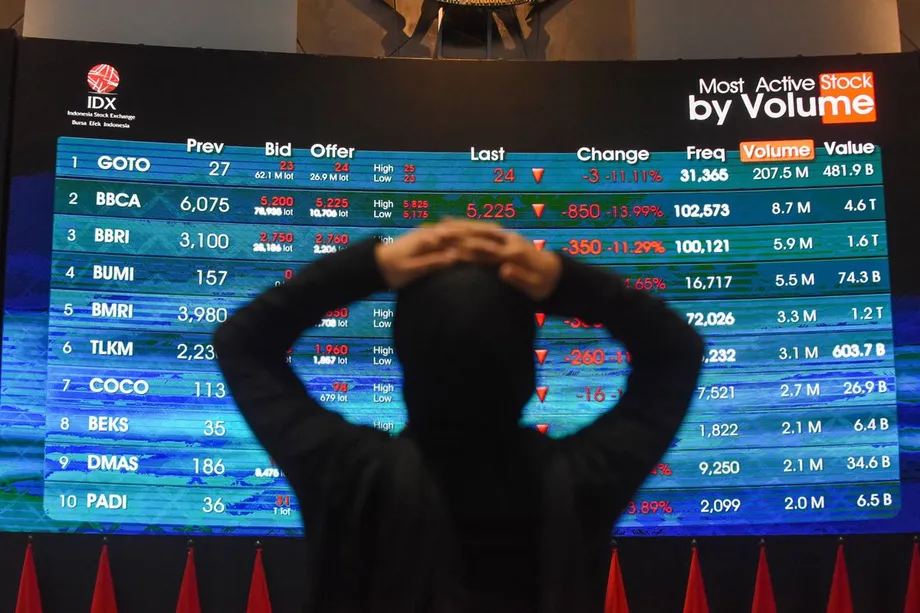
Indonesia's Jakarta Composite Index closed October 16 down 11.57% at 5,185.105, its lowest closing level since 2020. A temporary trading halt interrupted the session as selling accelerated. The index fell another 3.9% on the following Monday, taking the combined decline across the two sessions to about 15%.
The benchmark's decline since the start of 2026 reached about 38%. Barito Renewables and Petrindo shares had each lost nearly 80%, leaving market capitalizations of about 259 trillion rupiah and 54 trillion rupiah respectively. Market capitalization is the quoted share price multiplied by the number of shares.
Pangestu's estimated wealth fell from $39.5 billion at the end of 2025 to about $12.6 billion, a decline of roughly 68%. Coal businessman Low Tuck Kwong's estimated fortune fell by more than half to $10.9 billion, while banking and tobacco businessman Robert Budi Hartono's fell 38% to $13.3 billion.
Another transaction illustrated the gap that can emerge between an exchange price and the price negotiated for a large stake. Low and his daughter Elaine Low sold a combined 30.25% of Bayan Resources to PT Jhonlin Baratama at 2,588 rupiah per share, about 80% below the prevailing exchange price of 13,000 to 14,000 rupiah.
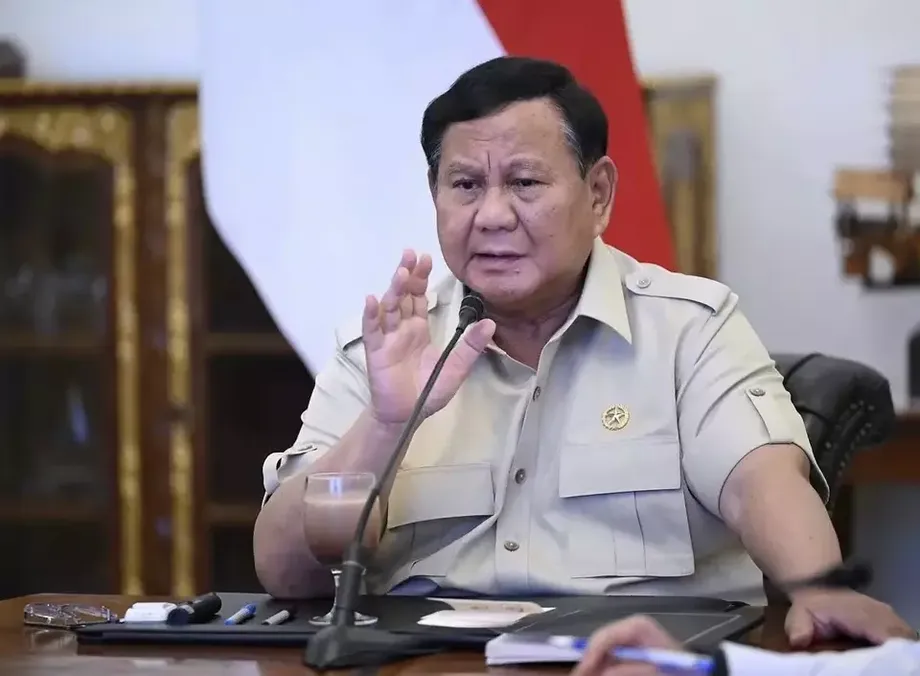
President Prabowo Subianto rejected MSCI's pressure during an October 21 cabinet meeting in Jakarta, saying Indonesia would not be intimidated or surrender. He also said the government was prepared to make substantial savings if necessary. His response placed national resolve alongside the regulators' more technical work on ownership disclosure and market access.
The dates investors now face
MSCI's review has developed over several months, moving from an earlier warning about frontier market status to a consultation on standalone status. Index classifications influence which country benchmarks include shares and, in turn, where funds following those benchmarks invest.
- January 30, 2026: MSCI warned about a possible move from emerging to frontier market status amid concerns about ownership transparency and trading practices.
- February 2 to 9: Indonesian authorities discussed proposals with MSCI and published a joint reform package.
- May 2026: Dian Swastatika, Barito Renewables and Petrindo were among six companies removed from the MSCI Indonesia Index.
- October 15: MSCI opened consultation on moving Indonesia to standalone status.
- October 16: OJK determined the principal fines, while the Jakarta Composite Index fell 11.57%.
- October 21: OJK served formal sanction notices, and Prabowo addressed MSCI's warning at a cabinet meeting.
- April 30, 2027: MSCI's consultation is scheduled to close.
- June 30, 2027: A final classification decision is expected by this date.
For public investors, the immediate changes include more disclosure of smaller shareholdings, tighter scrutiny of IPO allocations and penalties reaching the brokers and individuals who handle transactions. The next market classification decision will follow months in which Indonesia must put its revised ownership and trading rules into practice.
Key Points
- OJK imposed record principal fines totaling 2.1 trillion rupiah, about $117 million, involving trading and IPO violations connected with three companies.
- SMT, AH Ltd and TC Pte Ltd were the named recipients of the principal fines; brokers and individuals also received sanctions.
- Investigators found coordinated Dian Swastatika trading and concealed allocations to parties connected with controlling shareholders in the Barito Renewables and Petrindo IPOs.
- Indonesia lowered its ownership disclosure threshold to 1% and plans to raise minimum free float from 7.5% to 15%.
- Barito Renewables and Petrindo said operations remained normal, with two Barito generating projects scheduled for completion by the end of 2026.
- MSCI's consultation closes April 30, 2027, with a final decision on Indonesia's market classification expected by June 30.