A New Route From China's Interior to the Sea
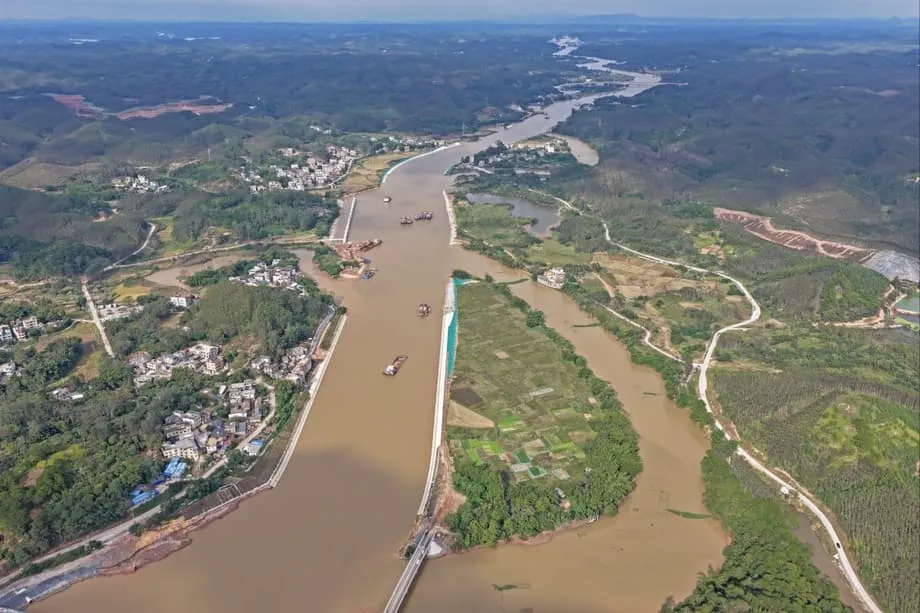
China's US$10.4 billion Pinglu Canal is approaching its final construction phase, with an opening to navigation expected by the end of 2026. The 134km waterway, equivalent to 83 miles, will connect Nanning, capital of the Guangxi Zhuang autonomous region, with the Gulf of Tonkin through the Qinjiang River. China calls the gulf the Beibu Gulf.
Contents
- A New Route From China's Interior to the Sea
- Locks That Lift Ships Across a 65 Meter Difference
- Shorter Journeys and Larger Cargo Flows
- ASEAN Trade Gives the Canal a Stronger Economic Setting
- Singapore, Malaysia and Brunei Have Existing Connections
- Guangxi Looks South After Decades of Uneven Development
- Water Reuse and Wildlife Passages Shape the Environmental Plan
- Vietnam Faces a Mix of Commercial and Strategic Concerns
- Indonesian Durian Shows the Port Network Already at Work
- Key Dates Behind the Opening Schedule
- A Regional Canal Rather Than a Global Shipping Chokepoint
- Completion Will Put the Economic Forecasts to the Test
- Key Points
About 89.7 percent of the planned investment has been completed. Preparations for opening the canal to shipping are scheduled to begin in May, according to a senior project manager. The timetable would bring the waterway into operation after four years of construction, giving China's southwestern provinces a shorter route to international shipping and Southeast Asian markets.
Yunnan, Guizhou and parts of Guangxi currently depend on routes through eastern coastal provinces or other indirect connections to reach overseas buyers. The canal is expected to shorten the journey to the sea by more than 560km, reduce some transport times from roughly a month to seven to ten days, and save an estimated US$725 million in annual transport costs.
China presents the project as a major milestone in inland navigation. The canal has been described as its first major canal construction in centuries, and the country has not built one of this magnitude since the founding of the People's Republic in 1949.
The immediate purpose is practical: move goods between inland production areas and southern ports more quickly and cheaply. Its wider significance lies in how that connection could change the position of Guangxi, strengthen trade with Southeast Asia and give western China another outlet to global markets. The opening remains scheduled for late 2026; no exact date has been given.
Locks That Lift Ships Across a 65 Meter Difference
The Pinglu Canal is designed for vessels of 5,000 tonnes. Its route includes three shiplock hubs, each with two parallel lanes, and 27 newly built or renovated bridges. Thirteen of those bridges have already entered service.
Ships must cross a difference in elevation of 65 meters between the inland waterway and sea level. Locks make that possible by holding a vessel in a chamber and changing the water level until it matches the next stretch of the route. The ship can then continue without navigating a steep slope.
Madao Junction contains what is described as the world's largest inland ship lock designed to save water. Its two parallel lanes have chambers measuring 300 meters long, 34 meters wide and 8 meters deep. The maximum operating head, meaning the difference between the water levels it handles, is 29.6 meters.
Three levels of water saving chambers allow 60 percent of the water used to lift ships to be reused instead of discharged downstream. The system reduces water consumption and is intended to speed transit, maintaining shipping movement despite the large differences in water level.
Construction has involved moving more than 1.76 billion cubic feet of earth. Engineers are also using a specialized concrete mixture designed to withstand more than 100 years of erosion by water. Its intended benefit is fewer repairs and lower maintenance costs over the canal's operating life.
Shorter Journeys and Larger Cargo Flows
The projected reduction of more than 560km would give southwestern China its most direct inland access to markets in the Association of Southeast Asian Nations, or ASEAN. The estimated shift from a month in transit to seven to ten days would make the journey roughly one third as long or less.
Manufacturing, agriculture and energy are among the sectors expected to benefit. Lower transport costs could make goods from inland provinces more competitive, while shorter journeys could improve the movement of agricultural products between southern ports and customers farther inland.
Research projections put canal cargo volumes at 95.5 million tonnes in 2035 and 120 million tonnes in 2050. Those figures describe expected future traffic, while the US$725 million estimate describes annual transport savings once the new route is being used.
Chen Liangjun, head of a business group in Guangxi, described the opening as a change in Nanning's economic position, from an inland center to a gateway serving ASEAN trade.
The opening of the Pinglu Canal represents a historic step for Nanning," said Chen Liangjun. "This project will transform the city from an inland center into a strategic maritime gateway to the ASEAN market.
Nanning's connection to the sea is central to that expectation. The canal would bring inland shipping into closer contact with coastal ports, allowing a larger share of western and southwestern China's goods to move south rather than travel toward the traditional eastern gateways.
ASEAN Trade Gives the Canal a Stronger Economic Setting
China's trade figures for 2025 show why a route toward Southeast Asia has become more valuable. Chinese exports to ASEAN increased 13.4 percent, while shipments to the United States fell 20 percent during the tariff conflict between the two countries. Growth in ASEAN trade helped partly offset the loss in the US market.
Total trade between China and ASEAN exceeded US$1 trillion in 2025, an increase of 7.4 percent from the previous year. Trade with the United States stood at US$559.7 billion, down 18.7 percent. On those figures, China's trade with ASEAN was more than 1.7 times its trade with the United States.
ASEAN's position as China's top trading partner gives the canal an economic setting beyond its engineering scale. The waterway is intended to connect inland suppliers more efficiently with a region already accounting for a large and growing share of Chinese trade.
The project is also part of the New Western International Land-Sea Corridor, a trade and logistics passage connecting production centers in Chongqing and Chengdu with overseas markets through southern and southwestern outlets. It offers another direction for goods that have traditionally moved toward eastern coastal provinces.
China's 14th Five-Year Plan and Vision 2035 place the canal within that wider development strategy. It is also associated with the Belt and Road Initiative, China's program of investment in transport and logistics links across Asia, Europe and Africa.
Singapore, Malaysia and Brunei Have Existing Connections
Singapore has a connection to this trade network through the Singapore-Chongqing Connectivity Project. The partnership with Chongqing makes the canal a potential opportunity for Singaporean businesses involved in moving goods between inland China and overseas markets.
Malaysia already has an industrial foothold in Qinzhou through the China-Malaysia Qinzhou Industrial Park, known as CMQIP. Established in 2012, the park has faced difficulties associated with Qinzhou's remote location. Better access to inland shipping could improve its position by connecting it more directly with suppliers and customers in China's interior.
Brunei's Muara Port, the country's only port serving deep water shipping, is a joint venture between Brunei Darussalam Asset Management and the Port of Beibu Gulf Group. Its direct shipping connection to the Chinese port network, combined with the canal, is expected to create more opportunities for Chinese businesses in Brunei.
The Beibu Gulf port system consists of Qinzhou, Fangchenggang and Beihai. The canal is expected to strengthen that group by bringing more inland cargo toward the coast. During an inspection of Guangxi in December 2023, Chinese President Xi Jinping stressed the importance of connections between river and sea transport for the region's future development, with the Pinglu Canal central to that approach.
Guangxi Looks South After Decades of Uneven Development
Guangxi's coastal position has not translated into evenly distributed prosperity. For decades, its coastal cities of Qinzhou, Fangchenggang and Beihai have performed more weakly than inland cities such as Nanning and Liuzhou. In 2020, the economy of landlocked Yunnan surpassed Guangxi's for the first time.
Guangxi's leaders have historically looked east toward Guangdong for economic opportunities rather than south toward their own coast. That approach proved insufficient because Guangxi's interests occupied a secondary place in Guangdong's priorities. The canal is intended to give Guangxi a more direct trade outlet under its own regional development strategy.
The intended effect resembles the role of the Funan Techo Canal in Cambodia: reducing reliance on neighboring territories for access to trade routes. For Guangxi, the immediate change would be a closer connection between its inland economy and its coastal ports.
Guangxi and Yunnan have also agreed to jointly build the Baise water conservancy project, valued at CNY5 billion, or US$703.6 million. That project is intended to establish a waterway from Yunnan to the sea, extending the benefits of improved navigation beyond Guangxi.
Qinzhou and other Guangxi cities are already preparing industrial parks and logistics facilities for the canal's opening. Those investments reflect the expectation that shorter transport routes will attract cargo handling, production and related businesses.
Water Reuse and Wildlife Passages Shape the Environmental Plan
Madao Junction's reuse of 60 percent of the water needed to raise or lower vessels is the canal's most prominent measure for reducing water demand. Saving water matters because every passage through a lock involves moving water between different levels.
The canal also includes ecological corridors and passages for animals and fish. These are intended to maintain biodiversity and allow wildlife to continue moving along natural migration routes while the waterway operates.
Construction measures include dust control to reduce air pollution. The specialized concrete mixture is intended to reduce the need for repairs, limiting the maintenance work and associated environmental effects required over the longer term.
A new waterway changes local ecosystems, even when protective measures are built into its design. Environmental monitoring is expected to continue after opening, with water quality and noise from increased shipping among the issues that will need attention as traffic grows.
Vietnam Faces a Mix of Commercial and Strategic Concerns
China and Vietnam have generally maintained cordial relations in the Beibu Gulf. They conduct regular joint patrols and settled territorial and maritime boundary disputes there in the early 2000s. Their cooperation in the gulf exists alongside continuing maritime disputes in the South China Sea.
Vietnam is expected to assess the canal's commercial opportunities together with its ecological and strategic effects. It has already expressed unease about the possible economic, environmental and strategic consequences of the China backed Funan Techo Canal in Cambodia.
China's drawing of a baseline in the Beibu Gulf in March 2024 was poorly received in Vietnam, although the Vietnamese government's response was relatively muted. The Pinglu Canal's completion will add another development to that sensitive relationship.
A People's Liberation Army Navy base near Qinzhou, at the canal's mouth, adds a military dimension. The canal's main purpose is commercial, while improved transport connections can also support military logistics. Its opening could strengthen China's influence in the gulf by improving access between the interior and the coast.
Nearby, the Hainan Free-Trade Port forms another part of China's effort to deepen economic connections with Southeast Asia. Its stated ambition had been to become the largest free trade port by 2025, with its location serving China's goal of expanding exports to the region.
Indonesian Durian Shows the Port Network Already at Work
Qinzhou Port hosted a ceremony in January 2026 marking the arrival of Indonesia's first container of frozen durian exported to China by sea. The cargo illustrates trade developing through the ports that the canal is intended to serve.
The container carried 23 tonnes of frozen durian pulp and puree. It left the Port of Jakarta on December 26, 2025, and reached a bonded warehouse in the Qinzhou comprehensive bonded zone on January 6, 2026. A bonded warehouse holds imported goods under customs supervision.
The shipment followed a phytosanitary protocol signed in May 2025 between China's General Administration of Customs and Indonesia's quarantine authority. Such a protocol sets plant health conditions for trade. The agreement removed the previous requirement for Indonesian durian products to be processed in a third country before entering China.
Budi Hansyah, trade attache at the Indonesian Embassy in China, described the shipment as a sign of the relationship between the two countries.
"The entry of Indonesian frozen durian into the Chinese market demonstrates the close and solid trade relations between the two countries," said Budi Hansyah.
Eight Indonesian companies have approval from Chinese customs authorities to export frozen durian. Negotiations on market access for fresh durian are underway.
Chen Jing'en, vice mayor of Qinzhou, said the canal's scheduled opening in 2026 is projected to reduce logistics costs by about 30 percent, helping Indonesian and other ASEAN agricultural products reach the Chinese market.
Guangxi ports imported more than 2.65 million tonnes of fruit from ASEAN between January and November 2025, up 15.8 percent from the same period a year earlier. The imports were worth more than 40.6 billion yuan, an increase of 22 percent. Fruit trade is therefore already growing through the regional port network before canal operations begin.
Key Dates Behind the Opening Schedule
The canal's expected launch follows several years of regional investment, diplomatic developments and changes in agricultural trade access. These dates show how the construction timetable fits into the wider trade relationship.
- 2012: The China-Malaysia Qinzhou Industrial Park was established.
- 2020: Yunnan's economy surpassed Guangxi's for the first time.
- December 2023: Xi Jinping visited Guangxi and stressed connections between river and sea transport.
- March 2024: China drew a baseline in the Beibu Gulf, prompting concern in Vietnam.
- May 2025: China and Indonesia signed the phytosanitary protocol allowing direct access for Indonesian frozen durian products.
- December 26, 2025: The container carrying 23 tonnes of frozen durian left Jakarta.
- January 6, 2026: The shipment reached the bonded warehouse in Qinzhou.
- May 2026: Preparations for opening the canal to shipping are scheduled to begin.
- End of 2026: The canal is expected to open to navigation.
- 2035 and 2050: Projected canal cargo volumes reach 95.5 million and 120 million tonnes respectively.
The immediate milestones are the preparations in May and the expected opening later in 2026. The cargo forecasts describe the longer period during which the canal is intended to become an established part of China's logistics network.
A Regional Canal Rather Than a Global Shipping Chokepoint
The Pinglu Canal serves a different purpose from the Suez and Panama canals. Those waterways are global shipping chokepoints used by very large cargo ships, often carrying more than 60,000 tonnes. Pinglu's capacity for vessels of 5,000 tonnes suits a regional role linking inland waterways with international ports.
Its wider effects would come from making China's western and southwestern goods easier to move into global trade. By providing an alternative to some journeys by truck, train or air, the canal is intended to lower costs and strengthen China's economic connections across the wider Belt and Road network.
An unnamed analyst described the intended commercial role as a bridge between western China and overseas markets.
In essence, the canal would act as a maritime bridge - one that brings western Chinese provinces closer to global markets," the analyst said. "This could enhance Beijing's export power and economic resilience while establishing new trade corridors that bypass traditional shipping chokepoints controlled by other nations.
The development strategy joins different forms of transport rather than simply adding more roads, railways and ports. Inland vessels, coastal terminals and international shipping are intended to work as parts of a connected corridor, giving production centers more choices about how goods reach buyers.
Completion Will Put the Economic Forecasts to the Test
The expected opening in late 2026 would mark a new stage in Chinese inland navigation and regional development. For the maritime sector, the project demonstrates China's engineering and logistics ambitions; for the national economy, it adds another route for foreign trade.
Countries facing similar difficulties in connecting inland production areas with the sea may look to the canal as a possible model. Its combination of engineering, transport planning and economic policy is intended to change trade routes and expand China's regional influence.
Large infrastructure projects can also produce redundant capacity and wasteful investment. Businesses and governments across Southeast Asia have shown interest in the canal, while its eventual performance will depend on the cargo it carries, the savings it delivers and the businesses that use its connections.
Opening on schedule and within budget will be closely watched. After launch, traffic volumes, environmental monitoring and the effects on neighboring trade relationships will provide practical measures of the project's results. The central promise remains a shorter journey between China's interior and the sea, supported by ports and industrial facilities already preparing for that change.
Key Points
- The US$10.4 billion Pinglu Canal is expected to open by the end of 2026 after four years of construction.
- The 134km route connects Nanning with the Beibu Gulf through the Qinjiang River.
- About 89.7 percent of planned investment has been completed, with opening preparations scheduled from May.
- The canal is designed for vessels of 5,000 tonnes and is expected to shorten routes to the sea by more than 560km.
- Projected benefits include US$725 million in annual transport savings and some journeys reduced from a month to seven to ten days.
- Madao Junction's lock system reuses 60 percent of the water used to move vessels between levels.
- China-ASEAN trade exceeded US$1 trillion in 2025, providing a growing market for the new connection.
- Indonesian frozen durian reached Qinzhou in January 2026 through the existing port network.
- Forecast canal cargo volumes are 95.5 million tonnes in 2035 and 120 million tonnes in 2050.
- Environmental performance, commercial use and regional relations will remain central to judging the canal after opening.