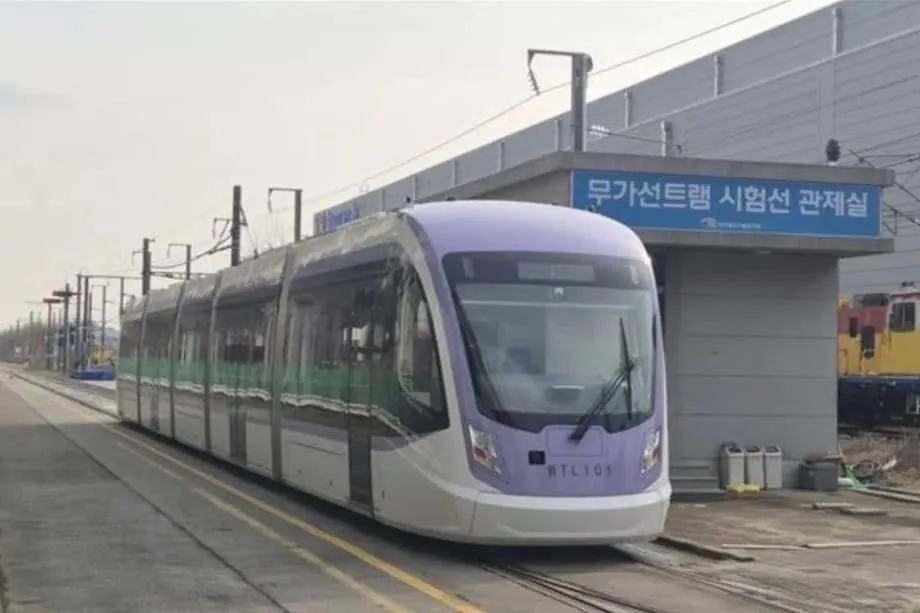
February Trials Bring Trams Back to Seoul
Seoul will begin full trial runs of the Wirye Line Tram in February 2026, bringing street rail vehicles back to the capital for the first time since 1968. The 5.4 kilometer route will use batteries instead of overhead power wires, making it South Korea's first tram system of this kind.
Contents
- February Trials Bring Trams Back to Seoul
- A Short Route Connecting Three Subway Lines
- Vehicles Designed for Easier Boarding
- How the Trams Run Without Overhead Wires
- Testing From Osong to the Wirye Tracks
- Safety Staff Will Watch Intersections and Crosswalks
- From the First Streetcars to a Revival in 2026
- Why the Vehicles Are Purple
- A Test for Other Suburban Tram Projects
- At a Glance
The first vehicle arrived at the Wirye depot in the early hours of January 27. Its delivery was carried out overnight, between 11 p.m. and 5 a.m., to limit disruption to road traffic. Seoul coordinated with Songpa Police Station to control traffic and place safety personnel along the transport route.
Commercial service is scheduled for late 2026. Before passengers can board, the city will test the vehicles, railway facilities and their interaction with surrounding traffic. The preparations include staff at 13 intersections and 35 crosswalks, along with a control center team monitoring operations around the clock.
The line will connect Macheon Station on Seoul Metro Line 5 with Bokjeong Station, which serves Line 8 and the Suin-Bundang Line. It will also provide access to Namwirye Station on Line 8. Together, those connections will give residents of Wirye New Town a more direct route into three major subway lines.
Seoul's return to trams combines an old form of transport with new equipment. The vehicles will have floors designed for easy boarding, batteries mounted on their roofs and systems that can apply emergency brakes when a possible collision is detected and the driver does not respond.
The immediate task is to establish how this equipment works on the actual route. Cars, pedestrians and trams will again share parts of Seoul's street environment after a gap of 58 years, making traffic coordination a central part of the testing program.
A Short Route Connecting Three Subway Lines
Wirye New Town stretches across parts of Seoul, Seongnam and Hanam. Although it sits within a metropolitan area served by 23 metro lines and 768 stations, the developing residential district has depended on buses and indirect subway transfers to reach much of that network.
The Wirye Line is intended to close that local gap. Its 12 stops will create a corridor between Line 5 and Line 8, with the Suin-Bundang Line available at Bokjeong. Residents will be able to use the tram to reach these subway connections instead of relying entirely on buses or taking longer routes between rail lines.
For passengers using this corridor, a direct connection between Line 5 and Line 8 will remove the need to travel into central Seoul to change between them. Commuters traveling between Gangdong and Songpa districts are expected to benefit from shorter journeys and a more comfortable alternative to crowded buses.
The route illustrates why a large subway network can still leave local transport needs unmet. The metropolitan network connects a broad area, while a neighborhood such as Wirye needs convenient links from its residential streets to nearby stations. The tram's role is to join those parts of a journey.
Vehicles Designed for Easier Boarding
Ten tram sets are planned for the Wirye Line. Each will consist of five connected sections, using an articulated design that allows the vehicle to bend as it follows curves in the track.
The vehicles will also have low floors, allowing level boarding. Wheelchair users, older passengers and parents pushing strollers will be able to enter without negotiating the high steps associated with older streetcars.
Woojin Industrial Systems is manufacturing the rolling stock in partnership with Hyundai Rotem. The fleet combines domestic manufacturing with battery propulsion and collision avoidance equipment, placing both passenger access and street safety at the center of the vehicle design.
The boarding arrangement is a practical difference between the returning trams and their predecessors. A service that connects homes with subway stations needs to be usable by people with different mobility needs, including those who find stairs difficult or cannot use them at all.
How the Trams Run Without Overhead Wires
The Wirye vehicles will draw power from large capacity batteries mounted on their roofs. Traditional electric trams commonly obtain electricity from overhead wires, known as a catenary system. Wirye's batteries will allow the vehicles to travel without that equipment above the street.
The trams will recharge at stations or depots. This arrangement retains electric propulsion while removing the web of overhead wires that usually accompanies street rail, reducing visual clutter in residential and historic neighborhoods.
The design also reduces the infrastructure costs and construction complexity associated with installing overhead power equipment. Along tree lined streets, the vehicles are intended to operate quietly without the industrial appearance of a conventional wired tram system.
Battery operation places the Wirye project within a broader shift toward sustainable urban transport. Its particular attraction for this route is the combination of electric travel and a less intrusive street appearance, a consideration for residents living alongside the tracks.
Each of the 10 planned sets will also carry a forward collision warning system. Radar and camera sensors will scan for obstacles ahead of the tram. If they identify a possible collision and the driver does not respond, the system will automatically activate emergency braking.
The equipment addresses a basic challenge of running rail vehicles at street level: a tram follows a fixed track, while cars and pedestrians can move into its path. Detecting an obstacle early and responding quickly are therefore essential parts of the operating design.
Testing From Osong to the Wirye Tracks
The first vehicle completed more than 5,000 kilometers of preliminary testing during 2025 at the Korea Railroad Research Institute's Osong test track in North Chungcheong Province. Those trials checked acceleration, braking, performance on curves, communications, ride comfort and noise.
Seoul will now move from that controlled testing environment to the main line. From February through August 2026, trial runs will cover 16 categories of performance and safety checks, including running safety, coordination with facilities beside the tracks and integration with existing traffic systems.
Comprehensive railway system tests will run from April through December, overlapping with the mainline trials. These will examine the stability of all facilities and the connections between them, while simulating different operating situations to check reliability.
The two programs address different parts of the same service. Vehicle trials examine how the tram runs along the route and interacts with its surroundings. System tests examine whether the railway's connected facilities work together reliably under different conditions.
Commercial operation remains scheduled for late 2026, with the comprehensive testing program extending through December. No exact opening date has been given. For now, the next scheduled milestone is the start of mainline trial runs in February.
The testing program is among the most comprehensive in Seoul's recent transit history. Its scope reflects the work required to introduce a transport mode that will operate alongside everyday road traffic, rather than in the largely separated environment of a subway.
Safety Staff Will Watch Intersections and Crosswalks
Seoul will place safety personnel at all 13 intersections and 35 crosswalks along the route during the trial period. They will watch vehicle movements and, when necessary, manually direct motorists and pedestrians.
A dedicated monitoring team will work around the clock from a control center, ready to respond to incidents. The test vehicles also carry insurance specifically covering potential accidents during the verification phase.
Pedestrians have been asked to follow traffic signals and instructions from safety staff. The city has also urged people to avoid distracted walking when crossing the tracks, including wearing earphones that could reduce their awareness of an approaching tram.
Drivers must slow down when sharing lanes with trams, leave a safe following distance and respect signals that give trams priority at intersections. These instructions will be part of the adjustment for motorists in a city that has gone almost six decades without streetcars.
Lim Chun-geun, head of Seoul's Urban Infrastructure Headquarters, said the city would make testing and verification central to preparations for passenger service.
We will ensure thorough testing and verification so citizens can use the service safely and conveniently.
The city's approach combines automatic safety equipment with people stationed along the route. Building public trust will depend on both the performance of the vehicles and the way the new service fits into streets already used by residents every day.
From the First Streetcars to a Revival in 2026
Seoul introduced streetcars in 1899 and operated them for nearly 70 years before closing the network in 1968. During that period, trams formed the backbone of public transport, carrying millions of residents as the city changed from a traditional Asian capital into a modern industrial center.
The decision to remove them reflected the transport priorities of the time. City planners considered trams an obstruction to automobile traffic and believed buses and subways could serve commuters more efficiently. Removing street tracks helped make room for roads designed primarily around private cars.
Seoul's experience followed a pattern seen in cities around the world during the middle of the 20th century. The Wirye project reverses that approach by using surface rail to complement subway services, especially in corridors with moderate development density where building a full metro line would be prohibitively expensive.
The project has a budget of 261.4 billion won, approximately $194 million. It offers an alternative to extending the subway while aiming to provide greater capacity and reliability than bus rapid transit, a form of bus service designed to move passengers more efficiently along a defined corridor.
Wirye's own development history has been lengthy. The project began in 2008 as a private investment initiative, but was suspended over feasibility concerns. Seoul Metropolitan Government revived it in 2018 and took direct responsibility for construction, which began in December 2022.
The main dates show how the current trials fit into nearly two decades of planning and delays:
- 1899: Seoul introduced its first streetcars.
- 1968: The city's tram network closed.
- 2008: The Wirye project began as a private investment initiative before being suspended over feasibility concerns.
- 2018: Seoul Metropolitan Government revived the plan.
- December 2022: Construction began.
- 2025: The first vehicle completed more than 5,000 kilometers of testing at Osong.
- January 27, 2026: The first vehicle arrived at the Wirye depot.
- February to August 2026: Mainline trials are scheduled.
- April to December 2026: Comprehensive railway system tests are scheduled.
- Late 2026: Commercial service is scheduled to begin.
Why the Vehicles Are Purple
The Wirye trams will have a purple exterior inspired by the royal robes of King Onjo, the founding monarch of the ancient Baekje Kingdom. Onjo established his first capital in Wirye, giving the design a connection to the area's history dating back to 18 B.C.
Purple also represents the union of the three municipalities crossed by Wirye New Town: Seoul, Seongnam and Hanam. The color combines red and blue, colors traditionally associated with the cities' distinct identities, to express their integration through the development.
The vehicle design followed public consultation, including surveys on Seoul's M-Voting platform and feedback sessions held locally. Residents therefore had a role in shaping the appearance of the transport system that will run through their neighborhood.
The result gives the tram a cultural role alongside its transport function. Its color connects the service with the area's ancient heritage and its present position across three municipalities, making the vehicles a form of moving public art as well as a link to subway stations.
A Test for Other Suburban Tram Projects
The Wirye Line could become a template for other suburban tram developments in South Korea. Its combination of battery operation, accessible vehicles and connections to existing subway lines offers a model for new towns that need more transport capacity without the cost of extensive tunneling.
The project occupies a middle position between subway construction and bus routes. Surface rail can provide rail transit amenities in developing districts while avoiding the tunneling costs associated with a metro extension. Removing overhead wires also addresses appearance concerns that can delay tram proposals in residential areas.
Other cities may adopt similar technology if the Wirye system proves reliable and safe in Seoul's demanding street environment. The forthcoming trials will examine the practical elements of that model: vehicle performance, connected railway facilities and coordination with road users.
Seoul's motorists and pedestrians will also need to adjust to steel wheels returning to the streets after two generations without trams. Collision avoidance systems, safety personnel and traffic guidance are part of the city's cautious preparation for that change.
For Wirye residents, the most immediate benefit is a simpler local journey. The planned service will bring 12 stops along a 5.4 kilometer route and connect homes with Line 5, Line 8 and the Suin-Bundang Line. The late 2026 opening target depends on completing the testing and verification now being prepared.
At a Glance
- Seoul will begin Wirye Line trial runs in February 2026, returning trams to its streets 58 years after the old network closed.
- The 5.4 kilometer route will have 12 stops, connecting Macheon on Line 5 with Bokjeong on Line 8 and the Suin-Bundang Line, and providing access to Namwirye on Line 8.
- Ten planned tram sets will use roof mounted batteries instead of overhead wires and have five connected sections with low floors for level boarding.
- Radar and cameras will warn of obstacles, with automatic emergency braking if the driver does not respond to a possible collision.
- Safety personnel will monitor 13 intersections and 35 crosswalks during trials, supported by a monitoring team working around the clock.
- The project is budgeted at 261.4 billion won, approximately $194 million, with commercial service scheduled for late 2026.
- The purple design honors King Onjo of Baekje and represents the connection between Seoul, Seongnam and Hanam.