Fighter pilots, autonomous drones and a new aviation business
South Korea's aviation companies are pursuing a shift that reaches from the cockpit of an FA-50 combat aircraft to the maintenance hangar: machines that can sense their surroundings, make decisions and carry out physical tasks. Korea Aerospace Industries (KAI) is developing a system in which one KF-21 fighter could eventually coordinate 20 unmanned aircraft, while Korean Air is developing autonomous drones and applying artificial intelligence to aircraft inspections.
Contents
- Fighter pilots, autonomous drones and a new aviation business
- Why autonomy matters when communications fail
- What KAI's next flight would test
- A development plan stretching beyond 2038
- Korean Air builds several kinds of unmanned aircraft
- Hanwha and KAI pursue different routes to growth
- Aircraft inspection becomes another proving ground
- Disaster response could extend the technology's reach
- Software and export demand will shape the outcome
- Key Points
The next practical step for KAI is smaller but essential. A planned December demonstration near the aviation center in Goheung, South Jeolla Province, would have a pilot in the rear seat of an FA-50 send flight commands directly to a drone weighing about 150 kilograms. An earlier formation flight used an AI program on the ground to control the unmanned aircraft.
Korean Air, Hanwha Aerospace and KAI are approaching the opportunity from different directions: autonomous combat aircraft, cooperation between pilots and drones, aircraft engines and digital maintenance. Their shared challenge is to turn aircraft manufacturing experience into systems that combine reliable hardware, software and communications.
The commercial ambitions are substantial. Straits Research projects the global drone market will grow from a starting estimate of $48.71 billion to $138.96 billion in 2034. Its military drone forecast rises from $26.97 billion to $63.05 billion over the same period. Those figures put military drones at about 55 percent of the starting market and 45 percent of the projected total in 2034, showing that civilian applications also account for a large part of the expected expansion.
Why autonomy matters when communications fail
The Russia-Ukraine war has pushed drones far beyond their earlier image as supporting tools for reconnaissance. Ukrainian attacks against Russian aircraft and targets deep inside Russia have demonstrated how unmanned systems can threaten expensive equipment and reach areas that would be dangerous for pilots.
AI addresses a practical weakness: a drone controlled from a distance depends on communications that an opponent may interrupt. Software that recognizes vehicles, equipment and terrain from camera images can help an aircraft follow a moving target or maintain its route when contact with an operator is lost. Visual navigation can also help when satellite navigation signals are disrupted.
Reconnaissance creates another problem that AI can help solve. Drones collect large quantities of imagery, and people need time to examine it. Automated analysis can identify objects of interest more quickly, shortening the time between observing an area and deciding what to do.
Son Jun-young, a professor in Pusan National University's School of Computer Science and Engineering, points to lower acquisition and operating costs than crewed aircraft, along with shorter production and improvement cycles. He sees demand extending beyond war preparations to border security and operations against terrorism.
What KAI's next flight would test
KAI's adaptable aerial platform, or AAP, is a small experimental aircraft intended to test how drones can work with combat aircraft. In the first formation flight described in its latest plans, the FA-50 flew alongside the AAP while a ground system controlled the drone.
The December demonstration would move that control into the air. A pilot in the FA-50's rear seat would transmit commands to the AAP, testing the connection between the two aircraft during flight. No precise flight date has been announced.
KAI also aims to raise the AAP's maximum speed from 790 kilometers per hour to 920 kilometers per hour, an increase of about 16 percent. Greater speed would help the drone operate alongside combat aircraft. The company is developing its own AI pilot, called KAIilot, to support more autonomous flight and plans formation flying with the KF-21 as well.
The larger goal is for AI to help set objectives and carry out missions in coordination with a crewed aircraft. Getting there requires more than keeping two aircraft close together: the aircraft must exchange instructions and information reliably while their software manages changing conditions.
A development plan stretching beyond 2038
KAI's roadmap for cooperation between crewed and uncrewed aircraft, often called manned-unmanned teaming or MUM-T, divides development into four phases. It starts with comparatively small demonstrations and advances toward a connected force of fighters, drones and other aircraft.
- 2023: Initial development began, including work involving helicopters and small drones launched from aircraft.
- 2025 to 2028: The second phase schedules an FA-50 demonstration involving control of up to four adaptable aerial platforms.
- June 2026: The first KF-21 delivery is scheduled, providing an aircraft family intended to support later development.
- By 2037: The third phase targets transferring more capable teaming technology to a KF-21 with two seats and advancing development of a combat drone that would accompany it.
- From 2038: The final phase aims to connect aircraft and sensors into a broader air and space combat network.
The four drones in the planned FA-50 demonstration could perform different jobs. One might act as a decoy, another carry a jammer to disrupt enemy electronics, another collect images, and another conduct a strike. Dividing those tasks would let a pilot draw on several aircraft without requiring each drone to carry every type of equipment.
The proposed KF-21 arrangement is larger. One fighter would control four accompanying combat drones, and each of those would direct four additional AAPs. The total would be four larger drones plus 16 smaller platforms, or 20 unmanned aircraft associated with a single fighter.
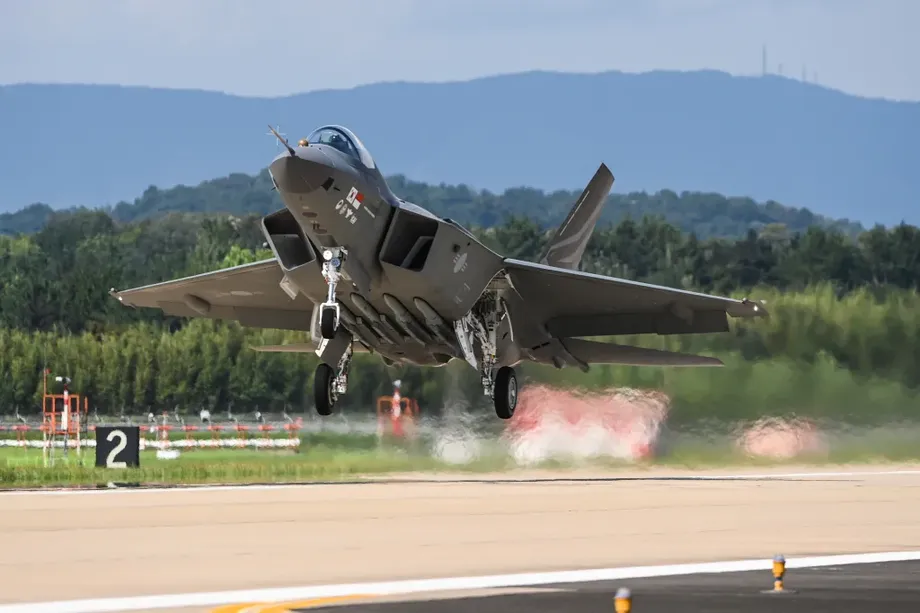
The KF-21 version intended for this role is the planned Block III configuration with two seats. Its development would connect the fighter program to software, communications and drone projects extending well beyond the aircraft's first scheduled delivery.
Korean Air builds several kinds of unmanned aircraft
Korean Air is expanding beyond passenger and cargo transport into aerospace and defense manufacturing. Its projects include the KUS-FX, a small cooperative drone about four meters long that would use autonomous mission technology and coordinated group flight.
Mission autonomy means a commander provides an objective and the aircraft help plan how to achieve it, including dividing tasks. Coordinated group flight requires drones to share position and speed information so they can maintain spacing and avoid collisions.
Korean Air is also developing a subsonic target drone for testing air defense systems and training crews to intercept aircraft, along with small and medium attack drones designed to identify and strike targets. Its KUS-LW project is a separate effort to develop an accompanying combat drone. Development began in November 2021, and the Defense Acquisition Program Administration selected Korean Air's Aerospace Division for the program in August 2022.
Korean Air has described the intended functions of that accompanying drone group:
The squadron of UAVs will not only support and escort a manned aircraft, but will also be able to perform its own missions including surveillance, electronic interference tactics and precise shooting,
The company is also working with American defense technology company Anduril on unmanned aircraft using AI. The combination places software development alongside airframe design as a central part of its defense ambitions.
Hanwha and KAI pursue different routes to growth
Hanwha Aerospace is working with General Atomics Aeronautical Systems on the large Mojave unmanned aircraft, which is designed to take off and land in short, restricted spaces. That capability could expand the places from which a large drone can operate.
Hanwha also intends to apply its own AI model, Engineerus, to autonomous drone flight and aircraft engine development. The two applications involve different tasks, but both require software to work with complex physical systems.
KAI's ambitions reach beyond fighters. Its proposed MC-X Orca would be a multirole aircraft with a maximum takeoff weight of 92 tons. Proposed duties include transport, aerial refueling, medical evacuation, maritime patrol, airborne early warning and cooperation with drones. Production could begin as early as 2035 if the project proceeds, and KAI has been seeking international partners.
A KAI executive has estimated a potential export market of up to 800 KF-21 aircraft over several decades and identified Saudi Arabia and the United Arab Emirates as prospective customers. Those ambitions make integration commercially relevant: a buyer considering a fighter may also want the drones, communications and software that would operate alongside it.
Aircraft inspection becomes another proving ground
Aircraft maintenance offers a different use for physical AI, the term for artificial intelligence that acts through machines in the real world. Instead of flying a combat mission, a robot or drone moves around an aircraft, collects measurements and helps identify damage.
Traditional exterior inspection can require technicians to use lifting equipment to examine surfaces directly. An automated system can combine drones and ground rovers with sensors that determine their position and build a three dimensional map of the surrounding space. The machines then gather detailed information from different parts of the aircraft.
AI can analyze that information for small cracks and component defects. Korean Air has applied physical AI to aircraft inspection, making maintenance a practical counterpart to its longer development programs for autonomous aircraft.
The business is known as maintenance, repair and overhaul, or MRO. Digital MRO uses data and software to support those activities. A market projection cited for the sector puts growth from $1.35 billion to $4.12 billion by 2034, roughly three times the starting value.
For airlines, the attraction is concrete: find damage reliably while reducing the time and expense of inspection. For aerospace companies, maintenance creates another route to revenue alongside building and selling aircraft.
Disaster response could extend the technology's reach
Korean Air also sees potential demand at major disaster sites, including wildfires. Its proposed approach would combine information from sensors on the ground, in the air and in space to watch for signs of fire around the clock.
When a possible ignition is detected, an autonomous drone could travel to the location and attempt an early response. Detecting a small fire and reaching it quickly would be the central purpose of the system.
The connection with military development is the need to combine observations, make decisions and move an aircraft toward a task. Disaster response would require those capabilities to work in a different environment, with missions focused on locating danger and supporting emergency operations.
Software and export demand will shape the outcome
Douglas Barrie, senior fellow for military aerospace at the International Institute for Strategic Studies in London, has described South Korea as having the industrial experience to pursue cooperation between crewed aircraft and drones. He also places the work at an early stage, alongside similar efforts elsewhere.
Barrie explained the financial attraction of adding unmanned aircraft to a force:
Any approach that allows you to bolster your combat mass at reasonable cost, and with systems that might allow the acceptance of higher attrition rates, is going to be attractive.
Combat mass means the number of aircraft and other assets a force can put into action. Attrition means losses during operations. The attraction is to add useful aircraft at a cost that makes losing some of them more manageable than losing expensive crewed fighters.
Kim Kwang-ok, a professor of aviation management at Korea Aerospace University, sees defense, unmanned aircraft and MRO as possible sources of steady revenue through long contracts. He argues that export success requires companies to prepare AI technology for the needs of overseas customers and adapt to changes in aviation.
Recruiting people with AI expertise is part of that task. South Korea's companies already build aircraft and engines; the next stage also requires software that can interpret sensor data, manage missions and coordinate machines. The planned flight demonstrations and maintenance applications provide concrete places to test those capabilities.
Key Points
- KAI plans to test direct control of a drone from an FA-50, following a formation flight controlled from the ground.
- Its longer roadmap envisions one KF-21 coordinating four combat drones and 16 smaller unmanned platforms.
- Korean Air is developing several drone types, working with Anduril and applying physical AI to aircraft inspections.
- Hanwha Aerospace is pursuing the Mojave aircraft with General Atomics and AI applications for flight and engine development.
- Maintenance and potential wildfire response systems extend the technology beyond combat missions.
- Export ambitions depend on matching aircraft, communications and AI software to customer needs.