Samsung talks connect chip supplies with changes at work
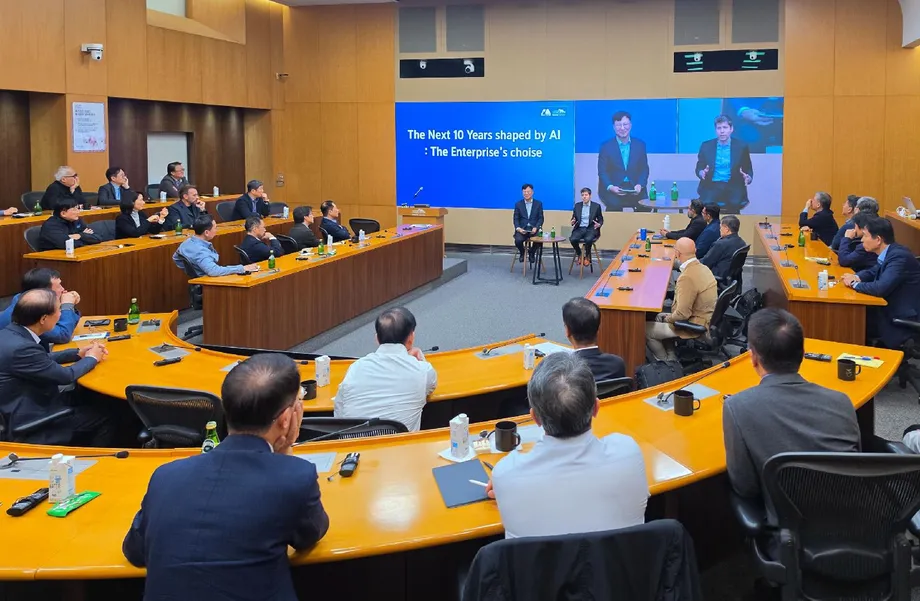
OpenAI chief executive Sam Altman met about 50 Samsung executives in Yongin, South Korea, on October 31, 2026, bringing together discussions about memory chips, AI data centres and a company training programme scheduled to reach all Samsung employees by February 2027.
Contents
- Samsung talks connect chip supplies with changes at work
- Why memory chips are central to the talks
- Samsung cooperation extends beyond semiconductors
- SK brings a second set of infrastructure projects
- Samsung sets a February 2027 training target
- Altman argues that adoption alone is not enough
- A compact keyboard illustrates the workplace pitch
- Funding adds pressure to the expansion plans
- How the partnerships developed
- Key Points
Samsung said the Saturday session at its Human Resources Development Center included leaders from electronics, finance and biotechnology businesses. Samsung Electronics Vice Chairman Jun Young-hyun and President Roh Tae-moon attended the discussion about how artificial intelligence could change corporate decisions, operations and business opportunities over the next decade.
Altman also had lunch with SK Group Chairman Chey Tae-won in Seoul during a visit lasting two days and one night. Executives from memory producer SK hynix and telecommunications company SK Telecom reportedly joined that meeting.
The visit brought OpenAI closer to two groups already involved in its Stargate infrastructure plans. Samsung and SK businesses have proposed supplying memory, developing data centres and finding commercial uses for AI. No additional contracts or investment plans were announced during the visit, and details of the SK lunch discussion were not disclosed.
Samsung used its meeting to connect those infrastructure ambitions with a more immediate task: teaching managers how to use AI in daily work. Before the discussion, executives practised organising scattered management documents into personal knowledge repositories that could support decisions.
Why memory chips are central to the talks
Memory shortages across a broad range of products are putting pressure on the electronics industry and driving chip prices higher. Data centre operators need enormous quantities of memory, increasing competition for supplies also used elsewhere in computing.
AI systems require both processors that perform calculations and memory that keeps information ready for those processors. High bandwidth memory, usually shortened to HBM, moves large amounts of data quickly, helping powerful AI chips work without waiting as long for information.
The five biggest participants in the AI infrastructure race plan to spend more than $3 trillion in the coming years. Memory accounts for roughly a third of data centre spending, making access to chips a major part of the cost and construction challenge.
South Korea is a leading producer of advanced memory, giving Samsung Electronics and SK hynix a central role in those expansion plans. Nvidia chief executive Jensen Huang and Advanced Micro Devices chief executive Lisa Su have each visited the country twice since last year to strengthen supply relationships.
Technology executives have warned that chip production is struggling to keep pace with demand. For OpenAI, agreements with Korean suppliers offer a way to plan for future computing capacity. For the suppliers, those plans create opportunities to sell memory into projects whose spending stretches across several years.
Samsung cooperation extends beyond semiconductors
Samsung Electronics and OpenAI signed a letter of intent in October 2025 covering global AI infrastructure cooperation. Samsung has since been pursuing supplies of memory semiconductors for Stargate, OpenAI's large infrastructure development project.
A letter of intent records the cooperation companies want to pursue. Turning those plans into operating facilities requires further work on commercial terms, construction and equipment.
Samsung SDS agreed to cooperate on AI data centres and services for businesses. Its role connects the physical computing facilities with the software and services companies would use to put AI into their operations.
Samsung C&T and Samsung Heavy Industries agreed to pursue joint development of floating offshore data centres. These would place computing facilities on floating structures rather than solely in buildings on land, bringing construction and shipbuilding capabilities into the partnership.
Samsung Electronics Chairman Lee Jae-yong visited OpenAI's San Francisco headquarters in July 2026. The October meeting extended that relationship to leaders across Samsung affiliates, including businesses whose interest in AI centres on using it rather than supplying computing hardware.
SK brings a second set of infrastructure projects
Chey and Altman met for lunch at the SK Seorin Building in Seoul's Jongno District. Their companies already have a strategic partnership covering memory supply and AI data centre development, agreed in October 2025.
Under that partnership, SK hynix proposed establishing production capacity to respond to HBM supply requests equivalent to as many as 900,000 DRAM wafer starts per month. DRAM is a widely used form of working memory. A wafer is the semiconductor disc on which chips are manufactured, so wafer starts describe the scale of production entering a factory.
SK Telecom and OpenAI also agreed to pursue a joint AI data centre in southwestern South Korea. Their cooperation includes developing AI applications for businesses and consumers, alongside technologies for future data centres.
Chey and Altman had also met at an AI summit in San Francisco in July to discuss cooperation over the longer term. The October lunch continued contact between leaders whose businesses cover different parts of the same chain: memory production, computing facilities and AI services.
Samsung sets a February 2027 training target
Samsung began its company programme for AI transformation in June 2026, covering research and development, production, marketing and support functions. The October gathering was part of leadership training intended to carry that change through its affiliates.
About 2,300 executives have been targeted for AI training since June. Samsung plans to extend the programme to general employees and complete training for all employees by February 2027.
The practical exercise before Altman's appearance focused on a common management problem: useful information spread across different documents and locations. Executives used generative AI to organise that material into knowledge repositories. Generative AI produces responses or other content from instructions, allowing users to ask for summaries or organise information through ordinary language.
Dedicated AI teams at Samsung affiliates are developing strategies suited to their businesses and supporting the use of data and AI models. Samsung also plans to expand employees' use of external generative AI services and review progress across affiliates.
A finance business, a semiconductor factory and a biotechnology company handle different information and decisions. Samsung's approach gives each affiliate responsibility for choosing applications suited to its work while pursuing training across the group.
Altman argues that adoption alone is not enough
Altman's message to Samsung executives focused on what companies do with AI after they introduce it. The discussion covered the abilities leaders would need as AI changes decision making and organisational management.
Altman, OpenAI's co-founder and chief executive, described how he expects companies to compete:
Competitive advantage will depend on how you use AI to move faster, make better products, and get ahead of your competitors.
Samsung's training programme gives that argument a practical setting. Managers were asked to use AI with business material, while affiliate teams are responsible for identifying specific tasks and reviewing results.
OpenAI said the meeting broadened discussion beyond the existing infrastructure relationship to AI adoption across Samsung affiliates. The relationship therefore runs in two directions: Samsung businesses can help supply the computing capacity OpenAI needs, while OpenAI's tools can become part of how Samsung employees work.
A compact keyboard illustrates the workplace pitch
Altman gave Samsung executives a Codex Micro, a compact control device designed by OpenAI with keyboard maker Work Louder. Listed at $230, it is intended for directing OpenAI's Codex coding agent and checking its progress rather than typing ordinary text.
A coding agent is AI software that can carry out programming tasks from instructions, such as reviewing code or attempting a bug fix. Users still need ways to follow its work, answer requests and approve or reject proposed actions.
The Codex Micro has 13 mechanical switches, including six Agent Keys, plus a touch sensor, rotary dial and joystick. It supports Bluetooth and USB-C connections and works with Mac and Windows computers.
Each Agent Key can connect to a conversation. Blue lights show that AI is working, green indicates a completed result that has not been read, and yellow signals that a response or approval is needed. Pressing the key opens the associated conversation.
Dedicated controls can start voice input, send messages and approve or reject requests. Voice input uses the computer's microphone. The joystick can trigger tasks such as code review, while the dial adjusts how much reasoning the AI applies to a problem.
Altman explained the idea behind the device to the executives:
The idea behind it is that in a world where you give computers instructions by speaking and use AI, you may not need a full keyboard.
Funding adds pressure to the expansion plans
OpenAI's infrastructure ambitions require money as well as chips and construction partners. Training AI models and operating services involve continuing costs for computing equipment, facilities and power.
OpenAI was reported on October 30 to have lowered its external fundraising target from $30 billion to $20 billion. That is a reduction of $10 billion, or one third of the earlier target.
The reported change adds financial context to Altman's meetings with companies that could supply essential equipment and participate in infrastructure development. Samsung and SK each combine manufacturing businesses with affiliates involved in technology services or facilities, allowing discussions to cover several needs at once.
The visit's announced activity centred on maintaining those relationships and exploring uses for AI. Samsung's February 2027 training deadline is the next concrete milestone given for its internal adoption programme.
How the partnerships developed
The October meetings followed a year of agreements and leadership contact. Infrastructure cooperation developed alongside Samsung's effort to make AI part of routine work.
- October 2025: Samsung Electronics and OpenAI signed a letter of intent on global AI infrastructure cooperation. SK and OpenAI agreed on memory supply and AI data centre cooperation.
- June 2026: Samsung began its company AI transformation programme and executive training.
- July 2026: Lee Jae-yong visited OpenAI's San Francisco headquarters. Chey and Altman also met at an AI summit in the city.
- October 31, 2026: Altman met about 50 Samsung executives in Yongin and held lunch talks with Chey in Seoul.
- February 2027: Samsung aims to complete AI training for all employees.
Samsung's meeting connected two timescales: infrastructure projects that require sustained supplies and investment, and workplace changes that managers are already being trained to make. SK's parallel relationship gives OpenAI another route to memory capacity and computing facilities in South Korea.
Key Points
- Altman met about 50 Samsung executives in Yongin on October 31, 2026, and held lunch talks with SK Chairman Chey Tae-won in Seoul.
- Samsung's existing cooperation with OpenAI covers memory, AI data centres, business services and proposed floating offshore facilities.
- SK's partnership includes planned memory capacity and a proposed AI data centre in southwestern South Korea.
- No additional contracts or investment plans were announced during the visit.
- Samsung aims to complete AI training for all employees by February 2027.
- Altman's Codex Micro gift illustrated his pitch for assigning tasks to AI and managing the results.