Chinese cloud giants seek a decade of supply security
Alibaba, Tencent and ByteDance are seeking long term server memory agreements with Samsung Electronics and SK hynix, with some customers requesting supplies through 2035. The proposed commitments would extend well beyond the usual three to five years as Chinese technology companies compete with American rivals for chips needed to expand artificial intelligence services.
Contents
- Chinese cloud giants seek a decade of supply security
- Why AI servers need several kinds of memory
- American customers have already reserved production
- China's expansion explains the urgency
- Tencent is buying Chinese memory too
- Export controls shape what Korea can supply
- CXMT is pursuing a different manufacturing approach
- Will shortages last long enough to justify the contracts?
- The dates behind the supply race
- Key Points
The requests cover server double data rate memory, known as DDR, and low power DDR, or LPDDR. Chinese buyers are reportedly seeking additional volumes beyond those covered by the Korean suppliers' existing agreements, at a time when major American customers have already reserved substantial production.
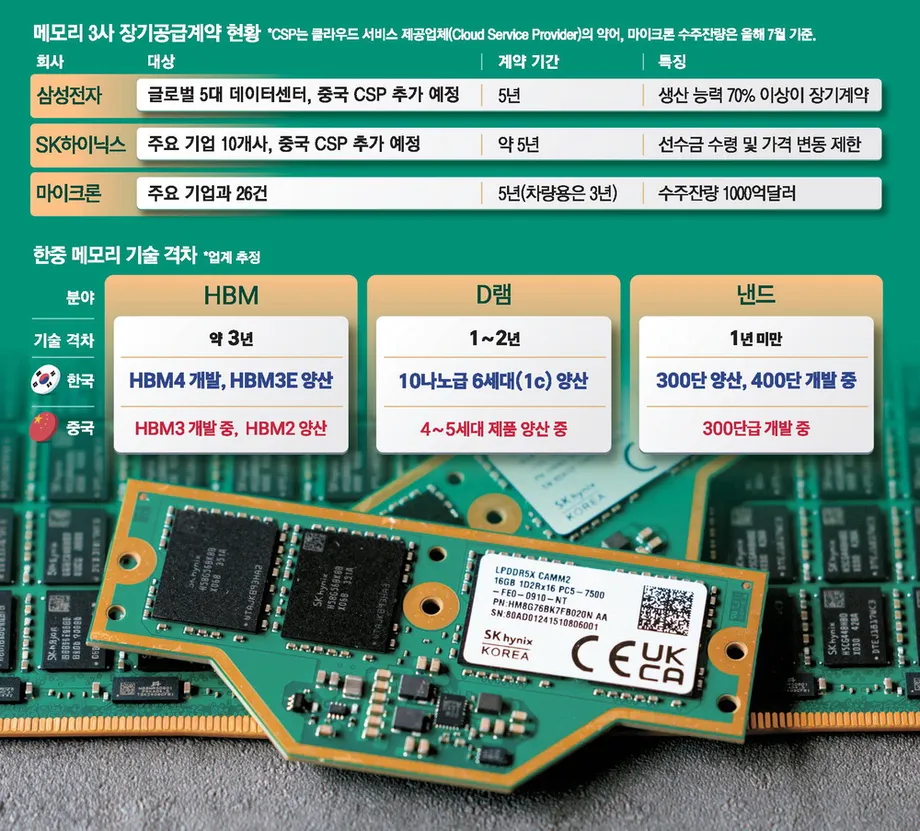
Samsung says it has completed agreements with five major data center customers and is negotiating with five more. SK hynix says it has concluded negotiations with around 10 customers, including key accounts. Industry estimates suggest agreements with global technology companies could absorb 70% to 80% of the two manufacturers' planned memory output for the coming year.
The Chinese proposals remain requests: Samsung and SK hynix have not publicly confirmed accepting the terms extending through 2035, and prices, volumes and advance payments have not been disclosed. Customers appear willing to pay more for dependable deliveries as access to memory becomes a practical limit on AI expansion.
Tencent is also securing domestic supply. A reported agreement with China's ChangXin Memory Technologies, known as CXMT, is worth more than 20 billion yuan, or about $2.94 billion. Together, the approaches show Chinese cloud companies pursuing two routes at once: buying more Chinese chips while seeking years of guaranteed deliveries from South Korea.
Why AI servers need several kinds of memory
DDR memory gives a server's central processing unit, or CPU, a fast working space for information it needs immediately. A simple comparison is a desk: the processor works on the information placed there, rather than repeatedly retrieving everything from a filing cabinet.
LPDDR performs a similar working memory role while using less electricity. It is familiar from smartphones, where battery life and heat matter, but server operators are increasingly interested in its potential to reduce power consumption across large installations.
High bandwidth memory, or HBM, serves another demanding role. It places memory close to powerful AI processors and moves large amounts of information quickly. Samsung and SK hynix have directed more manufacturing resources toward this valuable product, tightening the supply of conventional memory.
NAND flash provides storage that retains information when power is switched off. China's Yangtze Memory Technologies, known as YMTC, specializes in NAND, while CXMT makes DRAM. Cloud companies need both storage and working memory, making procurement a series of related purchases rather than a search for one interchangeable chip.
American customers have already reserved production
Samsung's five major data center customers are reported to include Amazon Web Services, Microsoft, Google Cloud, Meta and Oracle. Their agreements help explain why Chinese companies are moving quickly: buying additional chips becomes harder when suppliers have committed much of their future output.
Samsung has said it intends to allocate at least 70% of production capacity to long term agreements. Kim Dong-won, head of research at KB Securities, estimates an even larger share of its planned memory production for 2027 has already been secured by customers.
Kim described the remaining competition for Samsung's capacity:
We estimate that Samsung Electronics has already secured about 80% of its planned memory production for 2027 through LTAs," adding, "Hyperscalers are still competing to secure supplies of the remaining 20% of memory production not covered by contracts.
Hyperscalers are companies operating enormous networks of data centers. Their agreements can give manufacturers a clearer view of future demand while giving buyers more predictable deliveries. Supply prices and advance payments vary between contracts, so a lengthy agreement can reserve access without necessarily fixing one price for its entire duration.
China's expansion explains the urgency
China already has at least 24 gigawatts of AI data center capacity, according to a September assessment by semiconductor research firm SemiAnalysis. The United States has 56 GW. On those figures, China's capacity is about 43% of the American total.
SemiAnalysis estimates that roughly another 20 GW is under construction or being planned in China. That pipeline is equivalent to about 83% of the country's existing 24 GW, illustrating the scale of the equipment purchases being considered.
Gigawatts describe electrical power capacity. They help convey the physical scale of data centers, although the computing work each facility can perform also depends on its processors, memory and design.
ByteDance is building out about 5.3 GW, Alibaba 3.9 GW and Tencent 2.4 GW, according to the same assessment. Those three programs total 11.6 GW. Baidu is pursuing about 1.1 GW and Huawei about 1 GW, while China Mobile, China Telecom and China Unicom are also expanding AI infrastructure.
Each new facility needs chips before it can serve customers. A shortage of ordinary server memory can delay useful computing capacity even when buildings, electricity connections and AI processors are ready. Reserving deliveries years ahead therefore becomes part of planning the facilities themselves.
Tencent is buying Chinese memory too
Tencent's reported agreement with CXMT, worth more than 20 billion yuan, shows that domestic purchasing is already substantial. Details of the agreement emerged on June 29, citing three people familiar with the matter, as CXMT prepared a proposed 29.5 billion yuan initial public offering on Shanghai's Star Market.
Alibaba, ByteDance and Tencent are also reportedly securing supplies from CXMT and YMTC as Samsung and SK hynix give priority to HBM production. Chinese suppliers offer another source of chips when conventional memory is difficult to obtain.
South Korean manufacturers nevertheless retain advantages in the performance and manufacturing scale needed for demanding server applications, according to industry assessments. Servers run continuously, making reliability, consistent quality and dependable volumes central purchasing concerns.
YMTC's progress is already visible in storage. Omdia put its share of China's NAND market at 38.5% in the second quarter, ahead of Samsung's 33.5% and SK hynix's 17%. The competition has accompanied upgrades at Chinese NAND plants, including Samsung's planned move to 286 layers in Xi'an and SK hynix's work to introduce at least 240 layers in Dalian.
Export controls shape what Korea can supply
United States export controls prevent Samsung and SK hynix from shipping HBM to China, while general purpose DRAM remains available. Chinese companies are consequently seeking DDR and LPDDR agreements within a market already divided by restrictions on more advanced AI components.
The rules also affect manufacturing equipment. Chinese memory producers CXMT and YMTC are barred from obtaining advanced extreme ultraviolet lithography systems under restrictions described in the industry assessments. Known as EUV, these machines use extremely short wavelengths of light to create tiny chip structures.
ASML's EUV production capacity is expected to rise from 44 machines in 2025 to more than 80 in 2027. Chinese manufacturers face restricted access even as the equipment becomes more plentiful, limiting one route to producing denser and more advanced memory.
Samsung and SK hynix face a related challenge at their own Chinese factories, where equipment shipments require American permission. Their increased investment in China totaled 1.4871 trillion won across three plants in 2025. Wuxi supplies more than 30% of SK hynix's DRAM, while Xi'an accounts for roughly 40% of Samsung's NAND production, making those factories important to the supply response.
CXMT is pursuing a different manufacturing approach
CXMT chief executive Cao Kanyu has said the company developed a vertical surround gate transistor and plans to launch a DDR5 server memory module using a design known as 4F-squared by the end of the year. The transistor design aims to address problems including electrical leakage.
The 4F-squared label describes the area occupied by a memory cell, the tiny unit that stores information. Compared with the mainstream 6F-squared layout, it reduces cell area by about 33%, allowing more memory to fit on a chip of the same size.
Samsung aims to apply the approach to DRAM production below 10 nanometers by 2028, and SK hynix has also presented a development plan. CXMT has separately been reported to supply limited quantities of LPDDR6 for Xiaomi's XRING O3 processor, showing work on newer mobile memory alongside its server ambitions.
Song Zhe, a senior investment specialist at BNP Paribas Asset Management, described the difficulty of turning technical progress into economical production:
Next-generation memory is increasingly complex and difficult to manufacture at economic yields," said Song. "China is emerging as a serious supply-side competitor, but scaling production and climbing the technology curve will take time, particularly in HBM.
Yield means the share of manufactured chips that work properly. A design that performs well must also be produced consistently in large quantities for a supplier to satisfy the largest cloud customers.
Will shortages last long enough to justify the contracts?
Tesla chief executive Elon Musk has predicted large scale Chinese RAM production in 2028, suggesting greater competition for established suppliers. His remarks helped fuel an October 15 selloff in which Samsung shares fell 10.56% and SK hynix shares dropped 12.76%.
Nvidia chief executive Jensen Huang expects memory demand to remain ahead of supply through 2029 and HBM to remain heavily used. Roh Geun-chang, chief executive of Semicon Research Lab, expects tight supply to persist until at least 2030, pointing partly to restrictions on Chinese access to advanced equipment.
Peter Lee, managing director and head of Korea research at Citigroup Global Markets Korea Securities, sees limits to how far alternative cell designs can carry manufacturers without EUV. He described the difficulty of repeatedly shrinking the 4F-squared approach:
The problem with 4F-squared is that after one or two generations, it becomes hard to make the next transition," Lee said. "To shrink further, you would need to use EUV again.
Cloud companies considering commitments through 2035 face competing risks. Reserving too little memory could leave expensive facilities waiting for equipment. Reserving too much could become costly if supply expands, prices fall or computing requirements change. Contract provisions governing prices, product generations and delivery schedules will determine how buyers and manufacturers share those risks.
The dates behind the supply race
The requested agreements extend beyond several forecasts for new production and continuing shortages. The main milestones are:
- 2027: KB Securities estimates that customers have secured about 80% of Samsung's planned memory production.
- 2028: Musk expects large volumes of Chinese RAM production; Samsung targets using 4F-squared technology in DRAM below 10 nanometers.
- 2029: Huang expects memory demand to remain ahead of supply through this year.
- 2030: Roh expects the supply squeeze to last until at least this point.
- 2035: Some customers are seeking Korean memory deliveries through this year.
Phone and computer manufacturers also have a stake in these decisions. As servers compete for LPDDR, they draw on memory used in consumer devices. Daishin Securities expects continued price increases as server buyers pay prices comparable to server memory to secure LPDDR supplies.
Samsung and SK hynix must balance those customers against cloud operators seeking much larger commitments. Chinese buyers, meanwhile, are trying to secure enough dependable memory from both domestic and foreign manufacturers to keep their AI expansion moving.
Key Points
- Alibaba, Tencent and ByteDance are seeking long term DDR and LPDDR supplies from Samsung and SK hynix.
- Some customers want deliveries through 2035; acceptance of those terms has not been publicly confirmed.
- Major global customers have already reserved much of the Korean manufacturers' planned production.
- Tencent has reportedly agreed to buy more than 20 billion yuan of server DRAM from CXMT.
- China has at least 24 GW of AI data center capacity, with roughly 20 GW more being built or planned.
- Export restrictions, manufacturing capacity and competing forecasts for Chinese production will shape the value of lengthy supply commitments.