Cracks appear within hours of the $1,999 launch
A Melbourne customer said Apple's first foldable iPhone developed a crack along its inner screen after about six hours and fewer than 20 openings, while a Shanghai buyer reported that her 17,999 yuan handset broke during normal unfolding. The complaints emerged as the iPhone Duo reached customers on October 23, 2026, starting at $1,999.
Contents
- Cracks appear within hours of the $1,999 launch
- What happened to the Melbourne phone?
- Similar damage, different customer experiences
- What Apple says about the folding design
- Scratch, dust and bending tests find weaknesses
- A review unit survived more than 32,000 folds
- Repair bills make the diagnosis expensive
- Replacement speed matters alongside durability
- How the first complaints unfolded
- Key Points
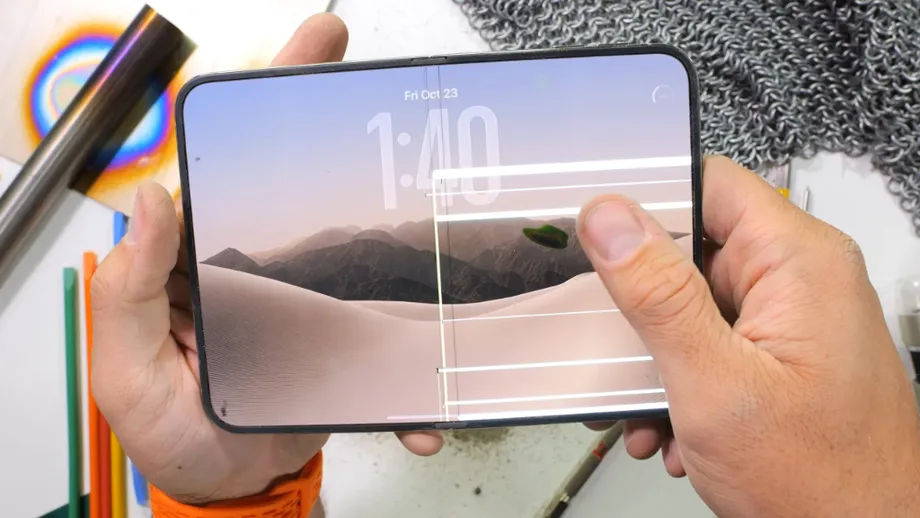
Owners in Australia, China, the United States and Canada have reported cracks or display failures near the central fold. Some photographs show a bright line extending from the fold toward the right edge, creating an L shape across the display. Other customers said problems appeared within a day or before they finished setting up the phone.
Apple replaced the Melbourne customer's device at a store. The Shanghai customer, identified as Ms. Zhang, said staff told her the handset would first need to be sent to Apple to determine whether the damage resulted from handling.
The number of affected phones, the failure rate and the cause remain unknown. Apple had not publicly addressed the specific display complaints as of October 23. For buyers, the immediate questions are whether their phone can withstand ordinary opening and closing, and how quickly a damaged device will be assessed or replaced.
What happened to the Melbourne phone?
The Australian owner, posting under the username Midnight_Slump, said much of the first six hours had been spent restoring an iCloud backup. When opening the phone to show a friend, the owner felt something beneath the display near the hinge, then heard a crack as the screen broke along the fold.
The owner reported no visible marks suggesting an impact or an object trapped against the screen. Community moderators later reviewed additional photographs and Apple repair paperwork and marked the account as verified; the cause remained unresolved.
Apple phone support initially offered an express replacement, according to the customer, but required an authorization hold for the handset's full price and could not promise an arrival date. An authorization hold temporarily reserves money or available credit on a payment card while the replacement process is completed.
The customer instead visited an Apple Store and received a replacement immediately. A detailed account described the replacement as arriving in a brown service box, with only one matching configuration available. The owner said a technician described the problem as a manufacturing error and said the damaged phone would go to California for testing.
Similar damage, different customer experiences
Ms. Zhang, the Shanghai buyer, said she heard a cracking sound while opening her new phone normally, followed by damage to the inner display. Her account places the failure during the same basic action described by the Melbourne customer: unfolding the device.
Photographs circulating online show several phones with damage near the hinge, including what appear to be demonstration units in China. The circumstances behind many of those images are unclear. White pixel lines, cracks and loss of touch response can also leave customers with different levels of usable screen space.
Commenters have suggested that the display might be pinched near the hinge, that a component could be faulty, or that small differences in assembly could put pressure on the panel. Another suggestion concerns springs that hold the phone at different angles. These remain proposed explanations; a technical diagnosis from Apple's examination would give owners a firmer answer.
What Apple says about the folding design
Apple's iPhone Duo product page describes a Grade 5 titanium frame and hinge cover, an inner display with more than 10 ultrathin layers, and a coating intended to resist scratches. The company says the hinge opens and closes with smooth, balanced resistance for lasting reliability.
Apple also describes transparent adhesives that allow the display layers to glide as the phone folds. A flexible screen contains several layers that must move together as it bends. Allowing some movement between them helps reduce stress and the visible crease.
Apple's technical specifications list a 7.6 inch folding OLED inner display and a 5.4 inch outer display. OLED screens produce light through individual pixels. The inner panel has a matte finish, described as nano texture, intended to reduce glare.
The specifications identify Ceramic Shield 2 on the front, Ceramic Shield on the back and a titanium hinge cover made through 3D printing. The materials protecting the exterior and the flexible surface inside have different jobs: the inner screen must repeatedly bend while continuing to display images and respond to touch.
Scratch, dust and bending tests find weaknesses
Durability tester Zack Nelson, known for JerryRigEverything, subjected an iPhone Duo to scratches, dust and forceful bending. The outer display reportedly resisted scratches until around level 7 on the Mohs hardness scale, while the inner surface showed scratches at level 2 and could be marked by a fingernail.
The Mohs scale compares resistance to scratching. A surface that scratches at a lower number is softer. Flexible inner screens across the foldable category commonly have a more vulnerable surface than the rigid glass covering conventional phone displays.
Dust and debris reportedly entered the hinge during Nelson's test and interfered with the phone closing fully. Forceful bending then produced a permanent green line across the inner screen; a second bend left it unresponsive. The frame and hinge stayed together, and the bending required substantial force.
Apple lists IP68 water and dust resistance under IEC standard 60529, including water testing at a maximum depth of six meters for up to 30 minutes. The rating describes protection under controlled test conditions. Concentrated debris and forceful bending present different stresses from routine opening and closing.
The dust test and the customer complaints leave engineers with separate problems to investigate: how debris moves through the hinge, how the display behaves under extreme force, and why particular owners experienced cracks during ordinary use.
A review unit survived more than 32,000 folds
Technology reviewer Joanna Stern used a custom machine to fold her review phone more than 32,000 times over four nights. A calibrated gauge measuring pushing and pulling force found that its hinge was stiffer afterward, although she reported little noticeable change in daily handling.
Stern described how the phone felt after the test:
But in everyday use, I really couldn't feel a difference. So, after 32,000 folds, it felt pretty much the same as day one, which is pretty darn impressive.
The test used a case, opened the phone flat and stopped short of closing it completely on each cycle. Stern did not report whether the crease became more visible. Those details matter when comparing the machine's repeated motion with the varied pressures and movements of daily use.
Reviewer Britta O'Boyle also reported no screen damage after using the Duo as her main phone for a week. She described a sturdy titanium frame and a hinge that held the device at different angles. The crease was mainly visible when it caught the light or could be felt by touch.
Samsung Display said the screen used in the Galaxy Z Fold7 passed a test of 500,000 folds in 2025. At 100 folds a day, that equals about 13.7 years, compared with roughly 320 days for 32,000 folds at the same rate. Apple has not published an equivalent lifetime fold figure, and the two tests used different procedures.
Repair bills make the diagnosis expensive
The Shanghai complaint included an estimated charge of 7,998 yuan for an inner screen repair outside warranty coverage, compared with a 628 yuan service fee with AppleCare+. The first amount is about 44% of Ms. Zhang's reported 17,999 yuan purchase price and roughly 12.7 times the stated service fee.
In the United States, published figures put an inner display repair at $999 without AppleCare+ and $99 with coverage. A separate cover layer replacement was listed at $49 without coverage and $19 with it. The $999 screen charge is almost half the phone's $1,999 starting price.
Those amounts were reported rather than confirmed through an official repair quotation linked to the complaints. Broader published estimates placed repairs and replacements between $49 and $1,499, depending on the work required.
AppleCare+ was reported to cost $19.99 monthly, $199.99 annually or $399 upfront. Customers comparing repair costs also need to account for the price and terms of that coverage. In the Melbourne case, the owner said the replacement was handled as a defect without an additional charge.
The central issue for an affected owner is how Apple classifies the damage. The Shanghai customer's account describes an inspection to decide whether handling caused the break, while the Melbourne customer received an immediate replacement. Warranty treatment, inspection requirements and local consumer protections can shape the route to a remedy.
Replacement speed matters alongside durability
Some Duo orders reportedly have estimated delivery dates extending to January 2027 after initial stock sold out shortly following preorders. Demand and reported production difficulties have made availability uneven, with some customers finding units in stores while others face months of waiting.
The Melbourne experience shows how much the replacement route can matter. Phone support offered a shipment without a delivery estimate and with a full price card hold; a nearby store had a matching service unit available immediately. Customers without access to a stocked store may face a different timetable.
The Duo's durability concerns also arrive alongside the uneven app experience at launch. Some applications already use the larger screen for multiple columns or activities, while others retain layouts designed for conventional phones. Buyers are weighing both the reliability of the folding hardware and the usefulness of the space it creates.
How the first complaints unfolded
The first days brought customer accounts, replacement paperwork and tests that examined different aspects of durability. The key dates and milestones are:
- 2025: Samsung Display said the Galaxy Z Fold7 display passed a test of 500,000 folds.
- Before the Duo's retail launch: Review testing included Stern's machine completing more than 32,000 folds over four nights and O'Boyle's week of daily use without reported screen damage.
- October 23, 2026: The iPhone Duo reached customers, and accounts of cracks near the hinge appeared, including the Melbourne owner's failure after about six hours.
- October 23: The Melbourne owner reported receiving a replacement at an Apple Store. Apple had not publicly addressed the specific display complaints.
- October 24: Further discussion circulated of Nelson's scratch, dust and destructive bending tests.
- January 2027: Some customers' reported delivery estimates extended into this month.
Apple also reportedly published self service repair instructions covering the battery, screen and hinge on launch day. For owners already facing a damaged display, the immediate practical steps are assessment, a decision on coverage and a clear replacement or repair timetable.
Key Points
- Early owners in several countries reported inner screen cracks or display failures near the iPhone Duo's central fold.
- A Melbourne owner said the screen cracked after six hours and fewer than 20 openings; an Apple Store replaced the phone.
- Apple describes a titanium hinge structure, a layered flexible display and IP68 water and dust resistance.
- Destructive testing damaged one device, while another review unit completed more than 32,000 machine folds.
- Reported repair costs are substantial, including $999 for an inner display without AppleCare+ in the United States.
- The cause, affected unit count and failure rate remain unknown. Apple had not publicly addressed the specific complaints as of October 23.