Third Yaogan-50 satellite reaches orbit from Taiyuan
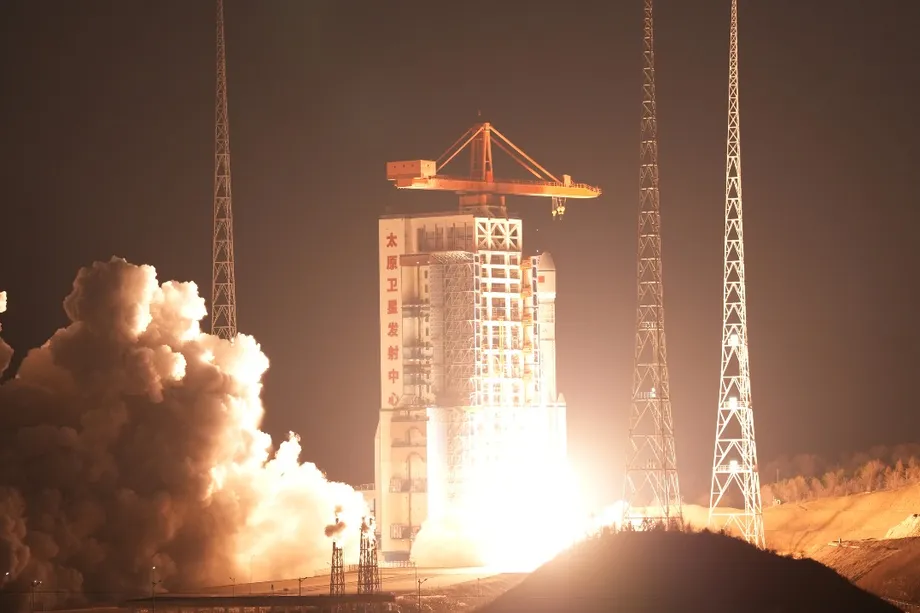
China launched the Yaogan-50 03 remote sensing satellite at 6:15 p.m. Beijing time on October 23, 2026, adding a third spacecraft to a series intended to survey land and natural resources, estimate crop yields and support disaster prevention and relief. The launch was the 672nd flight mission of the Long March rocket family.
Contents
- Third Yaogan-50 satellite reaches orbit from Taiyuan
- What the satellite will observe
- Why repeated passes matter
- Three launches across 2026
- What a retrograde orbit means
- The rocket behind the mission
- A launcher built for different satellite arrangements
- Where the flight fits in China's launch activity
- What the new capacity means on the ground
- Key Points
A Long March 6A rocket lifted off from Launch Complex 9A at the Taiyuan Satellite Launch Center in northern China's Shanxi Province. China Aerospace Science and Technology Corp., the state owned space company, said the satellite reached its planned orbit and the mission was successful.
The spacecraft, also identified as Yaogan 50C, was built by the Shanghai Academy of Spaceflight Technology. It entered a retrograde low Earth orbit, meaning it travels around Earth in the opposite direction to the planet's rotation.
Friday's mission follows the launches of Yaogan 50A in January and Yaogan 50B in March. Together, the three satellites are intended to revisit observation areas frequently, with coverage extending across China and to regions as far north as the United Kingdom and as far south as South Africa.
What the satellite will observe
Yaogan-50 03 has three stated main uses: land and natural-resource surveys, crop yield estimation, and disaster prevention and mitigation. Remote sensing means gathering information about a place from a distance. Satellites do this by recording light or other signals from Earth's surface, allowing large areas to be examined without sending survey teams to every location.
Land surveys can help agencies track how an area is being used. Crop yield estimation uses observations of farmland to help assess how much food a harvest may produce. Disaster monitoring can give responders a wider view of affected territory when damage stretches beyond what teams on the ground can quickly inspect.
The wider Yaogan family carries different instruments, including optical sensors and radar. Optical instruments collect light to form images, while radar sends out signals and measures their reflections. The particular sensor carried by Yaogan-50 03, its image resolution and its exact orbital altitude were not disclosed in the launch information.
Why repeated passes matter
The three Yaogan-50 satellites are described as capable of imaging selected locations several times a day, including at night. For an observation system, the time between visits matters because conditions on the ground can change between one image and the next.
A flood can spread, farmland can become waterlogged, and access routes can be affected while emergency teams are still assessing the first damage. More frequent observations give agencies more opportunities to update their picture of an affected area. For agriculture, repeated images can help track changes in crops through the growing season.
Adding a third satellite gives the series another spacecraft that can pass over observation areas. The actual interval between useful images depends on the satellites' paths, where their instruments point and the locations being watched.
The coverage described for the series reaches well beyond China. References to the United Kingdom and South Africa indicate its geographic reach; the mission's stated applications remain land and natural-resource surveys, agricultural estimates and disaster work.
Three launches across 2026
Yaogan-50 03 completes a sequence of three launches spread across roughly nine months. The Shanghai Academy of Spaceflight Technology built the first and third spacecraft, while the China Academy of Space Technology produced the second.
- January 2026: Yaogan 50A, the first satellite in the series, was launched.
- March 2026: Yaogan 50B, the second satellite, followed.
- Early September 2026: The second satellite experienced an event that created debris and was reported to remain operational.
- October 23, 2026: Yaogan-50 03 launched from Taiyuan at 6:15 p.m. Beijing time, equivalent to 10:15 a.m. UTC.
The September event is relevant to the condition of the developing observation network. The second satellite's continued operation means it was still described as contributing to the series when the third spacecraft launched.
Friday's announcement confirmed successful delivery to orbit. The next operational step for a newly launched observation satellite normally involves checking its systems and instruments before routine use.
What a retrograde orbit means
Yaogan-50 03 follows the same broad orbital direction as its two predecessors. A retrograde orbit runs against Earth's rotation. Low Earth orbit places a spacecraft relatively close to the planet compared with satellites operating much farther away.
For readers imagining a satellite moving along a fixed line on a map, Earth is also turning underneath it. Each pass can therefore bring a different strip of the surface into view. The angle of the orbit helps determine how far north and south the spacecraft can travel.
The Yaogan-50 series uses these orbital paths to provide repeated observation opportunities across a broad geographic area. Its stated ability to collect imagery during both daylight and nighttime is especially relevant when an event continues after sunset.
Other observation missions use sun synchronous orbits, which pass locations at approximately the same local solar time. That provides similar lighting conditions for comparisons between images. Different orbital designs serve different observation schedules, and revisit frequency also depends on the number of satellites and the reach of their instruments.
The rocket behind the mission
The Long March 6A, called the modified Long March-6 in the Chinese launch announcement, combines a core powered by liquid propellant with four boosters powered by solid propellant. It has a liftoff mass of about 530 metric tons.
The core booster is described as 50 meters long. Its main stages burn rocket grade kerosene and liquid oxygen, while the four attached boosters provide extra thrust during the early part of the ascent. Thrust is the force that pushes the rocket upward.
The rocket is rated to carry 8,000 kilograms to low Earth orbit or at least 4,500 kilograms to a sun synchronous orbit at an altitude of 700 kilometers. Those figures describe different destinations: a rocket's carrying capacity changes with the energy needed to reach the intended orbit.
The 4,500 kilogram rating is equivalent to 4.5 metric tons. For this mission, the rocket carried a single satellite. Its published capacity describes what the launcher can transport under specified conditions, while the actual spacecraft mass determines how much of that capacity a particular flight uses.
A launcher built for different satellite arrangements
China Aerospace Science and Technology Commercial Launch Vehicle Group, the company responsible for the Long March 6A launch service, described the rocket's ability to accommodate different payload arrangements in its statement after the flight.
It can meet a diverse range of high-density launch requirements, including the deployment of single satellites or multiple satellites arranged in various configurations, such as tandem, parallel, stacked, side-mounted, or rideshare setups.
In practical terms, a launcher can carry one large spacecraft or several satellites secured in arrangements suited to their sizes and release requirements. A rideshare flight allows multiple payloads to travel on the same rocket.
That flexibility matters as China adds groups of observation satellites as well as individual spacecraft. Each mission requires a suitable balance between the satellites' mass, their dimensions and the orbit they need to reach.
The Shanghai Academy of Spaceflight Technology developed the Long March 6A. The academy also manufactured Yaogan-50 03, giving it a role in both the launch vehicle's development and the spacecraft delivered on Friday.
Where the flight fits in China's launch activity
Friday's launch was the 28th mission of the Long March 6A and China's 74th launch of 2026. It was also the 280th Long March vehicle from the Shanghai Academy of Spaceflight Technology.
The different totals count different things. The figure of 672 covers the entire Long March rocket family. The figure of 28 covers the Long March 6A alone, while the national total includes China's launches across rocket types.
China has also recently expanded other parts of its remote sensing fleet. September missions deployed the Yaogan-53-01, 02 and 03 group, the Yaogan-56-01, 02 and 03 group, and Yaogan-40 Group-04.
The broader Yaogan series is described as China's largest family of Earth observation satellites. Its images and data serve government agencies, public services and businesses. Yaogan-50 03 adds another observation platform to that network, with its own stated focus on land, natural resources, farming and disaster monitoring.
What the new capacity means on the ground
Government agencies and other users need both a wide view and timely updates. A satellite image can show conditions across a large area, while repeated passes can help users identify what has changed since the previous observation.
For crop estimates, useful information comes from observations collected over time rather than a single picture. For disaster response, the value can lie in obtaining a newer view of an area where conditions are changing quickly. Land surveys similarly benefit from being able to compare observations taken on different dates.
Yaogan-50 03 adds capacity to collect those observations. Turning them into practical decisions also requires processing the data and combining it with information about conditions on the ground.
The immediate milestone is successful arrival in orbit. The larger development is a three satellite Yaogan-50 series designed to give users more frequent views of China and a substantial area beyond it.
Key Points
- Yaogan-50 03 launched from Taiyuan on October 23, 2026, at 6:15 p.m. Beijing time.
- China Aerospace Science and Technology Corp. said the satellite reached its planned orbit.
- The spacecraft's stated uses are land and natural-resource surveys, crop yield estimation, and disaster prevention and mitigation.
- It joins Yaogan 50A and 50B, launched in January and March, in a series designed for frequent observations.
- The Long March 6A flight was the 672nd mission of the wider Long March rocket family.