110 Robots, One Routine and No Errors
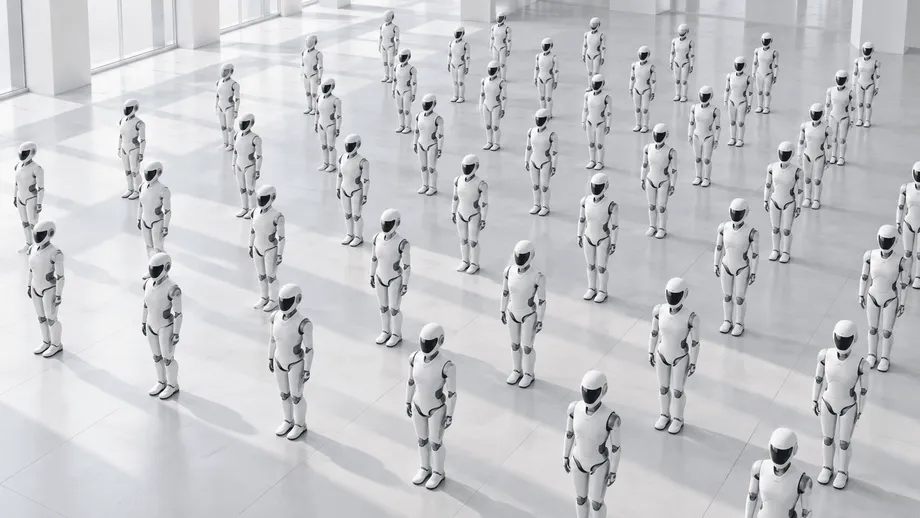
For 5 minutes and 43 seconds on October 24, 110 full size humanoid robots danced together at the Yellow River International Convention and Exhibition Center in Jinan, China. The Expedition A3 machines, made by AgiBot, completed synchronized movements and changing formations to set a Guinness World Record for the most humanoid robots dancing simultaneously.
Contents
- 110 Robots, One Routine and No Errors
- What the Robots Had to Coordinate
- Why Standard Production Machines Matter
- How LinkBots Keeps the Fleet Together
- Finding Position Amid Sunlight and Crowds
- From Shipping Cases to Starting Positions
- Where AgiBot Wants the Robots to Work
- The Company's Test Is Repeated Operation
- Key Points
A Guinness adjudicator attended the event, confirmed the count of 110 and presented a certificate. The challenge required more than an impressive routine: the fleet had to complete the performance without a single error. All 110 robots finished, moving through coordinated steps, wave patterns and formations shaped like countdown numerals.
AgiBot says every robot was a standard production unit, rather than a machine specially adjusted for the demonstration. That makes the performance a test of manufacturing consistency as well as choreography. Each robot needed to respond predictably while sharing space with 109 others.
The company also presented the event as a demonstration of how large groups of robots could be deployed for work. Its LinkBots scheduling system coordinated the machines, while positioning technology tracked their locations to an accuracy of less than 10 centimeters, according to AgiBot.
The immediate applications are close to the performance itself: tourism shows, outdoor parades and exhibition spaces. AgiBot also says its robots are undergoing trials at Jinan subway stations, where their tasks include giving directions and helping guide passenger movement. The link between those jobs and the dance is the ability to move reliably around other machines and people.
What the Robots Had to Coordinate
The Expedition A3 fleet performed walking movements, jumps, flips and formation changes during the routine. Some sequences required the robots to move together; others required different groups to carry out separate instructions while remaining part of the same performance.
A wave pattern, for example, depends on machines moving in a controlled sequence rather than all at once. A countdown numeral requires robots to reach the right places so that the group forms a recognizable shape. Both place demands on timing and position, even when the individual movement is relatively simple.
Wang Chuang, an AgiBot partner and senior vice president, said coordinating a fleet of this size requires a complete scheduling system covering live position sensing, distributed decision making and dynamic obstacle avoidance. In plain terms, the system needs to know where the robots are, organize their next moves and keep their routes from conflicting.
Why Standard Production Machines Matter
AgiBot's claim that all 110 machines came from normal production puts attention on the factory. A routine can be designed once, but each machine must reproduce it consistently for a large group to stay coordinated.
Wang attributed that consistency to common settings established on the production line. Introducing the fleet at the event, he said, in translation:
Every robot's joint zero positions, torque and motion libraries are standardized at the production line level; this consistency allows a hundred robots on the same stage to act as one.
A joint's zero position is its reference point for measuring movement. Torque is the turning force applied at a joint, while a motion library contains movements the robot can perform. Matching those settings helps the same instruction produce similar behavior across many machines.
For a customer receiving a fleet, that consistency matters before any performance begins. Robots that respond similarly can be organized around a shared routine, with less individual adjustment needed to make the group work together.
How LinkBots Keeps the Fleet Together
LinkBots, AgiBot's internally developed platform for coordinating multiple robots, handles formation planning, autonomous navigation and separate instructions for different groups. The company says formation changes are calculated using each robot's current state, rather than simply replaying a fixed sequence of stored movements.
A stored movement can tell a robot how to raise an arm or take a step. Fleet scheduling addresses a different problem: where that robot should go next, when it should move and how its route fits around the other machines. The Jinan routine combined those individual actions with shared movement across the venue.
The platform uses a common time reference and coordinated route planning. AgiBot describes its synchronization as operating at the level of milliseconds, or thousandths of a second. A common clock helps instructions reach their intended moment across the fleet, including when groups perform different parts of a sequence.
Communications combine 5G and Wi-Fi. AgiBot says this arrangement supports stable connections at the scale of 100 robots, while an automatic fault response can adjust a nearby formation if one robot loses its connection. That recovery capability is part of the platform's design; the record routine itself was completed without errors.
Finding Position Amid Sunlight and Crowds
Each Expedition A3 comes with ultra-wideband positioning, known as UWB. This radio technology helps determine location, allowing the scheduling system to track the robots' positions relative to one another. AgiBot gives the positioning accuracy as less than 10 centimeters.
The challenge also tested operation in open spaces, with sunlight, robots blocking one another and people obstructing positioning signals. Such conditions matter to the company's proposed uses, including theme park parades and performances in public squares, where the surroundings are less controlled than a simple indoor demonstration area.
AgiBot says the combined positioning and scheduling system allowed the robots to maintain their locations and avoid interfering with one another. For a moving fleet, the practical task is continuous: as a robot changes position, the system must keep track of the space available for its next movement.
From Shipping Cases to Starting Positions
The A3 robots can fold for transport in shipping cases. At the venue, they autonomously exited their cases, located themselves and moved into preset positions, according to AgiBot. Engineers did not steer each robot individually by remote control through the routine.
That setup process addresses a practical problem for large deployments. A fleet of 110 machines must be transported, unpacked and arranged before it can perform. If each one requires a worker to guide it into position and adjust it separately, preparation becomes a substantial part of the job.
AgiBot says autonomous setup can reduce logistics, staffing and adjustment costs at the venue. The company has not given a deployment timetable for the robots used in the record attempt, or figures for the time and money saved by their setup process.
The demonstration brought several stages together: arrival, positioning and coordinated operation. For an operator organizing repeated performances, the ability to prepare a fleet is part of the service, alongside what the machines do once the audience arrives.
Where AgiBot Wants the Robots to Work
Jinan's Olympic Sports Center and Zhuanshan West Road subway stations are among the locations where AgiBot says its robots are being trialed. Their tasks include answering inquiries, providing directions, assisting passenger flow, carrying out safety patrols and explaining local culture.
A station presents a different movement problem from a dance formation. Passengers choose their own routes, stop unexpectedly and gather in changing groups. The positioning, navigation and obstacle avoidance functions described at the record attempt are relevant to those tasks, while the station trials place them in an operating public service setting.
AgiBot says the robots from the record attempt will be assigned to public services, cultural and tourism performances, park exhibition halls, research and education. Its proposed entertainment uses include outdoor theme park parades, commercial performances in plazas and shows at fixed locations in scenic areas.
Those plans connect most directly to the demonstrated ability to manage formations and give different groups separate instructions. An operator could use those functions to organize a procession, change a moving display or coordinate several parts of a show through one scheduling platform.
The Company's Test Is Repeated Operation
Wang described dependable deployment, rather than spectacular movements alone, as the company's goal. Explaining what he meant by robots being ready for deployment, the AgiBot partner and senior vice president said, in translation:
The core of deployment is not dazzling stunts, but making robots work like mature production equipment and service terminals, with plug-and-play operation, sustained stable running, and the ability to replicate and scale quickly.
The Jinan event brought three parts of that ambition into a single performance: consistent production machines, shared scheduling and precise positioning. Manufacturing made the robots behave similarly; communications and timing organized their actions; location tracking helped them share the space.
For tourism venues, exhibition operators and public service organizations, the promised benefit is a fleet that can be prepared and managed as a group. AgiBot's next step is to put the machines into the uses it has announced, where setup, movement and continued operation become recurring tasks rather than a single record attempt.
Key Points
- AgiBot set a Guinness World Record with 110 Expedition A3 humanoid robots dancing simultaneously in Jinan on October 24.
- The routine lasted 5 minutes and 43 seconds and included synchronized movements, wave patterns, countdown numerals and formation changes.
- AgiBot says all 110 robots were standard production units and completed the challenge without errors.
- The LinkBots platform combined fleet scheduling, 5G and Wi-Fi communications, and UWB positioning accurate to less than 10 centimeters.
- The robots autonomously exited transport cases and moved into their starting positions, according to the company.
- AgiBot reports subway station trials in Jinan and plans to deploy the record fleet in public services, tourism, exhibitions, research and education.