From 700 Fans to a Tokyo Institution
Comiket is marking its 50th anniversary in December 2025, bringing hundreds of thousands of manga and anime enthusiasts to Tokyo's Koto Ward for a winter gathering built around independent creation. At Tokyo Big Sight, visitors queued well before the 10:30 a.m. opening to explore more than 12,000 circles displaying and selling their work.
Contents
- From 700 Fans to a Tokyo Institution
- Why the First Comic Market Was Created
- What Circles Make and Why They Return
- The People Behind the Tables
- Cosplay Has Its Own Spaces and Rules
- Managing the Crowds and Finding the Right Table
- How Admission Has Changed
- Five Decades of Disruption and Recovery
- Paper, Forests and Blood Donations
- Anniversary Displays and Special Collaborations
- International Visitors Join a Japanese Tradition
- Where Commercial Companies Fit
- Preserving the Gathering as It Changes
- The Bottom Line
The Comic Market, usually called Comiket, began in Tokyo's Toranomon district in 1975 with roughly 700 people. Guinness World Records recognizes it as the world's largest fan convention. Its summer event in 2019 drew approximately 750,000 attendees across what the anniversary account describes as three days.
Comiket's central attraction remains doujinshi, meaning comics, novels and magazines published by their creators rather than through conventional publishing companies. Tables carry both original creations and works based on familiar anime characters. Games, music, clothing and other goods have widened the range without replacing those publications at the event's heart.
Visitors can leave anniversary messages in a special commemorative section. Many have written wishes for Comiket to continue for years, expressing an attachment to a gathering held twice a year that has become part of their lives.
The anniversary also brings historical displays, commercial collaborations and reflections on family connections. One visitor in his 20s said his father had taken part in cosplay more than 20 years earlier. Joining the 50th anniversary made him feel that he was continuing a family tradition.
Behind the celebrations sits a practical question familiar to organizers throughout those five decades: how to preserve space for individual expression while managing an event whose crowds, costs and venue needs have grown enormously.
Why the First Comic Market Was Created
Yoshihiro Yonezawa, Teruo Harada and Jun Aniwa founded the doujin circle Meikyu, or Labyrinth, in December 1975. The group of university students organized the first Comic Market during a period of upheaval in manga, seeking a gathering devoted to works published by their creators.
A dispute that year helped shape their purpose. A doujin creator was refused admission to the Nihon Manga Taikai after criticizing its focus on professional guests instead of doujin creators. Comiket offered an alternative: an event run by fans that put amateur creativity and freedom of expression ahead of commercial interests.
The historical figures given for its beginnings vary. The founding account lists approximately 32 circles and 700 attendees; committee co-head Ichikawa Koichi has described its growth from 40 circles and 700 attendees to 23,000 circles and more than 200,000 visitors. Both descriptions place a small gathering at the start of a much larger institution.
Comiket remains a not-for-profit fan convention administered entirely by the volunteer-run Comic Market Preparatory Committee. Approximately 3,380 volunteers handle tasks including crowd control and booth assignments, maintaining an organizational connection to its beginnings.
Ichikawa Koichi, co-head of the Comic Market Preparatory Committee, said the event keeps generating new trends, new comics and new encounters. Reflecting on the anniversary, he described the organizers' feelings and preparations:
"We are very touched that this has continued for 50 years. We are thinking of various projects and merchandise," Ichikawa said.
He hopes Comiket will continue beyond its 100th anniversary. His explanation of its continuity rests on a principle he says has never changed: freedom of expression, supported by participants' respect for that freedom.
What Circles Make and Why They Return
Approximately 35,000 circles participate in an edition of Comiket in the broader description of its operations, with different groups exhibiting on different days. That figure sits alongside the anniversary descriptions of more than 12,000 circles showcasing work and Ichikawa's reference to 23,000 circles. The figures are presented for different descriptions of the event, without a single common counting basis.
Organizers place circles working on related subjects, such as a particular franchise or manga genre, together on the same day. Visitors seeking a favorite series can concentrate their search, while creators meet people already interested in their subject.
Doujin is described as noncommercial, self-published work, although participants sell their creations at the event. Comics, novels and magazines dominate. Smaller numbers of circles produce doujin soft, meaning independent video games, as well as board games, card games, music, clothing and other goods.
Many creations borrow characters or settings from existing anime, video games and other media. The account connects the legal treatment of this derivative fan work in Japan to shinkokuzai. Original work also has a substantial place, with publications ranging from polished productions comparable to professional work to experiments in artistic form.
Comiket's surveys show how little money most participants make. Approximately 70% of circles lose money through their involvement, while only 15% turn a profit. The share losing money is more than four times the share making a profit, using those survey figures.
A 2011 poll helps explain why creators keep returning. Nearly half participated simply because they enjoyed attending and showing their work. A significant percentage wanted to bring their creations to the public. For these participants, the chance to make something and share it carries value beyond sales.
The People Behind the Tables
Most circles are very small. In 2010, 59% consisted of one person, 20% had two people and 8% had three. Together, those categories accounted for 87% of participating circles, showing how much of Comiket's activity depended on individuals and small teams.
Women formed a majority of circle participants in the figures given for Comiket 84, accounting for 57%. General attendance showed a different balance at Comiket 78, where men accounted for 64% of attendees.
Those figures describe different editions and different forms of participation. They illustrate the event's combination of women taking a prominent role as creators and men forming a larger share of the audience in the cited attendance survey.
The anniversary messages and the visitor following his father's cosplay tradition add another dimension to those numbers. Comiket connects people across generations as well as across creative roles, with participants returning as makers, readers, performers and volunteers.
Cosplay Has Its Own Spaces and Rules
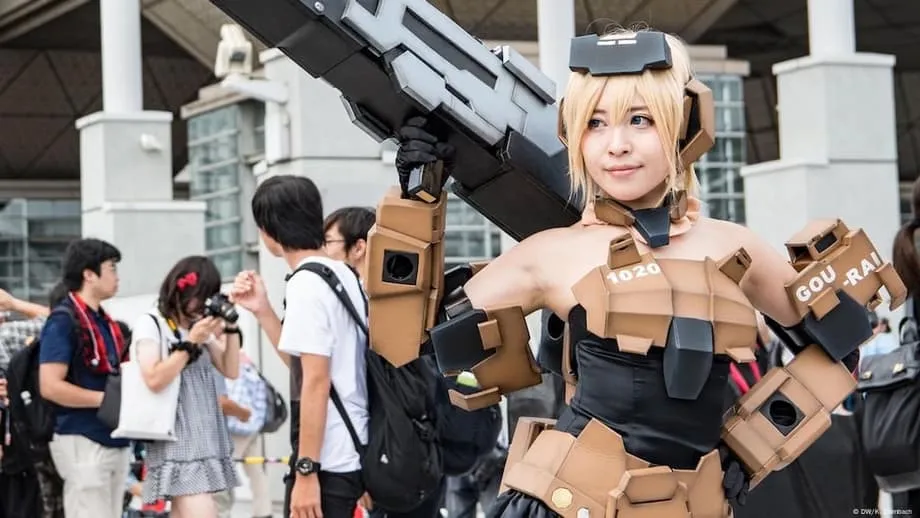
Tokyo Big Sight's East, West and South Halls have designated cosplay areas where participants pose for photographs and meet fans. Costumes recreate characters from established series such as Sailor Moon and Fullmetal Alchemist alongside newer favorites including Demon Slayer and Chainsaw Man.
Cosplayers devote time to makeup, props and clothing, as well as the posture and gestures associated with their characters. The performance involves both making a costume and learning how to inhabit it.
Since Comiket 80 in 2011, restrictions have gradually shifted from rules about particular objects toward rules about behavior. Current guidance prohibits excessively revealing clothes and imitation of uniformed officers. Participants must arrive at and leave the venue out of costume.
Photography also follows an etiquette intended to protect respectful interaction. People seeking individual photographs of popular cosplayers typically form organized queues. Permission to take a photograph and permission to publish it are separate matters, so photographers are encouraged to ask before uploading images to social media.
The Early Changing-Room Ticket costs 3,000 yen plus a 330 yen system fee. It includes the 500 yen cosplay registration fee and lets participants change before the event opens, using facilities in the TFT building before moving to the outdoor Garden Cosplay Area.
Managing the Crowds and Finding the Right Table
Mobile phone companies install temporary antennas to handle the concentrated demand at Comiket, while Tokyo Metro makes special arrangements for the passenger surge. Entry queues can last an hour at peak times, and some visitors arrive as much as five hours before opening.
Popular circles are often placed near loading docks so their queues can extend outside instead of blocking indoor walkways. Organizers recommend that newcomers consider an afternoon arrival to avoid the longest morning waits while retaining time to explore.
Comiket's catalog is a major planning tool. It lists participating circles, venue maps, travel directions, rules, participant survey results and articles relevant to doujinshi creators. Each circle receives one or two small preview images, known as circle cuts, giving visitors a visual clue to its work.
The catalog is available in print and DVD-ROM formats. The printed edition is roughly the size of a telephone directory; the DVD-ROM adds advanced searches and a clickable map. Since Comiket 83, an online version has been available with some content behind a paywall.
No complete English edition is available, but the catalog contains a basic guide spanning four pages in English, Chinese and Korean. Checking a circle's exhibition day matters because many groups take part on only one day of the event.
How Admission Has Changed
Comiket began requiring a purchased admission wristband at Comiket 96, ending its history of free entry. The change helped cover the cost of operating across four days and manage attendance while construction reduced the available venue space.
For Comiket 107, the winter anniversary edition, the ticket information describes options allocated through a lottery. General admission prices range from 440 yen to 5,000 yen. Early Entry Tickets cost 5,000 yen plus fees and admit holders before the general crowd.
Each day requires a separate ticket. The stated conditions make tickets lottery-only and prohibit cancellations, refunds and replacement of tickets that are lost or damaged. Names printed on tickets are intended to prevent unauthorized resale.
Visitors are also advised to buy tickets in advance through designated anime shops because tickets are not sold at the venue. The anniversary account presents both that purchasing advice and the lottery requirements; visitors need to check the official instructions for their particular admission category.
Organizers have discussed a possible return to four days, as used before the pandemic. Renovations at Tokyo Big Sight remain a constraint on planning, and no date is given for such a return. Space, crowd management and access remain linked decisions.
Five Decades of Disruption and Recovery
Venue changes repeatedly tested Comiket in the late 1980s and 1990s. Japan's bubble economy brought more trade shows competing for space. The murders committed by Tsutomu Miyazaki and the ensuing moral panic directed at otaku culture, the communities associated with intense manga and anime interests, also complicated efforts to secure locations.
Security threats created other crises. Before Comiket 54 in 1998, an arsonist placed incendiary devices in the venue. They were discovered and neutralized without major damage, allowing the event to proceed with tighter security. The arsonist was apprehended at the next event.
Anonymous threats in 2012 targeted circles making works related to Kuroko's Basketball. The anniversary account connects those threats to a prohibition on related sales at Comiket 85 and says the decision caused substantial financial losses for organizers.
The COVID-19 pandemic brought the first cancellation in Comiket's history. Comiket 98, described in the anniversary account as planned for August 2020, was canceled. Comiket 99 was postponed from December 2020 and eventually returned in December 2021 as a reduced event spanning two days, with attendance limited to 55,000 people daily.
The main stages of the event's history include:
- December 1975: Meikyu organizes the first Comic Market in Toranomon, drawing roughly 700 people.
- 1998: Incendiary devices are discovered before Comiket 54, which proceeds with increased security.
- 2011: Cosplay restrictions begin shifting toward behavior at Comiket 80.
- 2019: Summer attendance reaches approximately 750,000.
- 2020: The pandemic forces Comiket 98's cancellation and Comiket 99's postponement.
- December 2021: Comiket 99 takes place with a daily limit of 55,000 people.
- December 2025: Comiket 107 marks the event's 50th anniversary.
Pandemic disruptions led organizers to introduce health and safety procedures that have since become standard practice. Across these episodes, the event repeatedly adjusted its operation while retaining a gathering centered on independent creators.
Paper, Forests and Blood Donations
The Comic Market Preparatory Committee has donated more than 60 million yen to sustainable forest management since 1993. The initiative responds to the paper used in doujinshi production and the environmental cost of millions of printed publications.
Since 2007, Comiket has also worked with the Japanese Red Cross Society to bring bloodmobiles to its events. Donors receive posters exclusive to Comiket featuring anime and video game characters.
The program is credited with an estimated 1,500 blood donations at each Comiket. It connects enthusiasm for collectible artwork with a practical public need, giving participants another way to contribute beyond the convention floor.
Anniversary Displays and Special Collaborations
The anniversary program extends beyond the December gathering. Organizers describe a 50th Anniversary Year continuing into summer 2026, allowing participants at different editions to join the celebrations.
Displays around Tokyo Big Sight show catalog covers from all 106 previous Comikets. Newer visitors can trace the event's visual history, while returning participants can revisit editions they remember attending.
Snow Miku Sky Town, the official Hatsune Miku shop from Hokkaido, is making its first appearance with a temporary booth at Comiket 107. Its theme, CELEBRATION!, brings newly commissioned illustrations of Hatsune Miku and Snow Miku together with merchandise produced in limited editions.
The collaboration combines regional character promotion with the convention's fan culture. The illustrations come from popular artists, giving the anniversary another connection between established characters and individual creative work.
Visual Arts, the company behind visual novel brands including Key, is holding VA Winter Fes 2025 at Comiket 107. Its program includes merchandise for Summer Pockets, CLANNAD and AIR, plus stage events featuring voice actors and creators.
These projects sit alongside the handwritten messages and personal memories. The anniversary therefore reaches across commercial collaborations, historical exhibits and the experiences of participants who have kept returning over decades.
International Visitors Join a Japanese Tradition
Creators from outside Japan now participate in Comiket, and international fans travel to Tokyo specifically for the event. Organizers provide International Desks in both the East and West exhibition halls, with assistance in English, Chinese and Korean.
The desks help visitors find genres, locate booths and understand the venue, as well as answering general questions. That support is useful at an event where thousands of exhibitors and different daily schedules make advance planning valuable.
The International Otaku Expo Association, or IOEA, also maintains a presence. Its booth provides information on major anime conventions and related events across countries and regions, supporting connections among organizers.
Organizers planning anime events outside Japan can receive promotional assistance from the association. Its role connects Comiket's international visitors with a wider network of fan gatherings.
Ichikawa, also described as a co-representative of the Comic Market Committee, strongly recommends reading the official website and reviewing the catalog before attending. Identifying favorite genres and circles first can help visitors reach priority tables before popular items sell out or crowds complicate movement.
Summer visitors also need to prepare for Tokyo's heat. The practical advice includes drinking water, wearing sunscreen and bringing protection such as hats or parasols to reduce the risk of heatstroke. The winter anniversary and summer gathering have different weather demands, but both require planning around crowds and admission rules.
Where Commercial Companies Fit
Approximately 100 publishing companies and major anime and game franchises maintain corporate booths at each event. These are typically located on the fourth floor of the West and South Halls, selling official merchandise and hosting shows or smaller events.
Comiket's main purpose remains support for independent creators. Its limited corporate area places commercial participation alongside that purpose, while events such as Anime Japan concentrate specifically on major commercial anime works.
Visual Arts and Snow Miku Sky Town illustrate why companies continue to participate: Comiket brings established properties into the same setting as an extensive community of creators and fans. The event's identity still depends on preserving the space devoted to circles.
Manga creator Ken Akamatsu, known for Love Hina and Negima! Magister Negi Magi, has participated historically. After entering politics and becoming Parliamentary Vice-Minister of Education, Culture, Sports, Science and Technology in 2024, he declined to appear at Comiket because of regulations connected with his government position.
His absence shows how participation can intersect with roles beyond manga. Comiket brings amateur and professional creators into a shared setting, but their responsibilities outside the venue can affect how they take part.
Preserving the Gathering as It Changes
Comiket reaches its anniversary after economic downturns, venue changes, hostility toward fan culture, security threats and pandemic disruption. Its volunteer structure and continued focus on expression have provided continuity through those changes.
Digital distribution and emerging forms of creative work are part of the setting in which organizers must plan future events. Their stated challenge is to adapt while preserving the physical encounters that have made Comiket meaningful for five decades.
Ichikawa's hope for a 100th anniversary places that task on a long timescale. For participants leaving messages, producing small publications or following a parent's cosplay tradition, the immediate attraction remains concrete: a place to bring something they have made and meet people who care about it.
The Bottom Line
- Comiket 107 celebrates 50 years since the first gathering attracted roughly 700 people in Toranomon in 1975.
- The event reached approximately 750,000 attendees at its summer gathering in 2019 and is recognized by Guinness World Records as the world's largest fan convention.
- Independent publications remain central, alongside games, music, clothing, cosplay and corporate merchandise.
- Approximately 3,380 volunteers support the not-for-profit event; surveys say 70% of circles lose money and 15% make a profit.
- Anniversary projects include historical catalog displays, Snow Miku Sky Town's first Comiket booth and VA Winter Fes 2025.
- Admission requires advance preparation, with separate tickets for each day and specific conditions for early entry and cosplay facilities.
- Celebrations continue into summer 2026, while venue renovations affect discussion of a possible return to four days.