A familiar ghost reveals a different Hyrule
In the Forest Temple, a purple ghost approaches three torches carrying the flames of her defeated sisters and weeps before each one. The encounter follows a familiar puzzle from 1998's The Legend of Zelda: Ocarina of Time, but the animation gives an old enemy a new moment of grief. It captures Nintendo's approach to its remake: keep the adventure recognisable while changing how players move through it and feel about its characters.
Contents
- A familiar ghost reveals a different Hyrule
- What changes when Link starts moving?
- Why Nintendo removed new travel shortcuts
- The Water Temple gets relief, with a menu catch
- Familiar temples contain revised challenges
- A puppet show look gives the story new weight
- Music becomes something players can perform
- Who decided what to preserve?
- A celebrated adventure meets a tougher console market
- Key Points
Released on November 5, 2026, exclusively for Nintendo Switch 2, the remake arrives 28 years after the Nintendo 64 original. Its listed prices are £59.99 in Britain, with a digital edition costing $60 and a physical edition costing $70 in the United States. Nintendo is using one of its most celebrated adventures to attract new players and give existing fans a reason to buy its newer console.
Nintendo's official launch announcement describes completely overhauled visuals, voiced cutscenes, expanded dialogue, orchestral music and reworked camera and movement controls. It also confirms new activities, including the Hall of Fallen Foes, where players can challenge powerful enemies again.
Link's journey still follows a boy who becomes an adult while trying to save Hyrule from Ganondorf. Seven years separate the adventure's two periods. Familiar places and major puzzles remain, but individual challenges, conversations and scenes have been revised. The result is a remake built around a deliberate tension: making an older game easier to approach without removing the discoveries that made it memorable.
What changes when Link starts moving?
Link now has dedicated jump and sprint buttons. In the original, he automatically leapt across certain gaps; players could not simply make him jump whenever they wanted. The remake gives them that choice, alongside direct camera control and motion aiming for weapons such as the slingshot.
An October 14 preview described gameplay running at 60 frames per second, the number of individual images displayed each second. That presentation can make movement appear smoother. Early reviews also describe faster, more fluid combat, although switching the targeting system between enemies can still feel awkward.
The new controls have changed how some rooms teach players. In Kokiri Forest, the chest containing Link's first sword has moved from a corner of a maze to a raised platform near its centre. A rolling boulder still threatens him, but reaching the sword now requires a jump. A room once used to teach camera positioning instead introduces a new movement skill.
The remake's major milestones are:
- 1998: Ocarina of Time first appeared on Nintendo 64.
- 2011: Ocarina of Time 3D brought an earlier remake to Nintendo 3DS.
- October 14, 2026: A preview detailed revised rooms, movement and combat.
- November 4, 2026: Reviews assessed the complete Switch 2 adventure.
- November 5, 2026: The new remake launched exclusively for Switch 2.
Why Nintendo removed new travel shortcuts
Producer Eiji Aonuma initially asked the team to add warp points, allowing Link to move instantly between more locations. Testing persuaded him that the shortcuts were removing something valuable: the small discoveries players make while travelling.
Aonuma explained why he reversed his own proposal:
So even though I was the one who proposed adding warp points, they just weren't working for me in the end, so I got the team to take them all back out again.
The decision concerned newly added warp points. Nintendo kept the adventure focused on travelling through its existing world, with sprinting offering a quicker way across the ground and Epona providing another way to get around.
The sword room and the abandoned shortcuts show two sides of the same design process. Nintendo replaced an old lesson when the controls changed, but retained journeys that encouraged players to notice places along the way. Convenience was judged according to what each change did to the adventure.
The Water Temple gets relief, with a menu catch
The Water Temple benefits from easier equipment changes. Link's Iron Boots weigh him down so he can walk underwater, and the dungeon repeatedly requires players to put them on and take them off. Quicker access reduces the interruptions that made the original temple frustrating for many players.
The remake assigns equipment including boots, masks and the ocarina to directional controls. Other items share a horizontal selection menu, allowing players to change tools without repeatedly opening the full equipment screen. A new quest log, Threads of Time, also helps players work out where to go next.
Early assessments disagree about how well the item menu works. Some describe it as a welcome improvement that encourages switching between weapons and magic during combat. Others find the scrolling cumbersome, particularly when several bottles occupy individual spaces between the player and a needed tool such as the Megaton Hammer.
A circular menu, with items arranged around a wheel, has been suggested as a more convenient alternative. The practical issue is simple: a shortcut saves less time when players must scroll through objects they do not need. The remake reduces some menu work while leaving room for irritation.
Money also matters more. Great Fairy upgrades, previously free, can cost as much as 500 rupees, Hyrule's currency. Wallets can hold twice as much as before, giving players greater spending capacity while introducing new demands on their savings.
Familiar temples contain revised challenges
The Forest Temple retains its twisted corridors, movable blocks, small keys and ghost hunt. Its broad layout remains familiar, but a battle against Stalfos, animated skeleton warriors, shows how individual encounters have changed.
The original arena had a large hole in the floor. Link risked falling through it, while the skeleton enemy could move above the gap. The remake replaces that hole with a shallow pool of acid. Link takes damage if he enters, while the skeleton can cross it, preserving the unequal space available to each fighter.
The reinforcements change the battle further. Two arriving Stalfos previously brought a platform that filled the room. They now emerge from the acid, leaving Link constrained to the safer edges throughout the fight. The revised setting explains the hazard more directly and keeps it active for longer.
Inside the Great Deku Tree, a platform that once floated has become a crumbling bridge attached to the surroundings. Changes like these give familiar puzzle spaces a stronger physical logic while preserving the adventure's sequence of dungeons and discoveries.
For players arriving from Breath of the Wild or Tears of the Kingdom, the structure is more directed. Progress depends on exploring particular rooms, finding equipment and working out designed solutions. The remake brings newer controls to that older style rather than expanding Hyrule into another vast open world.
A puppet show look gives the story new weight
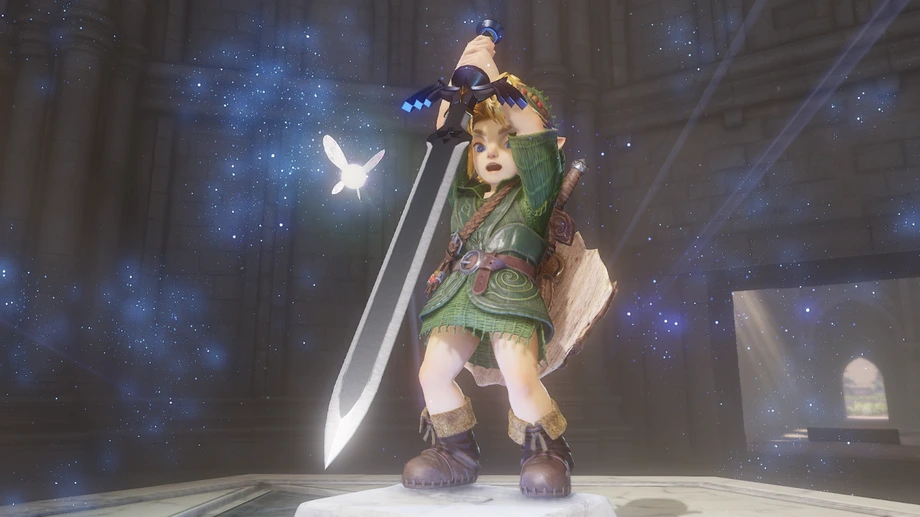
Nintendo has chosen a theatrical appearance rather than straightforward realism. Link has a dolllike face, richly stitched clothing and exaggerated tools. Fog, lighting and elaborate scenery help familiar locations resemble a staged retelling of an old legend.
Aonuma has described the intended feeling as a "puppet show" that evokes nostalgia. He said finding an appropriate art style can involve surprise even within the development team, comparing that adjustment with the early response to The Wind Waker's cartoon appearance.
The Zelda producer explained the purpose behind changing visual styles:
It's not just change for change's sake, of course.
Small details support that approach. The Goron and Zora tunics have distinct textures rather than appearing to be simple colour changes of Link's usual clothing. Ganondorf's first appearance and the moment Link draws the Master Sword receive more elaborate visual treatment.
Early reviews praise the environments while expressing reservations about particular character designs, including Nabooru's facial styling and a less androgynous appearance for Sheik. The richly detailed surfaces and cartoon proportions do not appeal equally to everyone.
Voiced cutscenes expand major encounters, while Link remains silent. A new scene develops the moment when he draws the Master Sword and is held outside ordinary time for seven years. Expanded dialogue also gives Hyrule's residents more to say about their lives and surroundings.
The extra drama has a cost in pace. Some early assessments welcome the stronger emotion, particularly around Ganondorf and Link's lost childhood. Others find that longer animations and opening scenes slow the adventure. Mido has also shifted from an outright bully towards an overbearing figure with better intentions, changing the tone of an early relationship.
Music becomes something players can perform
Nintendo has replaced the original musical presentation with symphonic orchestral arrangements. Music remains part of the game's machinery as well as its atmosphere: Link uses the ocarina, a small wind instrument, to affect the world, including changing night into day and calling Epona.
The Switch 2 microphone adds another way to perform those tunes. Nintendo says players can hum or play their own instrument to operate the ocarina in the game. Controller input remains an option.
New activities extend beyond the main quest. Fairy thoughts scattered around Hyrule offer small pieces of information, while the Hall of Fallen Foes provides another opportunity to fight powerful enemies. Navi is less intrusive, and the guiding owl Kaepora Gaebora is less prone to repeating dialogue.
Nintendo's ZELDA NOTES service, inside the Nintendo Switch App for smart devices, tracks daily accomplishments and offers challenges based on finding locations shown in pictures. Players can exchange challenge points for musical scores, create and share scores through QR codes, and take an Ocarina of Time quiz.
Some older comic quirks survive the more polished presentation. Iron Boots still clank loudly when Link walks, including during serious scenes if players have equipped them. That sound can turn an elaborate dramatic moment into an accidental joke.
Who decided what to preserve?
Nintendo EPD Production Group No. 3 is responsible for the remake. The development interviews include Aonuma, Hidemaro Fujibayashi, HokWai Ng, Aya Shida, Hiroki Taguchi and Masato Ohashi. Monolith Soft's possible involvement as a support studio has not been confirmed.
Aonuma said he gave developers room to make changes they believed were necessary, while retaining a supervisory role. His description explains why the game can preserve a familiar route yet alter the details within it:
I wanted the team to make The Legend of Zelda: Ocarina of Time their own, and to follow through on their own ideas about what the game should be.
Fujibayashi said the team established early which elements would change and which would remain. The additional capabilities of Switch 2 allowed the developers to revisit ideas under fewer technical restrictions than the original team faced during the 1990s.
Nintendo senior vice president of product development and publishing Nate Bihldorff has also described remakes and new games as equally important to the company's lineup. Ocarina of Time follows another major Nintendo remake, Star Fox, released in June 2026. For Nintendo, returning to familiar games is part of its current release strategy, alongside creating new adventures.
A celebrated adventure meets a tougher console market
The remake arrives during the Zelda series' 40th anniversary and a commercially important period for Nintendo. Switch 2 had sold roughly 24 million consoles since its June 2025 launch, but Nintendo reported hardware sales down 34.4% from a year earlier, when the system was new.
Nintendo also reported a 52% annual increase in second quarter gross profit, helped partly by income connected with its Super Mario Galaxy Movie. The contrasting figures show why the company can report stronger profit while still needing games that encourage more people to buy hardware.
The first Switch had sold about 156 million units, roughly 6.5 times the newer system's total, using the reported figures. Those lifetime totals cover very different lengths of time, but they show the size of the established audience Nintendo hopes to persuade to upgrade.
Price makes that decision harder. Nintendo raised the US Switch 2 price from $450 to $500 in September, an increase of about 11%. Buying the system and the digital Zelda remake at those listed prices costs $560 before tax; choosing the physical edition brings that to $570.
US spending on console hardware was down 9% for the year to date, according to figures attributed to market research company Circana. Joost van Dreunen, a professor at New York University's Stern School of Business, described the pressure on Nintendo:
The stakes are high for Nintendo, and they have to come out of this holiday season very strong.
Nintendo sold out a Zelda themed anniversary Switch 2 edition released in late October, while a Zelda concert and film are planned for 2027. The remake connects those anniversary activities to an adventure people can play now. Its central offer is concrete: the same journey through childhood and adulthood, with fewer control obstacles, richer performances and carefully chosen changes to familiar places.
Key Points
- Ocarina of Time launched exclusively for Switch 2 on November 5, 2026.
- The remake adds free jumping, sprinting, revised camera controls, voiced scenes and orchestral music.
- Familiar dungeons remain, with some redesigned rooms, hazards and encounters.
- New warp points were tested and removed to preserve discoveries during travel.
- Equipment shortcuts ease the Water Temple, although the scrolling item menu has drawn criticism.
- US prices are $60 digitally and $70 physically; the British price is £59.99.
- Nintendo is counting on the anniversary release to help attract buyers during the holiday season.