Historic Port Call Marks Beijing’s Strategic Expansion in Western Hemisphere
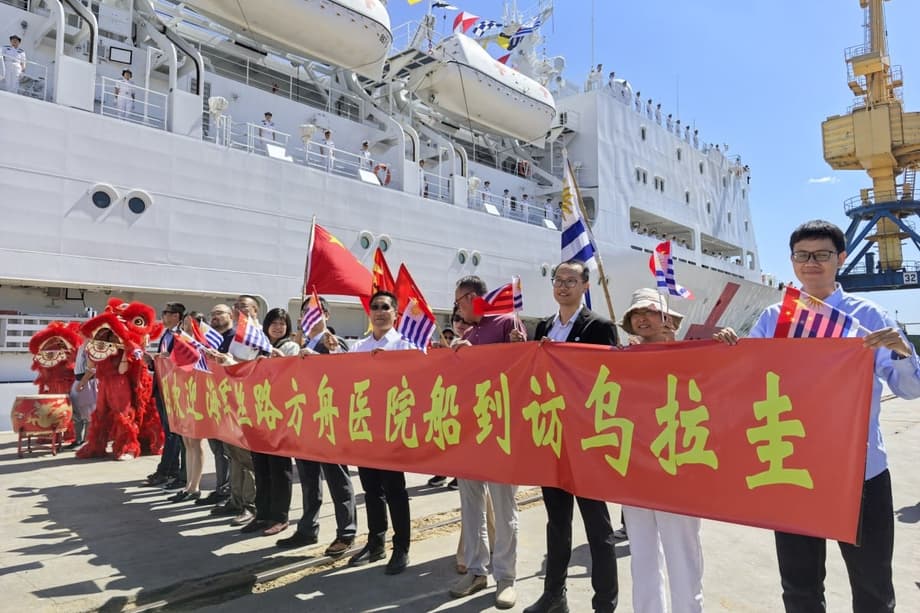
The PLA Navy hospital ship Silk Road Ark arrived at Uruguay’s port of Montevideo last Tuesday for a four-day technical stop, marking the first visit by a Chinese naval vessel to this South American nation strategically positioned between Brazil and Argentina. The port call, reported by China’s state news agency Xinhua, has drawn significant attention as it occurs amid intensifying geopolitical competition between China and the United States for influence in Latin America.
- Historic Port Call Marks Beijing’s Strategic Expansion in Western Hemisphere
- Strategic Importance of Uruguay in the Competition
- China’s Naval Strategy: From Hospital Ship to Global Ambitions
- US Response to China’s Growing Influence
- Economic Foundations of the Strategic Competition
- The Future of US-China Competition in Latin America
- Key Points
Analysts have interpreted this inaugural visit as a signal that Beijing’s efforts to expand its military exchanges in the western hemisphere remain unaffected by America’s recent military raid in Venezuela earlier this month. The timing of the Chinese naval visit coincided with a particularly sensitive period in regional relations, barely two weeks after the US captured Venezuelan leader Nicolas Maduro as part of President Donald Trump’s attempts to restore Washington’s strategic sway in the region.
“The port call indicates that China’s naval exchanges with South American countries remained unaffected,” said Cui Shoujun, professor and deputy director of the Institute of International Development Studies at Renmin University. This statement underscores the determination of Chinese authorities to continue their military outreach despite recent US efforts to reassert dominance in the Americas.
Strategic Importance of Uruguay in the Competition
Uruguay’s strategic location between South America’s two largest economies, Brazil and Argentina, gives it particular significance in both economic and geopolitical terms. The country has become increasingly important as China deepens its economic and diplomatic alignment in the region. In recent years, Uruguay has joined China’s Belt and Road Initiative and established what Beijing describes as a “comprehensive strategic partnership” with the Asian power.
During a meeting with China’s Vice Premier Ding Xuexiang last November, Uruguayan President Yamandú Orsi expressed his preparedness to deepen coordination with China to support what he called a “free and open international trading system and multilateralism.” This alignment with China’s vision comes as President Trump has made U.S. dominance in the Western Hemisphere a foreign policy priority, with his national security strategy explicitly calling for limiting the presence of nations not from the region.
“The United States believes that Mexico’s alignment with the American empire is automatic. I don’t think it’s that simple,” commented Ricardo Monreal, parliamentary leader for Mexico’s ruling Morena party, reflecting broader regional sentiments about resisting external dominance.
China’s Naval Strategy: From Hospital Ship to Global Ambitions
The Silk Road Ark is not just any naval vessel—it is one of China’s three 10,000-ton hospital ships that provide medical care and have been regularly deployed on “Harmony” missions across Africa, the Americas, Asia and the Pacific since 2010. This particular deployment, known as “Harmony 2025,” began last September and represents China’s strategy to build soft power and international relations through military-medical diplomacy.
As part of its more than 370-vessel navy—the world’s largest by hull count—China is pursuing an ambitious modernization effort under President Xi Jinping that aims to transform the People’s Liberation Army into a “world-class military” capable of global operations. By 2049, Xi has instructed the PLA to reach this status, with intermediate targets including achieving capabilities for reunification with Taiwan by 2027 and full modernization by 2035.
Under Xi’s leadership, China’s military has shifted focus from being predominantly land-based to prioritizing the sea, air, space, cyber and electromagnetic domains. The PLA Navy specifically aims to build a “blue water” capability that can operate globally, far beyond China’s traditional coastal waters. Between 2014-2018, China launched naval vessels with a total tonnage greater than the entire fleets of many major world navies combined.
China will actively carry out military exchanges and cooperation with [Latin America and the Caribbean] countries, expand friendly exchanges between defense and military leading officials of the two sides, strengthen policy dialogue and set up working meeting mechanisms.
This statement, from China’s Policy Paper on Latin America and the Caribbean released last December, explicitly outlines Beijing’s intentions to deepen military ties with countries in the region. The document emphasized that the relationship between China and Latin America is “not subjugated by any third party,” directly challenging the Monroe Doctrine interpretation that has historically defined U.S. relations with the hemisphere.
US Response to China’s Growing Influence
The United States has responded to China’s expanding presence in Latin America with a mixture of diplomatic pressure, economic initiatives, and military posturing. After years of what U.S. officials characterize as neglect in the region, the Trump administration has sought to “reassert and enforce the Monroe Doctrine to restore American preeminence in the Western Hemisphere.” As stated in the U.S. National Security Strategy: “We will deny non-Hemispheric competitors the ability to position forces or other threatening capabilities, or to own or control strategically vital assets, in our Hemisphere.”
Practical manifestations of this renewed focus include plans to upgrade U.S. military bases near China’s growing infrastructure projects in the region. The Pentagon has announced a $1.5 billion potential sale to upgrade facilities near China’s megaport in Peru, a move that officials claim “would not alter the regional military balance” despite the clear strategic implications.
U.S. officials have also expressed concerns about China’s Military-Civilian Fusion strategy, which systematically works to integrate civilian technology with military applications. As one former U.S. official explained: “Chinese strategic writings make clear that the objective of the CCP’s strategy is not merely to acquire power and influence for China on the world stage, but in fact to displace U.S. power and influence so as to reclaim the central geopolitical status and role of which China believes it was robbed by Western imperialism.”
This technology-focused competition extends beyond Latin America to other regions where China and the United States are competing for influence. In Southeast Asia, for example, the USS Cincinnati recently made a friendship visit to Cambodia’s Ream Naval Base, the first time a U.S. Navy warship has docked at the facility since its Chinese-funded renovation was completed. Similarly, the Philippines continues to bolster its military capabilities with new patrol vessels designed to counter China’s assertive behavior in the South China Sea.
Economic Foundations of the Strategic Competition
China’s growing military presence in Latin America is deeply connected to its economic expansion in the region through the Belt and Road Initiative (BRI). Launched by President Xi Jinping in 2013, the BRI has expanded from its original focus on Asia to include Africa, Oceania, and Latin America, significantly broadening China’s economic and political influence.
“China has had a fair amount of success in redrawing trade maps around the world, in ways that put China at the center and not the U.S. or Europe,” explains CFR’s David Sacks, an expert on U.S.-China relations. To date, 147 countries—accounting for two-thirds of the world’s population and 40 percent of global GDP—have signed on to BRI projects or indicated interest in doing so.
The estimated costs are staggering. China has already spent an estimated $1 trillion on BRI-related efforts, and experts predict total expenses over the life of the initiative could reach as much as $8 trillion. This massive investment infrastructure—including ports, railways, energy pipelines, and telecommunications networks—creates dependency and influence that extends beyond mere economics into strategic domains.
For China, the BRI serves multiple purposes: creating new trade linkages, cultivating export markets, boosting Chinese incomes, and exporting China’s excess productive capacity. It also helps develop China’s western regions historically neglected in favor of the eastern seaboard, and secures long-term energy supplies from Central Asia and the Middle East through routes the U.S. military cannot easily disrupt.
The Future of US-China Competition in Latin America
As the Silk Road Ark replenishes supplies in Montevideo and prepares for its next stops—likely in Peru and Chile before transiting to Papua New Guinea—the broader strategic competition between China and the United States in Latin America shows no signs of abating. China’s hospital ship mission represents just one facet of Beijing’s multi-pronged approach to building influence in a region traditionally dominated by the United States.
The United States has attempted to counter China’s infrastructure investments with its own initiatives. President Biden, in collaboration with the Group of Seven, launched the Build Back Better World Initiative (B3W), later renamed the Partnership for Global Infrastructure and Investment. However, these efforts have faced challenges—just one year after B3W’s announcement, commitments totaled only $6 million, highlighting the difficulty of competing with China’s massive financial resources and long-term investment horizon.
Regional countries themselves are finding themselves caught between these competing powers, seeking to balance relations with both China and the United States while pursuing their own national interests. Brazil, for example, maintains close ties with both powers as an emerging economy and member of the BRICS group of developing nations.
“We are very much interested in maintaining good relations with the United States, let that be clear,” said Celso Amorim, chief adviser to Brazil’s President Lula. “But those relations must be based on mutual respect; they must be conducted through dialogue.” This balanced approach reflects the complex diplomatic navigation required by Latin American nations in the current geopolitical environment.
Key Points
- China’s first naval visit to Uruguay by the hospital ship Silk Road Ark marks a significant expansion of Beijing’s military presence in Latin America
- The visit comes amid intensifying US-China competition for regional influence, occurring shortly after a US military operation in Venezuela
- Uruguay has strengthened economic and diplomatic ties with China, joining the Belt and Road Initiative and establishing a comprehensive strategic partnership
- China’s three hospital ships regularly conduct “Harmony” missions globally since 2010, combining medical diplomacy with strategic outreach
- The US has responded with renewed focus on the Western Hemisphere, including military base upgrades near Chinese infrastructure projects
- Belt and Road Initiative investments across Latin America total $1 trillion so far, creating economic dependency and strategic influence
- Regional nations are attempting to balance relations between both powers while pursuing their own national interests
- China aims to develop a “blue water” navy capable of global operations as part of its military modernization goals