A Decade After Its Breakthrough, IKEA Changes Course
IKEA entered South Korea in December 2014 with queues stretching for hours outside its Gwangmyeong store, traffic jams extending for kilometers and an immediate place among the country's biggest furniture sellers. Its only Korean outlet generated 308 billion won during its first fiscal year, putting the company third in the domestic furniture industry.
Contents
- A Decade After Its Breakthrough, IKEA Changes Course
- How a Strong Start Became a Profit Squeeze
- The Turning Points
- Why Self Assembly Has Become a Harder Sell
- Online Rivals Change the Price Comparison
- Caught Between Bargain Sellers and Premium Brands
- Suburban Stores Meet Urban Lifestyles
- Workers Describe Unequal Access to Breaks
- Gangdong Tests a More Accessible IKEA
- Investment and Price Cuts Signal a Fight for Customers
- Key Points
By March 12, 2026, the business faced a much harder calculation. Revenue had peaked at 687.2 billion won in 2021, while operating profit fell from approximately 30 billion won that year to about 10 billion won in 2025, despite a partial recovery between those dates. IKEA's challenge was becoming less about introducing Scandinavian design and more about making it fit the way Korean consumers shop, travel and spend their limited free time.
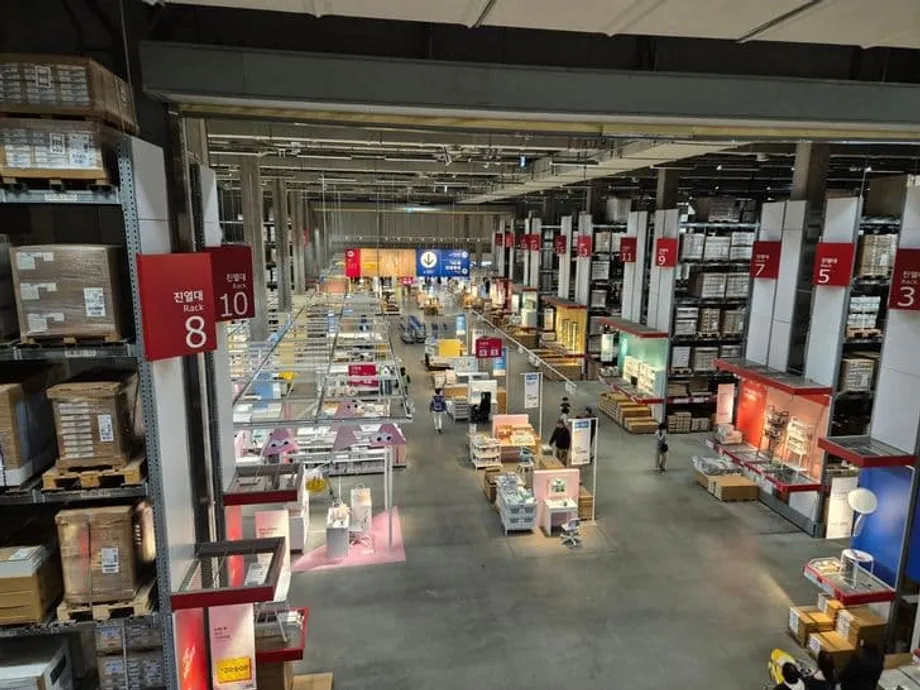
A Tuesday afternoon visit to the Gwangmyeong showroom illustrates the change. Lee, a father in his thirties visiting with his wife and toddler, photographed furniture displays while considering a redesign of his child's bedroom. His cart remained empty. Lee explained that he intended to compare the designs with cheaper alternatives online:
I will probably look online first to see if there are cheaper options with similar designs,
Passing the Billy bookcases, he added:
I am not buying anything today.
Office workers using laptops in the restaurant, mothers meeting for coffee and visitors photographing room displays show that IKEA still attracts people. The commercial problem is turning those visits into furniture purchases. Many purchases are small items costing less than 30,000 won, described as loss leaders, products intended to draw customers toward larger purchases. The full rooms on display increasingly serve as inspiration for shopping elsewhere.
How a Strong Start Became a Profit Squeeze
IKEA's early appeal rested on a straightforward change to Korean furniture shopping. In a market where identical pieces could carry very different prices depending on the neighborhood or a customer's negotiating skills, the company introduced transparent, fixed prices. Buyers could see the price before deciding, without haggling.
Self assembly also offered an alternative to expensive delivery services that brought furniture into the home and handled installation. Customers contributed their own time and effort in exchange for lower prices. The showrooms let them test sofas, open drawers and see how individual pieces worked together in a complete room.
Scandinavian design, previously associated with affluent consumers able to import designer furniture, became accessible to middle class families seeking modern, minimalist interiors. Revenue grew steadily and reached 687.2 billion won in 2021 as pandemic lockdowns encouraged spending on homes.
Sales declined over the next two years, falling to roughly 630 billion won even after IKEA added another outlet. The drop in earnings was sharper: operating profit, the money left from running the business before other financial costs and taxes, fell from approximately 30 billion won in 2021 to 21 billion won in 2022, then plunged 88 percent to roughly 2 billion won in 2023.
IKEA Korea also recorded its first fiscal year net loss since entering the market: $4.019 million for the period ending in September 2023. Net profit or loss includes costs beyond everyday operations, which explains why a company can report a small operating profit and still finish the year with a net loss.
Operating profit recovered to around 18 billion won in 2024 before falling again to approximately 10 billion won in 2025. Compared with the roughly 30 billion won earned in 2021, the 2025 figure was about one third as large. That uneven recovery helps explain why IKEA is changing its stores, services and prices together.
The Turning Points
IKEA's Korean experience moved from rapid entry to expansion, declining earnings and a change in direction. The key dates show how those developments followed one another:
- December 2014: IKEA opened its Gwangmyeong store, attracting long queues and traffic jams.
- First fiscal year: The single Korean store generated 308 billion won in revenue and ranked third in the domestic furniture industry.
- 2021: Revenue peaked at 687.2 billion won, with operating profit of approximately 30 billion won.
- 2022: Operating profit declined to roughly 21 billion won.
- 2023: Operating profit fell 88 percent to around 2 billion won. The fiscal period ending in September produced a net loss of $4.019 million.
- Late 2023: Gwangmyeong reduced its opening hours.
- April 2024: IKEA opened its Gangdong store inside a Seoul shopping complex. Operating profit recovered to around 18 billion won during 2024.
- 2025: Operating profit fell to approximately 10 billion won.
- Through 2026: Ingka Group committed $326 million to expansion in Korea.
The investment commitment places expansion alongside financial pressure. IKEA is trying to build a larger customer base while accepting that changes to prices and access may weigh on earnings in the meantime.
Why Self Assembly Has Become a Harder Sell
Korean consumers increasingly expect furniture shopping to include delivery, assembly and support after the purchase in one transaction. IKEA's traditional model asks customers to take on more of that work themselves, often beginning with a weekend drive to a suburban store.
A furniture purchase can involve navigating a large showroom and warehouse, moving bulky boxes, transporting them home and spending hours following assembly instructions. For consumers used to delivery on the day they order and retail services that handle installation, those steps can make a lower shelf price less attractive.
IKEA's approach has been described as selling inconvenience: customers perform some of the work that another retailer would handle, helping keep prices down. The model depends on buyers valuing those savings, or enjoying the process, enough to accept the effort.
A quoted assessment of the strategy, for which the speaker's name and role were not given, explained the tension between that model and Korean working lives:
IKEA's strategy has traditionally been to lower prices while offering customers a sense of engagement and enjoyment through self-assembly. But looking at the lifestyles of Korean consumers, many are busy and exhausted. It is not an environment where that strategy can easily drive rapid growth.
IKEA offers assembly services, but the extra fees reduce the price advantage that first attracts shoppers. A professional short of time may then choose a traditional furniture store and pay for convenience, or turn to an online alternative offering competitive prices with delivery and installation.
The cultural issue was visible even before IKEA entered Korea. Its marketing research identified people living under performance pressure, the intense competition running from kindergarten through university and into careers. IKEA positioned accessible home design as a source of comfort and happiness. Those same pressures, however, also leave many people with little time or energy for an assembly project.
Online Rivals Change the Price Comparison
Coupang and Ohouse have become strong competitors as furniture shopping moved online after the COVID-19 pandemic. Their retail models offer lower prices, free delivery and professional installation services, challenging several of IKEA's traditional advantages at once.
Online marketplaces also carry furniture imitating IKEA's clean Scandinavian appearance at a fraction of the cost. Consumers seeking a room suitable for an Instagram photograph can find a similar look without handling Allen keys or instruction manuals themselves. IKEA's displays can therefore help shoppers decide what they like, even when another seller receives the order.
Domestic furniture retailers have changed too. Many adopted transparent prices and modern design styles after IKEA entered the market. The features that once made the Swedish company stand out became more widely available, reducing the distance between IKEA and its local rivals.
Housing conditions added another difficulty. Furniture demand is closely connected to housing transactions because moving often prompts people to buy beds, wardrobes, tables and sofas. A real estate downturn and high interest rates slowed those transactions and weakened demand for home furnishings.
Even when apartment sales increased, expensive borrowing kept the wider housing market subdued. IKEA consequently faced competition for a pool of spending that was itself under pressure, limiting the furniture recovery it had anticipated.
Caught Between Bargain Sellers and Premium Brands
IKEA's position has become less distinct as online sellers compete on price and premium domestic chains compete on prestige. The company is no longer especially cheap beside many products sold online, yet it does not occupy the same place as a luxury furniture brand.
A second quoted assessment, also without an identified speaker or role, described the company's position:
IKEA is not particularly cheap compared with value-for-money products sold online, but it is not positioned as a premium brand either. It has ended up with an ambiguous market position.
Korea's furniture market has become divided between consumers seeking the lowest prices and affluent buyers pursuing luxury goods. Companies succeeding at either end have a clear target customer. IKEA's middle position exposes it to both groups of competitors.
Price sensitive customers can compare its products with cheaper online alternatives. Buyers looking for status may prefer a premium domestic brand. IKEA must give both groups a reason to choose its combination of design, price and service, rather than relying on the novelty that helped it in 2014.
The assembly question makes this positioning problem more difficult. A customer comparing prices may include delivery and installation in the calculation, while a buyer seeking premium service may expect those tasks to be handled from the beginning. The price tag on the furniture is only part of what each shopper is buying.
Suburban Stores Meet Urban Lifestyles
Gwangmyeong, Goyang and Giheung reflect IKEA's familiar blue box format: large stores on sprawling suburban sites. That model assumes customers have access to a vehicle and are willing to spend part of a weekend shopping.
The younger consumers IKEA wants to attract increasingly live in compact urban studios and use public transportation or ride services. The group often called the MZ Generation combines millennials born from 1981 to 1995 with Generation Z, born from 1996 to 2012. A large suburban furniture trip can fit poorly with their homes and travel habits.
The showroom route adds another demand on time. Its maze like layout guides customers through product categories before they reach the checkout, turning a visit into a lengthy walk. A journey lasting around an hour can feel tiring to younger shoppers accustomed to finding and ordering products quickly on a phone.
IKEA designed that route to expose customers to room ideas and a broad range of products. In Korea, the same experience can produce shopping fatigue. Visitors may appreciate the displays while deciding that the time required to browse, transport and assemble a purchase is too high.
The company's accessibility problem therefore extends beyond distance. It includes the time spent inside the store and the work left after the customer gets home. Smaller urban locations and services that reduce those steps address different parts of the same shopping journey.
Workers Describe Unequal Access to Breaks
IKEA's employees have raised a separate concern about how the business operates. The Mart Workers' Union, which represents IKEA Korea employees, has documented complaints of chronic understaffing and insufficient rest breaks, challenging the company's celebrated workplace culture.
A survey of 211 store employees found that 88.2 percent strongly agreed paid rest breaks were necessary. Workers cited continuous repetitive tasks and physically demanding workloads. They reported rotations every 15 minutes among checkout, serving and customer support duties, making it difficult to take full meal breaks.
Fika, the Swedish coffee break tradition promoted as part of IKEA's identity, became a focus of the complaints. While office staff enjoyed regular Fika breaks, 91.4 percent of the store workers surveyed reported unequal access to the benefit.
The union criticized conditions under chief executive Isabelle Puig and argued that cost reductions had reached employee welfare as well as store opening hours. In late 2023, the Gwangmyeong flagship changed its weekday schedule to open at 11 a.m. and close at 8:30 p.m.
Workers said staffing had not been adjusted to meet the demand remaining during those shorter hours. Their complaints add an operational challenge to IKEA's customer strategy: a retailer seeking to compete through better service also needs enough staff and workable conditions to provide it.
Gangdong Tests a More Accessible IKEA
IKEA abandoned plans for a major logistics center in Pyeongtaek and turned toward smaller locations integrated into urban areas. The shift puts access ahead of the scale associated with its standalone suburban warehouses.
The Gangdong store opened in April 2024 inside Gangdong I-Park The River, a shopping complex in Seoul. Covering 25,000 square meters, it sits within a development containing cinemas, grocery stores and restaurants. It is IKEA's first location embedded in a shopping complex rather than operating as a standalone destination.
Gangdong targets urban millennials who do not own cars and whom IKEA's earlier locations struggled to reach. Its surroundings let a furniture visit become part of a broader shopping trip instead of requiring a journey devoted entirely to IKEA.
The store's 44 model rooms were designed with people living alone and young families in mind. That focus reflects a specific Seoul household figure: 84 percent of households contain three or fewer people. Displays suited to smaller households make the store's ideas more relevant to the homes customers actually occupy.
Six dream home displays were created by popular YouTube influencers to connect with consumers comfortable using digital platforms. Gangdong also includes a service for buying back used furniture and a circular hub, placing reuse and sustainability alongside convenience in the store's approach.
IKEA's digital changes address customers who may never visit a showroom. Remote consultations through live video calls provide advice on room layouts, while automated warehouses using robots powered by artificial intelligence have reduced delivery times. The company has also invested heavily in its online infrastructure to compete with domestic commerce platforms.
Investment and Price Cuts Signal a Fight for Customers
Ingka Group, IKEA's parent company, committed $326 million to expansion in Korea through 2026 despite the financial setbacks. The plans include temporary stores at major department stores and shopping malls in Gwangju, Yeongdeungpo and Pangyo.
The expansion statement described a commitment of 300 million euros over three years. The person speaking was not identified by name or role:
We are investing 300 million euros that coming three years to see how we actually create new formats that can bring IKEA closer to where people live, work or socialize in order to complement the existing blue boxes that we have.
IKEA has also cut prices on more than 1,000 items to compete with online rivals. Lower prices can help retain customers, but they also reduce the amount earned on each sale unless costs fall or sales volumes rise. The company is accepting reduced profitability as part of its effort to maintain market share.
Rumors of a withdrawal from Korea have circulated online, encouraged by falling profits and shorter store hours. No withdrawal plan had been announced as of March 12, 2026. The investment commitments, urban expansion and waste management partnership with RECO point toward continued operations and an effort to establish deeper local connections.
IKEA's global structure also allows it to take a longer view. As an unlisted business, it faces less pressure from shareholders demanding quarterly results. An executive described the aim as reaching an eventual economic recovery with a much larger customer base built through today's investment in affordability.
The central task is adapting to Korean expectations without losing the design and pricing identity that made IKEA distinctive. Its new stores, video consultations, faster delivery and price reductions all address parts of that task. Success depends on persuading busy consumers either that the traditional IKEA experience merits the effort or that they can obtain its furniture without a suburban trip and hours of assembly.
Key Points
- IKEA's first Korean store generated 308 billion won in its first fiscal year after opening in December 2014.
- Revenue peaked at 687.2 billion won in 2021, then fell to roughly 630 billion won over the following two years.
- Operating profit fell 88 percent in 2023 to around 2 billion won, recovered in 2024 and declined to approximately 10 billion won in 2025.
- Online competitors, installation costs, demanding work schedules and suburban locations have weakened IKEA's traditional appeal.
- A survey of 211 store employees recorded strong demand for paid rest breaks and complaints about unequal access to Fika.
- The Gangdong store opened in April 2024 with 44 model rooms inside a Seoul shopping complex.
- Ingka Group committed $326 million to Korean expansion through 2026, while IKEA cut prices on more than 1,000 items.
- IKEA abandoned its planned Pyeongtaek logistics center and is pursuing urban stores and improved digital services.