Global Brands Navigate Post-War Landscape in $143.9 Billion Sector
Swedish furniture giant Ikea launched instant delivery services on JD.com in late January, covering nine major Chinese cities with promises of one-hour delivery for small household items. The move came just months after Chinese regulators forced domestic tech giants to call a truce on a devastating subsidy war that had burned through billions of dollars and pushed industry leaders into steep losses. For multinational corporations watching from the sidelines, the timing signals a critical inflection point in one of the world’s most dynamic retail markets.
- Global Brands Navigate Post-War Landscape in $143.9 Billion Sector
- The Scale of China’s Delivery Economy
- The Subsidy War That Shook the Industry
- Regulators Step In
- Why Foreign Companies Are Entering Now
- Beyond Price: The New Battleground
- New Entants and Market Evolution
- Challenges Remain
- Strategic Implications
- Key Points
Ikea joins a growing list of foreign companies, including German tyre manufacturer Continental, German discount supermarket chain Aldi Nord, and US warehouse retailer Sam’s Club, that are racing to establish instant retail operations in China. These companies are not merely replicating their home-country delivery models; they are creating faster, more comprehensive services tailored specifically to Chinese consumer expectations. The strategic bet rests on a simple premise: despite the recent chaos, China’s instant retail infrastructure and consumer demand create opportunities that do not exist elsewhere.
The Scale of China’s Delivery Economy
To understand why multinationals are entering now, consider the sheer scale of China’s logistics ecosystem. The country’s parcel delivery sector processed its 150 billionth parcel of 2024 by mid-November, a tenfold increase from the 14 billion handled in 2014. On peak days, the industry processes more than 729 million parcels, with monthly shipment volumes regularly exceeding 13 billion, according to the State Post Bureau.
This infrastructure supports an instant retail market valued at 650 billion yuan ($90 billion) in 2023, which analysts project will surpass 2 trillion yuan ($280 billion) by 2030. The sector, defined as delivering goods within 30 to 60 minutes of ordering, has evolved from a convenience into a consumer necessity. As one industry observer noted, Chinese consumers now expect immediate gratification not just for meals, but for phone chargers, clothing, electronics, and furniture.
“China leads the world in internet penetration and boasts a well-developed digital infrastructure,” said Fu Yifu, a special researcher at Su Merchants Bank in Nanjing. “In China’s highly competitive market, providing instant retail services can help foreign brands to drive sales growth more effectively.” By combining their product strengths with local platforms, foreign brands can offset limited local market insight while meeting sophisticated demand.
The Subsidy War That Shook the Industry
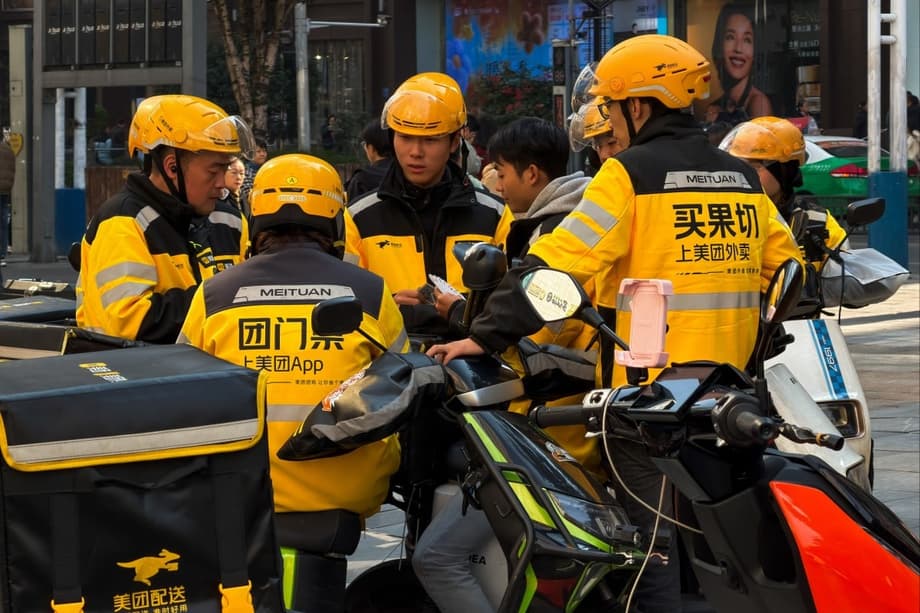
The path to this moment was neither smooth nor cheap. For much of 2025, China’s three dominant delivery platforms, Meituan, Alibaba-backed Ele.me, and JD.com, engaged in what analysts called a high-stakes “game of chicken.” The conflict began when JD.com, alarmed by Meituan’s expansion into general retail, launched a food delivery service in February 2025 to compete with Meituan’s core business.
The result was a price war of extraordinary intensity. Platforms offered coffee for as little as 2 yuan ($0.28), free lunches, and massive coupon campaigns. Alibaba’s Taobao Instant Commerce pledged 50 billion yuan ($7 billion) in subsidies over 12 months. JD.com announced two separate 10 billion yuan investment rounds. Meituan responded with record-breaking promotions that crashed its servers when daily orders hit 120 million on a single Saturday in July.
The financial damage was severe. Meituan reported a 16 billion yuan ($2.3 billion) loss in the third quarter of 2025, its largest since listing. JD.com’s new business arm, including food delivery, lost nearly 16 billion yuan despite doubling revenue. Alibaba saw earnings fall by half. Analysts at Nomura estimated industry-wide cash burn exceeded $4 billion in the second quarter alone, while Goldman Sachs projected delivery-related losses of 41 billion yuan for Alibaba and 26 billion yuan for JD.com over the following year.
Regulators Step In
The bleeding did not go unnoticed by Beijing. Starting in May 2025, the State Administration for Market Regulation (SAMR) began summoning the three platforms, urging them to end “involution-style” competition, a term Chinese policymakers use to describe destructive, zero-sum rivalries that harm all participants. By late July, the regulator demanded the companies adhere to fair competition rules and engage in rational market behavior.
The intervention reflected broader economic concerns. Chinese authorities worried that the race to the bottom was distorting price signals, disrupting markets, causing waste, and squeezing small merchants who were forced to absorb discount costs. The crackdown also aligned with “anti-involution” policies aimed at preventing excessive internal competition across various sectors.
In August 2025, the three giants publicly committed to curbing aggressive discounting. Meituan pledged to eliminate unfair competition and comply with regulations prohibiting sales “significantly below cost.” Alibaba promised to distribute subsidies rationally and resist unhealthy competition. JD.com vowed not to leverage order volume to create market bubbles. The companies also ceased offering “free lunch” promotions that had characterized the summer price war.
Why Foreign Companies Are Entering Now
The truce created an opening. With platforms shifting focus from predatory pricing to service quality, infrastructure efficiency, and sustainable growth, the market environment became more predictable for new entrants. For multinationals, the calculus involves several factors beyond the temporary peace.
China represents approximately 15 percent of global revenue for the 200 largest multinational corporations from Japan, Europe, and the United States, according to Bain & Company data. As one analyst noted, it is crucial for multinationals to defend their China operations not only as an end market, but as a key node in global supply chains supported by the country’s cost-efficient industrial ecosystem.
The consumer behavior gap between China and other markets continues to widen. While Western consumers might wait days for e-commerce deliveries, Chinese shoppers increasingly view 30-minute delivery as standard. This expectation has transformed instant retail from a value-added service into a baseline requirement for competitiveness. Foreign brands that fail to adapt risk obsolescence in their second-largest market.
Partnerships with established platforms provide a shortcut. Rather than building proprietary logistics networks from scratch, companies like Ikea are leveraging JD.com’s existing rider infrastructure and warehouse network. This approach allows foreign retailers to achieve coverage across nine cities immediately, rather than the years it might take to build equivalent capabilities independently.
Beyond Price: The New Battleground
The post-subsidy era shifts competition toward dimensions where multinationals may hold advantages. With platforms now prohibited from buying market share through destructive discounts, factors like product quality, supply chain reliability, and user experience become decisive.
“Supply chain capabilities, fulfillment efficiency and service quality will be the key factors that determine the future landscape,” noted a report from the Chinese Academy of International Trade and Economic Cooperation. This transition favors companies with strong brand equity and operational expertise, precisely the profile of entrants like Aldi and Ikea.
The shift also addresses sustainability concerns that plagued the subsidy era. During the price war, delivery riders faced intense pressure while small merchants saw margins evaporate. Now, platforms are investing in rider benefits, including JD.com’s 2 billion yuan commitment to upgrade full-time rider benefits and Meituan’s nationwide pension insurance rollout covering 1 million riders. These improvements stabilize the labor force that underpins instant delivery.
Additionally, the focus is expanding beyond food into general merchandise, electronics, and home goods, the categories where foreign retailers specialize. Taobao Instant Commerce reported 100 percent growth in non-food categories across 1,205 product types, suggesting consumers are adopting instant delivery for increasingly complex purchases.
New Entants and Market Evolution
The market continues to attract domestic challengers despite the recent bloodshed. East Buy, the e-commerce arm of education company New Oriental, recently announced plans to build instant retail fulfillment capabilities in Beijing, Shanghai, and Guangzhou, constructing massive warehouses to support 30-minute delivery. The company’s stock rallied 14 percent on the news, suggesting investor confidence that the sector retains growth potential even after the subsidy wars.
This ongoing interest underscores a fundamental reality: instant retail in China is evolving from a marketing gimmick into essential infrastructure. As one analyst observed, once instant delivery becomes embedded in daily life, it behaves less like a retail category and more like utility infrastructure. Such businesses require long periods of investment and competitive positioning before profitability emerges.
For multinationals, the current moment offers a chance to establish presence without facing the immediate pressure to match irrational subsidies. They can focus on integrating their global product strengths with local delivery capabilities, creating hybrid models unavailable in their home markets.
Challenges Remain
Success is not guaranteed. The market remains fiercely competitive even without extreme discounting. Meituan maintains a dominant position with roughly 50 percent of the food delivery market and 71 million daily orders. Alibaba holds 42 percent, while JD.com has captured about 8 percent but is struggling to justify the cost of its expansion.
Consumer expectations for speed create operational complexity. Achieving 30-minute delivery for furniture or automotive parts requires sophisticated inventory positioning and predictive logistics that differ fundamentally from traditional retail supply chains. Foreign companies must adapt their global operational models to these local requirements.
Regulatory scrutiny continues to intensify. Beyond pricing, authorities are examining labor practices, food safety, and data privacy. The government’s “zero-tolerance” attitude toward disorderly competition means any new entrant must tread carefully regarding promotional strategies.
Moreover, the truce among domestic giants remains fragile. While executives publicly commit to rational competition, the strategic logic that triggered the war, the desire to control the consumer’s primary interface with local commerce, remains unchanged. As Meituan’s CEO Wang Xing told analysts, “We will make the necessary investments to maintain our leading position.”
Strategic Implications
The entry of multinationals into China’s instant retail sector signals a maturation phase for the industry. Where domestic players fought to establish the market through capital destruction, foreign companies aim to capture value through operational excellence and brand differentiation.
This pattern reflects broader trends in Chinese retail. A recent Bain & Company report noted that brand growth can no longer rely on increasing supply or deepening discount strategies. Instead, success requires understanding why consumers choose specific channels and identifying key purchase moments. Membership stores grew 40 percent in 2025, while discount stores surged 92 percent, indicating consumers seek value beyond low prices.
For global retailers, China serves as both a revenue source and an innovation laboratory. The instant delivery capabilities they develop through partnerships with JD.com and similar platforms may eventually inform their strategies in other markets. Just as China’s mobile payment systems once seemed exotic and later became global standards, its instant retail infrastructure could define the next generation of global commerce.
The race is on to capture this market before it fully consolidates. With 545 million online food delivery users and expectations of 2 trillion yuan in market value by 2030, the stakes extend far beyond quarterly earnings. For Ikea, Aldi, Continental, and others, the bet is that China’s instant retail market will remain open long enough for them to establish sustainable positions, and that the recent regulatory intervention has created a window of stability in what remains one of the world’s most dynamic commercial battlegrounds.
Key Points
- Ikea, Continental, Aldi Nord, and Sam’s Club have launched instant delivery services in China, partnering with local platforms like JD.com to offer delivery speeds faster than their global standards.
- China’s instant retail market is valued at $143.9 billion and projected to reach 2 trillion yuan by 2030, supported by a logistics network that processed 150 billion parcels in 2024.
- Domestic tech giants Meituan, Alibaba, and JD.com burned through billions in subsidies during a 2025 price war, resulting in massive losses and regulatory intervention by the State Administration for Market Regulation.
- In August 2025, the three platforms agreed to a truce, ceasing destructive discounting and shifting focus to service quality, supply chain efficiency, and sustainable growth.
- Foreign companies are entering the market post-truce to leverage China’s advanced digital infrastructure while avoiding the unsustainable subsidy competition that characterized earlier market entry attempts.
- The competitive landscape is shifting from price wars to infrastructure and service quality, favoring established brands with strong supply chains and operational expertise.