Historic Infrastructure Project Nears Completion
China is on the verge of completing one of the most significant infrastructure projects of the 21st century – the Pinglu Canal. This US$10.4 billion waterway is expected to open to navigation by the end of 2026, after just four years of construction. The landmark project will provide China’s landlocked southwestern provinces with direct access to global shipping lanes, creating a faster, cheaper route to transport goods between the Chinese interior and neighboring countries across Southeast Asia.
- Historic Infrastructure Project Nears Completion
- Engineering Marvels and Technical Specifications
- Transforming China’s Inland Logistics Landscape
- Strategic Significance for China-ASEAN Relations
- Regional Development and Economic Transformation
- Environmental Considerations and Sustainable Development
- Geopolitical Implications and Regional Dynamics
- Early Trade Benefits Already Materializing
- Global Context and China’s Infrastructure Ambitions
- Future Outlook and Long-term Implications
- Key Points
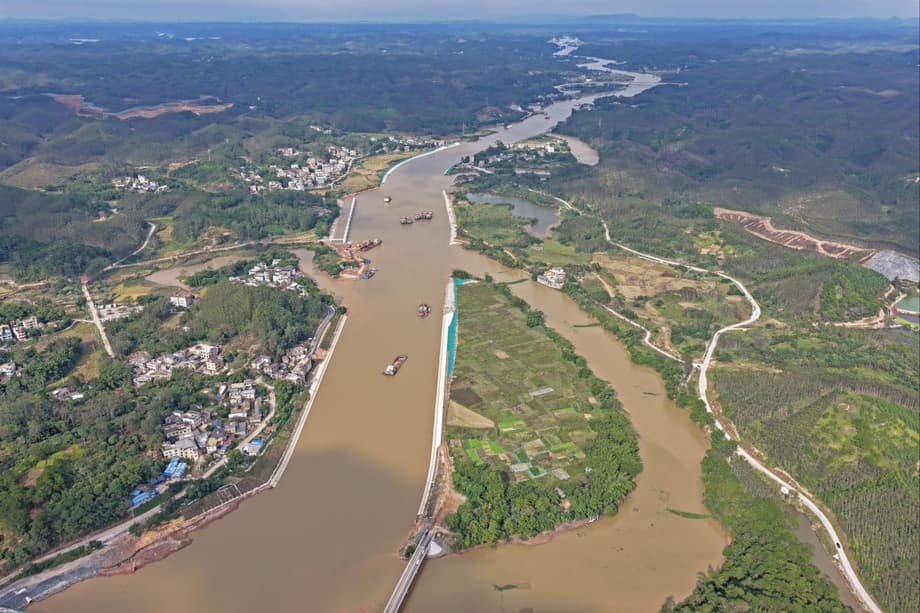
The 134km (83-mile) canal connects Nanning, capital of the Guangxi Zhuang autonomous region, with the Gulf of Tonkin (known in China as the Beibu Gulf) via the Qinjiang River. What makes this project extraordinary is that it represents China’s first major canal construction in centuries, marking a significant engineering and economic milestone for the world’s second-largest economy.
Construction has already entered its final phase, with about 89.7 percent of the planned investment completed, according to state media reports. With work progressing smoothly, preparations to open the canal to shipping traffic are set to begin from May, according to a senior manager on the project.
Engineering Marvels and Technical Specifications
The Pinglu Canal is far more than just a waterway – it’s a testament to China’s engineering prowess and ambition. The canal features a waterway large enough to accommodate 5,000-tonne vessels, three dual-line shiplock hubs, and 27 newly built or renovated bridges, 13 of which have already been put into operation.
One of the most impressive aspects of the project is the Madao Junction, which features the world’s largest inland water-saving ship lock. This double-lane structure measures 300 meters long, 34 meters wide, and 8 meters deep, with a maximum operating head of 29.6 meters. The three-level water-saving chambers allow 60 percent of water to be saved for lifting ships instead of being discharged downstream, representing a significant advancement in sustainable water resource management for large infrastructure projects.
The canal will overcome a 65-meter elevation difference between inland and sea level through innovative engineering solutions. More than 1.76 billion cubic feet of earth have been moved during construction, and engineers are using a specialized concrete mix designed to withstand over 100 years of water erosion, aiming to minimize long-term maintenance costs.
China hasn’t built a canal of this magnitude since the founding of the People’s Republic in 1949. The project also includes ecological corridors and animal and fish passages to protect the biodiversity of the area, demonstrating an awareness of environmental considerations alongside economic development goals.
Transforming China’s Inland Logistics Landscape
The Pinglu Canal represents a game-changer for China’s logistics and trade infrastructure. Currently, goods from southwestern provinces like Yunnan, Guizhou, and even parts of Guangxi must travel through the traditional eastern coastal provinces or via more circuitous routes to reach international markets.
Once operational, the canal will reduce shipping routes to the sea by over 560 kilometers, creating the most direct inland access to ASEAN markets. This dramatic shortcut will cut transportation time from roughly a month to between seven and ten days while saving an estimated US$725 million in annual transport costs.
The canal’s impact extends beyond simple distance reduction. It will have a cargo volume of 95.5 million tons by 2035 and 120 million tons by 2050, according to research results. This massive increase in logistics capacity is seen as a key factor in making China even more competitive in international trade, especially in the manufacturing, agriculture, and energy sectors.
“The opening of the Pinglu Canal represents a historic step for Nanning,” said Chen Liangjun, head of a business group in Guangxi, quoted by China News Service. “This project will transform the city from an inland center into a strategic maritime gateway to the ASEAN market.”
Strategic Significance for China-ASEAN Relations
The canal comes at a critical juncture in China’s economic relationship with Southeast Asia. In 2025, increased trade with ASEAN helped partially offset the impact of the tariff war with the United States, with Chinese exports to ASEAN growing 13.4 percent, compared to a 20 percent decline in shipments to the US market.
In value terms, trade between China and ASEAN exceeded $1 trillion in 2025, up 7.4 percent year-over-year, while trade with the United States stood at $559.7 billion, down 18.7 percent. This shift underscores ASEAN’s growing importance as China’s top trading partner and the strategic value of infrastructure projects that facilitate this economic relationship.
For Southeast Asian countries, the canal presents both opportunities and concerns. Singapore, as a partner with the city of Chongqing through the Singapore-Chongqing Connectivity Project, views the canal as a potential boon for Singaporean business interests. Malaysia has a foothold in Qinzhou via the China-Malaysia Qinzhou Industrial Park (CMQIP), established in 2012 but previously hindered by Qinzhou’s remote location. The Pinglu Canal could change these fortunes by making the area more accessible.
Brunei is also positioning itself to benefit. The Muara Port of Brunei, the country’s only deep-water port, is a joint venture between Brunei Darussalam Asset Management and the Port of Beibu Gulf Group. This direct shipping connection, combined with the canal’s opening, will open up more opportunities for Chinese businesses in Brunei.
The Pinglu Canal will further bolster the Port of Beibu Gulf (consisting of three smaller ports of Qinzhou, Fangchenggang, and Beihai). In his inspection tour of Guangxi in December 2023, Chinese President Xi Jinping emphasized that the future development of Guangxi hinges upon its river-sea intermodal connectivity, namely the Pinglu Canal.
Regional Development and Economic Transformation
The canal is part of a broader strategic vision for Guangxi’s economic development. The region has struggled economically for decades, with its coastal cities (Qinzhou, Fangchenggang, and Beihai) performing much weaker than inland cities like Nanning and Liuzhou. In 2020, Yunnan’s economy surpassed Guangxi’s for the first time, despite Yunnan being landlocked.
Guangxi’s leaders have historically looked eastward to Guangdong rather than southward to the coast for economic opportunities. However, this strategy proved insufficient as Guangxi’s interests remained subordinate in Guangdong’s considerations. The Pinglu Canal effectively does for Guangxi what the Funan Techo Canal does for Cambodia – making the province less reliant on neighbors for trade outlets.
The canal will also benefit the broader region. Guangxi and Yunnan have agreed to jointly build the Baise water conservancy project for CNY5 billion (USD703.6 million) to establish a waterway from Yunnan to the sea. Many cities in Guangxi such as Qinzhou are already setting up industrial parks and logistics facilities in anticipation of the canal’s opening.
As part of China’s 14th Five-Year Plan and Vision 2035, the canal represents a critical component of the New Western International Land-Sea Corridor, a trade and logistics passage connecting inland China’s production center in Chongqing and Chengdu with international markets via outlets in southern and southwestern provinces instead of the traditional eastern coastal provinces.
Environmental Considerations and Sustainable Development
Large infrastructure projects inevitably raise environmental concerns, and the Pinglu Canal is no exception. However, the project incorporates several features designed to minimize environmental impact.
The most significant is the water-saving lock system at Madao Junction, which reuses 60 percent of the water needed for lifting or lowering vessels. This technological innovation not only reduces water consumption but also speeds up ship transit, allowing for constant flow even under conditions of significant level differences.
The project also includes ecological corridors and fish passages to maintain biodiversity along the canal route. Engineers have been careful to design these features to allow wildlife to continue their natural migration patterns while the canal operates.
During construction, the project has implemented dust control measures to minimize air pollution, and special concrete mixes are being used that reduce long-term environmental impacts by requiring fewer repairs and maintenance.
Despite these measures, the canal’s environmental impact will continue to be monitored. The creation of a new waterway inevitably alters local ecosystems, and the increased shipping traffic could bring additional concerns regarding water quality and noise pollution that will need to be addressed as the canal becomes fully operational.
Geopolitical Implications and Regional Dynamics
The Pinglu Canal cannot be viewed purely as an economic or engineering project – it carries significant geopolitical implications, particularly in how it might affect China’s relationship with Vietnam and other Southeast Asian nations.
While China and Vietnam have mostly cordial relations in the Beibu Gulf – conducting regular joint patrols and settling territorial and maritime boundary disputes in the early 2000s – Vietnam will be closely evaluating the canal’s opportunities and risks. The country is already unnerved by the potential adverse economic, ecological, and strategic effects of the China-backed Funan Techo Canal in Cambodia.
China’s recent drawing of a baseline in the Beibu Gulf in March 2024 was not well received by Vietnam, although the Vietnamese government’s response was relatively muted. The canal’s completion could further test this delicate diplomatic relationship.
The presence of a People’s Liberation Army Navy base at the mouth of the canal near Qinzhou adds another dimension to the strategic considerations. While the primary purpose appears commercial, any improved transportation infrastructure inherently implies improved logistical capabilities for the Chinese military.
China-Vietnam interactions in the Beibu Gulf are complex, with both countries navigating between cooperation in the gulf and ongoing maritime disputes in the South China Sea. The canal could potentially strengthen China’s influence in this strategically important waterway.
The Pinglu Canal is not the only project China is working on to further integrate economic relations with Southeast Asia. Nearby is the Hainan Free-Trade Port, another grandiose project by China, which plans to be the largest free-trade port by 2025. Given the location of the Hainan port, it is being positioned to advance China’s economic goals of expanding exports to Southeast Asia.
Early Trade Benefits Already Materializing
Even before its official opening, the Pinglu Canal is already demonstrating its potential trade benefits. In January 2026, a ceremony was held at Qinzhou Port marking the arrival of Indonesia’s first container of frozen durian exported to China via maritime transport.
The container, carrying 23 tonnes of frozen durian pulp and puree from Indonesia, departed the Port of Jakarta on December 26, 2025, and arrived at a bonded warehouse in the Qinzhou comprehensive bonded zone on January 6, 2026. This shipment came after the signing of a phytosanitary protocol between China’s General Administration of Customs and Indonesia’s quarantine authority in May 2025, which removed previous requirements for Indonesian durian products to be processed in a third country before entering China.
“The entry of Indonesian frozen durian into the Chinese market demonstrates the close and solid trade relations between the two countries,” said Budi Hansyah, trade attache of the Indonesian Embassy in China. At present, eight Indonesian companies have been approved by Chinese customs authorities to export frozen durian, with negotiations for fresh durian market access underway.
Chen Jing’en, vice mayor of Qinzhou, noted that the scheduled opening of the Pinglu Canal in 2026 is projected to reduce logistics costs by about 30 percent, further facilitating the entry of Indonesian and other ASEAN agricultural products into the Chinese market.
Looking ahead, Guangxi ports imported more than 2.65 million tonnes of fruits from ASEAN between January and November 2025, up 15.8 percent year-on-year, with a total value exceeding 40.6 billion yuan, up 22 percent. These early indicators suggest the canal will significantly boost regional agricultural trade.
Global Context and China’s Infrastructure Ambitions
While the world’s eyes are often fixed on the Suez and Panama Canals as the iconic transoceanic shipping routes, the Pinglu Canal represents a different kind of infrastructure – one with potentially greater regional impact, even if not on the same global scale.
Unlike the Suez and Panama Canals, which serve as global chokepoints for massive cargo ships, the Pinglu Canal has a more regional focus – but with potentially global ripple effects. While it won’t accommodate the mammoth vessels that pass through Suez or Panama (which often carry more than 60,000 tons), its purpose is different: enabling a smoother flow of goods from China’s western and southwestern regions to key international ports.
The canal is part of China’s broader “Belt and Road Initiative,” a strategy to link developing economies across Asia, Europe, and Africa through investment in transportation and logistics. By offering an alternative to overland shipping via trucks, trains, or air, China hopes to cut transit costs and reinforce its influence across continents.
“In essence, the canal would act as a maritime bridge – one that brings western Chinese provinces closer to global markets,” one analyst noted. “This could enhance Beijing’s export power and economic resilience while establishing new trade corridors that bypass traditional shipping chokepoints controlled by other nations.”
The project also highlights China’s shift from mere infrastructure expansion to more strategic, integrated development approaches. Unlike earlier phases that focused on simply building more roads, railways, and ports, the canal represents a more sophisticated approach to logistics that connects different transportation modes and creates new economic corridors.
Future Outlook and Long-term Implications
The Pinglu Canal is expected to begin operations in late 2026, marking a new chapter in Chinese inland navigation and economic development. For the global maritime sector, this project reinforces China’s leading role in engineering and logistics, while for the national economy it represents the opening of a new strategic route for foreign trade.
The canal’s completion could inspire similar ventures in other countries facing geographic challenges in connecting productive areas to the sea. By combining innovation, scale, and strategic vision, China demonstrates that infrastructure and economic policy can work together to redefine trade routes and expand the country’s geopolitical influence.
Not all of these mega-projects are guaranteed for success; wasteful redundancies are almost inevitable in such large-scale infrastructure development. Nonetheless, the Pinglu Canal represents a strategic investment in China’s economic future and its position in the global trading system.
As the canal becomes operational, it will be crucial to monitor both its economic performance and its broader regional impact. The project has already generated significant interest from businesses and governments across Southeast Asia, suggesting that it could play an important role in shaping regional economic integration for decades to come.
China’s ability to deliver such ambitious infrastructure projects on schedule and budget will also be closely watched. If successful, the Pinglu Canal could become a model for other countries seeking to develop their own internal waterway systems while navigating the complexities of international trade and regional relations.
Key Points
- The Pinglu Canal, a US$10.4 billion project, is expected to open by end of 2026 after just four years of construction
- The 134km waterway connects Nanning in Guangxi with the Beibu Gulf, reducing shipping distance by over 560km
- Features include the world’s largest inland water-saving ship lock and can accommodate 5,000-ton vessels
- The canal will save an estimated US$725 million annually in transport costs and cut shipping time from ~1 month to 7-10 days
- Part of China’s Belt and Road Initiative and New Western International Land-Sea Corridor strategy
- Already boosting early trade benefits, with Indonesian frozen durian imported via related routes in January 2026
- Will strengthen China-ASEAN trade relations, with China-ASEAN trade exceeding $1 trillion in 2025
- Environmental features include water-saving systems and ecological corridors to protect biodiversity
- Represents China’s first major canal construction in centuries and a significant engineering milestone