New Buddha Statue Installation Follows Demolition of Hindu Lord Vishnu
Bangkok’s army has confirmed the installation of a Buddha statue on Thailand’s disputed border with Cambodia, positioned at the exact site where Thai forces demolished a statue of the Hindu deity Lord Vishnu just weeks earlier. The development has reignited tensions between the Southeast Asian neighbors, following three weeks of deadly clashes in December 2025 that left dozens dead on both sides.
- New Buddha Statue Installation Follows Demolition of Hindu Lord Vishnu
- Historical Roots of the Territorial Dispute
- From Hindu Deity to Buddha: The Statues at the Center of Conflict
- Regional and International Reactions
- Humanitarian and Economic Impacts
- Complex Diplomatic Efforts Underway
- Shared Heritage vs. National Sovereignty
- The Path Forward
- Key Points
The statue was installed in January 2026 in a contested border region known to Thais as An Ma and to Cambodians as An Ses. According to Cambodian officials, this move violates the spirit of de-escalation measures agreed upon in the December ceasefire. The Thai military has rejected these claims, asserting that the Buddha statue was installed within the framework of religious freedom and to boost morale among Thai citizens in the area.
“This was carried out within the framework of religious freedom and belief, as well as to boost morale among Thai citizens in the area,” stated the Thai army in a formal response. “The Buddha statue was not intended to insult or undermine the beliefs of any party.”
Historical Roots of the Territorial Dispute
The ongoing statue controversy represents the latest manifestation of a long-standing territorial conflict dating back to colonial-era boundary agreements between France and Siam (the former name of Thailand). The 1904 and 1907 Franco-Siamese treaties established the 800-kilometer border along the Dangrek Mountains’ watershed line, though ambiguities in the maps created persistent disagreements.
This dispute has periodically erupted into violence over the decades, with major confrontations occurring in 2008, 2011, and July 2025, when the deadliest conflict in recent years claimed 48 lives. The December 2025 clashes were triggered by the death of a Thai soldier following a landmine explosion, prompting Thai airstrikes against Cambodian military positions. The violence displaced hundreds of thousands of civilians on both sides before a fragile ceasefire was brokered by US President Donald Trump and Malaysian Prime Minister Anwar Ibrahim.
From Hindu Deity to Buddha: The Statues at the Center of Conflict
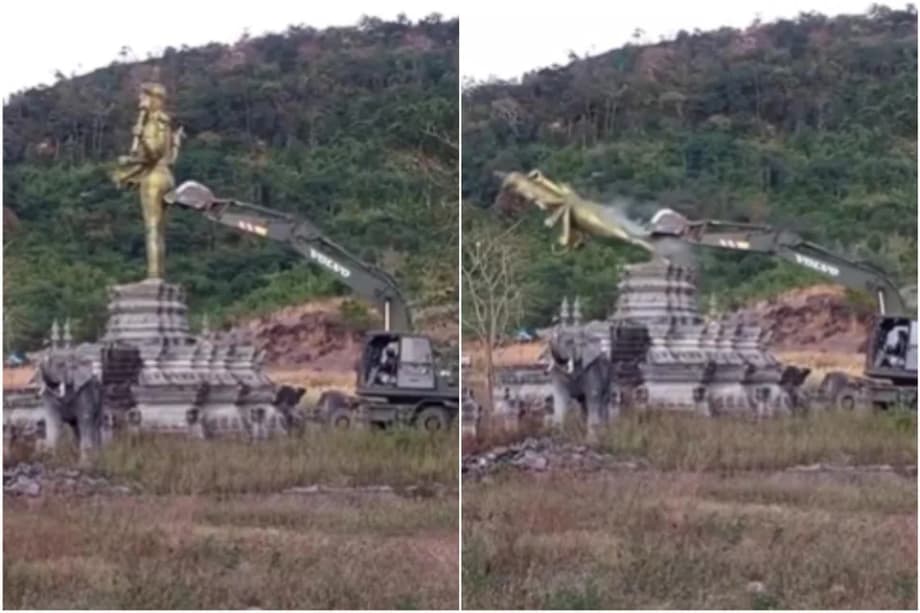
The current controversy began in December 2025 when Thai forces destroyed the Lord Vishnu statue that had stood near the border for several years. Cambodian officials condemned the act, with Kim Chanpanha, a government spokesman in the border province of Preah Vihear, stating that the statue, built in 2014, “was inside our territory in the An Ses area.”
We condemn the destruction of ancient temples and statues that are worshipped by Buddhist and Hindu followers. The statue was inside our territory in the An Ses area.
For Thai authorities, the demolition was a necessary assertion of sovereignty over territory they consider their own. The statue had been erected by Cambodian forces on land that Thailand maintains is its sovereign territory. Following Thailand’s military regaining control of the area, the destruction of the Vishnu statue was framed as an assertion of Thai sovereignty.
Just days after the violence subsided and the ceasefire took effect, Thailand installed a Buddha statue at the same location. According to Thai military sources, the statue represents the god Buddha under the protection of Naga, a significant figure in Buddhist iconography. The installation was overseen by a senior monk, Phra Dhamma Vajiarayankosol from Surin, who reportedly stated that the image was installed to “protect Thai territory.”
Religious Symbolism in Territorial Disputes
Both Thailand and Cambodia are predominantly Buddhist countries, yet the placement and destruction of religious symbols have become deeply politicized in this conflict. The Vishnu statue, while Hindu, had become a spiritual anchor for Cambodian troops and villagers in the border region, who regarded it as a guardian watching over the volatile frontier.
Professor David Chandler, an expert on Cambodian history, notes that “In Southeast Asia, Hindu deities like Vishnu have been incorporated into local Buddhist traditions for centuries. The deliberate destruction and replacement of these symbols transforms them from spiritual symbols into political statements.”
The replacement of one religious symbol with another at a contested site carries particular significance. The placement of the Buddha statue directly on the remains of the destroyed Vishnu statue, as evidenced in photographs from the installation ceremony, appears to many observers as a symbolic assertion of dominance rather than an act of religious devotion.
Regional and International Reactions
The controversy has drawn international attention and condemnation, with India expressing particular concern about the demolition of the Hindu deity statue. India’s Ministry of External Affairs issued a strong statement condemning what it called a “disrespectful act” that hurt religious sentiments.
We have seen reports on the demolition of a statue of a Hindu religious deity, built in recent times, and located in an area affected by the ongoing Thai-Cambodia border dispute. Hindu and Buddhist deities are deeply revered and worshipped by people across the region, as part of our shared civilizational heritage. Notwithstanding territorial claims, such disrespectful acts hurt the sentiments of followers around the world, and should not take place.
India urged both countries to resolve their differences through dialogue and diplomacy, emphasizing that religious sites and symbols should not become collateral damage in territorial disputes.
ASEAN, the regional association that includes both Thailand and Cambodia, has called for restraint and adherence to ceasefire agreements. However, the organization’s ability to mediate the conflict has been limited, reflecting the deep-seated nature of the territorial disagreement.
Humanitarian and Economic Impacts
The border conflict has had severe humanitarian consequences. According to official figures, the December 2025 violence left more than 40 dead and displaced nearly one million people. Communities along the border have been torn apart as families separated by the conflict seek refuge in safer areas.
Economically, the dispute has disrupted trade and commerce between the neighboring countries. Bilateral trade between Thailand and Cambodia reached over $10 billion in 2024, with Thailand serving as Cambodia’s fourth-largest trading partner. The border closures and fighting have devastated local economies, particularly in Thai provinces like Ubon Ratchathani and Cambodian towns like Poipet.
- Trade routes worth billions have been disrupted
- Border crossings remain partially closed
- Thousands of migrant workers have been displaced
- Local economies on both sides of the border have suffered
- Cambodia has begun seeking alternative trading partners
The conflict has also strained diplomatic relations and damaged the image of both countries in the international community. The use of religious sites and symbols in military operations has drawn criticism from religious leaders and human rights organizations worldwide.
Complex Diplomatic Efforts Underway
In an attempt to de-escalate tensions, Thailand and Cambodia’s General Border Committee (GBC) secretariats are meeting in Chanthaburi province to draft ceasefire terms. The meetings aim to revive the July 2025 US-brokered truce, though persistent disagreements continue to complicate diplomatic efforts.
Cambodia initially pushed for neutral venues like Kuala Lumpur for negotiations, but Thailand rejected this proposal, citing security concerns. Thailand’s insistence on Chanthaburi as the meeting location reflects the deep distrust between the neighboring countries.
Among the outstanding issues are Thailand’s allegations that Cambodian forces have violated ceasefire agreements by deploying anti-personnel mines and using temples as military bases. Cambodia, in turn, has accused Thailand of seizing additional border territory and conducting aggressive military operations.
Shared Heritage vs. National Sovereignty
The border region contains numerous ancient temple ruins and religious sites that represent shared cultural heritage between Thailand and Cambodia. The Preah Vihear temple, a UNESCO World Heritage site awarded to Cambodia by the International Court of Justice in 1962, has been a particular flashpoint in the dispute.
Many historians and cultural preservation experts have expressed concern about the potential damage to these ancient sites during military operations. The destruction of the Vishnu statue, while relatively recent compared to these ancient temples, represents a worrying trend of using religious heritage as a pawn in territorial conflicts.
“These temples and statues represent not just national heritage but shared civilization across Southeast Asia,” said Dr. Helen Ibbitson Jesudason, a Southeast Asian art historian. “When they become targets in territorial disputes, all of humanity loses a piece of its collective memory and spiritual inheritance.”
The Path Forward
Resolving the Thai-Cambodia border dispute will require more than just temporary ceasefires. The conflict stems from fundamental disagreements over colonial-era boundary demarcations, with both sides claiming historical and legal rights to the disputed territories.
International mediation may prove essential, though past efforts have had limited success. The role of ASEAN, often criticized for its non-intervention policy, remains unclear. The involvement of regional powers like China, which maintains close ties with both countries, could potentially facilitate dialogue, though such involvement also raises concerns about influence and leverage.
For now, the Buddha statue installed at the disputed border stands as a potent symbol of the complex interplay between religious identity, national sovereignty, and territorial rights in Southeast Asia. Until the underlying territorial disputes are resolved through diplomatic means, such symbolic actions risk continuing the cycle of tension and conflict that has plagued the region for generations.
Key Points
- A Buddha statue has been installed on Thailand’s disputed border with Cambodia, replacing a Hindu Lord Vishnu statue demolished by Thai forces
- The location is known as An Ma in Thailand and An Ses in Cambodia, both countries claim the territory
- The Vishnu statue was destroyed in December 2025 as Thai forces asserted control over the border region
- Cambodia condemned the Buddha statue installation as inconsistent with ceasefire agreements
- Thailand defended the move as an exercise of religious freedom and a morale-boosting gesture
- India condemned the demolition of the Hindu statue as disrespectful to religious sentiments
- The conflict stems from colonial-era border demarcation disputes dating back to 1904-1907 treaties
- Fighting in December 2025 left dozens dead and displaced nearly one million people
- The dispute has significant economic implications, with bilateral trade exceeding $10 billion annually
- Diplomatic efforts to resolve the conflict through ceasefire talks are ongoing but face significant challenges