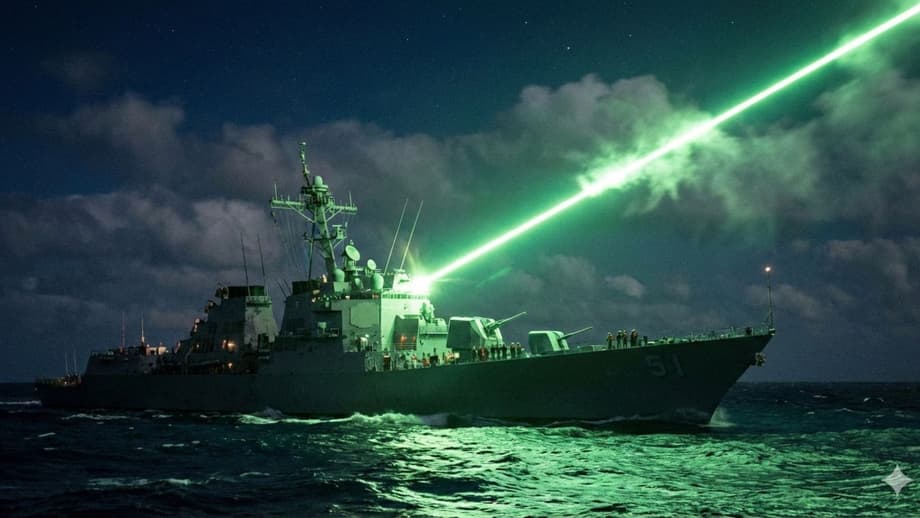
A Silent Weapon for Modern Warfare
It sounds like a contradiction. A weapon powerful enough to slice through metal and take down drones while they are still flying, yet completely silent and almost invisible when it strikes. Japan has begun testing a new defense system at sea that challenges everything we usually associate with modern weapons. For most of the test, it does not look dangerous at all. This new system represents a major shift in how nations approach security, moving away from explosive kinetic force toward directed energy. The weapon in question is a 100-kilowatt class laser, developed to address threats that did not exist a decade ago. During recent trials, the system proved capable of destroying drones in mid-flight and cutting through metal surfaces without making physical contact.
Modern battlefields are changing fast. Small drones, cheap flying devices, and fast-moving airborne threats are becoming more common. Traditional defenses are struggling to keep up with this evolving landscape. Missiles are effective, but they are expensive to manufacture and deploy. Guns require ammunition and time to reload. Japan’s latest system was designed to respond instantly, without explosions, and without relying on physical projectiles. From a distance, the moment of impact is barely noticeable until the target suddenly fails. This approach offers a clear advantage in environments where speed and precision matter more than brute force, especially at sea where response times can be critical.
Responding to the Drone Threat
The proliferation of unmanned aerial vehicles has forced military planners to rethink air defense. Swarm attacks, where dozens or hundreds of drones coordinate to overwhelm a target, are particularly difficult for conventional missile systems to counter. Shooting down a cheap drone with a multi-million dollar interceptor is financially unsustainable in the long run. Japan’s new laser system offers a solution to this asymmetry. By using light as a weapon, the cost per engagement drops dramatically.
The Japan Maritime Self-Defense Force has been keen to integrate this technology into its fleet. The system provides a layer of defense that can operate continuously as long as the ship has power. Unlike missiles, which must be stored in limited magazines and replenished at port, a laser weapon has what experts call unlimited magazine depth. This capability allows a ship to defend against multiple waves of attacks without running out of ammunition. The shift toward directed energy is driven by the need for sustainable defense mechanisms that can maintain a high rate of fire without the logistical burden of traditional munitions.
The Technology Behind the Beam
At the heart of this new defense system is a sophisticated array of fiber lasers. The weapon combines ten individual fiber lasers, each rated at 10 kilowatts, into a single 100-kilowatt beam. This process, known as beam combining, generates enough focused power to burn through metal surfaces and disable aircraft in seconds. The technology relies on a fiber laser architecture, where the beam is generated by light being amplified and focused as it travels through a solid-state optical fiber doped with rare earth elements. This method is distinct from older chemical laser technologies, which required hazardous fuels and were far less efficient.
Fiber lasers are favored for their scalability, safety, and operational efficiency. They are generally more compact and easier to cool than their predecessors, making them suitable for installation on naval vessels. The concentrated energy of the beam heats the target rapidly, causing structural failure or the detonation of explosive payloads on board a drone or mortar. Japan began its laser weapon research with chemical lasers over a decade ago but transitioned to fiber laser systems to overcome the limitations of the older technology. The result is a weapon that is not only powerful but also reliable enough for military use.
The development of this system has been a long-term project for Japan’s Acquisition, Technology, and Logistics Agency (ATLA). The agency has been working on laser weapon concepts for years, progressing from lower power prototypes to the current 100-kilowatt configuration. A prototype was confirmed to have been delivered to ATLA by the manufacturer, Kawasaki Heavy Industries, in early 2023. Since then, engineers have refined the system to ensure it meets the rigorous demands of maritime operations.
Power and Logistics at Sea
One of the most significant advantages of this laser weapon is its logistical simplicity. Traditional naval guns require massive magazines of heavy shells, while missile systems need vertical launch cells that take up valuable deck space. The laser system, in contrast, requires only electricity and cooling water to operate. This drastically reduces the logistical tail required to support the ship.
Officials from ATLA have highlighted the economic benefits of this approach. In a public technical briefing, the agency stated that provided sufficient power, the system can continue to engage targets without running out of ammunition. They noted that the cost-per-shot is substantially lower than conventional air-defense systems, likening the expense to the price of electricity consumption. This makes the weapon especially attractive for countering swarms of low-cost drones. In a scenario where an enemy attacks with hundreds of inexpensive drones, a ship equipped with lasers can neutralize the threat without depleting its expensive stockpile of interceptor missiles.
Testing Aboard the JS Asuka
To evaluate the performance of this advanced weapon, Japan has installed it on a dedicated test platform. The laser system was mounted on the JS Asuka, a 6,200-ton test ship operated by the Japan Maritime Self-Defense Force. The ship arrived at a Japan Marine United shipyard for the installation process. The weapon is packed into two 40-foot container-sized modules, which house the fiber laser array, beam control optics, power systems, and cooling infrastructure.
Visible on the rear deck of the Asuka is a distinctive dome-like unit. This is the beam director, which contains the optics necessary to aim the laser at a target. It is linked to thermal imaging cameras, fast-steering mirrors, and precision tracking sensors. These components work together to keep the laser focused on a specific point on a moving target, even when the ship is pitching and rolling in rough seas. The modular nature of the installation allows for easier maintenance and potential retrofitting onto other vessels in the future if the trials prove successful.
The current phase of testing involves preparing the system for live sea trials. These trials are scheduled to begin after February 27, 2026. The initial tests will focus on the system’s ability to detect, track, and hold a lock on aerial targets over the water. This is a critical step, as the maritime environment presents unique challenges that are not present in land-based tests. The motion of the ship, combined with humidity and sea spray, can interfere with the laser beam and the sensors tracking the target.
Engineering Challenges and Environmental Factors
While the concept of a laser weapon sounds straightforward, implementing it effectively in a real-world environment is a complex engineering challenge. One of the primary obstacles is atmospheric interference. Moisture in the air, rain, fog, and even dust can scatter the laser beam, reducing its intensity and accuracy at the target. The upcoming sea trials will determine how well the system can compensate for these factors. Engineers have developed algorithms to adjust the beam, using reference lasers to analyze the air between the weapon and the target and correct for distortion.
Another challenge is power management. Although fiber lasers are efficient, converting electrical energy into light energy still generates significant heat. A 100-kilowatt laser might require up to 300 kilowatts of electrical power to operate, with the excess energy dissipated as heat. Managing this thermal load is vital for the continuous operation of the weapon. The system onboard the Asuka includes robust cooling infrastructure to prevent the lasers from overheating during sustained firing.
Keeping the beam on target long enough to cause damage is also difficult. Fast-moving drones or mortar rounds require the beam director to track with extreme precision. The system must anticipate the movement of the target and adjust the mirrors instantly to maintain the focal point on a critical area of the threat. ATLA confirmed that the weapon successfully destroyed mortar rounds and unmanned aerial vehicles in ground-based tests earlier this year. These results provided the confidence needed to move the testing to the more demanding maritime environment.
Global Competition in Directed Energy
Japan is not alone in pursuing this technology. The development of directed-energy weapons has become a global race, with major military powers investing heavily in the field. The United States, France, Germany, and the United Kingdom are all confirmed to be developing similar systems. China is also suspected to be advancing its laser capabilities, following the appearance of what looked like a laser weapon on a Chinese amphibious transport dock in 2024.
Israel has emerged as a leader in this domain. The Israeli Defense Force announced that its Iron Beam system became the first high-energy tactical laser weapon to be fully integrated and cleared for operations in a national defense array. This system, also operating around the 100-kilowatt level, is designed to intercept short-range threats like rockets, mortars, and drones. Similarly, the United Kingdom has tested its DragonFire laser, which successfully shot down several drones during trials off the coast of Scotland.
This international activity underscores a broader shift in military doctrine. Directed-energy weapons are moving from experimental prototypes to operational assets. Japan’s decision to test a 100-kilowatt laser at sea places it among the leading nations in this field. The ability to field such a system is seen as a marker of advanced technological capability and industrial strength. For Japan, which relies heavily on a defensive posture due to its constitution, these weapons offer a potent shield that does not violate prohibitions on offensive strike capabilities.
The Future of Naval Defense
The current trials aboard the JS Asuka are just the beginning of a longer roadmap for Japan’s laser program. While the immediate focus is on countering drones and mortar rounds, ATLA has acknowledged that future iterations could tackle more difficult targets. Higher-powered lasers could potentially be used to intercept missiles, although this remains a long-term goal. The data gathered from these sea trials will be crucial in determining whether such an upgrade is feasible.
Looking ahead, the Japanese Ministry of Defense has scheduled the deployment of a sea-based laser system on vessels equipped with the Aegis combat system. These ships are expected to enter service with the new capability after 2032. This timeline indicates that while the technology is promising, there is still a significant period of testing and refinement required before it becomes a standard feature of the fleet.
The successful integration of laser weapons could fundamentally change the nature of naval warfare. Ships equipped with these systems will have a durable, cost-effective layer of defense against aerial threats. They will be less vulnerable to depletion of ammunition and better able to sustain operations during prolonged conflicts. As the technology matures, we can expect to see lasers become a common sight on warships, working alongside traditional guns and missiles to provide a comprehensive defense shield.
The Bottom Line
Japan’s testing of a 100-kilowatt laser weapon marks a significant milestone in military technology. The system offers a glimpse into the future of defense, where speed of light engagement and unlimited ammunition redefine what is possible at sea.
- Japan is testing a 100-kilowatt laser weapon aboard the JS Asuka test ship.
- The system combines ten fiber lasers to generate a single beam capable of cutting through metal.
- It offers unlimited magazine depth as long as the ship has electrical power.
- The cost per shot is comparable to the price of electricity, far cheaper than missiles.
- Sea trials are scheduled to start after February 27, 2026.
- The weapon is designed to counter drones, mortars, and other lightweight airborne threats.
- Japan joins the US, UK, Israel, and others in the development of directed-energy weapons.
- Operational deployment on Aegis-equipped ships is expected after 2032.