The End of Battery Anxiety for Wearable Sensors
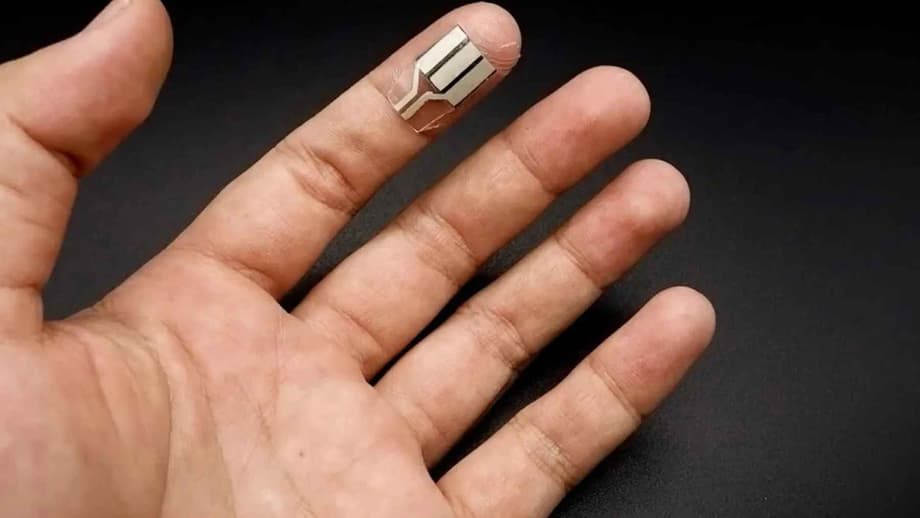
You know that mini panic when a fitness tracker dies right as you start a workout. Suddenly, the device meant to monitor your heart rate, calories burned, and exercise intensity becomes a useless piece of plastic on your wrist. The frustration of searching for charging cables, the inconvenience of devices that need constant replenishment from wall outlets, and the environmental guilt of disposable batteries have long plagued the wearable technology industry. Researchers in Japan have developed a technology that could make these frustrations obsolete. A team at Tokyo University of Science has created a thin, skin-mounted patch that generates electricity directly from human sweat, eliminating the need for rechargeable batteries or charging cables entirely.
- The End of Battery Anxiety for Wearable Sensors
- Turning Body Chemistry into Electricity
- Solving the Production Bottleneck
- Engineering the Perfect Ink
- Performance That Matches Real Life
- Applications Across Sports and Healthcare
- Environmental and Economic Impact
- Challenges on the Path to Market
- The Essentials
The breakthrough centers on a water-based enzyme ink that enables single-step screen printing of complete biofuel cells onto paper substrates. Published online on February 6, 2026, in ACS Applied Engineering Materials, the research demonstrates a peak power density of approximately 165 microwatts per square centimeter (around 1,065 microwatts per square inch) at 0.63 volts. This output is sufficient to power low-energy biosensors and wireless data transmission, potentially transforming how we monitor health during exercise, clinical care, and daily life. The innovation represents a fundamental shift from stored energy to harvested energy, using the body’s own chemistry as a fuel source.
Associate Professor Isao Shitanda, who led the research team from the Department of Pure and Applied Chemistry, explains that the goal was to overcome manufacturing barriers that have kept similar technologies trapped in laboratories for years. By creating an ink that prints uniformly in a single pass, the team has opened a practical pathway toward mass production of battery-free wearable biosensors. This development arrives as the global wearable medical device market approaches $195 billion in value, with battery elimination representing one of the field’s most urgent engineering challenges.
Turning Body Chemistry into Electricity
The devices are called enzymatic biofuel cells, or EBFCs, and they generate electricity by using biological enzymes to drive chemical reactions in body fluids. In this study, the main fuel is lactate, a metabolic byproduct present in sweat. When you exercise, your muscles produce lactate as they consume glucose for energy, and some of this compound exits the body through perspiration. The Japanese researchers designed their system to measure lactate concentrations across roughly 1 to 25 millimolar, a range that directly corresponds to real exercise conditions from light activity to intense physical exertion.
The electrochemical process is elegant in its simplicity. At one electrode, enzymes help pull electrons from lactate molecules. These electrons then move through an external circuit, creating an electrical current. At the opposite electrode, oxygen from the surrounding air accepts these electrons to complete the reaction. This continuous flow of electrons delivers usable power for sensing and data transmission without requiring any stored charge or external power source. Because the device relies on chemicals naturally produced by the body, electricity generation occurs passively during everyday activities such as walking, exercising, or performing routine tasks.
Previous studies from the same research group have already demonstrated that this power output can run Bluetooth Low Energy systems, allowing the device to transmit sweat lactate readings wirelessly without any battery assistance. This creates a self-powered monitoring loop where the harder you work, the more sweat you produce, and consequently, the more power becomes available to transmit data about your physical condition. For wearable health monitoring, this relationship is powerful. It means the sensor gets stronger exactly when your body needs monitoring most.
Solving the Production Bottleneck
For years, enzymatic biofuel cells have shown promise in laboratory settings, but manufacturing challenges have prevented their widespread adoption. Conventional fabrication methods involve multiple labor-intensive steps. Manufacturers must first print a carbon electrode layer, then separately drip-cast enzyme and mediator solutions onto the surface, and finally wait for the uneven films to dry. This multi-stage process introduces significant variability between devices, making quality control difficult and mass production impractical. Small differences in how much liquid lands, or how long it dries, can change power and sensing from patch to patch.
Addressing this challenge, Associate Professor Isao Shitanda and his team, including Ms. Mahiro Omori from Tokyo University of Science and Mr. Mitsuru Hanasaki from RESONAC Co. Ltd, developed a formulation that collapses these fragile steps into a single printable layer. The innovation lies in premixing the active chemistry directly into a printable ink, allowing both electrodes to be manufactured in one pass through a mesh screen onto a thin paper substrate.
In order to avoid labor-intensive, inefficient, and expensive EBFC fabrication techniques, we need to bring an enzyme ink to the market that can be printed uniformly and is suitable for mass production.
This screen-printing approach is already widely used in industrial manufacturing, which means the technology could integrate seamlessly into existing production lines. The water-based formulation avoids organic solvents that could damage delicate enzyme structures, ensuring the biological components retain their activity after the printing process. The consolidation reduces variation between devices, setting up the next challenge of turning laboratory prints into durable, wearable sensors that factories can actually build.
Engineering the Perfect Ink
Creating a stable, printable enzyme ink required careful balancing of multiple components. The research team combined magnesium oxide-templated mesoporous carbon, a porous material with extremely high surface area, with chemical mediators that facilitate electron transfer. They added a novel water-based binder called POLYSOL, a polymer emulsion that binds strongly to carbon surfaces while maintaining a stable environment for enzymes within the porous structure. Carboxymethyl cellulose served as a thickener to achieve the proper consistency for screen printing.
The inclusion of carboxymethyl cellulose is particularly significant. Related research published in Nature has shown that this additive improves the dispersibility of mesoporous carbon inks and increases the accessibility of the material’s internal pores. In previous studies, adding CMC to similar carbon formulations more than doubled maximal current density and increased power density over 2.5-fold compared with electrodes fabricated without the additive.
Perhaps the most challenging aspect of biofuel cell fabrication has always been the cathode, the oxygen-utilizing electrode where electrons complete their circuit. Oxygen-handling enzymes are particularly sensitive and difficult to stabilize using conventional manufacturing methods. By embedding bilirubin oxidase directly into the same printable ink mixture used for the rest of the cell, the Japanese team formed a stable, high-performing cathode in one pass. This represents the first successful screen printing of a fully functional cathode side using enzyme ink, clearing the last major bottleneck in scalable biofuel cell production.
Performance That Matches Real Life
Electrochemical testing revealed that the printed electrodes significantly outperformed conventional drop-cast alternatives. The complete lactate-oxygen biofuel cell achieved a maximum power density of 165 microwatts per square centimeter with an operating voltage of 0.63 volts. This substantially exceeds a previously reported value of 96 microwatts per square centimeter in similar systems, marking a major advance in energy harvesting efficiency for wearable applications.
Reliability testing showed equally impressive results. Drop-cast electrodes typically degrade to less than half their initial activity within minutes to hours, suffering from uneven enzyme distribution and poor adhesion to the substrate. The enzyme-ink electrodes exhibited minimal decay during extended testing periods, maintaining stable performance that is essential for practical wearable use.
The system operates effectively within the physiological range of lactate concentrations observed in healthy individuals during exercise, approximately 1 to 25 millimoles per liter. This alignment with natural sweat chemistry is critical for making the device practical for use in the real world. The team also demonstrated scalability through a roll-to-roll printing demonstration that continuously printed approximately 1,312 feet (400 meters) of substrate, proving the manufacturing approach works at industrial scales. Storage testing at 5 degrees Celsius under vacuum conditions showed the best preservation of enzyme activity, pointing toward viable shipping strategies for commercial products.
Applications Across Sports and Healthcare
The potential applications for self-powered sweat sensors extend across multiple domains. In sports science, real-time lactate monitoring could provide immediate feedback on exercise intensity and muscle fatigue without requiring athletes to stop for blood draws. Coaches could monitor fatigue thresholds, athletes could optimize pacing, and training loads could be adjusted based on live biochemical data rather than estimates. The link between sweat lactate and blood lactate remains complex, but for performance monitoring, the correlation is strong enough to deliver actionable insights today.
In healthcare settings, continuous metabolic monitoring could allow for early detection of health conditions. In nursing homes and elderly care facilities, patients cannot always communicate symptoms clearly. Dehydration, heat stress, and early-stage infection each alter sweat chemistry in measurable ways. A continuous, self-powered skin patch could flag those changes hours before conventional periodic checks would catch them. For clinical staff, that early-warning capability means faster intervention, reduced emergency escalations, and better patient outcomes. For patients, a paper-thin patch that simply sticks to skin removes every barrier to compliance.
Similar sensors may contribute to heatstroke prevention systems by detecting early metabolic warning signs when hot weather turns simple activities into risky challenges. In post-surgical recovery and chronic disease management, the same low-friction monitoring model applies, allowing consistent data collection that has historically been difficult to maintain with battery-dependent devices.
Environmental and Economic Impact
Every wearable device looks small individually, but the collective environmental impact is substantial. The world generated approximately 68.3 million tons of electronic waste in 2022, and only about 22 percent was documented as properly collected and recycled. Battery-free patches will not solve the e-waste crisis alone, especially if designed for single use, but they could reduce demand for miniature batteries and simplify device designs significantly.
Eliminating the coin-cell battery that has dominated wearable sensor design for decades reduces bulk, cost, and environmental impact simultaneously. For disposable medical patches that currently require battery replacement or disposal with toxic components, this technology offers a cleaner alternative that runs entirely on the chemistry the body already produces.
From an economic perspective, the technology promises dramatic cost reductions. If the entire device can be fabricated using full-screen-printing processes, production costs could drop to approximately 10 yen per device, making disposable or large-scale wearable applications economically viable. This positions the technology as a potential disruptor in the global wearable medical device market, which analysts project will exceed $195 billion by 2030.
Challenges on the Path to Market
Despite the promising results, additional work is needed before sweat-powered biofuel cells can be widely used in commercial devices. The paper substrate must prove it can handle sweat, bending, and daily movement without losing performance. Enzymes can gradually lose effectiveness due to temperature changes, exposure to oxygen, and environmental conditions during wear. The team acknowledges that practical implementation may come closer to 2030 after further optimization, validation over long time periods, and integration with wearable platforms.
Real-world value will depend on patches that feel comfortable, keep readings stable, and give clinicians and users clear signals across different body types and activity levels. While the roll-to-roll demonstration proved manufacturing scalability, the transition from laboratory conditions to consumer products requires rigorous durability testing and clinical validation. The researchers anticipate that printing companies and health care device manufacturers may be strong candidates for adopting this technology once these final barriers are cleared.
If these challenges are met, the use cases are easy to picture. Real-time lactate tracking could help athletes fine tune effort, and continuous metabolic monitoring could support care settings where passive, low-burden monitoring matters most. The technology has the potential to contribute to the realization of a safer and healthier society by serving as the basis for sensors that monitor one’s physical condition by simply wearing them.
The Essentials
- Japanese researchers at Tokyo University of Science developed a water-based enzyme ink that enables single-step screen printing of sweat-powered biofuel cells, achieving 165 microwatts per square centimeter at 0.63 volts.
- The technology eliminates the need for batteries in wearable sensors by converting lactate in sweat into electricity using enzymatic reactions, with sufficient power for Bluetooth Low Energy transmission.
- Unlike conventional multi-step manufacturing methods that cause device variability, the new enzyme ink allows both electrodes to be printed simultaneously on paper substrates, potentially reducing costs to approximately 10 yen per device.
- The system measures lactate concentrations from 1 to 25 millimolar, matching real exercise conditions, and could enable continuous health monitoring for athletes, elderly care patients, and heatstroke prevention.
- Practical implementation is targeted for around 2030, pending further optimization of storage stability, long-term validation, and integration with wearable platforms.