A Practical Revolution in Clean Power
While climate headlines often focus on targets decades in the future, a tangible shift is already sitting inside industrial facilities across Japan. In late September 2025, Kawasaki Heavy Industries began selling what it calls the world’s first large scale gas engine capable of running on natural gas mixed with up to 30% hydrogen by volume. Unlike experimental prototypes, this machine comes with a full manufacturer warranty, established service schedules, and a clear pathway for installation at existing power plants. For facility operators balancing electricity costs against carbon reduction mandates, the technology offers an immediate, practical step forward without requiring the complete reconstruction of energy infrastructure.
The commercial launch follows an eleven month operational verification period that began in October 2024 at Kawasaki’s Kobe Works facility near Kobe Airport. Engineers tested an 8 megawatt class system under real world industrial loads, focusing not merely on combustion stability but on the practical challenges of hydrogen supply integration, maintenance protocols, and day to day safety procedures. The successful completion of these trials in September 2025 marked the transition from pilot project to commercial product, making the technology available for immediate deployment in distributed power generation applications ranging from industrial facilities to municipal utilities seeking baseload power with reduced carbon intensity. Industry analysts note that this approach bridges the gap between current fossil fuel dependence and future renewable hydrogen economies.
From Laboratory to Commercial Reality
The new engine builds upon Kawasaki’s existing Green Gas Engine platform, specifically the KG Series that has accumulated more than 240 orders worldwide since its introduction in 2011. This established foundation allows the company to offer a hydrogen ready model that maintains the same 5 to 8 megawatt output range as its predecessors while accommodating fuel blends containing between 5% and 30% hydrogen by volume. The design philosophy centers on transition rather than replacement, enabling power plant operators to begin with conventional natural gas or city gas and gradually increase hydrogen content as supply chains mature and green hydrogen production scales up.
What distinguishes this launch from previous hydrogen demonstrations is the retrofit capability. Existing KG Series engines installed over the past decade can be upgraded to the hydrogen co-firing specification with limited modifications to the machine and surrounding equipment. For plant managers, this means that capital investments made years ago do not instantly become stranded assets. The retrofit approach allows facilities to extend the service life of current infrastructure while progressively lowering emissions, a crucial consideration for an industry facing pressure to decarbonize without disrupting grid reliability or undertaking multibillion dollar facility replacements.
The specific model, designated KG-18-H, is based on the KG-18-T city gas engine architecture. By designing the hydrogen mixing ratio control system to integrate with minimal changes to the existing engine block, Kawasaki ensures that the proven reliability of the KG series remains intact while adding flexible fuel capability. This engineering approach draws upon over a decade of operational data from the 240 plus units already in service, reducing the technical risks typically associated with adopting new combustion technologies.
Engineering Solutions for a Hydrogen Future
Hydrogen poses distinct engineering challenges compared to methane based natural gas. The molecules are far smaller, allowing them to diffuse through seals and joints that effectively contain larger methane molecules. Hydrogen also ignites across a wider fuel air range and burns with a higher flame speed and temperature, creating risks of abnormal combustion and overheating in conventional engine designs. These characteristics demanded comprehensive safety innovations and combustion control systems before commercial deployment could proceed.
Kawasaki addressed these concerns through multiple layers of protection. The system incorporates hydrogen leak detectors positioned around fuel lines and enclosed areas where gas might accumulate. Nitrogen purge systems flush fuel lines during startup, shutdown, or fault events, preventing the formation of explosive mixtures. Engineers also redesigned piping configurations to reduce the number of flanged joints where leaks could occur, addressing hydrogen’s tendency to escape through microscopic gaps. During the eleven month verification period, these safety systems underwent rigorous testing to ensure they could manage the specific risks of hydrogen combustion in industrial environments while maintaining operational efficiency.
The combustion control system dynamically adjusts conditions in response to power generation output and real time hydrogen content in the fuel mix. This capability is essential because hydrogen burns approximately seven times faster than natural gas, which can lead to knocking or premature ignition if not carefully managed. By controlling the combustion process to account for these properties, the engine achieves stable operation across the full 5% to 30% hydrogen blend range without sacrificing the high efficiency and low NOx characteristics that defined the original KG Series performance.
Maritime Applications Take Shape
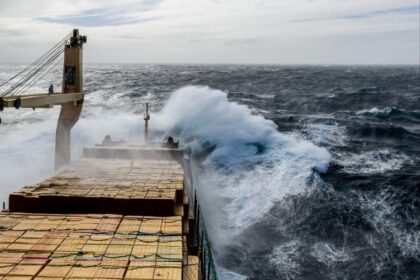
The transition technology is extending beyond stationary power plants to the shipping industry, where emissions regulations and fuel costs drive constant innovation. On October 28, 2025, a consortium including Kawasaki, Yanmar Power Solutions, and Japan Engine Corporation announced the completion of the world’s first land based operation of marine hydrogen engines. The demonstration at Japan Engine Corporation’s headquarters utilized a newly developed liquefied hydrogen fuel supply system to power several classes of engines designed for ocean going vessels, funded under Japan’s Green Innovation Fund.
Two medium speed four stroke engines from Kawasaki and Yanmar achieved stable hydrogen combustion at rated output during these tests. A low speed two stroke main engine, the type commonly used on large container ships, is scheduled to begin operation in spring 2026. All three designs feature dual fuel capability, allowing crews to switch between hydrogen and conventional diesel depending on fuel availability at ports. This flexibility addresses the current absence of global hydrogen bunkering infrastructure, ensuring that vessels can maintain operations even when hydrogen supplies are unavailable while cutting greenhouse gas emissions when the fuel is accessible.
The marine initiative receives funding from Japan’s Green Innovation Fund, a program managed by the New Energy and Industrial Technology Development Organization (NEDO) that directs approximately two trillion yen toward technologies supporting Japan’s carbon neutrality goals by 2050. These dual fuel engines represent a pragmatic approach to maritime decarbonization, acknowledging that international shipping routes may not have consistent hydrogen availability for years to come. By enabling ships to burn hydrogen when possible and diesel when necessary, the technology provides a transitional pathway similar to the stationary power applications, allowing the industry to begin reducing emissions immediately while infrastructure catches up.
Constructing the Hydrogen Supply Chain
Engines require fuel, and hydrogen supply chains remain the critical bottleneck for widespread adoption. Recognizing this dependency, Kawasaki and Japan Suiso Energy broke ground on November 27, 2025, for the Kawasaki LH2 Terminal in Ogishima, Kawasaki City. The facility represents the world’s first commercial scale terminal for liquefied hydrogen, featuring a 50,000 cubic meter storage tank, maritime loading and unloading facilities, liquefaction units, and truck dispatch infrastructure. Operations are scheduled to commence around fiscal year 2030, creating a backbone for importing hydrogen produced overseas and supplying it to domestic industry.
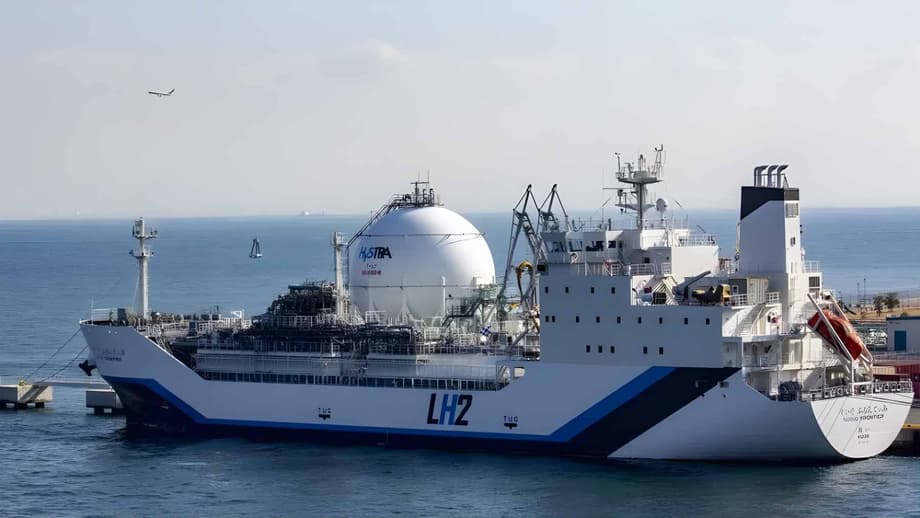
The terminal will be served by a new liquefied hydrogen carrier with approximately 40,000 cubic meters of capacity, much larger than the earlier Suiso Frontier vessel that conducted pilot shipments from Australia. Liquefied hydrogen, stored at temperatures of minus 253 degrees Celsius, requires specialized handling but offers advantages in energy density for maritime transport. Kei Nomura, who leads the Hydrogen Strategy Division at Kawasaki, stressed the strategic importance of this infrastructure, explaining the company’s long term vision:
“liquid hydrogen is a vital key to realizing a sustainable energy society”
Recent advances in liquefied hydrogen handling include an intermediate fluid vaporizer system developed in partnership with Kobe Steel. This technology captures the extreme cold of liquid hydrogen for use in industrial cooling, data center air conditioning, and refrigeration applications while efficiently converting the fuel to gas for engine consumption. By pressurizing hydrogen in its liquid state, the system drastically reduces the parasitic load, or energy used to run the plant itself, making hydrogen power economically viable for the first time at commercial scale.
Real World Validation and Carbon Tracking
Beyond the controlled environment of Kobe Works, the technology is already entering active service with third party verification. At the Himeji No. 1 power plant, Kansai Electric Power, Kawasaki Heavy Industries, and BIPROGY have implemented Japan’s first real time carbon tracking system for hydrogen co-firing operations, validated by DNV, an international accredited registrar and classification society. This monitoring system provides continuous emissions auditing, ensuring that carbon reduction claims are independently verifiable rather than merely theoretical projections.
This level of transparency addresses growing demands from regulators and investors for documented proof of emissions reductions. The system tracks the specific carbon intensity of electricity generated using the hydrogen blend, creating an auditable record that can be used for carbon accounting and sustainability reporting. Such verification mechanisms will likely become standard requirements as hydrogen co-firing expands beyond early adopter facilities to broader industrial deployment, providing the credibility necessary for carbon credit markets and compliance reporting.
The verification system uses advanced sensors and blockchain based recording to prevent tampering with emissions data, ensuring that the approximately 1,150 metric ton annual CO2 reduction claimed for 30% hydrogen operation is accurately reflected in facility reporting. This independent validation is crucial for power utilities that must demonstrate compliance with increasingly strict environmental regulations while maintaining their social license to operate in communities sensitive to industrial emissions.
The Economics of Transition
The 30% hydrogen threshold represents a calculated compromise between emissions reduction and infrastructure compatibility. At this concentration, the fuel mixture can travel through existing natural gas pipelines without causing metal embrittlement or requiring extensive modifications to seals and valves. For operators, this means adoption is possible without replacing underground distribution lines or storage tanks, greatly reducing capital barriers to entry. When operated at a 30% hydrogen ratio, the engine reduces carbon dioxide emissions by approximately 1,150 metric tons annually, equivalent to the yearly emissions of roughly 420 households.
However, the transition remains incremental. In the short term, many buyers will likely operate these engines primarily on natural gas or diesel, as hydrogen supplies at scale are still emerging. The commercial release of the KG series hydrogen ready engine solves part of the chicken and egg problem facing the hydrogen economy by creating demand that can grow gradually as supply chains mature. Plant operators can purchase the engines today, run them on 100% natural gas, and shift toward higher hydrogen blends as availability improves and costs decline, protecting their investment while preparing for a future with lower carbon intensity.
Looking ahead, Kawasaki plans to continue advancing hydrogen related technologies across the entire supply chain from production and transportation to storage and utilization. The company views these engines as vital products for eliminating carbon emissions in Japan’s power generation sector, which accounts for approximately 40% of the nation’s CO2 emissions. By providing a practical, retrofittable solution that works with today’s infrastructure while accommodating tomorrow’s fuels, Kawasaki is positioning its technology as a bridge between current energy systems and the carbon neutral societies targeted for 2050.
Key Points
- Kawasaki Heavy Industries launched commercial sales of the world’s first 30% hydrogen co-firing large gas engine on September 30, 2025, following eleven months of operational verification
- The 8 megawatt class engine runs on blends of up to 30% hydrogen by volume with natural gas or city gas, reducing CO2 emissions by approximately 1,150 metric tons annually
- Existing KG Series engines from the platform’s 240 plus installed units since 2011 can be retrofitted to accommodate hydrogen co-firing, protecting existing infrastructure investments
- Safety systems include hydrogen leak detectors, nitrogen purge systems, and redesigned piping to manage hydrogen’s high flammability and small molecular size
- Marine applications are advancing through a consortium with Yanmar and Japan Engine Corporation, with dual fuel engines capable of switching between hydrogen and diesel
- The Kawasaki LH2 Terminal in Ogishima, under construction for 2030 operations, will provide Japan’s first commercial scale liquefied hydrogen import and storage facility
- Real time carbon tracking with DNV verification is already operational at the Himeji No. 1 power plant, providing independent emissions auditing for hydrogen co-firing