The Vanishing Act of the Privileged Few
Just months ago, the Instagram feeds of Nepal’s political elite showcased lives of extraordinary opulence that seemed untouchable. Shrinkhala Khatiwada, former Miss Nepal and daughter of a former health minister, commanded more than a million followers with carefully curated images of privilege. Smita Dahal, granddaughter of a three-time prime minister and former Maoist guerrilla leader, regularly displayed collections of expensive handbags that would cost years of average Nepali wages. These digital diaries of designer labels, five-star resorts, and exotic destinations provided the kindling for a revolution that would eventually force a prime minister from office and bring the state to its knees.
Today, those accounts tell a different story, one of strategic retreat in the face of public fury. Khatiwada has shuttered her Instagram entirely, disappearing from the platform where she once wielded influence. Her final YouTube upload remains a 34-minute video defending herself against the “nepo kid” label, posted months before the storm broke. Dahal has retreated behind privacy settings, her last public Facebook update dating to late August. The silence is deafening, and it is calculated. Even the most prominent symbols of political privilege seem to recognize that visibility has become dangerous.
The contrast between these vanished displays of wealth and the reality of ordinary Nepali life could not be starker. In a country where youth unemployment stands at 20.6 percent and three million citizens labor overseas, often in hazardous construction jobs in the Gulf states, the brazen display of inherited luxury had become politically toxic. Satish Kumar Yadav, a 25-year-old lab technician, captured the sentiment that eventually drove thousands to the streets in fury.
“The kids of big politicians celebrate special occasions in places like Thailand and Switzerland,” he observed in the months before the explosion. “But, the children of the general public are forced to go to Gulf countries to find jobs.”
This disparity, visible on every smartphone screen, created a pressure that the political class failed to recognize until it was too late.
From Christmas Trees of Luxury to Flames in the Capital
The symbol that best captured this disparity was perhaps the most absurd. A former minister’s son, Saugat Thapa, stood beside boxes from Louis Vuitton, Cartier and Gucci piled high in the shape of a Christmas tree, an image that circulated widely among enraged youth. While Thapa continues to post images of Hong Kong, London, Istanbul and Marrakech to his 14,000 followers, defending his wealth as “returned to the community” by his father, the resentment had already crystallized into something volatile.
The spark that ignited this accumulated fury came on September 4, 2025, when the government banned 26 social media platforms including Facebook, WhatsApp, YouTube and Instagram. Officially, the ban targeted unregistered platforms violating new digital service tax rules. In reality, critics contend, it was an attempt to silence the viral #NepoBaby campaign that had been exposing the wealth gap between political dynasties and ordinary citizens.
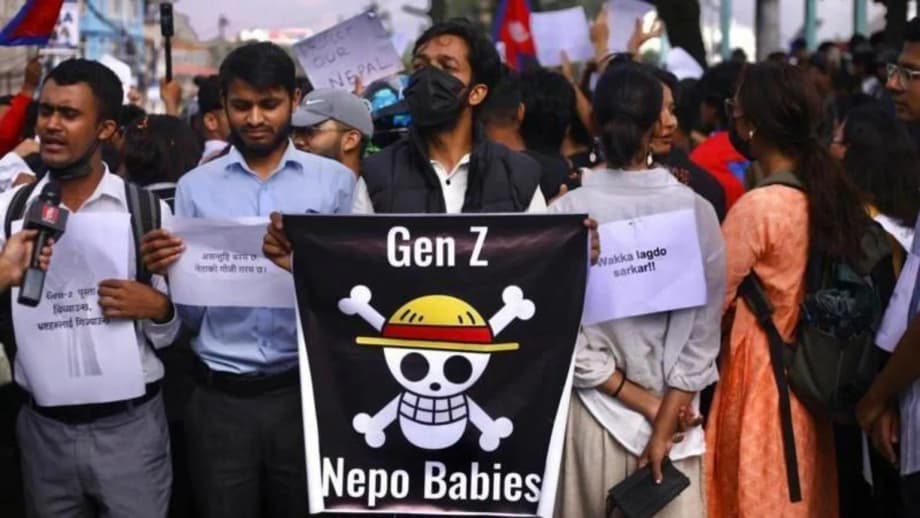
The response was immediate and catastrophic. On September 8, thousands of Gen Z protesters, many in school uniforms, converged on Kathmandu. What began as peaceful demonstrations organized by youth collectives like Hami Nepal turned violent when security forces opened fire. By nightfall, 19 protesters lay dead, many shot with live ammunition. The violence escalated over the following days as mobs torched the Parliament building, the Supreme Court, the Prime Minister’s Office, and the homes of former ministers. Former prime minister Sher Bahadur Deuba and his foreign minister wife were beaten inside their burning residence. At least 76 people died in total, including 22 protesters, three police officers, and 10 prisoners shot during jailbreaks.
Within 48 hours, Prime Minister KP Sharma Oli resigned and fled to an army barracks, eventually escaping by helicopter. The state had collapsed under the weight of generational rage.
How Discord Elected a Prime Minister
In the smoking ruins of Nepal’s government buildings, an unprecedented experiment in digital democracy emerged. While the army patrolled streets under curfew, over 100,000 young Nepalis gathered on Discord servers, the gaming chat platform that had become their headquarters for coordination. They were not merely organizing protests; they were selecting a new government.
The “Youths Against Corruption” server, established by activist Sudan Gurung of Hami Nepal, transformed into a virtual parliament. After debates and polls, the youth settled on Sushila Karki, the former Chief Justice known for her anti-corruption stance, as their choice for interim leader. It was perhaps the first time in modern history that a head of government was chosen through an online vote conducted by citizens rather than political parties.
President Ram Chandra Poudel, lacking credibility with the protesters, invoked the “doctrine of necessity” to appoint Karki on September 12. At 73, she became Nepal’s first female prime minister, tasked with steering the country to elections scheduled for March 5, 2026. Her interim cabinet includes technocrats rather than politicians, with former finance secretaries and power authority heads appointed to key ministries.
“I did not come to this position because I had sought it but because there were voices from the streets demanding that Sushila Karki should be given the responsibility,” she stated upon taking office.
Karki immediately moved to address the bloodshed, announcing compensation of 1 million rupees (approximately $7,000 to $11,330 depending on exchange rates) for families of slain protesters and medical care for the injured. She pledged her government would last no more than six months, just long enough to hold the polls.
The Reluctant Silence of the Elite
As the election approaches, the behavior of Nepal’s political families suggests they comprehend the depth of public anger, even if they remain uncertain how to address it. The social media blackout among the “nepo kids” is only the most visible symptom of this reckoning. The lavish wedding of Jaiveer Singh Deuba, son of five-time former Prime Minister Sher Bahadur Deuba, to singer Shivana Shrestha had once exemplified the excess that fueled resentment. Images of designer clothes and exotic holidays posted by the couple have vanished along with their accounts.
The political parties themselves have scrambled to demonstrate reformist credentials. The Nepali Congress removed Sher Bahadur Deuba as party president, replacing him with Gagan Thapa, a 49-year-old seen as a fresh face within the aging organization. The party has proposed investigating assets of public office holders dating back to 1991 and imposing term limits on prime ministerial and party presidential tenures. The Communist Party of Nepal UML, which held power during the massacre, has promised to mobilize youths in “political transformation.” The Rastriya Swatantra Party, only established a few years ago, has pledged to make constitutional bodies more accountable.
Yet for Rakshya Bam, one of Nepal’s most prominent Gen Z leaders, these gestures remain insufficient. She acknowledges the changes but notes the limits of such reforms.
“They forced it and made reforms within the party,” she tells observers. “They have also stipulated the time frame for which any candidate can serve as a prime minister or party president. They have also qualified how many times an individual can be a minister. I think this is a good practice and can be helpful to dismantle policy corruption.”
She says, however, that it does not go far enough, a feeling shared by other young people who witnessed the violence of September.
Promises on the Trail, Skepticism on the Streets
The March 5 election presents three distinct visions for Nepal’s future, though voters express doubt that any will break the cycle of dysfunction. Balendra Shah, a 35-year-old rapper-turned-engineer who gained fame as independent mayor of Kathmandu, has emerged as the front-runner. Running with the Rastriya Swatantra Party, he has pledged to create 1.2 million jobs and “raise strong voices against irregularities and corruption.” His black attire and sunglasses have become symbols of resistance to the traditional political class.
Gagan Thapa of the Nepali Congress promises to generate 1.5 million jobs and slash the outflow of workers by half within five years, while ridding Nepal of corruption within the same timeframe. Meanwhile, Khadga Prasad Oli, the very prime minister forced out by the protests, seeks an improbable return, pledging “zero tolerance” for corruption this time, despite having presided over the violent crackdown that killed dozens.
The skepticism among youth is palpable. Rakesh Kumar Mahato, who was shot in the spine during the protests and remains paralyzed, expresses the doubt felt by many who paid the highest price for change.
“They say they will investigate corruption, but we aren’t sure if they will totally implement this,” he told reporters.
Dipika Saru Mugar, who traveled 16 hours to cast her first vote, recognizes the shifting landscape.
“I think many people have forgotten the nepo babies trend,” she admits. “That trend is over and there is a shift in focus. Our attention spans these days is very short.”
Yet she insists the underlying grievances remain.
“The revolt was the result of a pain and I think that people should remember that while casting their votes.”
Transparency International Nepal offers a sobering assessment. “Since this is a structural problem, it won’t be quick and easy,” a representative noted. The organization points out that while parties promise investigations, two dozen commissions formed over 70 years have buried their reports without action.
The Exodus That Elections Cannot Stop
Regardless of who wins the March election, one crisis appears intractable. Nepal’s youth continue to leave at a rate of approximately 1,500 per day. At training centers in Kathmandu, young men like Rahul Pariyar, 21, practice construction skills not for local employment but for contracts in the United Arab Emirates. “I am not happy to leave my family back and go for work in a foreign country. But what to do?” he asks. Wages in Dubai are roughly four times those available at home.
The statistics reveal a failed domestic economy. Remittances sent home by the three million overseas workers account for nearly 25 to 33 percent of Nepal’s GDP, one of the highest ratios globally. Yet this influx has not translated into job creation. The manufacturing sector, historically an engine for development elsewhere, remains underdeveloped due to policy volatility, infrastructure gaps, and weak governance. Agriculture still employs over 60 percent of the workforce despite contributing a fraction of economic output.
The election promises of millions of new jobs ring hollow to those packing their bags. “Will this election give me a job? No, right?” asks Ramesh Bahadur B.K. Nimaile, preparing to depart for Romania to service family debts exceeding $17,000. “Inflation is soaring, everything is expensive. What option do I really have except to migrate for work?”
This economic reality undermines the political moment. While the Gen Z protests successfully decapitated a government and installed an interim female leader, they have not yet altered the material conditions driving Nepal’s youth abroad. The “nepo kids” may have gone quiet online, but the structural inequalities that allowed their parents to accumulate such displayable wealth while the nation exports its young people remain firmly in place.
A Regional Wave of Youth Revolt
Nepal’s uprising did not occur in isolation. It forms part of a broader pattern of youth-led movements reshaping South Asian politics. In Bangladesh, student protests in July 2024 against government job quotas expanded into a mass movement that forced Prime Minister Sheikh Hasina to flee the country. In Sri Lanka, the 2022 Aragalaya protests against economic collapse toppled President Gotabaya Rajapaksa. Earlier this year, Indonesian youth similarly mobilized against corruption and lack of opportunity, using the same Jolly Roger flag from the One Piece manga that appeared in Kathmandu.
These movements share common characteristics. They are digitally native, organized through platforms like Discord, TikTok and Instagram rather than traditional political structures. They are leaderless or collectively led, resisting co-optation by existing parties. They target not merely specific policies but the fundamental relationship between citizens and a state they view as captured by corrupt elites.
Richard Bownas, a professor at the University of Northern Colorado, notes the disturbing consequences for democratic governance. Unlike the Arab Spring, which targeted authoritarian regimes, these South Asian protests challenge elected governments in democratic states.
“What’s happening with democracy if people are protesting nepotism and corruption revolutionary-style against people who’ve been elected in, probably, free and fair elections?” he asks.
The question haunts Nepal’s upcoming vote. If the March 5 election simply returns the same parties with younger faces, the streets may erupt again.
The Essentials
- Nepal holds general elections on March 5, 2026, following the resignation of Prime Minister KP Sharma Oli after deadly Gen Z protests in September 2025
- The protests, which left at least 76 dead, were triggered by a social media ban but fueled by long-standing anger over corruption and the “nepo kids” phenomenon
- Children of political elites who once flaunted luxury lifestyles on Instagram have largely gone dark or made accounts private ahead of the vote
- Former Chief Justice Sushila Karki serves as interim prime minister, the first woman to hold the post, selected through a youth-led online vote on Discord
- Three main contenders for prime minister include rapper-turned-mayor Balendra Shah, Nepali Congress leader Gagan Thapa, and former PM Khadga Prasad Oli
- Despite anti-corruption promises from all major parties, approximately 1,500 young Nepalis continue to leave the country daily for overseas work due to domestic unemployment
- Youth unemployment stands at 20.6 percent, while remittances from overseas workers account for roughly 25 to 33 percent of Nepal’s GDP
- The movement represents part of a broader regional trend of Gen Z protests in Bangladesh, Sri Lanka, and Indonesia demanding accountability from entrenched elites