The Friday Night Exodus
For Choi Yu-jin, a 31-year-old fashion designer based in Seoul, the ideal escape requires three essential ingredients: genuine value, immaculate streets, and flavors that linger in memory long after the trip ends. Shanghai, she insists, delivers on every count. Since 2024, she has visited the Chinese metropolis three times, with a fourth trip scheduled for April. Her repeated pilgrimages reflect a broader seismic shift in travel patterns across the Korean Peninsula. Young South Koreans are increasingly treating Shanghai not as a distant foreign destination, but as an extension of their weekend playground.
This phenomenon, dubbed “Friday after work to China,” has transformed the way an entire generation approaches leisure travel. Rather than saving for annual vacations, Gen Z and millennial Koreans are embracing “special forces” style tourism: hyper-compressed itineraries that pack iconic sightseeing, culinary adventures, and shopping sprees into 48-hour windows. The trend has gained momentum thanks to a policy change that removed the most friction from international travel: the need for a visa.
In November 2024, China introduced a 30-day visa-free entry policy for South Korean citizens, effectively throwing open the doors to one of Asia’s most dynamic urban centers. The impact was immediate and profound. According to data from South Korea’s aviation information portal, the number of Korean visitors to Shanghai jumped from approximately 570,000 in 2023 to 1.1 million in 2024. By 2025, that figure climbed another 23.6 percent, reaching 1.37 million visitors. These travelers now represent roughly 43 percent of all South Korean visits to mainland China, up from 35 percent the previous year.
Policy Breakthrough and Expansion
China’s visa-free initiative for South Koreans began as a pilot program offering 15-day stays, but authorities quickly recognized its economic potential. The policy was subsequently extended through December 31, 2026, giving travelers ample time to plan repeat visits. This unilateral waiver allows Korean passport holders to enter China for tourism, business, family visits, and transit without the paperwork, fees, and waiting periods traditionally associated with Chinese visas.
The timing proved strategic. As China emerged from pandemic-era isolation, officials sought to revitalize the economy through inbound tourism while burnishing the nation’s international image. South Korea became one of nearly 40 countries benefiting from such exemptions, joining a roster that includes France, Germany, Australia, Japan, and Malaysia. For Koreans specifically, the policy complements existing 72-hour and 144-hour visa-free transit options available at 38 ports across 18 provinces, though the 30-day waiver eliminates the need for onward tickets to third countries.
Seoul responded with reciprocal measures, creating a two-way street of visa-free travel. From September 29, 2025, through June 30, 2026, Chinese nationals traveling in groups of three or more can enter South Korea without visas for stays up to 15 days. This temporary waiver builds upon Jeju Island’s long-standing 30-day visa-free policy for individual Chinese travelers. The symmetry of these policies has created unprecedented fluidity in cross-border movement, with both nations leveraging tourism as a tool for economic recovery and diplomatic engagement.
Shanghai’s Magnetic Appeal
While Beijing, Guangzhou, and Chengdu all feature on Korean travelers’ itineraries, Shanghai has emerged as the undisputed crown jewel of this tourism surge. The city welcomed 4.56 million foreign visitors in 2024, double the previous year’s figure, with South Koreans topping the list of nationalities. From January through September 2025 alone, Shanghai recorded 619,800 Korean visitors, marking a staggering 121.1 percent increase year-on-year.
Several factors explain Shanghai’s dominance. Geography plays a crucial role: the flight from Seoul to Shanghai takes just 90 minutes, shorter than many domestic Korean routes. Frequency matters too, with Korean Air reporting that Seoul-Shanghai routes operated at 86 percent of pre-pandemic capacity by late 2025, with load factors exceeding 88 percent in the fourth quarter. Airlines have responded to demand by restoring pre-Covid flight frequencies, making spontaneous weekend trips logistically feasible.
Yet proximity alone cannot explain the emotional connection forming between Korean visitors and Shanghai. Choi Yu-jin’s observations about cleanliness and value resonate widely among her compatriots. Korean travelers consistently cite Shanghai’s spotless streets, efficient public transportation, and surprisingly affordable upscale dining as major draws. A meal at a high-end Shanghai restaurant often costs significantly less than an equivalent experience in Seoul, without sacrificing quality or ambiance. This value proposition proves particularly attractive to young professionals seeking luxury experiences on modest budgets.
Culinary and Cultural Discoveries
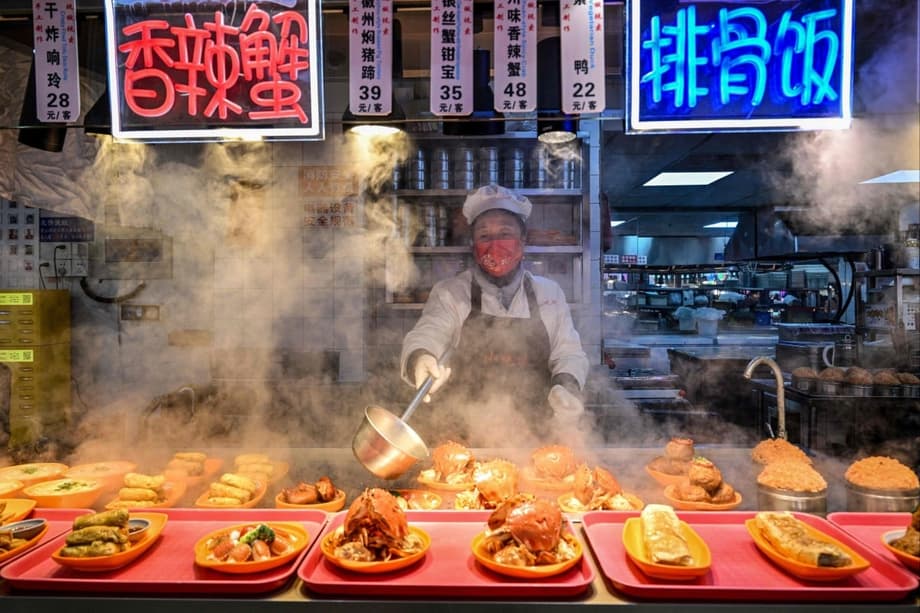
Food functions as a primary motivator for Korean visitors, with taste trends driving itinerary decisions. The numbing, spicy Sichuan seasoning known as mala has captivated Korean palates over the past decade, making Shanghai’s diverse culinary landscape an adventure in familiar-yet-exotic flavors. Hot pot giant Haidilao projected annual sales in Korea exceeding 100 billion won ($68 million) by late 2025, up from 78 billion won the previous year, demonstrating the cross-pollination of dining trends.
More recently, viral social media content has elevated the “towel cake” (a pillowy roll cake resembling folded towels) to must-try status among Korean visitors. Shanghai’s bakeries have become pilgrimage sites for young tourists seeking these photogenic treats featured prominently in mukbang videos and Instagram posts. Beyond specific dishes, the city’s cafe culture, street food scenes, and late-night dining options cater perfectly to Korean preferences for social eating and aesthetic presentation.
The Social Media Engine
Digital culture serves as both catalyst and chronicler of this tourism boom. On YouTube, more than 7,500 videos tagged “Shanghai travel” document everything from luxury hotel reviews to street food crawls, while Instagram hosts over 171,000 posts under the same hashtag. Korean influencers like Jang Su-seok have built substantial followings by livestreaming factory tours and food adventures across China, reaching millions of viewers who might never have considered such destinations otherwise.
This content shapes perceptions in real time. Kim Sae-mee, a 29-year-old Seoul resident planning her first Shanghai visit, describes her shifting views: “My perception of China has definitely shifted. From what I have seen on social media, it has become more positive, culturally interesting.” The imagery flooding Korean feeds shows fashionably dressed locals among Shanghai’s Art Deco architecture, electric vehicles gliding down tree-lined boulevards, and glittering skyline views from the Bund.
The disconnect between online portrayal and on-ground reality creates some irony. Korean visitors frequently photograph themselves at Instagram-worthy locations like the Oriental Pearl Tower and Yu Garden, despite Instagram being officially blocked in China. Many rely on VPN services or postpone posting until returning home, treating the platform as a travel diary rather than a real-time communication tool. This digital friction has not dampened enthusiasm, though it has created a unique travel culture where visitors navigate between connected and disconnected states.
Two-Way Tourism and Economic Ripples
The visa-free revolution extends beyond Koreans visiting China. Chinese tourists are reciprocating in substantial numbers, creating a balanced exchange that benefits both economies. During China’s October Golden Week holiday, South Korea’s urban centers echoed with Mandarin conversations as group tours surged. Travel platform Tuniu reported that South Korea-bound group travel increased over 60 percent compared with September 2024 figures.
Seoul has set ambitious targets, aiming to attract 5.36 million Chinese tourists in 2025, approaching the pre-pandemic peak of 6.02 million recorded in 2019. The economic stakes are substantial: the Bank of Korea estimates that each additional million Chinese visitors could boost South Korea’s GDP growth by 0.08 percentage points. For a nation where tourism contributes over 5 percent to the national economy, these arrivals provide crucial momentum amid sluggish domestic consumption.
Chinese visitors fill specific niches in the Korean tourism ecosystem. Young enthusiasts flock to Gangnam to experience locations featured in Korean dramas, while older travelers seek traditional experiences like dim sum in historic tea houses. Duty-free shops at Incheon Airport have reported 45 percent year-on-year sales increases to Chinese nationals, and cruise ship arrivals at Busan port are projected to surge from eight visits in 2025 to 173 scheduled calls in 2026.
Cruising Into New Territory
Beyond air travel, cruise tourism has emerged as a significant vector for bilateral visitor exchange. China’s inbound cruise market experienced unprecedented growth in 2025, with Shanghai’s ports handling 538 inbound and outbound cruise calls, representing a 16.2 percent increase year-on-year. In December 2025, a record-breaking 255 South Korean tourists disembarked at Lianyungang port in Jiangsu province, the largest single Korean group handled there since the visa waiver began.
These maritime arrivals benefit from streamlined immigration procedures. Port authorities have implemented dedicated e-channel kiosks and pre-filed passenger manifests, reducing clearance times to under 45 minutes for large groups. The 15-day visa-free cruise policy, introduced in May 2024, allows organized groups to enter at any of 13 seaports and travel onward to inland destinations including Beijing and Shanghai.
The cruise sector’s expansion reflects broader infrastructure investments. Shanghai’s Wusongkou International Cruise Terminal welcomed its first dual-ship berthing of 2026 in late January, accommodating both the returning MSC Bellissima and China’s domestically built Adora Magic City simultaneously. Over 98 percent of international cruise passengers now utilize visa-exemption arrangements upon arrival, with more than 120,000 foreign passenger trips passing through Shanghai’s cruise terminals in 2025, up 82.6 percent from the previous year.
Navigating the Digital Divide
Despite the enthusiasm, Korean visitors face distinct challenges when crossing into China. The digital ecosystem differs radically from what Koreans experience at home. Essential services familiar to Korean travelers, including KakaoTalk, WhatsApp, Google Maps, and YouTube, remain blocked by China’s internet firewall. Visitors must download Chinese alternatives with often awkward English translations to hail taxis, navigate streets, or process payments.
Financial transactions present particular friction. Credit cards and cash have become increasingly rare in Chinese cities, where Alipay and WeChat Pay dominate daily commerce. While these platforms now accept some overseas credit cards, the registration process requires real-name verification that can stump foreign visitors. Tour guides increasingly advise downloading payment super-apps before arrival and preparing for cashless transactions that differ significantly from Korean or international norms.
Language barriers persist, though technology offers workarounds. Restaurant workers increasingly rely on translation apps to guide Korean customers through digital queuing systems, while bilingual volunteers at major ports and tourist sites help bridge communication gaps. For many young travelers, these obstacles have become part of the adventure rather than deterrents, representing authentic cultural immersion rather than inconveniences.
Economic Impact and Future Trajectory
The tourism surge delivers tangible economic benefits on both sides of the Yellow Sea. According to the Korea-China Business Council, each tourist from either country now spends an average of $1,120 per trip, representing a 17 percent increase from 2019 levels. This spending supports hotels, restaurants, transportation networks, and retail sectors in destination cities.
For China, the influx helps offset slower recovery in other international markets. While flights to Europe and the United Kingdom have exceeded pre-pandemic levels, routes between China and North America remain depressed due to geopolitical complications including closed Russian airspace. South Korean visitors help fill this gap, providing steady demand for hospitality and service sectors.
Corporate mobility has also benefited from simplified procedures. Business travelers report that airlines now accept visa-free arrangements at online check-in without additional document uploads, while tour operators can confirm group trips within 24 hours. Korean suppliers can meet Chinese partners without lengthy paperwork delays, and Chinese technicians traveling to Korea benefit from streamlined visa-fee waivers.
Industry analysts view the current policies as trial balloons for broader regional liberalization. If the China-Korea experiment sustains political and economic support, observers expect Japan and potentially ASEAN partners to seek similar reciprocity with Beijing, potentially redrawing Northeast Asia’s travel map by 2027. For now, both governments treat the arrangements as temporary pilot programs, though officials privately suggest extensions are likely if visitor spending continues meeting expectations.
Key Points
- China’s 30-day visa-free policy for South Koreans, introduced in November 2024 and extended through 2026, has triggered a 121 percent increase in Korean visitors to Shanghai.
- South Korean arrivals to Shanghai reached 1.37 million in 2025, representing 43 percent of all Korean visits to mainland China.
- The “Friday after work to China” trend sees young Koreans taking 48-hour weekend trips, treating Shanghai as an accessible extension of domestic leisure options.
- Social media platforms, particularly YouTube and Instagram, drive destination awareness, with over 7,500 Shanghai travel videos and 171,000 related posts influencing traveler decisions.
- South Korea reciprocated with temporary visa-free entry for Chinese group tourists (three or more people) from September 2025 through June 2026, creating two-way tourism growth.
- Cruise tourism has expanded significantly, with Shanghai handling 538 cruise calls in 2025 (up 16.2%) and Lianyungang receiving record Korean group arrivals.
- Each tourist spends approximately $1,120 per trip, with the Bank of Korea estimating that one million additional Chinese visitors could boost Korean GDP by 0.08 percentage points.
- Digital barriers remain challenging, as Korean travelers must navigate China’s internet restrictions and cashless payment systems requiring Chinese super-apps.