From Gold Mining to Durian Empire
The quiet town of Raub in Malaysia’s Pahang state once gained national attention in the early 1900s for its gold, with miners scooping flecks of the metal from trays of freshly dug sand. Today, Raub’s economy has shifted to a different kind of “gold.” Its hillsides are now home to an estimated 150,000 durian trees spread across approximately 2,000 hectares of land. This transformation has been driven by China’s immense appetite for the Musang King durian, a variety so prized that Chinese consumers have dubbed it the “Hermès of durians.”
- From Gold Mining to Durian Empire
- The Musang King Phenomenon
- Economic Transformation and New Wealth
- China’s Insatiable Appetite
- The Hard Reality Behind the Wealth
- Challenges and Controversies
- Regional Competition
- Durian Diplomacy
- Trademark Protection and Market Positioning
- The Threat of Domestic Production
- Environmental and Market Concerns
- Future Outlook
- The Bottom Line
Durian has long divided opinions, with some praising it as the “king of fruits” for its sweet taste and creamy texture while others shun it for its pungent smell. Yet it has found eager buyers in China, where demand appears boundless. In recent years, the fruit has also taken on new cachet there, consumed not only fresh but reworked into desserts, milk tea, and even hot pot.
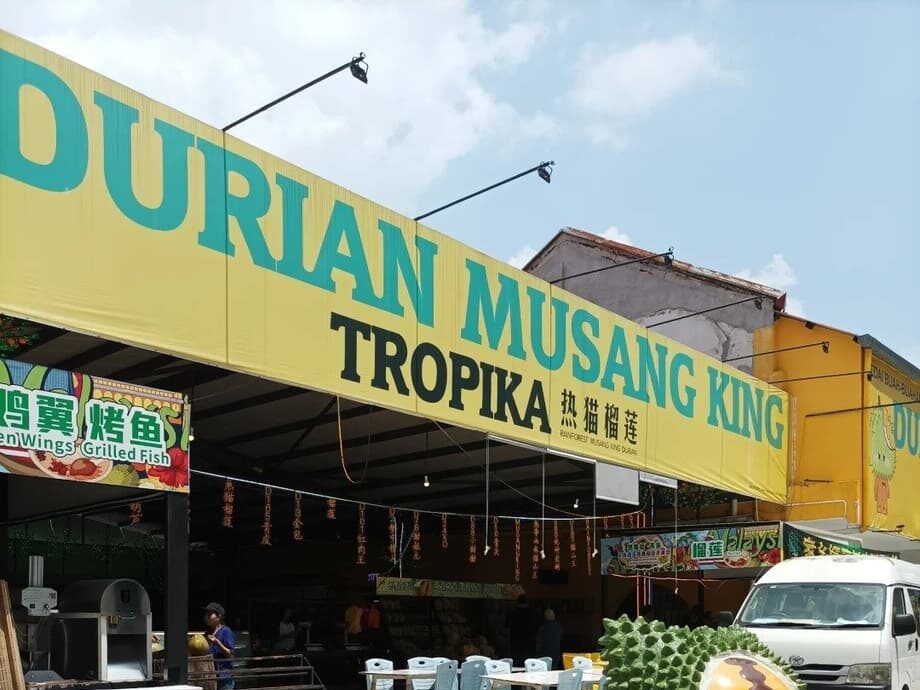
Driving around Raub, it is impossible to miss the prickly fruit that powers its economy. You can smell it from the steady stream of trucks winding through mountain roads. You can see it too: the green spikes of a giant sculpture, murals painted fondly on low walls and road signs that proclaim: “Welcome to the home of Musang King durians.”
A gold mining town in the 19th Century, Raub has seen its economy take on a new hue of yellow in recent years. Today it is better known as the land of the Musang King, a buttery, bittersweet variety that sits at the heart of a global durian rush.
“Even if only 2% of Chinese people want to buy durians, that is more than enough business,” says Chee Seng Wong, factory manager of Fresco Green, a durian exporter in Raub.
Wong recalls how farmers cut down durian trees to make room for oil palms, the country’s main cash crop, during an economic downturn in the 1990s. “Now it is the other way round. They are chopping oil palms to grow durians again.”
The Musang King Phenomenon
Among the fruit’s many varieties, Musang King stands out for its distinctive bittersweet taste and premium status. Its buttery texture and complex flavor profile have made it the most sought-after durian variety in China. The comparison to luxury French fashion house Hermès is not hyperbolic. Like a Birkin bag, authentic Musang King durians command premium prices and serve as status symbols among China’s affluent consumers.
Musang King durians can fetch anywhere from $14 to $100 per fruit, depending on quality and season, compared to less than $2 for common varieties in Southeast Asia. The price premium reflects both the difficulty of cultivation and the fruit’s superior taste characteristics. In Raub, the geographical conditions, particularly the soil composition and climate, create ideal growing conditions for this prized variety.
“The soil in Raub is very suitable for cultivating durians. Also, the climate is very good,” says Lu Yuee Thing, who owns a local farm called Uncle Thing Durian Leisure Farm. “The town’s geographical location is also ideal for growing the luxe variety the town is known for.”
Chinese consumers have developed increasingly sophisticated palates for durian. “Maybe in the beginning we only liked durians that were sweet. But now we look for things like fragrance, richness and nuanced flavors,” says Xu Xin, a 33-year-old who sells the fruit back home in northeastern China.
“Nowadays there are more customers who walk into the shop and ask, ‘Are there any bitter ones in this batch?'”
Xu was on a recent trip to sample durians in Raub with two other durian exporters from southern China. “There are so many people who haven’t eaten it yet. The market potential is huge,” says one of her companions.
Eager Chinese tourists have been flocking to rural Malaysia for a bite of the fruit. Seated at a durian shop, they dig into platters carefully arranged from the mildest to the richest. If eaten in the right order, locals say, fresh notes should emerge with each glob: caramel, custard and finally, an almost alcoholic bitterness heralding the Musang King.
Economic Transformation and New Wealth
The durian boom has created numerous millionaires in Raub, transforming the economic landscape of this once-sleepy town. Farmers who previously struggled to make ends meet now find themselves with substantial wealth, upgrading their homes from wood to brick and affording higher education for their children overseas.
Eric Chan, one of Raub’s durian success stories, pivoted from writing code for satellites and robots to starting a company that supplies durian paste for various dishes. He later sold a controlling share in the firm for about $4.5 million, roughly 50 times his initial investment.
“Everybody has been making good money,” Chan told The New York Times. “They rebuilt their houses from wood to brick. And they can afford to send their children overseas for university.”
Durian farm owner Jovi Kong reports accumulating assets including luxury cars and two properties, one in Raub and another in Kuala Lumpur. “Raub is very different from other Malaysian towns, the people living here are rich,” Kong told Channel News Asia in 2019.
Uncle Thing is another success story. At his farm, he points out the Japanese pickup trucks that have replaced the rickety jeeps he used to rely on for transporting crates of his fruit. In family businesses like his, sons often help with transporting durians while daughters handle accounting and the finances.
“Durian has contributed a lot to the economy here,” Uncle Thing says. The economic transformation extends beyond individual farmers. The entire supply chain has expanded, creating jobs in packaging, logistics, processing and related services. Local restaurants and hotels have also benefited from the influx of tourists seeking the authentic Musang King experience.
China’s Insatiable Appetite
China has become the world’s top durian importer, accounting for approximately 95% of global demand. In 2024 alone, China imported a record $7 billion worth of durians, a three-fold increase from 2020. This staggering figure represents more than 90% of the world’s durian exports now headed to Chinese markets.
Between 2018 and June 2025, Malaysia shipped a total of 115,359 tons of durian products, including pulp, paste, frozen and fresh whole fruits, worth RM6.37 billion ($1.51 billion) to China. In 2024, China imported RM1 billion worth of the fruit from Malaysia following a bilateral agreement that opened the door to fresh durian shipments. Previously, Malaysia had been limited to frozen products.
The ability to export fresh durians has significantly boosted Malaysia’s competitiveness in the Chinese market. Unlike frozen durians, fresh Malaysian durians have ripened naturally on the trees and fallen to the ground before being harvested. This natural ripening process results in richer flavor and softer flesh compared to Thai and Vietnamese durians, which are picked from trees and ripened during transportation.
However, this natural ripening also means Malaysian durians have a shorter shelf-life, requiring complete cold-chain logistics and distribution to ensure fresh durians reach consumers within 48 hours after falling from the trees. This logistical challenge necessitates air freight, making Malaysian durians more expensive to transport but maintaining their premium quality positioning.
The Malaysia Chamber of Commerce and Industry in China projects that China’s durian imports from Malaysia will increase by 15-20% in 2025, driven by sustained consumer demand despite weather-related challenges in Malaysia. “Right now, it is impossible to get Grade A Musang King below RM30 per kilogramme at farm price,” says MayCham chairman Loh Wee Keng. “During the off-season like May, prices can go up to RM80 per kg.”
The Hard Reality Behind the Wealth
Despite the financial rewards, durian farming remains physically demanding work. Farmers face risks and long hours, often waking before dawn to harvest the fruit. At 72, Lu Yuee Thing, known locally as “Uncle Thing,” rises early each day and navigates his steep, uneven farm to gather ripe durians, either dangling from trees or nestling in nets close to the ground.
A few years ago, a falling durian landed on his shoulder, leaving him with a throbbing pain that still flares up from time to time. “It looks like farmers make easy money. But it is not easy,” he says.
Lu began growing durians in the 1980s, starting with kampung varieties. In the early years, durian farming brought little profit as prices were volatile. “It was so terrible that some farmers began planting oil palm instead,” he says, adding that he had also similarly converted some of his land. As the industry matured, businesses shifted to better varieties and exports of Musang King began to generate profits.
Once harvested, the durians are brought to Uncle Thing’s shop, where they undergo meticulous sorting into grades ranging from A for large, round specimens to C for small and irregular shapes. Sitting in the middle of the sorting floor is a lone basket reserved for Grade AA durians, the handsomest of the lot. Those will soon be flown to China.
The labor-intensive nature of durian farming extends beyond harvesting. Maintaining the orchards requires regular pruning, fertilization and pest management. The hilly terrain of Raub makes mechanization difficult, meaning much of the work must be done manually. Younger generations are increasingly reluctant to take on this physically demanding work, raising concerns about the future labor supply for the industry.
Challenges and Controversies
The rapid expansion of durian farming has not come without challenges. A recent oversupply situation in Malaysia, fueled by newer orchards producing lower-quality cloned varieties, pushed prices of Musang King down to RM10 ($2.4) per kilogram from RM60-80 per kilogram during the main harvest season. This price crash has left some growers selling directly from their orchards to consumers, cutting out intermediaries to stay afloat.
Faisal Iswardi Ismail, deputy director-general for Food Security and Operations at the Federal Agricultural Marketing Authority, says the oversupply has been fueled by newer orchards producing lower-quality cloned varieties such as Musang King. These fruits do not meet export standards for major markets like China and Singapore.
The Federal Agricultural Marketing Authority has stepped in to support farmers by buying affected village durians and sending them to specialized facilities for processing into paste and pulp. It also launched the Agro MADANI sales program, which sold more than 30 tonnes of durians and seasonal fruits in two days, generating RM100,000 in revenue on the first day alone.
Perhaps more troubling is the ongoing land dispute in Raub. Authorities have felled thousands of durian trees they say were planted illegally on state land. Farmers say they have been using the land for decades without issue and allege they are now being forced to pay a lease to continue farming there or face eviction.
Between March and April 2025, the Pahang State Enforcement Unit conducted enforcement operations against illegal Musang King durian plantations over 202 hectares of land near Raub. The action prompted the “Save the Musang King Alliance,” which represents the interests of most of the farmers involved, to accuse the Pahang state government of violating the terms of a court order by the Court of Appeal in May 2024 forbidding the felling of trees or destruction of structures.
Many Chinese farmers who had fled to the fringes of the Malayan jungles cleared and tilled land outside legal plots after the Malayan Emergency (1948-1960). Their argument for working on state land lies in the purported encouragement of an informal agricultural economy in the past. In 1974, the Malaysian government established the Green Book Plan, which encouraged citizens to take up short-term gardening or farming for personal consumption, leaving these farmers undisturbed for decades.
Regional Competition
Malaysia’s position in the Chinese durian market faces competition from other Southeast Asian nations. Thailand and Vietnam are the top durian suppliers to China, accounting for nearly all imports. In 2023, China imported 1.43 million tonnes of fresh durians worth $6.7 billion, with 99.8% coming from Thailand and Vietnam.
Vietnam has rapidly gained market share since gaining approval to export fresh durians to China in July 2022. In less than two years, it has become the second largest exporter of durians to the Chinese market, with ambitions to overtake Thailand. In the first seven months of 2024, Vietnam’s exports of fresh durians to China reached $1.22 billion, a 46% increase over the same period the previous year.
In the first two months of 2024, Vietnam even briefly overtook Thailand, accounting for 62% of durians exported to China. However, Thailand regained top spot after its harvest in the second quarter. “While Vietnam has durian varieties that are not found in Thailand and Malaysia, such as the Ri6 durian, it lacks a famous variety like Malaysia’s Musang King,” says Vo Tan Loi, director of fruit exporter Phuong Ngoc Cai Be Company in Tien Giang province.
Vietnam enjoys logistical advantages due to its land border with China. Durians from Vietnam can reach Chinese markets in approximately 36 hours via the Friendship Pass, compared to at least three to four days for Thai durians. “Being connected to China by land enables Vietnam to transport durians by trucks or trains, which is faster and less expensive,” Vo says.
Cambodia has also entered the market, becoming the latest Southeast Asian nation approved to export fresh durians to China in April 2025. However, it lacks the brand recognition of established players like Thailand and Malaysia. “Cambodia is still building its reputation in the international market,” says Lim Chin Khee, an adviser to Durian Academy. “It lacks the long-standing brand recognition of Thailand’s Monthong or Malaysia’s premium Musang King.”
Durian Diplomacy
China’s appetite for durians has become a diplomatic tool, with Beijing signing a flurry of trade agreements with producers across Southeast Asia. These deals are touted as celebrations of bilateral ties with Thailand, Vietnam, Malaysia, Cambodia, Indonesia, the Philippines and Laos. “In this durian competition, everyone’s a winner,” declared a Chinese state media article in 2024.
The deals dovetail with China’s investments in infrastructure in the region. The China-Laos Railway, launched in 2021, now transports more than 2,000 tonnes of fruit every day, most of them Thai durians.
Gifting premium durians has become a gesture of goodwill between Southeast Asian states and Beijing. During a state visit in 2024, Malaysia’s King Ibrahim presented President Xi Jinping with two boxes of premium durians, including Musang King. Earlier that year, Chinese Premier Li Qiang and Malaysian Prime Minister Anwar Ibrahim were filmed together tackling a durian with a knife and spoon.
“Durian diplomacy is not just diplomacy, it is durian business,” said Malaysian Deputy Prime Minister Ahmad Zahid Hamidi in November 2024. “We need to work with Chinese businessmen to further develop Musang King plantations in Malaysia, and we should also strengthen downstream industries together.”
For China, the durian trade is part of a broader strategy called the “food silk road,” an emerging network of investments and trade agreements designed to diversify China’s food imports across many regions of the world. New Zealand exports most of its premium gold kiwifruit to China, while the Chinese market is an equally important destination for Chilean cherries and Kenyan avocados.
Trademark Protection and Market Positioning
To protect its premium position, Malaysia has renewed the intellectual property status of its Musang King variety until March 2034. This designation means Musang King “belongs to Malaysia” and cannot be claimed by durian sellers from other countries.
In China, where consumers often eat Thai and Vietnamese durians because of the much higher import volumes, respect for Malaysia’s intellectual property status should help sustain prices that can be four to five times higher than other types of durian in a competitive market. Chinese consumers buying trademarked Musang King durians will feel more confident that they are getting the authentic product rather than a mislabeled fruit.
“After price wars, in terms of quality and branding, the trademark might be a relatively good strategy,” says Peng Peng, executive chairman of the Guangdong Society of Reform, who is also helping a Shenzhen importer sell Malaysian durians in Guangzhou.
This trademark protection is particularly important given previous incidents where Thai buyers harvested unripened Musang King from Malaysia and sold them to China as “Thailand Musang King.” Consequently, the Thai government banned Thai buyers from such actions and stopped imports of Malaysian durians before the incident was closed. This also prompted Malaysia to speed up negotiations with China on the export of fresh durians.
The Malaysian government has been working to educate Chinese consumers about the real characteristics of Musang King and other varieties to protect the integrity of Malaysian durian brands. Some traders have been known to mislabel kampung durians as Musang King to fetch higher prices, which damages market credibility. “Even kampung durians have a market if sold honestly. We have to educate Chinese consumers on the real characteristics of Musang King, D24 and others,” Loh Wee Keng emphasizes.
The Threat of Domestic Production
Perhaps the most significant long-term challenge comes from China itself. The island province of Hainan has been working on cultivating its own durians, aiming for what state media calls “durian freedom.” Hainan’s durian harvest for 2025 was expected to reach 2,000 tonnes.
“For one thing, we won’t have to rely on Thai and Vietnamese vendors when buying durians anymore!” proclaimed a Chinese state media article in August 2024.
While currently accounting for less than 1% of China’s durian consumption, Hainan’s efforts represent a potential future threat. Hainan’s first home-grown durians hit the market with much fanfare in 2023. However, experts say the taste differs significantly due to soil and climate conditions. “Hainan Musang King cannot replace the Malaysian original,” says Loh Wee Keng. “The taste is different due to the soil and climate. My friend also tried growing it here, but it wasn’t successful.”
Uncle Thing has a pragmatic view on the situation. “Hainan has already succeeded in its experiment. If they have their own supply and start importing less, our market will be affected. But that is not something we can worry about. All that we can do is take good care of our farms and boost yields.”
Ask anyone else in Raub about Hainan’s quest, and the question will be swatted away with a smug comeback: they are still no match for Malaysian durians. And yet, as China chases “durian freedom,” it is hard to ignore the fact that the Musang King sits on an ever shakier throne.
Environmental and Market Concerns
The rapid expansion of durian cultivation has raised environmental concerns. In Indonesia, Laos and Malaysia, the establishment of new durian plantations has led to deforestation, disrupting local habitats and ecosystems. This poses a risk to endangered animal species such as the Malayan tiger.
In Vietnam, many coffee farmers have pivoted to durian, driving up global coffee prices already affected by severe weather. Vietnamese authorities have begun addressing the issue, asking local governments to review plantation sizes, coordinate planning, and promote professional durian plantations rather than haphazard expansion.
Food safety concerns have also emerged. In 2024, Chinese authorities found carcinogenic chemical dye in Thai durians, believed to make the fruit appear more yellow. The same year, China suspended durian imports from 15 packaging factories and 18 plantations in Vietnam after finding excessive levels of the heavy metal cadmium in recent batches.
“With China’s increasingly stringent requirements for imported fruits, the relevant Vietnamese parties should enhance their management of durian plantations and packaging factories to ensure that the price of durians is reasonable and that the fruit is safe for consumption,” says Vo Huu Thoai, head of Vietnam’s Southern Fruit Research Institute.
Some consumers are concerned that the export of large quantities of fresh durians to China would drive up prices in Malaysia and Singapore. “It seems that durians will be increasingly expensive now that fresh durians are sold to China,” says Kuala Lumpur resident and business owner Tan Guet Meng, 54.
Raymond Ng, who operates durian stalls in Singapore, says: “If Malaysia exports durians to China on a large scale, Singaporeans may end up eating durians at expensive prices. If prices increase, we can only roll with it. In fact, durians are already not cheap now.”
Future Outlook
Malaysia’s durian export value is projected to reach RM1.8 billion by 2030, involving an export volume of 69,000 tonnes. The Malaysian government continues to promote collaboration with Chinese businesses to expand downstream activities and Musang King plantations.
Industry experts emphasize that Malaysia is not directly competing with Thai durians due to differences in price points and quality. Instead, they see Malaysian durians competing with premium fruits like kiwis, cherries, Japanese strawberries and grapes in the Chinese market. “We are actually competing with kiwis and cherries as well as those products from Japan such as strawberries and grapes,” Loh Wee Keng points out.
For now, Raub continues to thrive as the heart of Malaysia’s durian industry. The town has embraced its identity as the “Musang King Durian Town,” with road signs proclaiming “Welcome to the home of Musang King durians” and murals painted fondly on walls celebrating the prickly fruit.
Despite the challenges, including land disputes, market fluctuations, competition from other countries and the specter of Chinese domestic production, the durian industry has fundamentally transformed Raub’s economy. From its gold mining heritage to its current status as a global durian hub, the town exemplifies how Chinese consumer preferences can reshape economic landscapes across Southeast Asia.
As the durian market continues to evolve, farmers in Raub face both opportunities and uncertainties. The town’s future will depend on its ability to maintain the quality and reputation of its Musang King durians while navigating the complex dynamics of international trade, diplomatic relations and market competition.
The Bottom Line
- China imported a record $7 billion worth of durians in 2024, accounting for 95% of global demand
- Malaysia exported RM6.37 billion worth of durian products to China between 2018 and 2025
- Musang King durians can fetch $14-100 per fruit compared to under $2 for common varieties
- Raub is home to an estimated 150,000 durian trees across approximately 2,000 hectares
- China’s durian imports from Malaysia are projected to increase 15-20% in 2025
- Malaysia has renewed Musang King’s trademark protection until 2034