A sudden chill in the China Japan air corridor
Air travel between Asia’s second and third largest economies has been hit hard by politics. Up to 40 percent of scheduled December flights from China to Japan have been cut, with more than 1,900 flights canceled as carriers pull back services and travelers rethink plans. Chinese airlines are leading the reductions. Cuts are concentrated at tourism hubs such as Sapporo and Osaka, where local economies depend heavily on visitors from the mainland. Airlines have also been told to limit Japan capacity until March 2026, signaling a dispute that could last beyond the winter season.
Measurements vary by dataset and date, but they point in the same direction. Industry schedules compiled in late November show 16 Chinese carriers trimming December operations from about 4,703 one way flights to roughly 3,537, a reduction of around 25 percent. Seat capacity fell by roughly a quarter to about 673,000 seats. Other tallies captured more than 900 cancellations out of approximately 5,548 scheduled flights early in the process, about 16 percent, before subsequent waves of cuts pushed the month’s total higher. Cancellation rates also swing by route and by day, depending on airline policy and demand.
The pullback follows a cascade of travel warnings and refund offers that made it easy to abandon trips. Chinese airlines offered free cancellations and waivers through December 31, and demand fell sharply. Bookings to Japan dropped by hundreds of thousands within days of the advisory, according to aviation analysts who track ticketing flows. For Japan, which leaned on inbound spending to prop up a fragile recovery, the shock is significant and immediate.
What triggered the latest breakdown
The spark came in early November when Prime Minister Sanae Takaichi told lawmakers that a Chinese attack on Taiwan could threaten Japan’s survival and allow the exercise of self defense. That is consistent with security laws adopted a decade ago, but it crossed a red line for Beijing. China responded with a travel advisory urging citizens to avoid trips to Japan. The advisory quickly fed into airline refund policies, social media campaigns and a slowdown in cultural and educational exchanges.
Major Chinese carriers, including the three state owned giants, offered no fee refunds on Japan bound tickets through the end of December. Distributors postponed screenings of several Japanese films on the mainland. Some travel agencies paused individual visa processing for trips to Japan, while others kept services open in hopes that tension would ease.
Tokyo, meanwhile, urged Japanese nationals in China to take extra care, citing a rise in anti Japan sentiment and the potential for confrontations in crowded places.
Japan’s chief cabinet secretary, Minoru Kihara, explained the rationale behind the guidance.
We have made judgments based on comprehensive consideration of the security situation in the country or region, as well as its political and social conditions.
China’s foreign ministry sought to reassure. It said safety for foreign citizens in China would be protected according to the law.
It always and will continue to protect the safety of foreign citizens in China in accordance with the law.
How Tokyo’s defense rules frame the debate
Japan’s postwar constitution renounces war, but security legislation reinterpreted in 2015 allows limited collective self defense if Japan faces a survival threatening situation. The Taiwan Strait is close to Japan’s southwestern islands, and planners in Tokyo view a conflict there as a direct risk to national security. Beijing regards any suggestion of Japanese military involvement in a Taiwan crisis as unacceptable.
The mutual security treaty between the United States and Japan adds another layer. If Japan were attacked, the alliance would require a response from Washington. Any situation near Taiwan that draws in Japanese forces could quickly involve the United States, a scenario China wants to avoid.
How large are the cuts, and where are they concentrated
The reductions are large but uneven. Across 16 mainland carriers, planned December flights to Japan dropped by about a quarter, with seat capacity down by a similar share. Other schedule trackers recorded more than 1,900 cancellations for December, following an initial wave of roughly 16 percent cancellations earlier in the process as the advisory took effect. On some peak days right after the warning, the share of cancellations surged well above normal levels.
Sapporo New Chitose and Osaka Kansai are the hardest hit. Sapporo faces roughly a 43 percent drop in flights and a 45 percent drop in seats. Osaka is down about 35 percent in flights and 34 percent in seats. Tokyo Narita and Nagoya Chubu also face steep cuts, while Tokyo Haneda, which serves more business heavy routes with limited slots, has seen only modest changes.
- Airports most affected: Sapporo New Chitose and Osaka Kansai, with large reductions in both flights and seats.
- High cancellation ratios on specific routes into Kansai, including departures from Tianjin, Nanjing, Guangzhou and Shanghai.
- Entire routes canceled in December include Beijing Daxing to Sapporo New Chitose, Changsha to Osaka Kansai, and Fuzhou to Nagoya.
- Chinese carriers have removed service on more than 70 routes for parts of December, cutting an estimated 156,000 seats.
Although Tokyo area airports are less exposed to leisure oriented reductions, the loss of regional connectivity weakens the broader network. It makes last minute rebooking harder and pushes more travelers to scrap plans outright.
Tourism shock in Japan’s regions
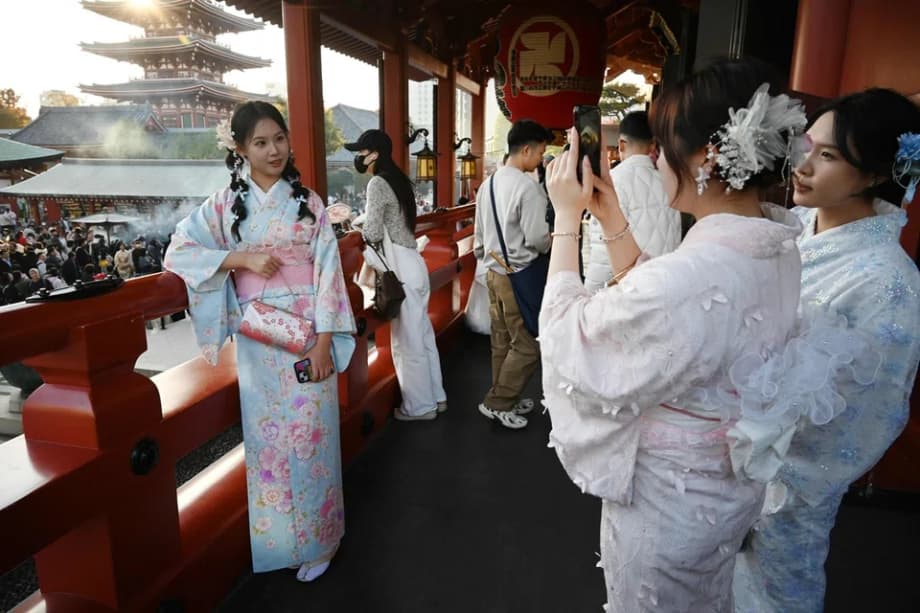
Chinese visitors are central to Japan’s travel recovery. From January through October 2025, an estimated 8.2 million travelers from mainland China visited Japan. In the third quarter alone, Chinese visitors spent more than one billion dollars per month and made up nearly 30 percent of all tourist spending nationwide. That helped power a comeback in hotels, restaurants, outlet malls and transport services from Hokkaido to Kyushu.
The current wave of cancellations is now eroding that momentum. One set of projections points to up to 1.2 billion dollars in lost spending between November and the end of the year. If the boycott persists, losses could reach into the trillions of yen on an annual basis, according to private sector forecasts.
Front line travel companies are already feeling the pain. A Tokyo based tour operator that specializes in group travel for Chinese clients reported losing around 80 percent of its remaining bookings for the year within days of the advisory.
Yu Jinxin, vice president of East Japan International Travel Service, described the hit plainly.
This is a huge loss for us.
Hospitality and events are also being disrupted. A flagship hotel in the capital reported postponements and cancellations of banquets and accommodation booked by Chinese corporate customers. Retail brands with large exposure to China are reassessing sales targets for the winter season. Regions that invested heavily in winter tourism, including Hokkaido and the Kansai area, face a tougher outlook as visitor flows shrink.
Chinese travelers pivot to other destinations
With Japan trips on hold, Chinese holidaymakers are redirecting plans to other nearby markets. Booking and search data show South Korea, Thailand, Malaysia, Singapore, Vietnam and Indonesia absorbing demand. In the mid January window before the Lunar New Year, flight bookings to Thailand are reported to be more than 20 percent higher than a year ago, and Seoul recently topped outbound flight searches on major platforms.
Soft power and cultural exchange are feeling the chill as well. Distributors have postponed several Japanese film releases in China. Some local level cultural events and research collaborations have been put on pause. A number of travel agencies stopped accepting individual visa applications for Japan, while others continue to process requests in case the political temperature cools.
Independent aviation analyst Li Hanming, who tracks mainland schedules and bookings, said the scale of cancellations was comparable only to the early months of the pandemic.
The percentage of cancellations on peak days was unlike anything since early 2020. On one day, cancellations were 27 times the number of new bookings.
Li expects further cancellations if the dispute continues into the first quarter, especially on leisure routes that depend on advance group bookings.
What it means for airlines and fares
For mainland carriers, the bilateral market with Japan is important but still smaller than domestic flying. That helps cushion the financial hit. Aircraft grounded from Japan runs can be redeployed to other popular leisure destinations, including Southeast Asia, where demand remains solid.
Even so, the scale of the retreat is striking. December schedules indicate at least 904 flights and about 156,000 seats removed by Chinese carriers. Two of the largest airlines, China Southern and China Eastern, are leading the way, with reductions that together exceed nine hundred flights across more than 70 routes. Mid sized operators such as Spring Airlines and Juneyao Airlines have made larger proportional cuts as they shrink Japan networks for winter.
Prices tell the story on remaining services. Round trip fares on some city pairs, such as Shanghai to Osaka, have fallen sharply as extra seats opened at short notice. Tokyo Haneda has been more stable, reflecting slot constraints and a higher share of corporate traffic and government travel.
Several point to point routes are suspended until late March. Sichuan Airlines has pulled its Chengdu to Sapporo service for the winter period, and multiple Spring Airlines flights to Japan have been canceled. Carriers continue to offer full refunds for Japan bound tickets through December 31, which is still encouraging cancellations.
Diplomatic signals and what comes next
The aviation squeeze is also a signal. Authorities in China have asked airlines to keep Japan capacity reduced until March 2026. Forward bookings by prospective tourists are already weaker into spring, and schedules for January 2026 and beyond remain unsettled. It will take time for confidence to return even if relations improve.
Japan has dispatched senior diplomat Masaaki Kanai to Beijing to meet his counterpart, Liu Jinsong. Business leaders at home want calm. Yoshinobu Tsutsui, who chairs the leading corporate lobby Keidanren, framed the stakes for commerce in simple terms.
Political stability is a prerequisite for economic exchange.
Prime Minister Takaichi has not withdrawn her remarks and says Japan’s policy on Taiwan has not changed. Military outlets in China warned that Japan could face grave consequences if it intervened in a Taiwan conflict. The strategic context includes the mutual security treaty between the United States and Japan and the proximity of Japan’s southern islands to Taiwan.
Families, students and business travelers are caught in the middle. Many of the cancellations already extend into the first quarter. Airlines are still adjusting winter timetables week by week. Any diplomatic thaw would likely show up in schedules with a lag, and the window for peak winter tourism in Hokkaido is already narrowing.
Key Points
- Up to 40 percent of December flights from China to Japan have been cut, with more than 1,900 cancellations logged.
- Chinese carriers are leading reductions, and authorities have asked airlines to limit Japan capacity until March 2026.
- Sapporo New Chitose and Osaka Kansai face the steepest declines in flights and seat capacity.
- Industry schedules show a 25 percent reduction in December flights across 16 carriers, with total seats down by about a quarter.
- Some routes are suspended entirely for winter, including links from Beijing Daxing, Changsha and Fuzhou to Japanese cities.
- Chinese visitors are vital to Japan’s tourism recovery, accounting for nearly 30 percent of tourist spending in the third quarter of 2025.
- Japan could lose up to 1.2 billion dollars in visitor spending by year end, and a longer boycott could mean much larger losses.
- Chinese travelers are shifting to South Korea and Southeast Asia, while cultural events and film releases tied to Japan have been postponed.
- Fares on some remaining routes have dropped as capacity exceeds demand, though Tokyo Haneda remains relatively stable.
- Diplomatic efforts continue, but schedules for early 2026 are still unsettled and many cancellations already stretch into the first quarter.