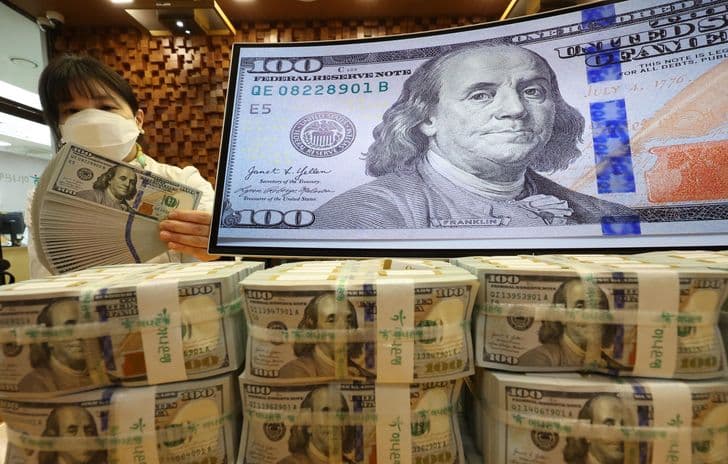
The Currency Crisis Behind the $350 Billion Promise
The South Korean won has tumbled to its weakest level against the dollar since the global financial crisis, driven by mounting expectations of massive capital outflows tied to a landmark trade agreement with Washington. The currency recently traded near 1,470 won per dollar, approaching depths unseen since 2009, as markets brace for the deployment of Seoul’s $350 billion investment pledge to the United States.
- The Currency Crisis Behind the $350 Billion Promise
- Domestic Investment Frenzy Exacerbates Currency Pressure
- Trump’s Tariff Threat Over Implementation Delays
- Seoul Delays $20 Billion Tranche Amid Forex Instability
- Washington’s Rare Verbal Intervention
- Foreign Investors Flee Korean Bonds
- The Long-Term Structural Challenge
- Key Points
This weakness stems from a fundamental supply-demand imbalance in the foreign exchange market. According to a report from the Korea Institute of Finance, residents’ overseas securities investment reached $129.4 billion between January and November last year, a figure that exceeds the country’s current account surplus of $101.8 billion over the same period. Song Min-ki, a researcher at the institute, explained that this surge in overseas investment has created significant pressure on the domestic currency, though it does not fully account for the recent spike in dollar demand.
The anticipated outflows relate to a trade deal struck in July 2025 between President Donald Trump and South Korean President Lee Jae Myung. Under the agreement, Seoul committed to invest $350 billion in American business projects in exchange for reduced tariffs on Korean exports. The structure calls for $200 billion to be paid in cash through phased installments capped at $20 billion annually, with the remaining $150 billion designated for shipbuilding and other strategic sectors.
Domestic Investment Frenzy Exacerbates Currency Pressure
Beyond the government-level pledge, South Korean investors have displayed an insatiable appetite for foreign assets, further straining the won. The Korea Institute of Finance report highlights that domestic investors poured money into overseas securities at a pace that outstripped the nation’s entire current account surplus, creating a structural deficit in dollar availability within the local market.
This capital flight reflects both seeking higher returns abroad and hedging against domestic economic uncertainty. The Bank of Korea manages approximately $420 billion in foreign reserves, investing nearly 90 percent of these holdings in securities to generate returns of about $15 billion annually. Historically, these returns were reinvested to bolster reserve levels, but under the new framework, they will be redirected to fund the US investment pledge.
While the government insists this financing scheme will minimize impact on the onshore dollar-won market by avoiding direct drawdowns of the principal reserve amount, analysts remain skeptical, however, about the ultimate effect. Ha Gun-hyung, an analyst at Shinhan Investment & Securities, noted that the fact that capital will flow to the United States remains a factor that weakens the won’s fundamentals. Lim Hye-yoon, an economist at Hanwha Investment & Securities, added that investments that could have been directed domestically will instead take place overseas, limiting the won’s appreciation potential over the medium to long term.
Trump’s Tariff Threat Over Implementation Delays
The investment timeline has become entangled in political friction, triggering a sudden escalation in trade tensions. On January 26, 2026, President Trump announced via social media that he would increase tariffs on South Korean autos, lumber, pharmaceuticals, and other goods from 15 percent to 25 percent, claiming Seoul’s legislature had failed to enact the deal swiftly enough.
The announcement caught South Korean officials by surprise. Trade Minister Yeo Han-koo had met with US Trade Representative Jamieson Greer in Davos just days earlier without hearing any complaints about implementation delays. The threat reverses the tariff reduction that took effect on November 1, 2025, when rates on Korean autos and auto parts dropped from 25 percent to 15 percent to match Japanese competitors.
South Korea’s presidential Blue House scrambled to respond, insisting the country remains committed to implementing the deal. Lee’s chief policy aide convened an emergency meeting, while the industry minister prepared to visit Washington to meet Commerce Secretary Howard Lutnick. The ruling Democratic Party indicated that five pending bills required to create the investment fund and managing corporation could potentially pass in February with opposition support.
Choi Seok-young, a former South Korean trade negotiator, suggested Trump’s tariff hike threat represents a political move in which the United States is exerting maximum pressure to force concessions during ongoing negotiations over non-tariff barriers. The US has expressed concerns about South Korean regulations affecting American tech firms, including recent regulatory actions against Coupang, a company listed in the United States that operates in online retail.
Seoul Delays $20 Billion Tranche Amid Forex Instability
Faced with the won’s steep depreciation, South Korean authorities have acknowledged that the investment rollout cannot proceed as originally envisioned. Finance Minister Koo Yun-cheol confirmed in mid-January that the first planned $20 billion tranche is unlikely to be allocated in the first half of 2026, citing the time-consuming process of selecting projects and the need for foreign exchange stability.
This delay represents a significant shift from earlier expectations. The original framework designed the $20 billion annual cap specifically to protect South Korea’s foreign exchange reserves and prevent market disruption. However, even this measured pace has proven too aggressive given current currency conditions. A person familiar with the government’s thinking stated that the investment will have to wait until the foreign exchange situation stabilizes, though they did not specify target levels for the currency.
Highlighting how the timeline may be stretched, the finance minister noted that uncertainty over a US Supreme Court ruling on Trump’s tariffs expected soon could also affect the process. The postponement creates a diplomatic dilemma. While Seoul seeks to prevent further won weakness, Washington expects prompt fulfillment of the investment commitment.
Washington’s Rare Verbal Intervention
In an unusual move, Treasury Secretary Scott Bessent offered direct verbal support for the Korean currency on January 14, 2026, calling recent declines excessive. His remarks, released through both social media and official Treasury Department statements following a meeting with Finance Minister Koo, marked a rare instance of senior government concern regarding a trading partner’s currency valuation.
Bessent stressed that excess volatility in the foreign exchange market is undesirable, reflecting Washington’s recognition that a stable won is crucial for the investment deal’s success. Choi Ji-young, a senior official at South Korea’s Ministry of Economy and Finance, explained that the two finance ministers shared concerns over the recent steep depreciation and agreed that currency stability is an important factor for bilateral trade and economic cooperation.
Despite this intervention, Seoul has ruled out seeking a bilateral currency swap arrangement with Washington. Choi stated that a currency swap is something that can be considered only in the event of a foreign exchange crisis, noting that dollar supply remains sufficient. Instead, both sides are focusing on structuring the investment deployment to minimize market shocks, with officials now recognizing the potential for disruption from upfront fund deployment.
Foreign Investors Flee Korean Bonds
The currency instability has triggered significant capital flight from South Korea’s bond markets, compounding pressure on the won. Foreign investors offloaded approximately 10.4 trillion won ($7.4 billion) worth of Korean government bond futures in just three sessions in late September 2025, marking one of the largest single-week retreats since the onset of the COVID-19 pandemic.
Traders reported that a significant share of the proceeds from these bond sales was converted into dollars, adding upward pressure on the exchange rate. The three-year government bond yield climbed to 2.562 percent, its highest level since April, while the 10-year yield touched a peak since the beginning of the year of 2.943 percent.
Ahn Dong-hyun, an economics professor at Seoul National University, observed that foreign bond investors respond not just to exchange rate expectations but also to currency market swings. With negotiations over the $350 billion investment fund clouded in uncertainty, volatility in the won is increasing their retreat from Korean bonds. This creates a feedback loop where currency weakness drives capital outflows, which in turn weakens the currency further.
The Long-Term Structural Challenge
The $350 billion investment pledge represents a decade-long commitment that will test South Korea’s financial resilience. With annual outflows capped at $20 billion, the program matches the size of the country’s total foreign direct investment in the US, which amounted to approximately $22 billion in 2024. Sustaining such outflows without destabilizing the won requires careful calibration of timing and market conditions.
The financing structure relies on investment returns from foreign reserves rather than principal drawdowns, a mechanism designed to limit direct forex market impact. However, this approach means South Korea’s foreign reserves, currently the world’s tenth largest, will likely stagnate rather than grow. As more central banks globally bolster reserves to brace against potential market volatility, Korea’s standing could eventually fall behind.
Lee Hyo-seob, senior research fellow at the Korea Capital Market Institute, warned that facing heavy devaluation pressure amid expected dollar demand, the won could depreciate to 1,500 won per dollar rapidly. Such a level would mark uncharted territory for modern South Korean monetary policy and could force more drastic interventions.
Last week, however, both governments appeared to moderate their positions. President Trump later stated that the US and South Korea will work something out, while Seoul continues preparing the legislative framework for the investment fund. The resolution will likely determine not only the trajectory of the Korean currency but also the stability of one of Asia’s most significant trade relationships.
Key Points
- The Korean won has fallen to its weakest level since 2009, trading near 1,470 per dollar, driven by expectations of capital outflows for a $350 billion US investment pledge.
- South Korean residents invested $129.4 billion in overseas securities between January and November 2025, exceeding the country’s $101.8 billion current account surplus.
- Seoul has delayed the first $20 billion tranche of the investment plan until the second half of 2026 at the earliest, citing currency instability.
- President Trump threatened to raise tariffs on Korean goods to 25 percent from 15 percent, claiming Seoul’s legislature was slow to implement the investment deal.
- US Treasury Secretary Scott Bessent called the won’s decline excessive, marking rare verbal intervention, while Seoul ruled out seeking a currency swap.
- Foreign investors sold $7.4 billion in Korean bond futures in three sessions in late September, converting proceeds to dollars and adding further pressure on the currency.
- The $350 billion commitment includes $200 billion in cash installments capped at $20 billion annually, with remaining funds directed to shipbuilding and strategic sectors.