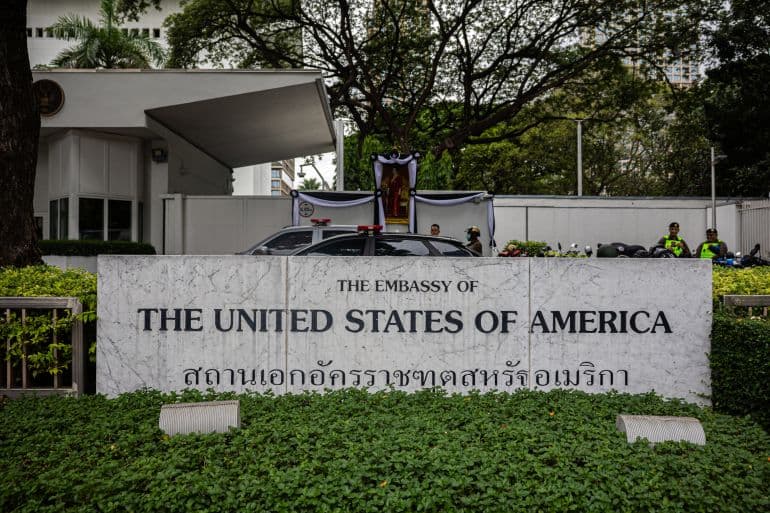
A Dream Deferred in Bangkok
For 27-year-old Khaochat Mankong, an English tutor living in Bangkok, the year 2026 was supposed to mark the beginning of a new chapter. After months of navigating bureaucratic hurdles and filing the necessary paperwork with the United States embassy, she was poised to move to California to start a life with her American husband. However, those plans evaporated instantly last week when the Trump administration announced an indefinite pause on the processing of immigrant visa applications for nationals from 75 countries, including Thailand.
The sudden policy shift has sent shockwaves through Thai society, affecting thousands of families, workers, and students who viewed the United States as a destination for opportunity and stability. The announcement has not only disrupted personal lives but has also sparked a diplomatic dilemma for Thailand, a historic U.S. treaty ally that now finds itself grouped alongside nations facing severe instability and conflict.
The U.S. Department of State stated that the suspension targets countries whose migrants claim welfare benefits at “unacceptable rates.” The justification has left many in Thailand, a country with a relatively prosperous diaspora and strong economic ties to the U.S., confused and angry.
“I’m shocked; I never thought they would interfere with permanent visas or marriage visas,” Khaochat told Al Jazeera. “But now everything has to be paused for who knows how many years.”
Like many others caught in the limbo, Khaochat argues that the rationale does not apply to her situation. She emphasized her financial independence and language skills, questioning why she should be blocked from living with her spouse.
“If they want to screen people, then test language ability, check financial accounts,” she said. “I have the language skills, I have money. Why should I be blocked from living with the person I love?”
The Scope of the Suspension
The suspension, which formally took effect on January 21, 2026, is one of the most expansive restrictions on legal immigration in recent American history. According to official statements and a State Department memo, the pause affects all immigrant visa categories for the listed nations. This includes EB-class employment visas, which are sought by foreign workers, and K-class spousal and dependent visas, which are crucial for family reunification.
The policy is rooted in the “public charge” provision of the Immigration and Nationality Act. This legal ground allows the U.S. to deny entry to anyone likely to become dependent on government assistance. While this rule has existed for decades, the Trump administration has aggressively expanded its definition and enforcement. Under the new guidance, consular officers are instructed to consider a wide range of factors, including age, health, financial status, and English proficiency, to determine if an applicant might ever rely on public benefits.
State Department spokesperson Tommy Pigott defended the move as a necessary step to protect American resources.
“The State Department will use its long-standing authority to deem ineligible potential immigrants who would become a public charge on the United States and exploit the generosity of the American people,” Pigott said in a statement. “Immigrant visa processing from these 75 countries will be paused while the State Department reassesses immigration processing procedures to prevent the entry of foreign nationals who would take welfare and public benefits.”
Notably, the suspension does not apply to nonimmigrant visas, such as those for tourists (B-1/B-2), students (F/M), or temporary workers (H-1B). This distinction means that while Thai nationals can still visit the U.S. for short periods, they cannot permanently relocate or build a life there during the freeze.
An Unexpected Inclusion
The inclusion of Thailand on the list of 75 nations has generated significant confusion and debate. The list features countries that are currently experiencing conflict, such as Afghanistan, Somalia, and Ukraine, or those with severe economic challenges, like Haiti. In contrast, Thailand is the second-largest economy in Southeast Asia and a major U.S. trading partner.
Statistical data appears to contradict the administration’s rationale for targeting Thailand. According to the Pew Research Center, the median annual income of Thai-headed households in the United States was approximately $82,000 in 2023. This figure is higher than the national average of $75,000 for all U.S. households. Furthermore, data from the Department of Homeland Security indicates that Thailand has a relatively low visa overstay rate compared to many other nations, suggesting that Thai visitors and immigrants generally comply with the terms of their stay.
Observers have pointed out that the Thai diaspora has a history of successful integration, with many immigrants building lucrative businesses after initially taking low-paid jobs in restaurants or factories. The apparent mismatch between the economic profile of Thai-Americans and the “welfare dependency” narrative has led to speculation about the true criteria used to compile the list.
Thailand is one of only two U.S. treaty allies in Southeast Asia, with a formal diplomatic relationship dating back to 1833. Historically, the two nations have cooperated on security issues, first during the Cold War fight against communism and more recently in countering China’s influence in the South China Sea. This context makes Thailand’s presence on the blacklist particularly stinging for officials in Bangkok.
The Diplomat, a foreign affairs magazine, noted that the decision to include Thailand is “downright confounding” given the country’s status as a treaty ally and its lack of a reputation for irregular migration. The lack of a detailed explanation from the Trump administration has opened the door to speculation regarding whether other geopolitical factors are at play.
Human Stories of Displacement
Beyond the diplomatic wrangling and statistical debates, the visa freeze is having a tangible, often devastating, impact on individuals. Stories of dashed hopes have flooded Thai social media, illustrating the high cost of the policy change.
Songtham Artsomjit, a 26-year-old Thai national, saw his pathway to the American dream dissolve. After paying a Thai agency $800 to initiate the paperwork for an EB-3 unskilled work visa, he was preparing to move to Wisconsin. His plan was to work on an assembly line manufacturing flat-bed trailers, a job he viewed as a “turning point in life” that would eventually lead to permanent residency.
With the U.S. door now closed, Artsomjit has been forced to pursue a much riskier alternative. “Instead, I’ve taken a job in a supermarket in Israel,” he told Al Jazeera. His statement highlights the desperation many feel, as he admitted to being more afraid of poverty than “the risks of war” in the Middle East.
For families, the stakes are even higher. Married couples have expressed fear of being separated indefinitely, with some worrying about their children being denied the right to stay in the U.S. The indefinite nature of the pause creates a state of uncertainty that makes long-term planning impossible. Applicants are technically allowed to submit forms and attend interviews, but the State Department has instructed consular officers to refuse issuance under Section 221(g) of the Immigration and Nationality Act, which covers cases requiring additional processing or information.
Diplomatic Friction and Regional Impact
The Thai government has formally expressed its disappointment over the situation. Foreign Minister Sihasak Phuangketkeow, who is also a candidate for prime minister in Thailand’s upcoming general elections, met with Elizabeth J. Konick, the U.S. Charge D’Affaires, to seek clarification.
Phuangketkeow questioned the logic of including Thailand on the list, pointing to the contributions of Thai nationals to the U.S. economy and the historical closeness of the two nations. He warned that this development is not conducive to a healthy bilateral relationship. “These questions are not good for the relationship,” he said, summarizing the diplomatic sentiment.
Thailand is not alone in its dismay among Asian nations. The freeze affects 13 countries in the Asia-Pacific region, including Afghanistan, Bangladesh, Bhutan, Cambodia, Kazakhstan, Kyrgyzstan, Laos, Mongolia, Myanmar, Nepal, Pakistan, Thailand, and Uzbekistan. Collectively, these nations account for over 40% of Asian and Pacific Islander immigrant visas issued in recent years, according to the advocacy group Stop AAPI Hate.
Other affected nations have also reacted with concern. Pakistan’s Foreign Office stated that authorities are in contact with U.S. counterparts and described the move as a procedural review, hoping for a quick resumption of normal operations. However, the broad scope of the ban suggests that the suspension is not a temporary glitch but a cornerstone of the administration’s broader immigration strategy.
Phil Robertson, a U.S. citizen based in Thailand and the director of Asia Human Rights and Labour Advocates, criticized the administration’s approach to foreign relations.
“The Trump administration is not respectful of the relationship; it has a transactional worldview,” Robertson told Al Jazeera. He called the policy “crass and cruel,” predicting that the administration would create so many hurdles that it would effectively become impossible for people from these nations to migrate.
Domestic Reactions and Political Divides
Within the United States, the visa freeze has drawn sharp criticism from immigrant rights advocates and civil rights organizations. Stop AAPI Hate issued a strong statement opposing the policy, characterizing it as an attack on working-class people of color. The group argued that the freeze is designed to “shut them out and remake America into a country where only the white and wealthy are deemed worthy.”
The organization highlighted that 90% of the countries on the list are non-European nations with majority populations of people of color. They argued that the aggressive expansion of the “public charge” rule penalizes low-income families and invites arbitrary bias based on race, ethnicity, or language ability.
Critics also point to studies from organizations like the Cato Institute and the American Immigration Council, which have consistently shown that immigrants use fewer public benefits than native-born Americans. The Center on Budget and Policy Priorities noted that federal law already bars most immigrants from accessing means-tested public benefits for their first five years of residency, further undermining the rationale for the freeze.
However, the policy does have its supporters. Noi, a Thai national living in Niceville, Florida, who holds a green card, expressed support for the administration’s efforts to restrict welfare claims. She echoed the administration’s sentiment that tax dollars should not support new immigrants.
“Ever since the Trump administration, there have been efforts to stop using our tax dollars to support immigrants from various countries,” Noi told Al Jazeera. “Of course, this impacts the various countries that are being banned. But people are waking up and seeing what’s been happening.”
A Transactional Era of Foreign Policy
The inclusion of Thailand on the visa list cannot be viewed in isolation. It is part of a broader pattern in U.S.-Thai relations that has become increasingly strained since Trump’s return to office. Like other export-reliant countries in Southeast Asia, Thailand has faced significant economic pressure from Washington.
Thai exports to the U.S. have been hit with a 19% tariff since August, a move that has strained the trade relationship. Simultaneously, negotiations for a comprehensive trade deal have stalled, largely due to U.S. demands that Thailand open its market to American agricultural giants. The visa freeze adds another layer of tension, suggesting that traditional diplomatic alliances may no longer guarantee preferential treatment under an “America First” doctrine.
For Khaochat Mankong, the collapse of her plans carries a bitter irony. In the original interview, she revealed a complication that highlights the complex intersections of politics and personal lives. “My partner voted for Trump,” she said. This admission underscores how the sweeping nature of the policy can reach into the homes of the administration’s own supporters, causing unintended collateral damage in the pursuit of stricter immigration enforcement.
As the indefinite pause continues, families in Bangkok and Washington remain in limbo. The State Department has provided no timeline for the review, leaving thousands of applicants in a state of perpetual waiting. For now, the American dream for many Thai nationals remains frozen, held hostage by a policy debate that extends far beyond their individual circumstances.
The Bottom Line
- The Trump administration has paused immigrant visa processing for 75 countries, including Thailand, effective January 21, 2026.
- The policy targets nations whose migrants are deemed to be at “high risk” of using public welfare benefits, though data shows Thai-Americans have a higher median income than the U.S. average.
- Thailand, a U.S. treaty ally since 1833, expressed disappointment and confusion over its inclusion on a list featuring conflict-ridden nations like Afghanistan and Somalia.
- The suspension affects family-based visas (K-class) and employment visas (EB-class), but does not apply to nonimmigrant tourist or student visas.
- Civil rights groups argue the freeze is racist and classist, while supporters claim it protects taxpayer dollars.
- The policy adds to existing trade tensions between the U.S. and Thailand, which is already dealing with a 19% tariff on its exports to America.