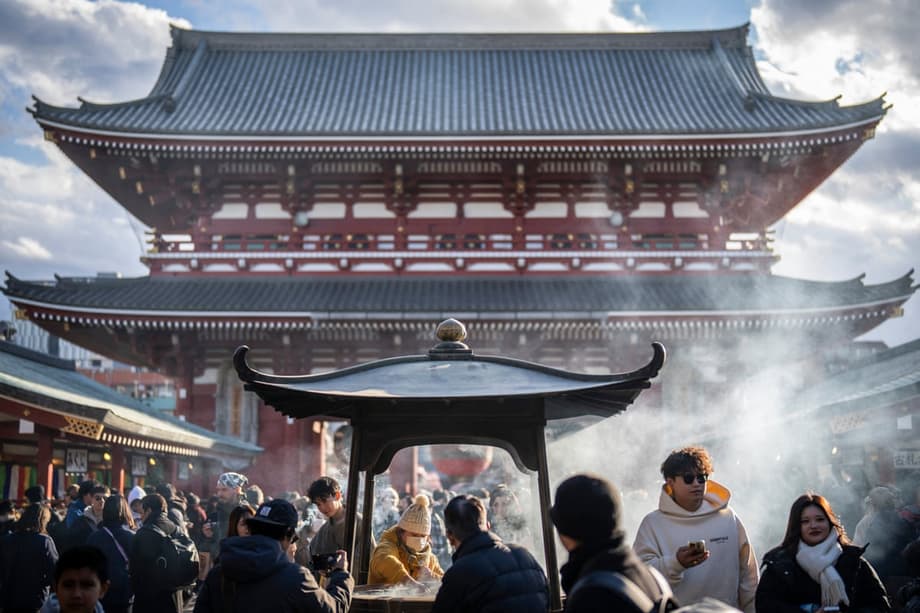
A Sharp Decline in Tourism Numbers
Chinese tourism to Japan fell dramatically in December 2025, dropping by approximately 45% compared to the same period in the previous year. The Japan transport ministry reported that only about 330,000 tourists from mainland China visited Japan in December, marking a significant downturn in what has traditionally been the country’s largest source of international visitors. This decline follows a bitter diplomatic dispute between Beijing and Tokyo that erupted after Japanese Prime Minister Sanae Takaichi suggested her country could become militarily involved if China attempted to invade Taiwan.
Despite this significant drop in Chinese visitors, Japan’s tourism industry overall continues to show remarkable resilience. The country welcomed a record 42.7 million foreign visitors in 2025, comfortably surpassing the previous record of 37 million set in 2024. Japan’s transport minister, Yasushi Kaneko, downplayed the impact of declining Chinese tourism by highlighting the annual achievement of surpassing 40 million visitors for the first time in history.
“While the number of Chinese tourists in December decreased, we attracted a sufficient number of people from many other countries and regions to offset that,” Kaneko said. “We also hope and want to make sure that Chinese visitors will return to us as soon as possible.”
The decline in Chinese tourists is particularly significant given their outsized economic contribution. In the first nine months of 2025, almost 7.5 million Chinese visitors arrived in Japan, accounting for approximately one quarter of all foreign visitors. Chinese tourists are also high spenders, contributing a combined $3.7 billion in the third quarter of 2025 alone, with each Chinese visitor spending on average 22% more than tourists from other countries.
The Diplomatic Spark
The current crisis originated from a parliamentary session on November 7, 2025, when Prime Minister Takaichi, a hawkish conservative known for her tough stance on China, responded to questions about how Japan would react to a potential Chinese invasion of Taiwan. Her response marked a departure from Japan’s traditional position of strategic ambiguity regarding Taiwan.
“If there are battleships and the use of force, no matter how you think about it, could constitute a survival-threatening situation,” Takaichi told parliament. This statement carries significant weight because a “survival-threatening situation” is a specific legal term under Japan’s 2015 security legislation, which allows Japan to exercise collective self-defense when an armed attack on its allies poses an existential threat to the country.
Takaichi’s remarks came just weeks after she had met Chinese leader Xi Jinping at the APEC summit in South Korea, where both leaders had pledged to build “constructive and stable” relations. The sharp contrast between these diplomatic niceties and Takaichi’s subsequent parliamentary comments fueled Beijing’s anger.
The Chinese response was swift and severe. Beijing summoned Japan’s ambassador and demanded that Takaichi retract her statement. When she refused, China began implementing a series of retaliatory measures targeting Japan’s tourism and cultural sectors.
The diplomatic situation escalated further when Xue Jian, China’s consul general in Osaka, reshared a news article about Takaichi’s remarks on social media platform X (formerly Twitter) with his own comment that “the dirty head that sticks itself in must be cut off.” Though the post was later removed, it drew sharp criticism from Japanese officials who lodged formal protests.
China’s Retaliatory Measures
Beijing’s response to Takaichi’s comments has been multifaceted, targeting various sectors that rely on Chinese engagement. The most visible impact has been in tourism, with China’s foreign ministry issuing a travel advisory warning citizens against visiting Japan. The embassy statement cited “blatantly provocative remarks regarding Taiwan” that it claimed had “severely damaging the atmosphere for people-to-people exchanges” and posed “significant risks to the personal safety and lives of Chinese citizens in Japan.”
Beyond tourism advisories, Chinese authorities urged their students to reconsider studying in Japan, affecting the more than 100,000 Chinese students enrolled in Japanese educational institutions. The Chinese Ministry of Education told students already based in Japan to closely monitor the security situation, raising concerns about the long-term educational exchange between the countries.
Cultural exchanges also felt the impact of the diplomatic tensions. The Chinese releases of at least two popular Japanese films, “Crayon Shin-chan the Movie: Super Hot! The Spicy Kasukabe Dancers” and “Cells at Work!” were postponed indefinitely. Chinese state media reported that distributors cited “sentiments of the domestic audience” as the reason for these delays, while also noting declining ticket sales for the hit Japanese animation “Demon Slayer: Infinity Castle.”
Major Chinese airlines, including Air China, China Southern Airlines, and China Eastern, offered full refunds for flights to Japan, signaling the severity of the situation. Aviation analysts reported that approximately 500,000 tickets from China to Japan were cancelled following the travel advisory, dealing a substantial blow to airlines, hotels, and the broader tourism sector.
Economic Ripple Effects
The diplomatic tensions quickly manifested in financial markets. Japanese stocks related to tourism and retail experienced significant declines in the wake of the travel advisory. The parent company of Mitsukoshi and Isetan department store chains plunged by almost 12%, while cosmetics giant Shiseido and other retail brands saw their share prices drop sharply.
Even companies with broad international exposure were affected. Shares in the owner of global fashion chain Uniqlo closed more than 5% lower, while carriers Japan Airlines and ANA Holdings also saw declines. Oriental Land, which operates the Tokyo Disney Resort, ended the day 5.8% lower, reflecting investor concerns about reduced Chinese visitor spending.
The economic impact extended beyond tourism. China suspended imports of Japanese seafood, citing concerns over treated radioactive water from the Fukushima Daiichi nuclear plant. While officially framed as a safety measure, many observers viewed this as part of China’s broader retaliation against Japan. The suspension created significant challenges for Japanese fisheries that had only recently begun recovering from previous trade restrictions.
Japan’s response was measured but firm. Japanese authorities warned the approximately 100,000 Japanese citizens living in China to take extra safety precautions, avoid crowded places, and be mindful of local customs. The Japanese embassy in China issued specific guidance advising citizens to “pay attention to your surroundings and avoid as much as possible squares where large crowds gather, or places that are likely to be identified as being used by many Japanese people.”
Japanese officials also disputed China’s characterization of safety risks in Japan. In meetings with Chinese counterparts, Japanese representatives rejected the justification for the travel warning, stating that “public order within Japan has in no way deteriorated” and urging China to take “appropriate measures” to de-escalate the situation.
Historical Context and Strategic Significance
The current tensions must be understood within the broader historical context of China-Japan relations. The two countries share a complex history marked by periods of cooperation and conflict, including Japan’s brutal military campaign in China during World War Two, which remains a sensitive issue in bilateral relations. Historical grievances frequently surface during diplomatic disputes, as seen when a Chinese defense official warned that Japan would face “crushing defeat” if it failed to learn from history and took reckless risks.
Taiwan represents another critical fault line in the relationship. Located just 100 kilometers from Japan’s westernmost island of Yonaguni, Taiwan holds strategic importance for Japan’s security. The Taiwan Strait serves as a crucial maritime corridor for global trade, including shipping lanes vital to Japan’s resource-dependent economy. Additionally, approximately 20,000 Japanese citizens live in Taiwan, further connecting Japan to the island’s fate.
Japan’s official position has traditionally been one of “strategic ambiguity” regarding Taiwan—maintaining unofficial but substantial ties with Taipei while formally acknowledging China’s One China policy. This approach allowed Japan to support Taiwan economically and politically without explicitly challenging Beijing’s territorial claims. Previous prime ministers, including Takaichi’s mentor Shinzo Abe, carefully avoided directly stating that Japan would defend Taiwan militarily.
Experts note that Takaichi’s remarks represent a significant shift in this approach. Jeffrey J. Hall, a special lecturer at Japan’s Kanda University of International Studies, observed that while security experts have long believed Japan would play a role in a Taiwan conflict, the country’s leaders had avoided stating it directly until now. This strategic ambiguity “allowed China to save face, even though China’s government probably already expected that Japan would take such a stance in a Taiwan conflict.”
The Taiwan Question and Regional Security
Taiwan has been self-governing since 1949, but Beijing considers it a breakaway province that must eventually be reunified with mainland China, by force if necessary. China has never renounced the use of force to achieve reunification and has significantly increased military pressure on Taiwan in recent years, including regular incursions into Taiwan’s air defense identification zone.
The issue has gained renewed urgency following Russia’s invasion of Ukraine in 2022, which many in the region view as a precedent for a larger power attempting to seize territory from a smaller neighbor. Additionally, questions about whether the United States would defend Taiwan under various political scenarios have prompted regional allies to reconsider their own security postures.
Japan has taken several steps to enhance its defense capabilities in response to regional tensions. The country has stepped up measures to defend its outlying islands, particularly near Taiwan and around the uninhabited Senkaku Islands in the East China Sea. These islands are administered by Japan but claimed by China, which calls them the Diaoyu Islands, making them a persistent source of bilateral tension.
The strategic stakes extend beyond territorial disputes. The 1960 US-Japan security treaty allows American forces based in Japan to operate across East Asia, meaning any conflict in the Taiwan Strait would likely involve US forces stationed on Japanese soil. This interdependence makes Japan’s position on Taiwan directly relevant to its alliance with the United States and its own national security calculations.
John Lim, a research fellow at the Institute for Advanced Studies on Asia at the University of Tokyo, noted that this is the first time Taiwan has explicitly become a central issue in a major China-Japan diplomatic crisis, shifting the focus from earlier disputes that typically revolved around history or territorial issues. He described Takaichi’s remarks as “preventive clarity” aimed at signaling Japan’s red lines while attempting to avoid a full-scale confrontation.
Domestic Politics and International Implications
The timing of Takaichi’s remarks carries political significance within Japan. As the country’s first female prime minister and a protégé of the influential late leader Shinzo Abe, Takaichi has pursued a conservative agenda that includes closer ties with the United States and increased defense spending. These positions have raised alarms in Beijing but resonate with portions of the Japanese electorate concerned about China’s growing military capabilities.
Japanese public opinion appears divided on the question of Taiwan. A Kyodo news agency poll conducted after the diplomatic row erupted found that 48.8% of respondents favored Japan exercising its right to self-defense if Beijing attacks Taiwan, while 44.2% were against it. The same poll showed that 60.4% supported Takaichi’s plan to increase Japan’s defense spending, suggesting broad support for a strengthened military posture despite the diplomatic costs.
International observers have analyzed the crisis from various perspectives. Ryu Yongwook, an assistant professor at the Lee Kuan Yew School of Public Policy in Singapore, noted that the dispute “reveals that Beijing cannot let go of Taiwan at all, as the political legitimacy of the Communist Party of China is so tied to the Taiwan issue.” This explains China’s particularly strong reaction to external comments about Taiwan’s security status.
Kei Koga, an associate professor at Nanyang Technological University in Singapore, explained that “whenever China hears statements about Taiwan from external actors in an unfavorable light, particularly concerning tensions or potential contingencies, it responds quickly and assertively, regardless of the diplomatic signals those actors intend to send.” This pattern suggests that China’s response was not merely performative but reflected genuine strategic concerns about setting boundaries for what it considers acceptable international commentary on Taiwan.
Some analysts have suggested that China may be testing Takaichi early in her tenure. Dylan Loh, also of Nanyang Technological University, noted that “because she is early in her tenure and because her position is not quite stable yet, China sees itself as able to more fully test the boundaries.” This perspective frames the current dispute as part of a longer-term strategic positioning between the two regional powers.
Taiwan’s Response and Regional Ripple Effects
Notably absent from much of the coverage has been Taiwan’s own response to the situation. Taiwanese officials have expressed solidarity with Japan amid the diplomatic tensions. Taiwan’s Foreign Minister Lin Chia-lung called on Taiwanese citizens to increase travel to Japan and purchase more Japanese products in support of the neighboring country.
“The Chinese Communist Party has repeatedly deployed economic and military coercion to bully other countries,” Lin said during a legislative session, framing China’s actions as part of a broader pattern of using trade, investment, and tourism as tools of pressure. He characterized this behavior as “uncivilized and undemocratic” and pledged Taiwan’s support for Japan at what he termed a “critical time.”
Taiwan’s stance highlights the complex regional dynamics at play. As both China and Japan vie for influence, Taiwan finds itself both a point of contention and a potential partner for Japan. The strong cultural and economic ties between Japan and Taiwan, built on decades of exchange, provide a foundation for cooperation even amid tensions with Beijing.
The diplomatic crisis has also drawn attention from other regional players and international observers. The United States, Japan’s primary security ally, has maintained its own policy of strategic ambiguity regarding Taiwan, even as it strengthens defense cooperation with both Japan and Taiwan. The European Union and other Western democracies have expressed concerns about maintaining peace and stability in the Taiwan Strait, viewing the status quo as essential to global economic security.
Ryo Sahashi, Professor of International Politics at the University of Tokyo, noted that while Japan’s fundamental stance on Taiwan remains unchanged, “what distinguishes Prime Minister Takaichi is that she explicitly used Taiwan as an example and strongly hinted at the possibility of exercising collective self-defense.” This more direct approach, he suggested, places less emphasis on accommodating foreign sensitivities and represents a recalibration of Japan’s diplomatic communication style.
Looking Forward: Potential Paths for Resolution
Despite the severity of the current tensions, experts suggest that neither China nor Japan seeks a complete breakdown in relations. Both economies face internal pressures, and global supply chain realignments make economic cooperation mutually beneficial. Historical patterns also suggest that even at the lowest points in China-Japan relations, dialogue eventually resumes.
John Lim noted that “the pendulum of China-Japan relations is always swinging between reconciliation and conflict” and that “history shows that even at the lowest point, dialogue is always restored.” This perspective offers hope that the current crisis will eventually pass, though the trajectory of relations may be altered in its aftermath.
Japan appears to be pursuing a “dual-track communication” approach, dispatching senior security officials to Beijing while maintaining firm positions on core security issues. This strategy attempts to reassure China that Japan is not seeking to alter the status quo fundamentally while still asserting its security interests and red lines.
The duration and intensity of China’s retaliatory measures remain uncertain. Jeffrey J. Hall suggested that “this will likely go on until the Chinese government believes it has sufficiently punished Japan,” indicating that Beijing views economic pressure as a calculated tool for signaling displeasure rather than an end in itself. This perspective suggests that China’s response will remain within bounds that do not threaten its own economic interests or broader regional stability.
For Japan’s tourism industry specifically, the immediate challenge will be diversifying visitor sources while maintaining relationships for when Chinese visitors eventually return. The record overall tourist numbers suggest that Japan has made progress in attracting visitors from other markets, potentially reducing vulnerability to future disruptions in any single source country.
The broader implications for regional security remain significant. As China continues its military modernization and expansion of regional influence, Japan faces difficult choices about how to balance security cooperation with the United States against economic engagement with China. Takaichi’s approach, emphasizing clarity about security red lines even at economic cost, may signal a longer-term strategic recalibration.
The Bottom Line
- Chinese tourism to Japan dropped by approximately 45% in December 2025, falling to about 330,000 visitors due to a diplomatic row over Taiwan.
- Despite this decline, Japan achieved a record 42.7 million foreign visitors in 2025, surpassing the previous record of 37 million set in 2024.
- The diplomatic crisis began after Prime Minister Sanae Takaichi stated that a Chinese attack on Taiwan could constitute a “survival-threatening situation” justifying military response.
- China responded with travel advisories, warnings to students, postponement of Japanese film releases, airline refunds, and suspension of Japanese seafood imports.
- Japanese tourism and retail stocks fell sharply following the announcements, with some department store chains dropping nearly 12% in value.
- Chinese tourists typically represent about 25% of Japan’s foreign visitors and spend 22% more on average than tourists from other countries.
- Both countries issued safety warnings to their citizens in the other’s territory, reflecting mutual concerns about rising tensions.
- Japan maintained that its position on Taiwan remains unchanged despite Takaichi’s more explicit statements about potential military involvement.
- Historical tensions between China and Japan, including World War II grievances and territorial disputes, continue to influence their relationship.
- Taiwan expressed solidarity with Japan and encouraged its citizens to support Japanese tourism and businesses.