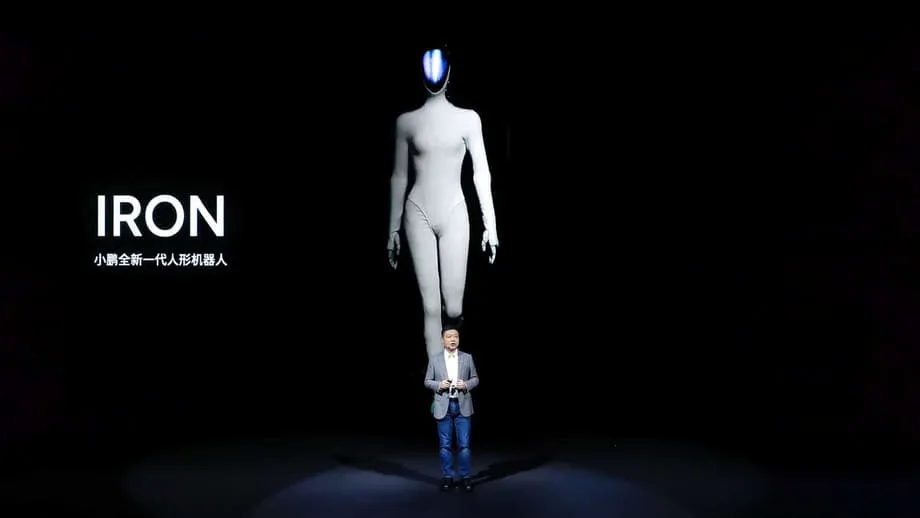
From a Viral Demonstration to a Production Target
Xpeng has completed its first ET1 humanoid robot prototype developed to automotive standards, bringing the Chinese electric vehicle manufacturer a step closer to its goal of mass production by the end of 2026. Chairman and CEO He Xiaopeng announced the milestone on Weibo, saying he had spent the day observing the development and discussing it with his team.
Contents
- From a Viral Demonstration to a Production Target
- What the ET1 Milestone Means
- A Body Designed Around Human Movement
- Three Chips and an AI System for Physical Tasks
- Why Xpeng Chose Solid State Batteries
- The Catwalk That Prompted an Onstage Inspection
- A Data Factory and Plans for Developers
- Showrooms First, With Industrial Work Planned
- Useful Work Is the Next Test
- A Growing Market With Economics Still Being Tested
- Investors Are Also Watching the Vehicle Business
- Key Points
As of January 20, 2026, the achievement places manufacturing at the centre of a programme that attracted attention through a striking public demonstration. Xpeng's next generation IRON robot, unveiled at its 2025 AI Day event in November, walked with such realistic posture and movement that some viewers suspected a person was hidden inside it.
Xpeng now describes itself as a "global embodied intelligence company," a shift beyond its identity as an electric vehicle maker. Embodied intelligence means artificial intelligence operating through a physical machine: a system that must turn what it sees and understands into movement and action.
The company is drawing on capabilities developed for vehicles, including AI computing, batteries, manufacturing and supply chains. Its challenge is to combine those technologies in a humanoid that can perform useful work reliably and at an acceptable cost.
IRON's initial commercial focus is on guides, shopping assistants and receptionists, rather than personal use in homes. Industrial work is also part of the programme through a partnership with Chinese steel giant Baosteel. Xpeng's own experiments with robots tightening screws have already shown why choosing the right task matters: the company found that performance and repair costs made that application inefficient at scale.
What the ET1 Milestone Means
The ET1 prototype is a development milestone in Xpeng's effort to produce advanced humanoid robots in large numbers. Developing it to automotive standards reflects the company's plan to bring practices from vehicle engineering and production into robotics.
Xpeng believes its existing manufacturing infrastructure and automotive supply chain can shorten the time needed to reach the market compared with startups focused solely on robots. The company can draw on experience coordinating components, software and production processes across a complex machine.
Mass production requires that process to work repeatedly. A robot assembled for a demonstration must become a product that can be built consistently, maintained and deployed across different locations. Xpeng's target is to reach large scale production by the end of 2026, although no exact start date, planned production volume or selling price was given.
The programme's recent milestones and announced plans follow this sequence:
- November 2025: Xpeng unveiled its next generation IRON humanoid at its 2025 AI Day event.
- During the unveiling: staff opened the robot's leg on stage after viewers questioned whether a person was inside.
- By January 20, 2026: He Xiaopeng announced completion of the first ET1 prototype developed to automotive standards.
- By the end of 2026: Xpeng aims to achieve mass production of advanced humanoid robots.
A Body Designed Around Human Movement
IRON stands approximately 178 centimetres tall and weighs 70 kilograms, giving it proportions close to those of a person. Xpeng describes its construction as a "bone-muscle-skin" framework intended to mirror human anatomy.
A flexible humanoid spine allows the robot to bend and adjust its balance. Bionic muscles provide actuation, the process of turning power into movement, with motion profiles designed to resemble organic movement. Together, these features support the coordinated posture and steps displayed during its public walk.
The robot has 82 degrees of freedom across its body. A degree of freedom describes an independent movement available to a mechanism, such as bending or rotating. Each hand has 22 degrees of freedom, allowing a range of finger movements for handling objects and interacting with equipment.
Xpeng says the hands use the industry's smallest bevel gear joints. Bevel gears transfer movement between shafts set at an angle, helping compact mechanisms fit into the hands. The company says this allows hand sizing at a 1:1 scale with human hands and supports delicate tasks, including grasping fragile objects and operating touch interfaces.
Flexible synthetic skin covers the exterior and can be customised for different body shapes and proportions. A curved display in three dimensions serves as the robot's face, providing a surface for expressive communication. Its appearance is therefore part of the planned interaction with people, alongside speech and movement.
Three Chips and an AI System for Physical Tasks
IRON carries three Turing AI chips developed by Xpeng, with a combined computing capacity of 3,000 TOPS. TOPS means trillions of operations per second, a measure of how many computing operations a processor can perform. The stated capacity is roughly comparable to that found in advanced autonomous vehicles.
Xpeng is adapting that computing power to coordinate the robot's articulated body while processing visual information and language at the same time. A humanoid must connect those activities: an instruction may require it to identify an object, decide how to approach it and move its hands without losing balance.
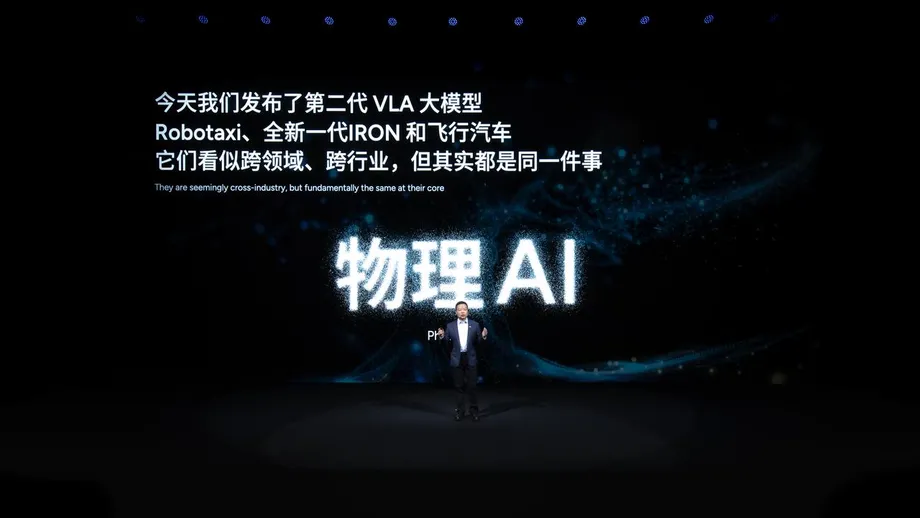
The robot uses Xpeng's second generation VLA, or Vision-Language-Action, model, which the company describes as its first mass produced physical world large model. Its broader architecture combines VLT, VLA and VLM, with each component assigned a different role.
VLA generates actions by translating sensory information into commands for movement. VLM, or Vision-Language-Model, handles natural language dialogue and social interaction. VLT, or Vision-Language-Task, is a new model developed specifically for robotic reasoning and described by Xpeng as the "core engine" for autonomous decision making.
Xpeng says the combined system supports conversation, walking and interaction with the surrounding environment. It is designed to break complex instructions into smaller tasks, plan sequences of actions and adapt to changing conditions without constant human supervision.
Why Xpeng Chose Solid State Batteries
Xpeng says IRON uses batteries with an entirely solid electrolyte, an approach it describes as an industry first. These solid state batteries offer higher energy density and greater safety than traditional lithium ion batteries. Energy density describes how much energy a battery can store for its weight, an important consideration for a machine that must carry its own power supply.
According to Xpeng, the battery approach supports a lightweight design with a weight reduction of approximately 45%. The company also says the system passed demanding safety tests, including an acceleration impact of 9G, meaning nine times the acceleration associated with gravity.
The choice draws directly on Xpeng's automotive technology and access to the electric vehicle supply chain. For a humanoid operating near people in an enclosed public space, battery weight affects movement, while battery safety is part of making the machine suitable for deployment. Those considerations would also matter for eventual use in homes.
Battery endurance remains a wider limitation for humanoid robots, with operating time restricted to a few hours. A machine that needs frequent charging must fit that downtime around the work it is expected to perform.
The Catwalk That Prompted an Onstage Inspection
IRON's appearance at the November 2025 AI Day event quickly spread online. The robot performed a catwalk with fluid movement and realistic human posture, including coordinated steps and hip motion that made its walking style unusually convincing.
Some viewers suspected that the demonstration involved a person wearing a robot costume. Xpeng responded during the presentation by having staff cut open the robot's leg, exposing metal joints, actuators and wiring to show its internal machinery.
The moment drew attention to the engineering behind balance and motion control. Reproducing an elegant human gait requires coordinated movements across the body, including adjustments that keep the machine stable as its weight shifts from one leg to the other.
The demonstration also brought a response from Tesla CEO Elon Musk, whose company is developing the Optimus humanoid robot. Musk reportedly sent a direct message assessing Xpeng's robot and the competitive position of Chinese companies:
Not bad... Tesla and China companies will dominate the market. Other companies in the West are weak.
He Xiaopeng, Xpeng's chairman and CEO, responded on social media by pointing to the origin of the robot shown on stage:
Let this stand as the final proof: the robot that mastered the catwalk is built by a Chinese startup.
The exchange reflects the growing competition between American and Chinese companies developing humanoids. Tesla and Xpeng are both applying experience from electric vehicles to robotics, contributing to the view among some industry observers that the contest could increasingly centre on technology companies from the two countries.
A Data Factory and Plans for Developers
Xpeng has established its first embodied intelligence data factory in Guangzhou to address a persistent problem in robotics: the shortage of training data covering a wide variety of physical tasks.
A robot needs examples of actions and their results to learn how to work in real environments. Xpeng's facility is intended to generate varied datasets for that purpose, supporting the transition from selected demonstrations to a broader range of tasks.
The approach resembles Tesla's strategy of using data from real environments to train autonomous systems. For Xpeng, dedicated data collection is part of the infrastructure needed to improve how IRON interprets instructions and responds to the physical world.
The company also plans to open the IRON software development kit, or SDK, to developers around the world. An SDK provides tools that other developers can use to build applications for a platform.
Xpeng hopes outside developers will extend the robot's capabilities and find uses that its own team has not anticipated. The strategy follows platform models used in mobile and automotive software, where third parties can build products around a shared technical foundation.
Showrooms First, With Industrial Work Planned
Xpeng plans to prioritise commercial services for IRON's first deployments. Its own retail showrooms are expected to provide settings for robots working as guides, shopping assistants and receptionists.
Showrooms offer the company a controlled environment in which to collect data about specific tasks and manage interactions with customers. Starting there also gives Xpeng greater control over operating conditions and potential liability than deploying robots directly into private homes.
Baosteel has signed on as an ecosystem partner, with IRON robots planned for inspection and material sorting in the steel company's facilities. Those uses are intended to provide revenue and practical operating experience while testing the platform in demanding industrial environments.
Xpeng has also explored using IRON within its own manufacturing operations, including tightening screws on assembly lines. The company concluded that this would be inefficient at scale because of performance problems and high repair and replacement costs compared with human workers.
The contrast helps explain its commercial choices. A service role and a repetitive manufacturing task place different demands on a robot. Xpeng's assessment of screw tightening shows that selecting a task must account for speed, reliability and maintenance costs, alongside the machine's ability to perform the motion.
Useful Work Is the Next Test
Criticism of IRON has focused on the limited practical applications shown publicly. One demonstration placed the robot in the driver's seat of an Xpeng vehicle as a technology guide, with its role centred on presentation rather than carrying out a useful physical task.
Critics have contrasted that emphasis on appearance and movement with demonstrations of Tesla's Optimus sorting parts and tightening screws in factory settings. The concern is whether Xpeng's public displays communicate capabilities that will translate into dependable commercial work.
The wider industry faces similar technical and safety constraints. Many activities still require human operators to control robots like puppets while collecting data for later training. Researchers caution that humanoids remain far from general purpose use in homes and offices.
Xpeng must now connect its motion control, AI and manufacturing progress to measurable value for customers. Commercial deployment will require robots that complete tasks consistently, operate safely around people and justify the costs of purchase, repairs and replacement.
A Growing Market With Economics Still Being Tested
Chinese robotics company UBTECH has announced what it calls "the world's first mass delivery of humanoid robots," saying more than 1,000 Walker S2 robots were sent to factories in 2025.
Industry specialists describe deployment as still being at an early stage, with the time and money saved by humanoids yet to be determined. Delivery volumes and useful operating performance are both central to judging how quickly the market is developing.
Automotive plants have become important testing environments because they combine established automation with varied, complex tasks. Their partly structured settings offer opportunities to trial humanoids while keeping more control over conditions than would be possible in a home.
Tesla, Boston Dynamics and Xpeng are running humanoid pilots in industrial plants belonging to their parent companies. Access to those factories allows them to draw on manufacturing expertise while testing where the machines fit into existing work.
Industry insiders predict that a single industrial enterprise could purchase and receive more than 10,000 humanoid robots in 2026. They see that scale as a possible first turning point for the sector, comparable to the start of large scale expansion in new energy vehicles around 2018. The prediction places much larger purchases alongside the factory deliveries already announced for 2025.
Investors Are Also Watching the Vehicle Business
Xpeng's shares fell in Hong Kong following the robot announcement, against a backdrop of pressure on its core automotive business. Macquarie had recently lowered its price target to $26 from $32 while maintaining an "Outperform" rating.
The reduction was $6, or 18.75% of the earlier $32 target. Macquarie described 2026 as a transition year for Xpeng as the company expands its product portfolio amid slowing demand in China's electric vehicle market.
The stock movement illustrates the competing demands facing the company. Humanoid robots could broaden Xpeng's business over time, while investors are also assessing vehicle sales, product expansion and performance in a competitive car market.
Completion of ET1 gives Xpeng a concrete development milestone, but the programme remains a strategic investment requiring further technical, commercial and regulatory work. Competition includes Tesla, established robotics companies and emerging developers worldwide.
The coming 18 months are an important period for those ambitions, with the end of 2026 production target the nearest major deadline. Xpeng's central task is to turn the attention generated by IRON's public appearance into a product that performs useful work and delivers economic value.
Key Points
- Xpeng completed its first ET1 humanoid prototype developed to automotive standards and targets mass production by the end of 2026.
- IRON stands about 178 centimetres tall, weighs 70 kilograms and has 82 degrees of freedom, including 22 in each hand.
- Three Xpeng Turing AI chips provide a combined 3,000 TOPS, supporting models for reasoning, dialogue and action.
- Xpeng claims an industry first for IRON's solid state batteries and reports a weight reduction of approximately 45%.
- Initial service deployments are planned for Xpeng showrooms, with inspection and material sorting roles planned through Baosteel.
- A Guangzhou data factory and a planned SDK for global developers support the robot's further development.
- Xpeng found assembly line screw tightening inefficient at scale because of performance and repair costs.
- Commercial usefulness, safety, battery endurance and operating costs remain central challenges as production approaches.