A handshake that changes before the robot finishes moving
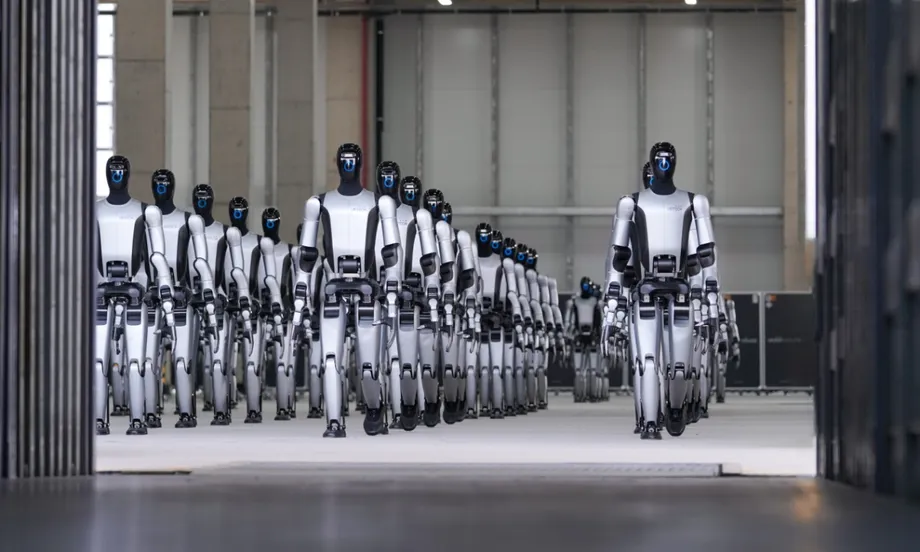
Xpeng says its IRON humanoid robot can now predict changes in human movements up to six seconds ahead, updating its assessment every 0.2 seconds as it watches the person in front of it. The upgrade is designed to let the machine adjust when someone suddenly turns an open palm into a fist or moves the target for a high five.
Contents
- A handshake that changes before the robot finishes moving
- How five updates a second change the interaction
- The AI connection between a car and a humanoid
- What the chips do inside IRON
- A body built for more than a single gesture
- Shops first, with industrial work also planned
- The manufacturing challenge behind the demonstrations
- A public fall and the timetable ahead
- Key Points
The Chinese electric vehicle maker attributes the capability to its second generation VLA model, an artificial intelligence system that connects visual information with physical actions. The prediction system runs inside the robot rather than depending on a connection to cloud computers, according to the company.
IRON carries three of Xpeng's Turing AI chips, with a combined computing capacity of 2,250 TOPS. Its new interaction capability draws on the same underlying physical AI technology that Xpeng uses to anticipate changing situations around its vehicles.
The immediate examples are familiar gestures: handshakes, fist bumps and high fives. Their difficulty lies in timing. A person may change direction halfway through a movement, leaving the robot to adjust its own arm, hand and posture while the exchange is still happening.
Xpeng's commercial plans make that responsiveness relevant beyond demonstrations. The company wants IRON to work first in shops, shopping centres and other commercial settings, where visitors will move and behave at their own pace. Its official target is to achieve mass production of advanced humanoid robots by the end of 2026, with deliveries planned for the first half of 2027.
How five updates a second change the interaction
IRON reassesses what it sees every 0.2 seconds, equivalent to five updates per second. Across a period of six seconds, that rate would allow about 30 fresh assessments. The robot therefore keeps revising its expectations instead of committing to a movement after recognising a single gesture.
A handshake illustrates the difference. A fixed sequence might tell a robot to extend its hand after detecting an approaching palm. If the person then closes their hand for a fist bump, the machine needs to recognise the change and alter its response before the two hands meet.
Xpeng describes IRON doing that during interactions, as well as adjusting its posture and switching hands when someone changes the position of a high five. The process forms a repeating loop: observe the person, estimate what comes next, move, then observe again.
The company presents six seconds as the system's prediction horizon. It has not published a prediction accuracy rate, detailed testing conditions or a measured success rate for these interactions. Those measurements would help prospective users understand how consistently the capability works across different people and surroundings.
The AI connection between a car and a humanoid
Xpeng introduced its second generation VLA at its technology day in Guangzhou on November 5, 2025. In its technology day announcement, published on November 17, the company described a model that generates action instructions directly from visual signals, removing an intermediate language translation step.
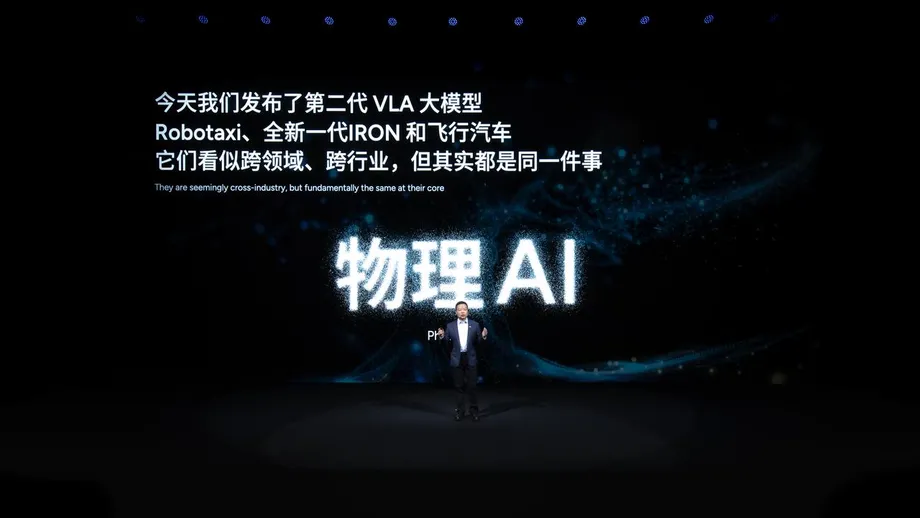
VLA stands for vision, language and action. In simple terms, these systems connect what a machine sees and understands with what it should do. Xpeng says its revised architecture makes the route from visual input to movement more direct, while also allowing the model to reason about how a scene may develop.
A vehicle approaching a changing road situation and a robot facing a moving hand share a practical problem: both need to respond to where something is going, rather than only where it is now. Xpeng says its physical AI foundation supplies that common ability to interpret movement over time.
The November announcement described IRON's intelligence as a combination of VLT, VLA and VLM models. Xpeng identified VLT as a model developed specifically for robot reasoning and autonomous decisions. VLM, or vision language model, connects visual information with language. The newer interaction upgrade centres on the second generation VLA's ability to understand sequences and anticipate movement.
What the chips do inside IRON
IRON's three Turing chips provide the computing resources for repeated assessments and action generation inside its body. TOPS means trillions of operations per second, a measure of how many computing operations hardware can perform. At 2,250 TOPS, the stated capacity is 2,250 trillion operations per second.
Running the interaction model locally means the robot can process observations and generate responses without sending each decision to a remote server. That is useful when a hand is already moving toward it and a response must arrive quickly.
Xpeng also uses substantial cloud computing resources to develop its AI. Its November announcement described a cluster of 30,000 computing cards, a foundation model with 72 billion parameters and training involving nearly 100 million driving video clips. Parameters are the adjustable values through which an AI model learns patterns.
The cloud infrastructure supports model development, while the chips carried by IRON handle the deployed interaction system. Xpeng's strategy joins those two stages: train models using large computing resources, then adapt them to operate within the power and hardware limits of a physical machine.
A body built for more than a single gesture
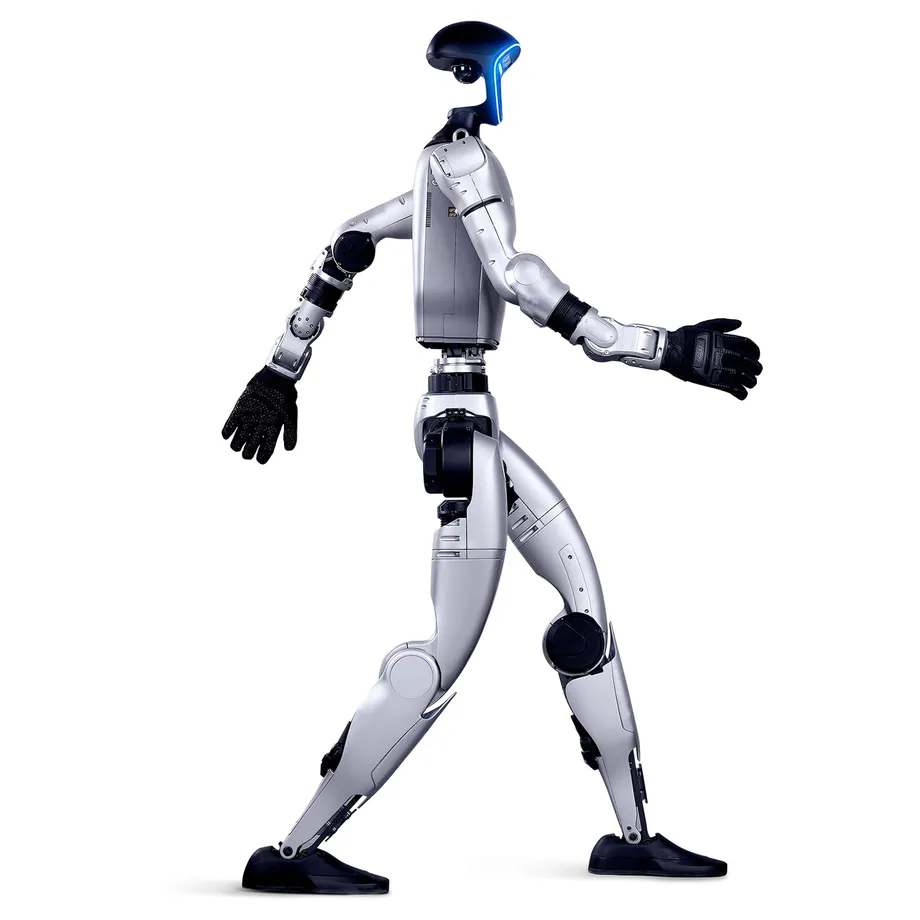
The new generation IRON unveiled on November 5, 2025, has 82 degrees of freedom across its body and 22 in its hand design, according to Xpeng. A degree of freedom is an independent movement, such as a joint bending or rotating. More such movements give engineers more ways to position the body and shape a gesture.
Xpeng lists a spine modelled on human anatomy, structures resembling muscles, flexible skin covering the body, shoulders designed for humanlike movement and a curved three dimensional display on the head. Small harmonic joints, a type of compact precision mechanism, help the hands approach human proportions.
The relationship between the body and the prediction system is practical. Recognising that a person has moved their hand creates a new target; the robot's joints and control software must then place its own hand in the right position while maintaining balance.
Xpeng also says IRON uses an all solid state battery. Such batteries use a solid electrolyte, the material through which charged particles move inside the battery. The company describes the design as supporting lower weight, high energy density and safety. It has not given a working duration for the upgraded interaction capability.
Shops first, with industrial work also planned
Xpeng's official initial service roles are guiding visitors, helping shoppers and conducting patrols. Its commercial plans put stores and shopping centres first, followed by a gradual expansion into industrial and household settings.
Those choices put human interaction near the centre of the product. A shopping assistant may need to turn toward a visitor, follow a pointing gesture or respond when someone approaches from an unexpected direction. The latest upgrade addresses a small but concrete part of that challenge: keeping a physical exchange responsive when the person changes their movement.
Baosteel is an announced partner for the IRON programme. Xpeng's November statement said the companies would explore applications including inspection in complex industrial settings. Zou Jixin, chairman of Baosteel, described a plan for IRON to enter the company's facilities and develop through practical use.
Xpeng has also announced plans to open an SDK, or software development kit, for IRON. An SDK gives outside developers tools for building applications on a platform. For the robot programme, the aim is to let partners create uses beyond those designed by Xpeng's own team.
The company has established an embodied intelligence data factory in Guangzhou to address a shortage of robot training data. Embodied intelligence means AI acting through a physical body, where a decision must become a movement involving weight, contact and balance.
The manufacturing challenge behind the demonstrations
He Xiaopeng, Xpeng's chairman and chief executive, has described the difficulty of the robotics business as roughly 20 times that of making cars. He has said the company develops most of the robot's hardware, software, design and supply chain itself.
He also said his earlier reluctance to show the robots publicly was mainly because they could not yet be mass produced. He criticised the use of edited capability demonstrations in the wider industry. His comments put repeatable manufacturing and dependable operation alongside visual performance as central concerns for the programme.
Xpeng's November statement identifies an immature hardware and software supply chain as one of the industry's problems. A design assembled for a demonstration must eventually become a product that can be built repeatedly, serviced and operated across many locations.
The company's ET1 prototype milestone, announced by January 20, 2026, marked another step toward that goal. He said Xpeng had completed its first ET1 humanoid prototype developed to automotive standards. The programme's initial focus remained guides, shopping assistants and reception work, with industrial applications also under development.
Xpeng's experience making vehicles gives it manufacturing processes and component expertise to draw upon. He Xiaopeng's assessment of the difficulty also reflects the amount of engineering still required to combine AI, mechanical movement and production in a humanoid product.
A public fall and the timetable ahead
IRON's Shenzhen mall fall, during the weekend before February 4, 2026, showed another side of that work. After walking across a stage at the MixC shopping centre, a robot lost its balance while standing still and was carried away. A replacement continued the demonstrations, and the following day IRON conducted interactions while attached to a support frame.
The incident matters because shopping centres are among Xpeng's intended first workplaces. An interaction system must operate together with reliable balance and physical control when visitors are nearby. Engineers therefore have to develop anticipation, movement and stability as parts of the same machine.
The programme's milestones and plans span several dates:
- 2024: Xpeng introduced the first generation IRON.
- November 5, 2025: Xpeng unveiled the new generation at its Guangzhou technology day.
- January 2026: He Xiaopeng announced completion of the ET1 prototype developed to automotive standards.
- The weekend before February 4, 2026: IRON fell during a public demonstration at Shenzhen's MixC mall.
- October 22, with no year specified in the upgrade accounts: Xpeng announced the movement prediction capability.
- End of 2026: Xpeng targets mass production of advanced humanoid robots.
- First half of 2027: Deliveries are planned, initially for commercial settings.
For businesses considering IRON, the next practical step is the move from development milestones to production and delivery. The six second prediction horizon describes one part of the proposed product: a robot intended to adapt to people while carrying out useful work in places they already use.
Key Points
- Xpeng says IRON predicts changes in human movement up to six seconds ahead and reassesses visual information five times per second.
- The interaction system runs locally on the robot, which carries three Turing AI chips providing 2,250 TOPS.
- The new generation has 82 degrees of freedom across its body and 22 in its hand design, according to Xpeng.
- Initial planned roles include guiding visitors, assisting shoppers and patrols, with Baosteel involved in exploring industrial applications.
- Xpeng targets mass production by the end of 2026 and deliveries in the first half of 2027.
- The company has not published detailed accuracy or success measurements for the movement prediction upgrade.