A $540 Million Market Puts Chinese Manufacturers in Front
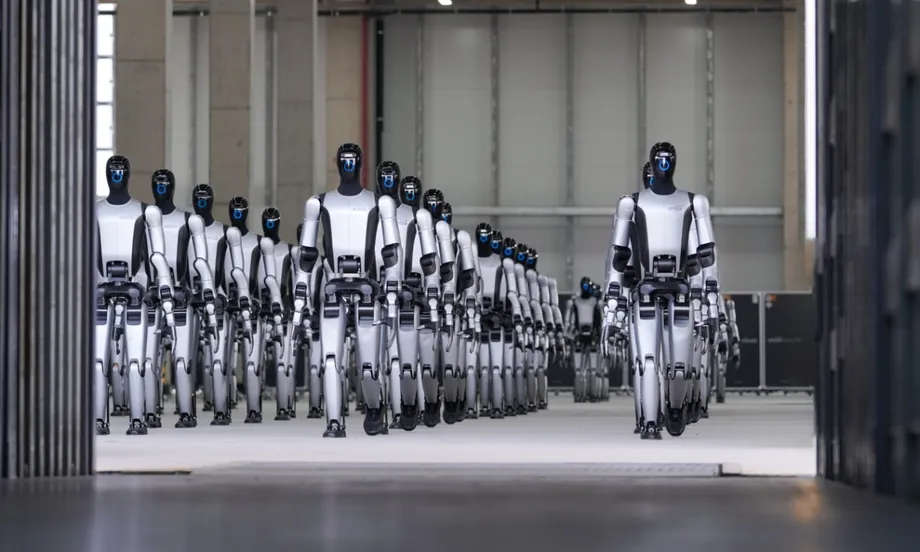
Chinese companies occupied all five leading positions in global humanoid robot revenue in the first half of 2026, together accounting for 57.4% of the market, according to Frost & Sullivan's 2026 Global Humanoid Robot Market Research Report. Shenzhen supplied two of those companies, including leader UBTech, while the city's wider robot exports reached 11.13 billion yuan in the first eight months of the year.
Contents
- A $540 Million Market Puts Chinese Manufacturers in Front
- Who Leads, and How Much Are They Selling?
- Why Two Market Counts Give Different Totals
- Shenzhen's Robot Valley Brings Suppliers Together
- Exports Accelerate Beyond Humanoid Robots
- Factory Work Is Growing From a Small Base
- Orders and New Factories Test Delivery Capacity
- Lower Prices Meet Local Purchasing Targets
- The Dates Behind the Expansion
- Key Points
Global humanoid robot sales reached 36,000 units from January through June, already exceeding the 35,000 sold throughout 2025. Revenue reached $540 million, compared with $500 million for the whole previous year. In six months, the industry sold about 2.9% more machines and generated 8% more revenue than in the preceding 12 months.
UBTech led with 620 million yuan in humanoid robot revenue and a 16.5% market share. AgiBot followed closely with 610 million yuan and 16.1%, ahead of Unitree, Galbot and Leju Robotics. UBTech and Leju are based in Shenzhen, where a dense network of component suppliers is helping companies turn designs into machines more quickly.
Shenzhen Customs recorded a rise of 12.2 times in the city's exports of separately classified robot products compared with the same period a year earlier. Those products reached more than 120 countries and regions. The customs figures cover several kinds of robots, while Frost & Sullivan's ranking focuses on humanoids, machines with bodies broadly shaped like people.
The two measures capture different parts of Shenzhen's robotics expansion: manufacturers are winning humanoid sales, and the city's broader robot industry is reaching more overseas customers. Factory openings, lower prices and government purchasing targets are now pushing the business beyond demonstrations toward regular commercial use.
Who Leads, and How Much Are They Selling?
Frost & Sullivan's ranking puts the five leading manufacturers within a market that includes machines for entertainment, research, education and industrial work. Their results for the first half of 2026 were:
- UBTech: 620 million yuan in revenue, a 16.5% market share and 16,123 robots sold.
- AgiBot: 610 million yuan, a 16.1% share and 7,850 robots sold.
- Unitree: 580 million yuan, a 15.3% share and 4,900 robots sold.
- Galbot: 210 million yuan, a 5.5% share and 308 robots sold.
- Leju Robotics: 150 million yuan, a 4% share and 3,540 robots sold.
UBTech retained first place from 2025, when its humanoid robot revenue was 870 million yuan and sales reached 13,838 units. Its volume in the first half of 2026 was already about 16.5% above that annual total, although its revenue remained below the previous full year's figure.
AgiBot moved ahead of Unitree in revenue, reversing their positions in 2025. Leju and Galbot also exchanged places, with Galbot moving into fourth. The differences between revenue and sales volume show how strongly the type of robot sold affects a company's position: Galbot generated more revenue than Leju while selling far fewer machines.
Frost & Sullivan excludes manufacturers' internal transactions and transactions with related parties from its revenue calculation. That rule matters in a business where companies may build robots for their own factories as well as for outside customers. The ranking measures revenue under that definition, while technical development and internal deployments follow their own schedules.
Why Two Market Counts Give Different Totals
Frost & Sullivan puts global humanoid sales at 36,000 in the first half of 2026; IDC puts worldwide shipments at nearly 25,000 for the same period, including more than 19,000 in China, or approximately 77.9% of its global total. IDC also records growth of 432.1% from a year earlier.
AgiBot's figures vary too. The Frost & Sullivan ranking records 7,850 units sold, while another figure for the company's first half shipments exceeds 8,600. Sales and shipments can refer to different stages of a transaction, and the studies' detailed definitions and reconciliation were not given.
Both market estimates describe rapid expansion, with China occupying a large commercial position. Readers comparing companies need to keep the measurement consistent: a share calculated from IDC's shipment total belongs alongside IDC's figures, while Frost & Sullivan's revenue shares belong alongside its own market total.
Shenzhen's Robot Valley Brings Suppliers Together
More than 200 companies involved in robotics are concentrated in Nanshan's Robot Valley in Shenzhen. Their work stretches from software algorithms and sensing systems to movement mechanisms, core components and complete machines. System integrators connect those parts so a robot can perform a customer's task.
Liu Tuo, founder of Shenzhen Tuoji Technology, described how that concentration changes the process of making a prototype. Comparing Shenzhen with Silicon Valley, he said:
Prototyping in Silicon Valley takes two months because you have to source components from around the world; but if you come to Shenzhen, perhaps 90% of the components can be found in Robot Valley.
A prototype is an early working version used to test a design. When suppliers are nearby, engineers can obtain parts, identify problems and make changes without waiting for components to travel across several countries. Liu's comparison points to a practical advantage in development speed.
A senior United States delegation visited Robot Valley on the afternoon of October 16. The visit brought international attention to a district where component production, software development and robot assembly are clustered together.
Shenzhen's robotics growth also fits its wider manufacturing expansion. The city recorded GDP of 3.87 trillion yuan in 2025, growing by 5.5%, while Nanshan crossed 1 trillion yuan in economic output, as detailed in coverage of Shenzhen's industrial growth. Robotics is developing inside an established technology and export economy rather than starting with an isolated production base.
Exports Accelerate Beyond Humanoid Robots
Shenzhen Customs recorded robot exports worth 8.58 billion yuan in the first seven months of 2026, rising to 11.13 billion yuan for January through August. Subtracting those cumulative totals gives 2.55 billion yuan in August, approximately 22.9% of the eight month total.
The earlier customs figure showed growth of 10.5 times compared with the corresponding period in 2025; the eight month figure showed growth of 12.2 times. Shenzhen's statistics bureau also recorded a 44.8% increase in industrial robot production during the first eight months.
Exports, production and humanoid revenue each describe a different business activity. The export total measures goods sold abroad across the customs categories concerned. Industrial production measures output, while the humanoid ranking measures manufacturers' revenue in a particular robot market. Together, they show expansion across several parts of Shenzhen's robotics industry.
Factory Work Is Growing From a Small Base
Frost & Sullivan divides humanoid applications into entertainment performances, research and education, data collection, and production work. Robots used for production generated $78 million in revenue in the first half of 2026, up from $47 million throughout 2025. Their sales rose from about 700 units to 1,200 over those periods.
Production work therefore accounted for about 14.4% of the $540 million global humanoid market in the first half. Its revenue exceeded the previous annual total by about 66%, but most market revenue still came from other applications.
Industrial customers need machines that can repeatedly complete useful tasks, operate safely and keep working reliably. A robot performing a rehearsed movement on stage faces a different assignment from one handling parts during a factory shift. China's manufacturers have been pursuing both, including the Chengdu robot performances in December 2025 that drew attention to improvements in balance and coordination.
UBTech's industrial business shows how much product categories affect the revenue table. In the narrower category of full size embodied intelligent humanoids, machines designed to combine physical movement with AI guided interaction, it recorded 590 million yuan in revenue and 921 units sold in the first half of 2026. AgiBot sold 996 units in that category, yet UBTech's revenue was about 1.8 times AgiBot's.
UBTech, AgiBot, Galbot, Robot Era and Leju occupied the top five revenue positions in that narrower category. UBTech's corresponding business generated 820 million yuan in 2025, with a 45.1% market share.
Orders and New Factories Test Delivery Capacity
UBTech recorded total company revenue of 1.269 billion yuan in the first half of 2026, up 104.2% from a year earlier. Its new orders exceeded 1 billion yuan, including three orders worth at least 100 million yuan each, with aviation manufacturing, the automotive industry and smart manufacturing among its target markets.
Airbus placed an initial order for 100 Walker S2 robots. UBTech also opened its industrial humanoid factory in Liuzhou, Guangxi, on September 12. The plant has planned annual capacity exceeding 10,000 robots and a stated production rhythm of one machine every 10 minutes.
UBTech had already secured a different kind of customer through its Guangxi border robot agreement, valued at 264 million yuan in November 2025. That project assigned Walker S2 robots to duties including traveler assistance, patrol support and logistics, extending their intended use beyond factory floors.
Consumer robot manufacturers are also increasing output. Qiyuan Robotics, a brand under Swancor Advanced Materials, launched its Q1 and T1 personal robots on September 20, each starting at 19,999 yuan. Company chief executive Tian Hua said its manufacturing process produces a robot every 2.5 minutes and uses the IATF16949 automotive quality management standard.
The different production rhythms reflect different products and manufacturing arrangements. Customers will experience the expansion through delivery times, prices and the machines' ability to keep working after installation. Manufacturers must connect increasing output with service and dependable operation.
Lower Prices Meet Local Purchasing Targets
Unitree's R1 price fell from 39,900 yuan to 29,900 yuan, a reduction of about 25%. Songyan Power's Bumi was priced at 9,998 yuan, taking a bipedal humanoid below 10,000 yuan. Qiyuan opened its first global store in Shanghai in late September and has also established experience stores in Guangzhou, Shenzhen, Xi'an, Xiamen, Hangzhou and Wuhan.
Local components support that pricing push. Unitree's prospectus states that more than 90% of the R1's core technology is domestic and that more than 80% of its core components are developed or produced independently, including its motors, reducers and controllers. Reducers adjust motor speed and torque so joints can move with the required force and control.
The China Academy of Information and Communications Technology's 2025 humanoid industry white paper puts the domestic share of China's core humanoid components at 75% by the end of 2025. Those figures connect the national supply base with the concentration of suppliers visible in Shenzhen.
Shanghai launched its action for developing a new generation of smart manufacturing on October 12. Its targets for 2028 include putting 8,000 humanoid robots into factories, cultivating 500 advanced smart factories and exceeding 2,000 manufacturing applications for AI.
Shenzhen's embodied intelligent robotics action plan for 2025 to 2027 sets a target of more than 100 billion yuan in related industry activity by 2027. Its goals also include cultivating more than 10 additional companies valued above 10 billion yuan and implementing at least 50 applications at a scale of 1 billion yuan.
The Dates Behind the Expansion
Commercial orders, factory openings and policy targets are moving on overlapping schedules. The main milestones show how the industry's expansion is being pursued through both supply and demand:
- January to June 2026: Global humanoid sales reached 36,000 and revenue reached $540 million in Frost & Sullivan's study.
- January to August 2026: Shenzhen's exports of separately classified robot products reached 11.13 billion yuan.
- September 12, 2026: UBTech opened its Liuzhou factory, with planned annual capacity exceeding 10,000 robots.
- September 20, 2026: Qiyuan launched two personal robots starting at 19,999 yuan each.
- October 12, 2026: Shanghai launched its new smart manufacturing action.
- October 16, 2026: A senior United States delegation visited Shenzhen's Robot Valley.
- 2027 and 2028: Shenzhen's robotics industry goals and Shanghai's factory deployment targets reach their respective deadlines.
Manufacturers now face a commercial task that extends beyond making more machines. Factory customers need reliable work, consumers need useful products at affordable prices, and suppliers need repeat orders. The revenue ranking shows Chinese companies leading current sales; the production and purchasing programmes set the next tests of sustained demand.
Key Points
- Chinese firms held the top five humanoid robot revenue positions in the first half of 2026, with a combined 57.4% market share.
- UBTech led with 620 million yuan in humanoid revenue; Shenzhen's Leju ranked fifth.
- Frost & Sullivan counted 36,000 global sales, while IDC counted nearly 25,000 shipments.
- Shenzhen's broader robot exports reached 11.13 billion yuan in January through August, serving more than 120 markets.
- Production work generated $78 million, about 14.4% of global humanoid revenue.
- New factories and lower prices are expanding supply, while Shanghai targets 8,000 humanoids in factories by 2028.