G1 production reaches five figures as Unitree pushes into services
Unitree founder and chairman Wang Xingxing says the company has produced roughly 10,000 to 20,000 G1 humanoid robots since the model debuted in May 2024, putting a concrete manufacturing figure behind its push to turn walking machines into useful commercial workers.
Contents
- G1 production reaches five figures as Unitree pushes into services
- What the production and shipment figures show
- What buyers get with the G1
- Wang's AI forecast centres on connecting thought and movement
- Why services may arrive before household help
- What the martial arts performances contributed
- H2-X brings greater force and fresh safety questions
- More robots require more than an assembly line
- A timeline of expansion and investor attention
- Key Points
Speaking at the 2026 World Physical AI Conference and Unitree Partner Ecosystem Conference, Wang described the G1 as the world's bestselling humanoid robot. His production estimate covers machines leaving the factory since launch. Unitree's shipment figures, which track robots sent to customers, provide a separate measure of its business.
The announcement comes as Unitree promotes its new H2-X Kung Fu Legend Guardian, a larger humanoid shown striking vehicles and acting out protection and rescue scenarios. Behind those demonstrations is a more practical challenge: making artificial intelligence reliably control a robot in a changing physical environment.
Wang expects commercial services to achieve useful deployment before household and industrial applications. He sees a possible breakthrough in embodied intelligence within one to three years and hopes to bring AI models and robot technology together more fully in 2027 or 2028.
Embodied intelligence means AI operating through a physical machine. A chatbot can describe how to pick up a cup. A robot must also locate it, position its fingers, apply enough pressure and move without spilling its contents. Unitree's next stage depends on connecting those decisions to dependable movement.
The conference brought together more than 3,000 guests and over 40 exhibition areas, reflecting the growing network of manufacturers, software developers and component suppliers around the company.
What the production and shipment figures show
Unitree announced on August 12, 2026, that cumulative production of its humanoid robots had reached approximately 18,000 units. That count covered its range of robots that walk on two legs and excluded humanoids using wheeled bases.
The company had previously put cumulative G1 production at about 11,000 units by May 2026. The August figure therefore covered a broader product range than the May G1 figure. Wang's latest estimate of 10,000 to 20,000 concerns the G1 alone.
Industry figures put Unitree's humanoid shipments above 5,500 units in 2025 and at roughly 5,900 in the first half of 2026. In other words, shipments in six months had already exceeded the previous full year's total.
Unitree accounted for about 31% of global humanoid shipments in the first half of 2026, according to those industry figures. The two largest suppliers together held close to 75%, showing how much of the young market was concentrated among a small number of producers.
Earlier in 2026, Wang forecast annual Unitree humanoid shipments of 10,000 to 20,000 units. That was a projection for deliveries during one year; his latest G1 announcement describes production accumulated since 2024.
What buyers get with the G1
Unitree's official G1 specifications list a starting price of 85,000 yuan including tax, compared with the 99,000 yuan starting price announced at launch. The reduction is 14,000 yuan, or about 14% of the launch price.
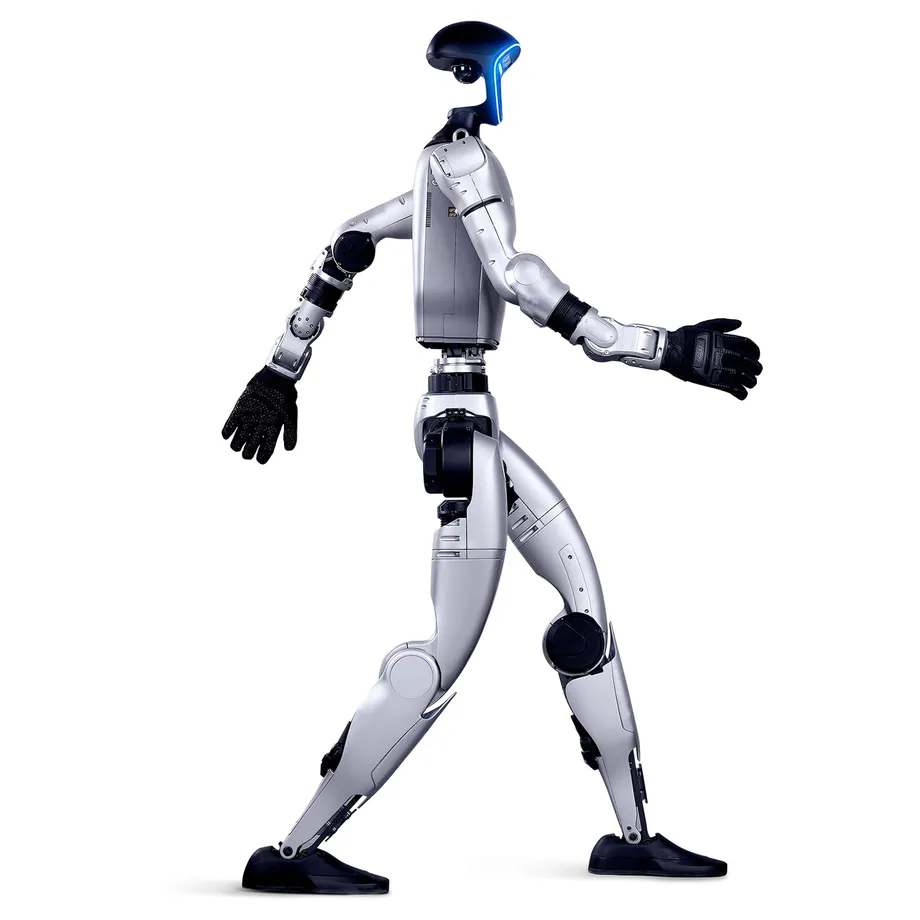
The current specifications give the G1 a standing height of 1.32 metres and a weight of approximately 35 kilograms with its battery. Launch coverage described it as approximately 1.27 metres tall. Folded dimensions are 690 by 450 by 300 millimetres, making storage and transport part of its design.
The basic G1 has 23 powered joints. The G1 EDU, intended for education and development, can have up to 43 degrees of freedom, meaning independently controlled movements. Optional equipment includes additional wrist movement and Dex3-1 hands with three fingers and force control.
A depth camera and 3D lidar help the robot sense distances and surrounding objects. Four microphones provide sound input. Unitree lists a removable battery rated at 9,000 milliamp hours and an operating time of about two hours, with performance varying by configuration and use.
Wang's AI forecast centres on connecting thought and movement
Wang's central argument is that advances in AI software are bringing robots closer to a major jump in usefulness. He told the conference that leading AI developers had, to some extent, achieved internal processes in which models write programs and collect data with limited human guidance.
He also presented a video described as showing robot training using GPT-6. According to his presentation, the robot performed drawing and navigation planning without additional training for those tasks. The precise training setup and the meaning of zero training were not detailed.
The technical challenge Wang identified is aligning an AI model's inputs and outputs with a real robot. Camera images, sounds and sensor readings must become useful information for the model; its decisions must then become movements that motors can execute safely and accurately.
Wang's target of 2027 or 2028 builds on a prediction he made at the 2025 World Robot Conference, where he placed a possible robot ChatGPT moment two to three years away. The phrase describes a breakthrough that makes a technology's usefulness apparent to a much wider public.
At that earlier conference, Wang said Unitree expected humanoid shipments to double annually, with breakthroughs potentially lifting annual volumes to hundreds of thousands or millions within two to three years. Those figures describe his expectations for future growth.
Why services may arrive before household help
Unitree plans to expand beyond research, education, consumer experimentation and commercial performances into commercial services and industrial work. Wang has identified guided tours and relatively fixed industrial environments as applications that could produce useful results during 2026 or 2027.
A guided tour gives a robot a fairly predictable route and a defined task. Household work requires it to cope with different rooms, unfamiliar objects and instructions that change from moment to moment. Wang has described general purpose embodied intelligence as the limiting factor for domestic use.
Factories present another test: productivity. Wang has said robots around the world still fall short of human efficiency in factory work. A machine that performs a movement successfully must also repeat it at a useful speed and cost to become an attractive employee substitute or assistant.
Wang, Unitree's founder and chairman, explained the connection between technical progress and demand in an interview around the 2026 Spring Festival Gala:
"The biggest market growth for humanoid robots comes from the maturity of technology. When technology becomes more and more valuable, the entire market scale will gradually expand," Wang Xingxing said.
What the martial arts performances contributed
Unitree's 2026 Spring Festival Gala performance used 24 G1 robots, compared with 16 robots in its appearance the previous year. That was a 50% increase in the number of machines performing together.
The robots executed martial arts movements, flips and coordinated routines. Wang said the preparation also produced faster movement between actions, with a maximum running speed of four metres per second, equivalent to 14.4 kilometres per hour.
Unitree developed group control and positioning technology so the robots could sense their surroundings and return to their intended positions after large movements. Coordinating 24 moving machines requires each robot to keep track of where it should be while the group stays on schedule.
Wang has said those capabilities could transfer to factories. Rapid repositioning and coordinated movement could help groups of robots work in the same area. Unitree's commercial ambition is to carry the control techniques developed for performances into environments where machines complete practical tasks.
H2-X brings greater force and fresh safety questions
Unitree's H2-X promotion takes a different approach to demonstrating physical capability. The video shows the humanoid denting vehicle bodywork, responding to staged robbery scenarios and lifting a car to help someone underneath it.
The H2-X has been described as standing 1.82 metres tall, weighing 70 kilograms and having 31 degrees of freedom. Those specifications make it approximately twice the G1's listed weight. Demonstrations also show it jumping from platforms up to four metres high.
The advertised endurance needs particular attention: the more specific description is approximately eight hours of standing between charges. Buyers would need operating figures for walking, lifting or other tasks to assess how long it could work in their intended setting.
H2-X pricing and a detailed commercial release schedule have not been announced. The related H2 is described as a robot standing about 1.8 metres tall, priced at $29,900, with an optional Nvidia Jetson AGX Thor computing module.
Unitree's G1 product page warns users to maintain a safe distance because humanoid robots have complex structures and powerful motors. It also says some example functions remain under development and advises individual buyers to understand the technology's limitations before purchasing.
More robots require more than an assembly line
Wang's longer term manufacturing ambition reaches an annual capacity of 10 million robots. He places that alongside the development of physical AI models, their commercial deployment, large computing servers and the manufacture of processing and memory chips.
His argument connects robot growth to data, computing capacity, chip production, energy and minerals. A robot needs physical components, while the AI controlling it also needs software development and computing resources. Expanding either side places demands on suppliers beyond the robot manufacturer.
Unitree, Nvidia and Sharpa announced an H2+ robotics collaboration at Computex 2026. The project involves a blueprint for robots using Nvidia training resources and its Jetson AGX Thor T5000 chip. It sits alongside the H2-X's focus on physical demonstrations.
China's wider robotics industry was already growing rapidly in the first half of 2025. Xin Guobin, vice minister of industry and information technology, said operating revenue rose 27.8% from a year earlier, while industrial robot output increased 35.6% and service robot output rose 25.5%. Those categories describe a broader industry than humanoids alone.
A timeline of expansion and investor attention
Unitree's production announcements have accompanied a move into public markets. The company listed on Shanghai's STAR Market on August 19, 2026, under stock code 688836.
On October 19, its shares rose more than 17% during trading and briefly exceeded 500 yuan. They closed at 495.92 yuan, taking the company's market value back to approximately 200 billion yuan. Subsequent market coverage also described a fall of 55% from an earlier peak.
The main milestones trace how quickly Unitree has moved from introducing the G1 to discussing production at a much larger scale:
- May 13, 2024: Unitree launches the G1 with a starting price of 99,000 yuan.
- 2025 World Robot Conference: Wang forecasts a possible robot ChatGPT moment within two to three years.
- May 2026: Cumulative G1 production reaches approximately 11,000 units.
- August 12, 2026: Unitree announces roughly 18,000 humanoid robots produced across its range of machines that walk on two legs.
- August 19, 2026: Unitree lists on Shanghai's STAR Market.
- October 2026: Wang puts cumulative G1 production at roughly 10,000 to 20,000 units as Unitree promotes the H2-X.
- 2027 or 2028: Wang hopes to achieve a closer union of AI models and robot technology.
For customers, the next useful milestones will be practical ones: robots completing defined tasks reliably, working for sufficient time between charges and delivering enough value to justify their purchase. Wang's forecast puts commercial services near the front of that effort.
Key Points
- Wang Xingxing says Unitree has produced approximately 10,000 to 20,000 G1 robots since May 2024.
- Unitree's official G1 starting price is 85,000 yuan including tax, with about two hours of listed operating time.
- Industry figures put Unitree's first half shipments in 2026 at roughly 5,900 humanoids and its global share at about 31%.
- Wang expects commercial services to develop ahead of household and industrial applications.
- The H2-X demonstration features powerful movements; its approximately eight hours of advertised endurance refers to standing.
- Wang hopes to connect AI models and physical robot control more fully in 2027 or 2028.