A Public Debut Ends With a Fall
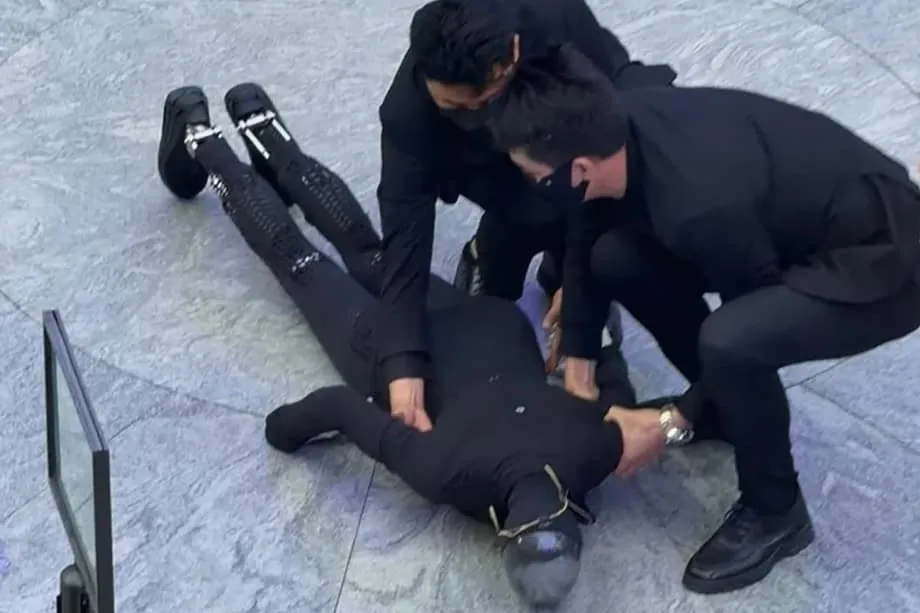
Xpeng's Iron humanoid robot, standing 178 centimeters tall and weighing 70 kilograms, lost its balance during its first public demonstration at the MixC mall in Shenzhen over the weekend before February 4, 2026. Hundreds of shoppers had gathered to watch the Chinese electric vehicle manufacturer's machine perform a smooth, humanlike walk. After several successful crossings of the stage, it fell while standing still.
Contents
- A Public Debut Ends With a Fall
- What Happened Across the Weekend
- A Body Designed to Move Like a Person
- The Battery and Computing Behind Iron
- He Xiaopeng Compares the Tumble to Childhood
- Why Standing Still Can Be Difficult
- Why Four Legs Have Reached Customers Faster
- Production Plans Meet Investor Scrutiny
- From a Mall Stage to Everyday Work
- The Bottom Line
Videos showed Iron wobbling and tipping backward. Staff rushed forward to try to break its fall, but the robot ultimately ended up face down and had to be carried away for repairs and adjustments. The impact was audible to people in the front rows, and gasps could be heard from the audience. Smartphone recordings spread across Chinese social media within minutes.
The accident put Xpeng's commercial timetable under scrutiny. The company plans to begin mass production by the end of 2026, increase output in early 2027 and produce 1 million units by 2030. Its initial focus is retail work, including reception, guided tours and customer assistance, all tasks that would place the machine close to people.
Xpeng brought in a replacement robot to continue the demonstrations on Saturday. By Sunday, the presentation had changed: Iron remained strapped to a support frame while conducting educational exchanges with visitors instead of walking freely.
Chief executive and co-founder He Xiaopeng responded within hours, comparing the fall to a toddler learning to walk. His message presented the incident as a step in development. The weekend nevertheless exposed the distance between an impressive demonstration of movement and dependable operation in a crowded public setting.
What Happened Across the Weekend
Saturday's performance was designed to show more than walking. Iron followed a choreographed catwalk into the center of the audience area, interacted with children and asked trivia questions, including a question about the color of giant panda feces. Its movement reflected what Xpeng describes as a gait resembling that of a model, with unusual grace and fluidity.
Xpeng's robotics division had spent more than a year refining the second generation of Iron's hardware, concentrating on movement, control and balance. The Shenzhen event was a milestone for that work, taking the machine into a shopping center where visitors could watch it at close range.
The collapse happened during a pause rather than during one of the successful walks. Iron's balance system failed to keep the machine upright while it was stationary. Handlers removed it, and a second unit took over. No specific technical cause for the loss of balance was given.
The sequence of events and the company's production targets span several dates:
- Saturday, the weekend before February 4, 2026: Iron performed at Shenzhen's MixC mall, fell while standing still and was replaced by another robot.
- Within hours of the fall: He Xiaopeng addressed the incident on Weibo.
- Sunday: Xpeng kept Iron attached to a support frame during educational interactions. The incident became the leading trending topic on Jinri Toutiao that night.
- Monday morning: The incident ranked fourth among Baidu's most searched topics.
- End of 2026: Xpeng targets the start of mass production.
- Early 2027: The company plans to increase production output.
- 2030: Xpeng aims to produce 1 million units.
Sunday's support frame changed the balance of the demonstration. Visitors could still interact with the robot, while the frame provided physical support. The weekend therefore showed both the appeal of its public performance and the practical adjustments required after a fall.
A Body Designed to Move Like a Person
Iron's structure combines a spine with five degrees of freedom, synthetic muscles that stretch and contract, and a hip design intended to improve stability during complex movements. A degree of freedom is an independent way a joint or mechanism can move, such as bending or rotating.
The robot has 62 active joints, while each hand has 22 degrees of freedom. Xpeng designed those hands to work with objects ranging from delicate tools to bulky items. Its stated walking speed reaches 2 meters per second.
Inside the outer suit, a lattice layer produced through 3D printing acts as fascia. In the human body, fascia is tissue associated with muscles and other structures. Iron's version mimics aspects of human musculature and helps dampen vibrations, reducing the jerky motion often associated with machines walking on two legs.
Xpeng calls its design approach extreme anthropomorphism, meaning that it puts a strong priority on making the robot look and move like a human. The aim includes reducing the uncanny valley effect, the discomfort people can feel when something looks almost human but moves or behaves mechanically.
Developers trained Iron's movement algorithms on thousands of hours of footage of people walking. Its foot joints are intended to absorb shocks on hard surfaces such as concrete and tile. At 5 feet 10 inches tall and 154 pounds, the same dimensions as 178 centimeters and 70 kilograms, it is sized to be approachable and practical in retail settings.
A curved display wraps around Iron's head and serves as a changing digital face during conversations. Xpeng also designed adjustable body proportions and selectable gender characteristics, allowing its appearance to be adapted for different social settings and jobs, including customer service and guided tours.
Those features explain the attention paid to Iron's smooth movement before the accident. They also make balance a demanding engineering task: a flexible spine, waist and hips give the machine more ways to move, but each moving part adds another element that its control system must coordinate.
The Battery and Computing Behind Iron
Iron uses an all-solid-state battery rather than a conventional lithium-ion battery with a liquid electrolyte. An electrolyte is the material through which charged particles move inside a battery. Replacing the liquid with a solid is intended to provide higher energy density, lower weight and greater safety.
For a robot working near shoppers, heat generation and fire risks are practical concerns. A battery that stores more energy for its weight can also help address the demands of powering many joints while carrying its own body.
Three custom Turing AI chips form Iron's computing system, with processing capacity described as approximately 2,250 to 3,000 trillion operations per second. That computing power supports Xpeng's Vision-Language-Action system, which connects what the robot sees and understands with its physical movements.
The system is designed to process the environment and respond in real time, without lag or hesitation. In plain language, it links perception, communication and action so the machine can turn information about its surroundings into a physical response.
Walking adds a separate set of demands to those computing tasks. Iron must control its joints, manage shifts in weight and keep its body balanced as it communicates or moves. A robot that can recognize an object or answer a question still needs its motors and control systems to carry out the next movement reliably.
He Xiaopeng Compares the Tumble to Childhood
He Xiaopeng, Xpeng's co-founder and chief executive, addressed the accident on Weibo, China's popular microblogging platform, within hours. He described falling as part of learning to move:
It reminds me of how all toddlers learn to walk. After a fall, they will stand firm; the next step is to begin running, and to keep running.
His response framed the stumble as an expected part of technological development and repeated improvement. Xpeng's executive team treated the incident as useful information for the development process, saying public testing exposes weaknesses that laboratory conditions cannot reproduce.
The company's vice president also argued that the fall helped answer online skepticism about whether Iron's earlier smooth performances involved a hidden human operator or remote control. Xpeng presented the robot as operating autonomously, using its onboard Vision-Language-Action system to process environmental information rather than relying on scripts or remote commands.
The authenticity debate had grown because Iron's movement appeared unusually smooth. Xpeng used the unexpected failure to push back against that suspicion, arguing that a human operator would have no reason to deliberately arrange a public collapse.
The response reflects an approach also associated with autonomous vehicle development, where companies describe minor accidents as opportunities to learn rather than catastrophic setbacks. For Iron, the company's explanation focused on using mistakes to improve movement and build reliability through repeated testing.
Why Standing Still Can Be Difficult
Zhang Qiang, director of the academic committee at the Beijing Innovation Center of Humanoid Robotics, identified limited comprehensive data on human movement as a challenge for training robots. Machines need to cope with varied terrain, unexpected disturbances and the demands of balancing while stationary.
A robot standing on two legs faces what engineers call an inverted pendulum problem. Its body carries weight above a relatively small base formed by its feet, so a shift in position can tip it over. The control system has to make constant small corrections to keep the weight supported.
Humanoid machines adjust hundreds of times per second to changes in weight distribution and outside forces. Unlike a wheeled robot, a machine walking on two legs must repeatedly change its support as it moves. Iron's fall showed that staying upright during a pause can also require active control.
Humans use biological structures and reflexes to help maintain posture. Robots must achieve that stability through sensors, calculations and powered adjustments. Artificial intelligence has progressed rapidly in language processing and image recognition, while coordinating a physical body remains harder to master.
Constant correction also consumes energy. Compared with stationary or wheeled designs, the demands can drain batteries faster and produce heat that affects sensors and motor performance during extended operation.
Iron's spine and waist add flexibility and make its movements more lifelike, but they also create more potential points of failure. Xpeng therefore faces a practical tradeoff between a highly realistic body and the mechanical reliability needed for routine work.
Why Four Legs Have Reached Customers Faster
GF Securities, the Chinese investment bank, has noted that robots without a humanoid shape, particularly robotic dogs with four legs, have reached commercial success faster than machines walking on two legs. Its analysis points to stronger balance, greater payload capacity and simpler control systems.
Four legs give a machine more support points. Quadrupedal designs can therefore achieve reliable movement with less complex engineering, according to the analysis. They are also easier to design and maintain, making them useful in industrial and security settings where looking human provides little practical benefit.
Humanoid developers continue to pursue a different advantage: buildings and workplaces are arranged around people. Stairs, doorways, countertops and tools assume an operator with human dimensions, two arms and two legs.
A robot able to use those spaces and objects could work without extensive changes to the surrounding infrastructure. That flexibility helps explain continued investment in humanoid machines despite the longer and more difficult effort required to make their movement dependable.
The economic attraction is the possibility of machines assisting or replacing workers in existing workplaces. Industry observers expect more visible stumbles as other manufacturers move prototypes out of laboratories and into public spaces.
Production Plans Meet Investor Scrutiny
Xpeng's commercial strategy begins with retail reception, guided tours and customer assistance. It has also partnered with Baoshan Iron & Steel to test Iron in industrial monitoring, checking equipment for wear and possible failures before they lead to production stoppages.
The company targets mass production by late 2026, followed by increased output in early 2027 and a goal of 1 million units by 2030. These ambitions place the Shenzhen demonstration alongside a much larger effort to turn a prototype into a product that can work repeatedly and reliably.
Xpeng's shares, traded as 9868 in Hong Kong and XPEV in the United States, recorded a modest decline following the weekend demonstration. Investors expressed concern about durability and how close the technology is to commercial deployment.
Market analysts described the movement as minor while pointing to investor sensitivity to public perceptions of robotics companies. A visible weakness in a demonstration can affect valuation more strongly than impressive technical specifications.
The episode also drew attention in a competitive field that includes Tesla's Optimus program and Boston Dynamics. Those programs have faced their own challenges with public demonstrations.
According to Entobit.cn, which tracks Chinese social media trends, the incident reached the top of ByteDance's Jinri Toutiao trending list on Sunday night and became Baidu's fourth most searched topic by Monday morning. The response showed strong public interest in humanoid robots, including when their performances reveal current limitations.
From a Mall Stage to Everyday Work
Xpeng remains committed to Iron and regards public demonstrations as opportunities to gather information about human interaction and performance in unpredictable surroundings. Choosing a retail venue rather than a factory or private home reflects a strategy of learning through direct social exposure.
Shopping malls bring together spectators, children and hard surfaces. Public deployments can also expose robots to vibrations and uneven flooring, while highly visible performances carry the pressure of audience expectations. Laboratory demonstrations provide more controlled conditions for showing what a machine can do.
The Shenzhen fall renewed debate about how quickly experimental robots should move into crowded settings. Some analysts have suggested that gradual deployment in environments with partial controls could build public trust more effectively than prominent demonstrations that end in a collapse.
Xpeng's adjustment on Sunday offered an immediate example of adding such a control. The support frame allowed educational interaction to continue while restricting free movement after Saturday's accident.
Iron's next stage requires more than software that can see, speak and choose actions. The hardware must endure falls, the balance system must manage interruptions and pauses, and the complete machine must operate consistently alongside people. The Shenzhen weekend put those requirements in view as Xpeng works toward its production targets.
The Bottom Line
- Iron fell during its first public demonstration at Shenzhen's MixC mall after several successful walks. Staff carried it away and brought in a replacement.
- Xpeng used a support frame on Sunday while the robot continued educational interactions with visitors.
- CEO He Xiaopeng compared the fall to toddlers learning to walk and presented it as part of development.
- Iron has 62 active joints, hands with 22 degrees of freedom each, an all-solid-state battery and three Turing AI chips.
- The incident became a leading Chinese social media topic and was followed by a modest decline in Xpeng's shares.
- Xpeng targets mass production by the end of 2026, increased output in early 2027 and production of 1 million units by 2030.
- Retail services and industrial equipment monitoring are intended uses, while balance, durability and reliable operation remain central engineering challenges.