Six months of paid experience for 100,000 graduates
Indonesia is offering 100,000 recent university graduates a route into the workplace through government subsidized internships, as youth unemployment runs at about three times the national average. The Program Magang Nasional provides a monthly stipend equivalent to the provincial minimum wage for six months, targeting a hiring barrier that many graduates cannot overcome: employers asking for experience before giving them their first job.
Contents
- Six months of paid experience for 100,000 graduates
- Why a degree is no guarantee of work
- The experience requirement that blocks beginners
- Frustration behind the urge to leave
- Businesses are central to the plan
- Education quality shapes what internships can achieve
- Finding a job is only part of the challenge
- Digital matching and the limits of a temporary placement
- The figures behind the urgency
- Key Points
The initial placements form part of the government's broader 8+4+5 economic stimulus package, intended to accelerate national growth and address obstacles to employment. Plans call for continuing the program at the same scale into the following year. The immediate goal is to help graduates move from university into work while making it less costly for employers to train someone without experience.
Statistics Indonesia figures put national unemployment at around 5 percent, while unemployment among people aged 15 to 24 has reached approximately 17 percent in recent years. Millions of young Indonesians enter the labor market annually, adding pressure to an economy that has struggled to turn growth into enough opportunities for its newest workers.
The stakes extend beyond finding a first placement. Indonesia has a large population of working age, but a growing number of educated people remain unemployed, and many available jobs offer limited pay, protection or prospects. The internship program addresses the immediate experience gap. Its lasting value will depend on whether participants can move into stable employment after their six months of support.
Why a degree is no guarantee of work
More than 1.01 million university graduates were unemployed in early 2025. For families that have invested heavily in higher education, that figure captures a difficult reality: completing university does not necessarily lead to a job that repays the time and money spent studying.
Research from the Centre for Strategic and International Studies in Indonesia points to a growing number of educated workers without jobs. About 45 percent of Indonesians of college age are enrolled in tertiary education, but employers have not absorbed the expanding pool of graduates. Some remain unemployed; others enter work that makes limited use of their qualifications.
Universities and employers also face a mismatch between what students learn and what workplaces require. Graduates may leave with theoretical knowledge but lack the practical abilities companies expect. Technical, digital and interpersonal skills all matter when a new employee must apply knowledge to an actual task, work with colleagues or adapt to unfamiliar equipment and processes.
The problem reaches beyond individual applicants. Expanding university participation can increase the supply of qualified candidates, but those candidates still need suitable vacancies and a workable route into them. Critics argue that earlier government responses have been limited and temporary, leaving the underlying causes of weak graduate employment unresolved.
The experience requirement that blocks beginners
Coordinating Economy Minister Airlangga Hartarto identified the problem directly when addressing the Indonesian Chamber of Commerce and Industry. He described recruitment requirements that exclude people before they have had a chance to begin their working lives.
When you advertise a job, you write one year or two years of experience, so those who want to enter the workforce are rejected first,
Airlangga's point describes a circular problem: a graduate needs a job to gain experience, yet needs experience to get the job. Positions intended for people beginning their careers can therefore remain beyond the reach of those who have just finished university.
The subsidized internship program seeks to interrupt that cycle. Government support covers part of the cost of bringing inexperienced workers into a company, reducing the financial risk to employers and encouraging them to create placements that might otherwise remain unavailable. Graduates receive both income and a chance to show what they can do in a workplace.
Academic studies of internship models suggest that structured work experience can improve interpersonal skills, attitudes toward work and abilities that employers value. Participants in similar programs have reported increases in their own assessments of their work capabilities after completing an internship. Such experience can help young people translate classroom learning into tasks that a business needs done.
Without an accessible first step, many young Indonesians turn to informal work. These jobs can leave them without contracts, social security or clear routes to career advancement. The program is intended to improve access to formal employment, where a recognized working relationship can provide greater security and a stronger basis for building a career.
Frustration behind the urge to leave
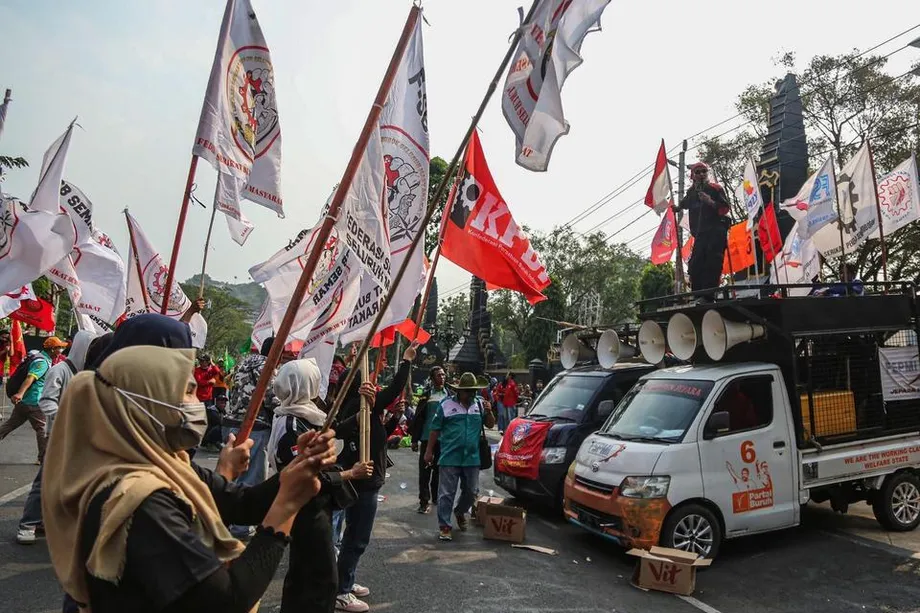
Economic anxiety has become part of everyday language among Indonesian Millennials and Generation Z. The phrase "in this economy" expresses frustration with unstable finances and scarce opportunities. In early 2025, that frustration also appeared in the viral hashtag #KaburAjaDlu, translated as "Just Escape for Now".
Young people using the hashtag described the difficulty of finding decent work, earning fair wages and receiving proper appreciation in Indonesia. Many pointed to recruitment requirements they considered exclusionary and to a lack of security that made opportunities abroad more attractive.
Manpower Minister Yassierli acknowledged the trend. He interpreted the desire to leave as a search for skills and better opportunities, rather than a rejection of Indonesia. His response recognized that young people were seeking something the domestic labor market was struggling to provide.
Generation Z accounts for nearly 28 percent of Indonesia's population, or around 75 million people. Frustration across a group of that size carries considerable economic and political weight. The government sees the internship initiative as part of its response to concerns that have become difficult to ignore.
A paid route into formal work could give graduates a reason to build their futures at home. For that promise to carry weight, the opportunity must extend beyond receiving a temporary stipend. Young people looking for fair pay and security also need prospects for continued employment once the placement ends.
Businesses are central to the plan
The Indonesian Chamber of Commerce and Industry, known as Kadin, has expressed strong support for the paid internship initiative. Its chairman, Anindya Bakrie, described it as a proper policy that needs to be implemented in coordination with the business community. He said the initiative could strengthen the supply of talent available to companies while supporting national economic growth.
Employers provide the workplace in which graduates gain experience, making their participation essential. Public funding can help open the door, while the usefulness of each placement depends on the work and training that a company provides. The intended exchange is straightforward: graduates gain practical abilities, and businesses develop people who may become future employees.
The government also offers a fiscal incentive through the Super Deduction Tax. Under this policy, companies can deduct expenditures related to internships or vocational training from their gross income. The measure lowers the cost of training and is intended to bring educational institutions and employers closer together.
Media Wahyudi Askar, director of public policy at the Center of Economic and Law Studies, assessed that the National Internship program could speed the transition toward better access to formal employment. He linked its value to support for Generation Z, which has been particularly affected by the economic slowdown.
Askar also warned against allowing the initiative to become merely a temporary response. Sustained work by government and industry is needed to reduce youth unemployment over time. Analysts have similarly argued that employer incentives need to sit within a strategy involving several sectors, rather than operate alone.
Education quality shapes what internships can achieve
Indonesia's demographic opportunity comes from having about 70 percent of its population in the productive age group. A large working population can support economic growth when people have the skills and jobs to produce more and earn better incomes. Without improvements in education quality and access to employment, the same population structure can leave large numbers struggling to find a useful place in the economy.
Indonesian students score below the global average in reading, mathematics and science in PISA assessments, lagging behind neighboring Singapore and Vietnam. These learning difficulties matter before students reach the stage of applying for an internship, because later training builds on the abilities developed at school.
Criticism of universities also concerns the relevance of teaching. Institutions have been accused of preparing students to pass examinations rather than preparing them for work. A curriculum that gives too little attention to practical, technical, digital and interpersonal abilities can leave graduates with credentials but without the skills employers need.
Technical and Vocational Education and Training, or TVET, offers another way to connect education with the workplace. Its purpose is to develop abilities linked more directly to occupations and practical tasks. Research nevertheless indicates that Indonesia's vocational schools still need improvement.
Vocational graduates have a slightly higher probability of finding initial employment than those with a general education, but that advantage tends to diminish over time as they struggle to adapt to changing labor market demands. Strengthening these institutions and aligning teaching with industry needs is therefore part of the longer task of improving employment prospects.
Internships can help graduates practice and develop workplace skills, while improvements in schools, universities and vocational training address how prepared they are when they arrive. Both parts matter to a country trying to turn its large working population into sustained economic gains.
Finding a job is only part of the challenge
The World Bank's figures point to a problem with the quality of employment as well as its availability. In 2023, only 8.4 percent of income earners in Indonesia had jobs that supported a middle class lifestyle, a decline from previous years. Most new employment was concentrated in work requiring limited skills and producing relatively little economic value.
That means an increase in the number of people working can coexist with continued financial insecurity. A graduate may find employment yet still struggle to earn enough or build a career that makes use of their education. Better access to jobs and better jobs are connected goals, but each requires attention.
The regional pressure is also substantial. The World Bank expects about 320 million people to reach working age across East Asia and the Pacific over the next decade. Indonesia shares the challenge of creating opportunities for a growing workforce, with the size of its youth population making the task especially consequential.
The International Labour Organization reports that global youth unemployment has recovered to levels seen before the pandemic. Job quality remains a concern, however, with temporary paid employment and informal work often the options available to young people in developing regions. A lower unemployment rate can therefore sit alongside widespread insecurity.
Artificial intelligence and digitalization are also changing Indonesia's employment landscape. New technologies alter the abilities companies need, creating demands that parts of the current workforce may be unprepared to meet. Training must help people begin working and adapt as the content of work changes.
Digital matching and the limits of a temporary placement
The government has acknowledged a mismatch between qualifications and employer demands, weaknesses in workforce quality and disruption from technological change. Alongside the internship subsidy, authorities are pushing companies to report vacancies and using digital platforms, including KarirHub and SiapKerja, to connect applicants with opportunities.
Vacancy reporting helps make openings visible, while digital matching can help employers and job seekers find each other. These measures address a different part of the employment problem from training: even an applicant with suitable skills needs to know where work is available and how to apply.
The internship initiative brings several parts of that response together. Graduates receive financial support while gaining experience, employers receive help with training costs, and the government seeks to improve access to formal work. Continued cooperation between educational institutions, businesses and public authorities will shape how well those parts fit together.
No date was given for the next intake, and the program description does not specify how many of the initial 100,000 placements are expected to lead to permanent jobs. The announced support lasts six months. The central test is what happens afterward: whether participants can use their experience to secure stable work with better pay and prospects.
The figures behind the urgency
The employment challenge has developed across several years. The figures describe different parts of it, from the quality of existing jobs to graduate unemployment and the public response among young people.
- 2023: Only 8.4 percent of Indonesian income earners had jobs supporting a middle class lifestyle, according to the World Bank.
- Early 2025: More than 1.01 million university graduates were unemployed, while #KaburAjaDlu spread as an expression of frustration about opportunities at home.
- January 21, 2026: Indonesia's response includes an initial target of 100,000 subsidized graduate internships, with six months of support and plans to continue at the same scale the following year.
Youth unemployment of approximately 17 percent, compared with national unemployment around 5 percent, explains why the government is concentrating on entry into work. The figures also show why a placement program needs to operate alongside better education, relevant training and the creation of stable jobs. Experience helps graduates compete for opportunities; a growing supply of good opportunities gives that experience somewhere to lead.
Key Points
- Program Magang Nasional initially targets 100,000 recent university graduates, with a stipend equivalent to the provincial minimum wage for six months.
- The initiative is part of the 8+4+5 economic stimulus package, with plans to continue at the same scale the following year.
- Youth unemployment has reached approximately 17 percent, compared with a national rate around 5 percent.
- More than 1.01 million university graduates were unemployed in early 2025.
- Kadin supports the program, while the Super Deduction Tax provides an incentive for internship and vocational training expenditures.
- Education quality, changing skill requirements and the limited supply of secure jobs remain central challenges.
- The lasting outcome depends on whether temporary placements help graduates move into stable employment.