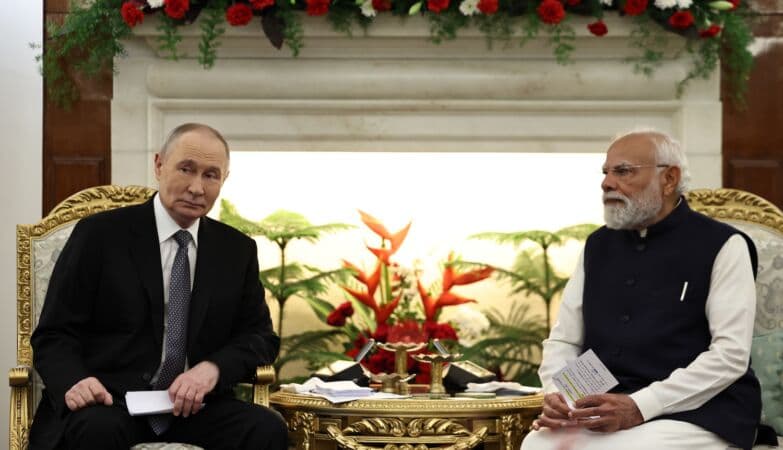
A high stakes visit in New Delhi
Vladimir Putin arrived in New Delhi for his first state visit to India in three years, a trip aimed at reinforcing trade and defense ties with a partner that has become central to Russia since the invasion of Ukraine. Prime Minister Narendra Modi used the opening session of the annual summit to send a message to both Moscow and Western capitals. India is not neutral on the war, he said, it is actively aligned with the cause of peace. The meeting comes as Washington increases pressure on New Delhi to curb purchases of Russian oil and as Moscow works to secure energy sales that keep its budget funded.
- A high stakes visit in New Delhi
- What Modi means by rejecting neutrality
- Oil trade at the center of the dispute
- Defense and nuclear ties still bind New Delhi and Moscow
- Money flows, trade balance and sanction workarounds
- Washington and Europe turn up the heat
- Ukraine war diplomacy and the limits of India influence
- Risks for India and what success looks like
- Key Points
The United States has announced an extra tariff of 25 percent on Indian goods, lifting the total rate to 50 percent, because India buys Russian crude and refined products. The move, part of a broader push to squeeze Russia wartime revenues, raised the stakes for Indian exporters and for a government that values strategic autonomy. At the same time, Russia promised India uninterrupted fuel deliveries, an assurance meant to ease concerns over energy security in the third largest oil consumer in the world.
India and Russia say they will broaden cooperation well beyond energy and arms. The two sides set an economic cooperation program through 2030 that targets more balanced trade and new channels for Indian exports. Agreements signed in New Delhi include a mobility arrangement that makes it easier for Indian professionals to work in Russia, and steps to expand trade in agriculture, seafood and manufactured goods. The package sits alongside longstanding projects such as the Kudankulam nuclear plant and collaboration in space and aviation.
Modi has framed the Indian position on the war as principled and practical. He stresses that the conflict must end through dialogue and diplomacy and that the battlefield will not deliver a durable solution. Addressing the summit in New Delhi, Prime Minister Narendra Modi said:
“Peace is the only path to progress. We must all seek a path to peace.”
What Modi means by rejecting neutrality
India has abstained on several United Nations resolutions that condemned the invasion. It also avoided direct criticism of Russia and became one of the top buyers of Russian oil since early 2022. Western critics read these moves as tacit support for the Kremlin. New Delhi presents a different case. It argues that a large developing economy must secure affordable energy for 1.4 billion citizens and that engagement with all major powers gives it leverage to push for an end to the war.
Modi and his ministers describe this approach as active alignment with peace rather than detached neutrality. During the summit, he restated the central line. Modi told Putin and the assembled delegations:
“India has a clear position in favor of peace and supports all efforts aimed at that goal.”
The policy is often called strategic autonomy in New Delhi. It allows India to deepen ties with the United States and Europe, including defense and technology cooperation in the Indo Pacific, while preserving legacy links to Russia that date to the Cold War. That balance has grown harder under a tariff regime in Washington and new rounds of sanctions, yet the government sees room to shield its core interests on both fronts.
Oil trade at the center of the dispute
Energy is the most sensitive strand of the relationship. After European buyers turned away from Russian crude and products, Russian cargoes moved to Asia at discounted prices. India imported about 1.75 million barrels per day of Russian crude between January and June 2025, up roughly 1 percent from a year earlier, and traders projected an increase to nearly 1.9 million barrels per day in one recent month as more cargoes became available. Analytics firms also tracked flows near 1.5 million barrels per day in late summer, showing the scale of India role in absorbing Russian supply.
The extra tariff of 25 percent set by Washington pushed the total levy on Indian imports to 50 percent. The White House argues that flows of Russian oil weaken efforts to limit Moscow war machine. President Donald Trump also warned other nations that buy Russian energy that they could face similar measures. He said Modi had told him India would stop buying Russian oil, a claim New Delhi officials did not corroborate. Indian ministries say procurement decisions are made by companies based on market conditions and national energy security.
In an earlier briefing, Randhir Jaiswal, spokesperson for the Ministry of External Affairs, set out the principle behind that stance. Jaiswal said:
“India’s imports are based on market factors and carried out with the general objective of ensuring energy security for 1.4 billion people.”
Indian refiners respond to prices and risk. Some state companies curtailed purchases when discounts narrowed and when tariff threats rose. Private refiners Reliance Industries and Nayara Energy remained major clients for Russian grades. Separate sanctions against large Russian producers also squeezed access and briefly forced a shift to other sources. The price cap set by the Group of Seven restricts access to Western shipping and insurance for deals priced above the cap. As a result, many Russian cargoes sail under alternative arrangements and are marketed to buyers prepared to accept those terms.
Research on trade during the war shows that politics and commerce now move in tandem. Russian exports swung away from Europe and toward Asia, and political proximity has helped shape where oil flows. China and India became preferred destinations, while Western markets largely closed. Oil has again proved to be a strategic instrument, with both sanctions and alignment influencing who buys what and at what price.
Defense and nuclear ties still bind New Delhi and Moscow
The security relationship remains a second pillar. India relies on Russian platforms and spare parts across its armed forces, from air defense to submarines. A deal for five S-400 Triumf air defense systems signed in 2018 has faced delays, with the final batteries slated for delivery in 2026 and 2027. New rounds of talks cover the lease of a nuclear powered attack submarine and potential cooperation on fighter aircraft.
President Vladimir Putin used the summit to praise a long record of defense cooperation and to signal continuity. Putin said:
“We have a very high level of trust in technical military cooperation. We intend to move forward in all these areas.”
Beyond defense, Moscow and New Delhi cited progress at the Kudankulam nuclear plant and fresh collaboration in aviation, space exploration and digital technologies. The two governments also agreed to ease the movement of skilled Indian workers to Russia, a new feature of the partnership that could widen economic links.
Money flows, trade balance and sanction workarounds
Bilateral trade has grown fast since 2022, driven by oil. That surge left a wide imbalance, because India pays for energy while selling relatively little back to Russia. Moscow says it wants to import more Indian goods and services and both capitals now target a trade value of 100 billion dollars by 2030. New Delhi set out a program to make exchanges more balanced and diverse, with attention to agriculture, marine products and manufacturing.
Sanctions complicate payments. Banks in both countries experimented with settlements in rupees and roubles, but the system has struggled because Russian exporters accumulated rupees that were hard to deploy. Companies turned to a mix of currencies and intermediaries to keep transactions moving, while lawyers worked case by case to avoid breaching sanction rules issued in the United States and Europe.
The leaders also discussed shipping routes and logistics that could lower costs, including the Arctic sea route and corridors that connect Indian ports to the Russian far north and to the Caspian region. Such projects are long term, yet they fit the goal of insulating trade from tensions elsewhere.
Washington and Europe turn up the heat
Pressure from Western capitals has increased. The United States framed the tariff hike as a tool to reduce revenue that supports Russia military campaign. It also threatened secondary measures for countries that continue to trade energy with Moscow. The European Union targeted the Indian refiner Nayara Energy under its own regime. Markets in India swung on the headlines and trade experts warned that a prolonged tariff fight could cut Indian exports to the United States by as much as one third.
Indian officials struck back at what they call double standards. They pointed to European trade with Russia in 2024, including record imports of liquefied natural gas, and to continued American purchases of Russian inputs such as enriched uranium, palladium and fertilizers. Lawmakers across the Indian political spectrum criticized the tariff move and urged Washington to stop what they described as bullying tactics.
New Delhi says it will keep decisions on energy guided by price and security. That position has already produced shifts. When discounts fell or sanction risks grew, some refiners paused or reduced orders for Russian grades and tapped other suppliers in the Middle East and the Americas. When discounts widened, they returned. The pattern shows a calibration designed to limit costs at home while reducing exposure to punitive action abroad.
Ukraine war diplomacy and the limits of India influence
At the summit, both sides said they discussed the fighting in Ukraine and prospects for talks. United States envoys have shuttled through capitals to test a plan for a ceasefire and a broader settlement. That effort has encountered roadblocks, including a Russian demand for control of parts of Donetsk and Luhansk and the refusal in Kyiv to accept losses of territory. European leaders are trying to coordinate positions while seeking support from China for a halt in the fighting.
Putin said he updated Modi on recent exchanges with American intermediaries and praised India focus on peace. Putin said:
“I informed Prime Minister Modi about the situation in Ukraine and the talks that are taking place. I thank him for the attention he pays to the conflict and for his efforts toward a resolution.”
The capacity of India to move Moscow is limited, yet it has channels that few others have. It hosts regular leader level talks with Russia. It is a member of groupings such as the BRICS and the Shanghai Cooperation Organization. It coordinated a G20 statement in 2023 that called for respect for the United Nations Charter and for diplomacy. By keeping open lines to both Russia and the backers of Ukraine, New Delhi aims to reduce harm and to seize openings for mediation when they arise.
Risks for India and what success looks like
The strategy carries risks. Deeper tariffs could hurt export oriented sectors from textiles to machinery. Extra sanctions could place Indian refiners, shipping firms and banks in legal jeopardy. Defense supplies from Russia can face delays and spare parts can be held up by sanctions. Energy markets can tighten without warning, sending prices higher for Indian consumers.
Success for New Delhi would mean protecting its energy security, keeping defense supplies flowing, preserving gains with the United States and Europe, and reducing the cost of the war for civilians in Ukraine. That is why the government describes its posture as active alignment with peace. The visit by Putin underlined how closely that goal is tied to choices on oil, trade and a diplomatic track that stays open even under strain.
Key Points
- Modi told Putin India is not neutral on the war in Ukraine and is aligned with peace through dialogue and diplomacy.
- Washington added a 25 percent tariff on Indian goods, raising the total rate to 50 percent in response to Indian purchases of Russian oil.
- Putin pledged uninterrupted deliveries of fuel to India and highlighted long running defense cooperation.
- India imported between 1.5 and 1.9 million barrels per day of Russian crude during 2025, making it a key outlet for Russian supply.
- Some Indian state refiners reduced purchases as discounts narrowed and pressure increased, while private refiners continued buying.
- Defense ties include S-400 deliveries expected in 2026 and 2027, talks on a submarine lease, and work on the Kudankulam nuclear plant.
- Both sides set a trade roadmap through 2030, signed a worker mobility agreement, and pledged to diversify trade beyond oil and arms.
- India criticized what it calls double standards in Western trade with Russia, while the United States and the European Union stepped up pressure with tariffs and sanctions.