A rare mid mission setback and a fast debris strike
China will send its damaged Shenzhou 20 spacecraft back to Earth without astronauts on board for a detailed inspection, after a cracked window forced the first mid mission no go decision in the country’s human spaceflight program. The decision follows a week of contingency operations around the Tiangong space station to bring the crew home safely and to restore an emergency ride for the team that remains in orbit.
- A rare mid mission setback and a fast debris strike
- What engineers found on the window
- How the emergency unfolded
- Why tiny debris can cause big problems
- The choice to stand down was a safety call
- What the uncrewed return and inspection will involve
- Operations on Tiangong and the role of the lifeboat
- How other missions have handled similar surprises
- What to watch in the months ahead
- Key Points
The anomaly surfaced on Nov. 5 during routine checks ahead of undocking. Astronauts spotted a small flaw along the edge of a return capsule window. Subsequent imagery from multiple angles and from an external camera on Tiangong indicated the feature was a genuine crack, not surface residue. Engineers judged that a return with crew carried unacceptable risk, since cracks in a pressurized reentry capsule can propagate under stress and heat.
The three Shenzhou 20 astronauts had just completed a six month shift on Tiangong. Instead of departing as planned, they waited nine days for a replacement craft, then strapped into Shenzhou 21 for the trip home. Their landing at the Dongfeng site in Inner Mongolia ended the longest continuous stay by a Chinese crew in orbit to date, a little over 200 days.
The damaged Shenzhou 20 has stayed docked to the station. It will be commanded to undock and reenter without crew so that engineers can study how the cracked window behaves during the high stress phases of return and collect flight data for future designs. Ji Qiming, spokesperson for the China Manned Space Agency, said the vehicle would return uncrewed and produce valuable in flight measurements that could not be obtained any other way.
What engineers found on the window
Program officials say the culprit was likely a tiny piece of space debris. Even a speck smaller than a grain of sand can strike at relative speeds of several kilometers per second in low Earth orbit. The energy released on impact is enough to chip or crack glass and metals. According to the spacecraft design team, the Shenzhou 20 window suffered a through thickness crack that extended from its inner surface to its outer surface, visible near the edge of the viewport.
Jia Shijin, chief designer for China’s crewed spacecraft system at the China Academy of Space Technology, described the assessment and the risk to the crew. He said specialists in glass materials reviewed photos and video captured inside the cabin and by Tiangong’s robotic arm camera. Their finding drove the call to stand down from the original return plan.
Our preliminary judgment is that the piece of space debris was smaller than 1 millimeter, but it was traveling incredibly fast. The resulting crack extends over a centimeter. We cannot examine it directly in orbit, so we will study it closely when Shenzhou 20 returns.
Window assemblies on crew vehicles usually contain multiple panes and redundant barriers. Shenzhou windows include a three layer structure, with an outer thermal protection element that must endure the extreme heat of reentry, temperatures that can exceed 1,000 degrees Celsius. A through crack in any pane defeats the safety margin that designers count on for a pressurized return. Teams on the ground also modeled a worst case in which the fracture might grow during reentry, cause depressurization, and allow high speed gases to punch into the cabin. In that scenario, life support could be overwhelmed within seconds. That risk was unacceptable.
How the emergency unfolded
Within 12 hours of confirming the crack, mission control postponed the Shenzhou 20 return and moved to contingency procedures. The crew remained aboard Tiangong to await a safe ride. When Shenzhou 21 arrived with the next rotation, China executed a rare swap. The outgoing astronauts took the fresh ship home, leaving the incoming team without an immediate lifeboat.
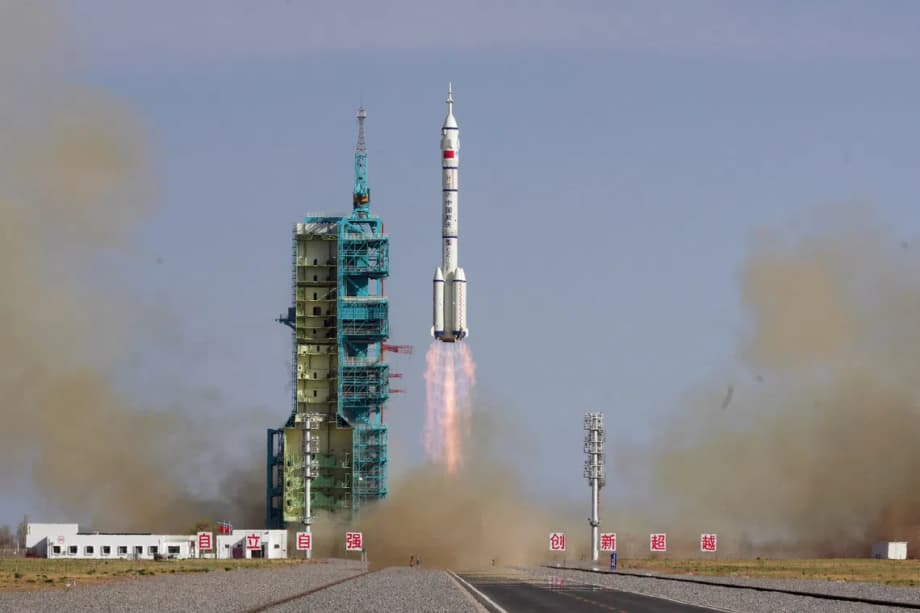
To close that gap, the space program pulled forward its standby plan. On Nov. 25, just twenty days after the delay was announced, a Long March 2F rocket lofted the uncrewed Shenzhou 22. The spacecraft completed an automated rendezvous and docking only a few hours after launch, restoring an escape option for the trio now stationed on Tiangong. The mission also delivered extra supplies and specialized tools for handling the damaged viewport when technicians prepare Shenzhou 20 for departure.
Why tiny debris can cause big problems
Objects in low Earth orbit move fast, roughly 7 to 8 kilometers per second. When two objects meet at different angles, the closing speed can be even higher. Even fragments too small to track from the ground carry immense kinetic energy at those velocities. A submillimeter particle can pit metal, crack glass, or damage thermal blankets. Larger confirmed debris strikes have scarred solar arrays, punctured radiator coolant loops, and sandblasted windows on spacecraft in the past.
Engineers design crewed spacecraft to cope with this environment. Many surfaces are protected by layered bumpers known as Whipple shields. These break up small particles before they can reach the pressure hull. Windows present a tougher problem. Crews need clear visibility for docking and for situational awareness, so windows cannot be covered by dense shielding. Designers instead use thick, multi layer panes of toughened materials, add protective covers when visibility is not required, and limit the size and number of windows. Even with these measures, a well aimed particle can still cause damage if it strikes at an unlucky angle or at very high speed.
Tracking networks monitor more than thirty thousand objects large enough to catalog. Millions of smaller fragments are too small to track but still big enough to do harm. Debris comes from spent rocket stages, old satellites, fragments from collisions, and tiny natural micrometeoroids. The United Nations and national space agencies encourage debris mitigation practices such as passivation, controlled reentry at end of mission, and responsible disposal orbits. Even with these steps, the density of objects in popular orbital lanes keeps rising.
Spacefarers rely on a mix of avoidance maneuvers and shielding to reduce risk. Stations and visited vehicles regularly perform orbit adjustments to dodge tracked debris, while crews shelter in their return capsules during risky conjunctions. Calls for better space traffic coordination and shared data have grown in recent years. China has promoted joint debris observation projects with partners and is investing in technologies like deorbit sails and precision tracking to manage this threat.
The choice to stand down was a safety call
Shenzhou 20 could likely have withstood the stresses of a normal reentry, but there was no way to prove that in orbit. Risk managers consider both probability and consequence. The probability of catastrophic growth of the crack might have been low, yet the consequence would have been fatal. The safer option was to wait for a sound return vehicle and then fly the damaged craft home without people.
Mission commander Chen Dong addressed that tradeoff after landing. He framed the episode as proof that exploration requires discipline and patience.
The path of human exploration of space is not smooth and is full of difficulties and challenges.
For the first time in China’s station program, an outgoing crew returned to Earth on a ship they did not launch on. The operation extended their mission by nine days, set a new national duration mark, and tested emergency launch and landing procedures that will become standard playbook items for future crews.
What the uncrewed return and inspection will involve
In the coming days or weeks, flight controllers will conduct standard checkout of Shenzhou 20, close its hatches, and command it to undock from Tiangong. The spacecraft will perform a deorbit burn to drop out of orbit and reenter over a designated corridor. Recovery teams at the Dongfeng landing area in the Gobi Desert will secure the capsule once it reaches the ground under parachute.
Engineers want more than a closer look. They aim to capture realistic data on how a cracked window behaves during reentry. Temperature, pressure, and vibration sensors can log how the fracture responds to heat soak, air loads, and acoustic stress. Ji Qiming said the return would yield the most authentic experimental data, a phrase that suggests the team will compare real world reentry loads with their models and with ground tests. That kind of information strengthens future designs and improves flight rules for rare but serious anomalies.
Once in a controlled laboratory, specialists can measure the geometry of the crack, analyze any residue at the impact site, and check whether the fracture propagated during descent. Investigators will also review manufacturing records for the window assembly and the installation process to rule out latent defects unrelated to orbital debris.
Operations on Tiangong and the role of the lifeboat
With Shenzhou 22 now docked, the current crew has an escape option should a medical problem or another emergency arise. Long duration stations always pair crews with a ready return capsule. It serves as a lifeboat, a taxi, and a heat shield that waits for months before a short sprint home. Tiangong can host six astronauts during changeovers, yet its life support system is tuned for three for extended stays. Maintaining a docked, healthy return ship is central to that operating model.
China keeps both a Shenzhou spacecraft and a Long March 2F rocket in a standby configuration. The system is designed for rapid call up, much like the way Russia and the United States maintain Soyuz and crew vehicles for contingencies. The sprint launch of Shenzhou 22 demonstrated that readiness. It also served as a logistics resupply, bringing tools, spares, and experiments to keep the station productive.
How other missions have handled similar surprises
Spaceflight history offers parallels that underscore the prudence of the Shenzhou 20 decision. In 2022, a micrometeoroid punctured a coolant line on a Russian Soyuz docked at the International Space Station. The crew that was meant to ride that ship home stayed on orbit until a replacement Soyuz launched uncrewed. NASA astronaut Frank Rubio and two cosmonauts returned safely after an extended mission.
In a separate episode, a test flight of an American crew capsule experienced thruster and propulsion issues that kept two astronauts at the International Space Station far longer than planned. They joined the resident crew’s work while teams on the ground devised a safe path to bring them back. Caution and redundancy, not schedule pressure, dictated the outcome in both cases. That is the same logic at play with Shenzhou 20.
What to watch in the months ahead
The next milestones are uncrewed return and post flight analysis of Shenzhou 20, continued operations with Shenzhou 22 as a lifeboat, and a steady cadence of science and maintenance on Tiangong. The rotation launched on Shenzhou 21 includes the youngest Chinese astronaut to date. One member is expected to remain in space for more than one year as part of a long duration biology and human factors study. Those plans can proceed because an emergency ride is back in place.
China’s human spaceflight program has not faced many in flight failures, which makes this episode stand out. It also shows a mature response. The team prioritized crew safety, executed a rapid launch to restore station safeguards, and turned an anomaly into a learning opportunity by bringing the damaged craft home for methodical inspection. The findings will likely inform window design, impact shielding, and return to flight rules across future missions, including a planned lunar landing attempt later in the decade.
Key Points
- Shenzhou 20 will return to Earth without crew after a cracked window made it unsafe for a crewed reentry.
- Astronauts Chen Dong, Chen Zhongrui, and Wang Jie returned safely on Shenzhou 21 after a nine day delay, setting a new national duration record.
- An emergency launch on Nov. 25 sent uncrewed Shenzhou 22 to Tiangong to serve as a lifeboat and to deliver tools and supplies.
- Engineers believe a submillimeter debris fragment caused a through thickness crack more than one centimeter long in a window pane.
- Ji Qiming said the uncrewed return aims to collect authentic flight data on how the cracked window behaves during reentry.
- China will analyze the capsule after landing at the Dongfeng site to guide future designs and flight rules.
- The incident highlights persistent debris risks in low Earth orbit and the value of standby crew rescue plans.