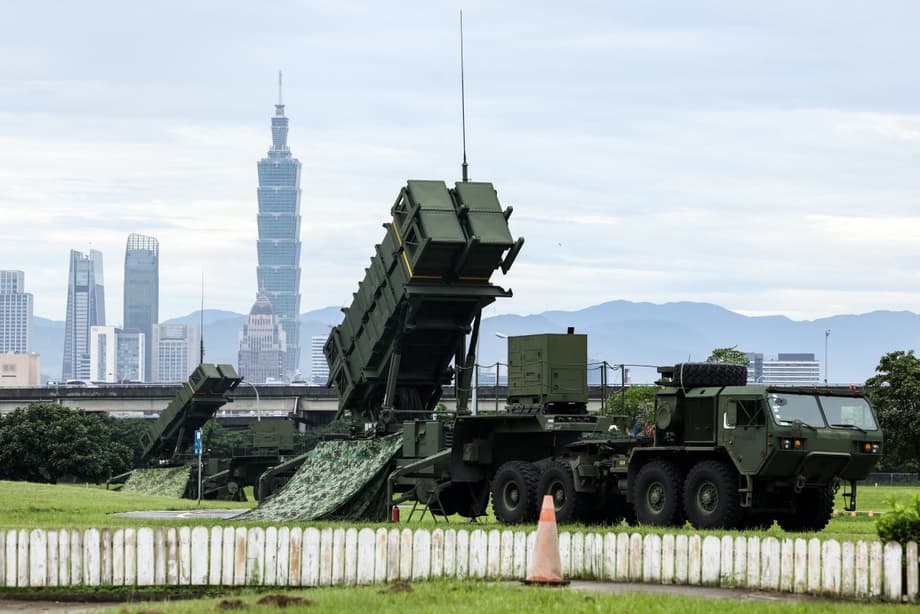
New shield for a dangerous neighborhood
Taiwan has put forward an eight year, 40 billion dollar plan to build an island wide air and missile defense architecture known as T-Dome, a network designed to detect, track, and intercept everything from drones and cruise missiles to ballistic missiles and manned aircraft. The project, unveiled by President Lai Ching-te during National Day celebrations, would sit on top of Taiwan’s existing defenses and stitch them into a faster, more resilient whole. The aim is simple but ambitious, to deny an attacker the benefits of a surprise strike and to keep Taiwan’s government, military, and critical infrastructure functioning under pressure.
- New shield for a dangerous neighborhood
- What is T-Dome and how it would work
- Inside the sensor to shooter concept
- Funding, procurement, and timeline
- How it compares to Israel’s Iron Dome
- Lessons from Ukraine and the PLA threat picture
- Can Taiwan build it in time
- Regional and economic ripple effects
- What to Know
The plan comes amid sustained military drills by the People’s Liberation Army around the island and frequent flights into Taiwan’s Air Defense Identification Zone (ADIZ). Taipei’s strategy mixes new procurement with tighter integration of what it already fields. President Lai has also committed to a larger defense budget, with spending expected to rise to more than 3 percent of gross domestic product next year and, if the plan holds, reach 5 percent by 2030. A special budget to seed T-Dome and related projects is due for legislative review at the end of the year.
Introducing the plan in his National Day address, Lai cast the network as a nationwide safety measure for civilians and troops alike. He emphasized speed, detection, and layered protection.
President Lai Ching-te said the system would deliver “multilayer defense, high level detection and effective interception” and would “weave a safety net” to protect Taiwan’s people.
The backbone of T-Dome is a sensor to shooter approach, a concept that links radars, electro optical sensors, data processing nodes, and launchers so decisions move in seconds rather than minutes. Taiwan’s defense ministry says the goal is a higher probability of kill against incoming threats and smarter allocation of scarce interceptors when salvos are large.
What is T-Dome and how it would work
T-Dome is not a single weapon. It is a network that connects what Taiwan already operates with new systems that expand coverage. Think of it as two intertwined layers. First, a command and control layer that fuses data and directs fire. Second, interceptor layers that handle threats at short, medium, and high altitude. Surface to air missiles like Patriot and the domestically built Sky Bow family, soon to be joined by National Advanced Surface to Air Missile System units on order, will be linked with lower tier systems such as Stinger teams and mobile guns. Taiwan is also developing the Chiang Kong interceptor for high altitude missions, a role focused on fast, steep ballistic targets.
Command and control spine
At the core is a command system that ingests data from ground based radars, airborne sensors, and civil aviation feeds, then identifies tracks, classifies threats, and assigns weapons. The idea is to collapse the time from detection to engagement, using automation, better communications, and multiple redundant paths. Mobility and dispersion are part of the design so that command nodes can survive first strikes, relocate quickly, and continue to direct fire from dispersed launchers. The ministry has framed this as a move toward a truly integrated sensor to shooter chain that raises the chance of a successful intercept while conserving interceptors for the most dangerous targets.
Defense officials say the procurement plan will prioritize mobile launchers, decoys, and quick setup communications that can reconstitute after a hit. The command system will also manage electronic warfare effects, including jamming and deception, so that missiles and drones face a mix of kinetic and non kinetic hurdles on their way to targets.
Interceptor layers
A layered architecture gives defenders multiple shots at a single threat. At the low end, man portable Stinger teams, mobile guns, and short range missiles guard air bases, ports, power stations, and troop concentrations from drones, helicopters, and low flying cruise missiles. Medium altitude threats meet NASAMS launchers and improved versions of Taiwan’s Sky Bow family. At high altitude, Patriot units and Taiwan’s Tien Kung 3 take on aircraft and ballistic missiles during the terminal phase. The planned Chiang Kong missile is intended to expand the high altitude envelope further, adding another line of defense against fast, lofted trajectories.
Inside the sensor to shooter concept
Sensor to shooter describes a chain that connects sensing, decision, and firing without slow handoffs. In practice, a coastal radar might spot a swarm of cruise missiles flying at low altitude. That radar’s track is fused with other sensors to confirm what the targets are and where they are headed. The command system immediately assigns the closest available launchers with the right missiles, alerts civil authorities to shelter vulnerable sites, and orders other batteries to reposition to avoid being fixed and hit by follow on strikes. If a launcher cannot safely fire because a decoy target is detected or communications are jammed, another launcher takes the shot, and the system updates across the network in real time.
US forces have pushed similar concepts in recent years, seeking to break down stovepipes and connect every sensor to every shooter. Taiwan’s version adapts that thinking to an island with limited depth, dense cities, and critical infrastructure packed into a small area. The payoff for Taipei is a shorter kill chain and the flexibility to manage interceptor stocks under stress, a critical point if a conflict drags on or if large missile salvos seek to saturate defenses.
Funding, procurement, and timeline
The government’s 40 billion dollar special budget is slated to run from 2026 to 2033. In a briefing, officials linked the package to a broader Special Budget for Strengthening Defense Resilience and Asymmetric Warfare Capabilities, a program that directs funds to projects that make a smaller military more survivable and dangerous to invade. The administration estimates the defense build up could generate around 13 billion dollars of economic activity and support as many as 90,000 jobs in the domestic economy through production, maintenance, and supply chain work.
What Taiwan plans to buy
Procurements tied to T-Dome include precision artillery, long range precision strike missiles to hold launchers and assembly areas at risk, and additional air defense fire units. Taiwan is awaiting delivery of NASAMS, intends to expand its inventory of Patriot interceptors, and will continue mass production of Sky Bow systems. The defense ministry’s list also highlights unmanned systems, including aerial drones, drone boats, and unmanned surface vessels, along with improved command systems that use automation and AI to sift data faster and assign tasks more effectively. Stocks of spare parts and war reserve munitions figure prominently, since any layered defense is only as good as the reloads that keep it running after the first volleys.
Budget politics and delivery bottlenecks
The special budget still needs legislative approval, and Taiwan’s opposition holds a majority in parliament. Lawmakers have clashed over defense spending this year, which could slow the release of funds. Delivery timelines also depend on US production capacity and export approvals, since a large share of missiles and radars will come from American lines already working through heavy backlogs. Taiwan’s military has set a goal of high joint combat readiness by 2027 and more comprehensive deterrent capacity by 2033. Building the full T-Dome architecture by 2027 is not feasible, officials concede, because integration, training, and interceptor production cannot be rushed without risk to reliability and safety.
How it compares to Israel’s Iron Dome
The name invites comparisons with Israel’s Iron Dome. The inspiration is real, but the mission sets differ. Iron Dome grew out of the need to intercept short range rockets fired in large numbers, often on ballistic arcs at low cost per round. Taiwan’s problem spans a wider spectrum, from PLA fighter and bomber sorties to low flying cruise missiles and ballistic missiles that descend at high speed and steep angles. A Taiwan focused network must manage more types of threats, aim at targets with different flight profiles, and survive the opening moments of a coordinated joint strike at sea and from the mainland.
Geography matters too. Taiwan is small in area and densely populated, which makes dispersal and mobility crucial. Every minute of warning and every second shaved off the decision cycle counts. Cost also weighs heavily. Advanced interceptors are expensive, and large attackers can launch more missiles than defenders can shoot down. A resilient defense needs smart fire control, decoys, and electronic warfare to complicate the attacker’s plan before an interceptor leaves a launcher. T-Dome’s promise lies in using all of those tools together, so expensive shots are held for targets that actually demand them.
Lessons from Ukraine and the PLA threat picture
Ukraine’s experience has shaped how Taiwan thinks about air defense. Kyiv’s ability to keep power flowing, protect leadership, and sustain military operations under waves of missile and drone attacks owed a lot to a layered approach, agile launchers, and a command system that could prioritize what needed saving. Taiwan’s planners draw the same lesson. Vital assets must be shielded by multiple layers, launchers must hide, move, and fake their locations, and operators must train to switch between targets quickly as waves of drones and missiles arrive together.
The PLA has the numbers to stress any defense. Warships and coastal launchers can fire hundreds of missiles in minutes, while aircraft can lob cruise missiles from outside many ground based missile envelopes. Taiwan’s defense ministry has warned that drills can be flipped into real world operations with little warning. That reality is why Taipei wants an integrated network that can ride out the first blows, keep enough launchers and command nodes alive, and impose hard choices on the attacker about where to aim next.
Can Taiwan build it in time
Officials say early elements of T-Dome will arrive in the near term as new batteries are delivered and existing units are knitted together more tightly. The full concept will take years. Building a command system that works across services, training operators to trust automation without losing human judgment, and stocking ample reloads are all slow tasks. Taiwan’s own defense industrial base can help by producing more of what it needs at home, but many key components will still come from overseas partners who face their own backlogs.
In his National Day speech, President Lai framed the project as a defensive move aimed at preserving the status quo and deterring aggression. He added that Taiwan seeks stability, not confrontation, and that strength is the surest path to that end.
President Lai said Taiwan is “determined to maintain peace through strength” and called on Beijing to renounce the use of force in the Taiwan Strait.
Beijing’s response was swift. Chinese officials argue that Taiwan belongs to China and accuse Lai of incitement. A Chinese foreign ministry spokesperson said his speech misrepresented the situation and inflamed tensions.
The spokesperson said, “Lai’s remarks distort facts and mislead public opinion,” and labeled him a “troublemaker” and a “warmonger”.
Regional and economic ripple effects
Beyond new hardware, T-Dome’s build out aims to deepen Taiwan’s defense industry, strengthen supply chains, and create skilled jobs in software, electronics, and aerospace. Government projections tie the plan to tens of thousands of new positions and billions of dollars in economic activity. The logistics tail is significant. Maintaining radars, missiles, and mobile command nodes requires trained technicians, a steady flow of spare parts, and factory lines that can surge to replace losses in a crisis.
Allies are watching closely. The United States is a critical supplier and partner in training and exercises, while Japan, Australia, and European partners are invested in a stable Indo Pacific. A more layered, agile Taiwanese air defense makes it harder for an attacker to achieve quick, decisive effects. That, in theory, lowers the risk of miscalculation and buys time for diplomacy if a crisis erupts. Regional militaries are studying similar sensor to shooter integration for their own air and missile defenses, since faster decisions and better connected networks are now central to surviving modern precision strikes.
What to Know
- Taiwan proposed an eight year, 40 billion dollar special budget to build T-Dome, an island wide air and missile defense network.
- T-Dome links existing systems like Patriot and Sky Bow with new units such as NASAMS, backed by a faster command and control network.
- The concept uses a sensor to shooter chain to shorten the time from detection to intercept and to raise the probability of kill.
- Procurements include precision artillery, long range missiles, new air defense fire units, and a large push into drones and AI enabled command systems.
- Taipei targets more than 3 percent of GDP for defense next year and seeks to reach 5 percent by 2030, pending legislative approval.
- The build runs from 2026 to 2033, with early integration steps possible sooner but full implementation well beyond 2027.
- Officials say mobility, dispersion, decoys, and electronic warfare are key to keeping launchers and command nodes alive under attack.
- Beijing condemned the plan and labeled President Lai a troublemaker, while Lai said Taiwan aims to maintain peace through strength.
- Government estimates tie the defense build up to as many as 90,000 jobs and roughly 13 billion dollars in economic activity.
- Lessons from Ukraine shape the approach, with emphasis on layered protection for forces, infrastructure, and civilians against mass missile and drone attacks.