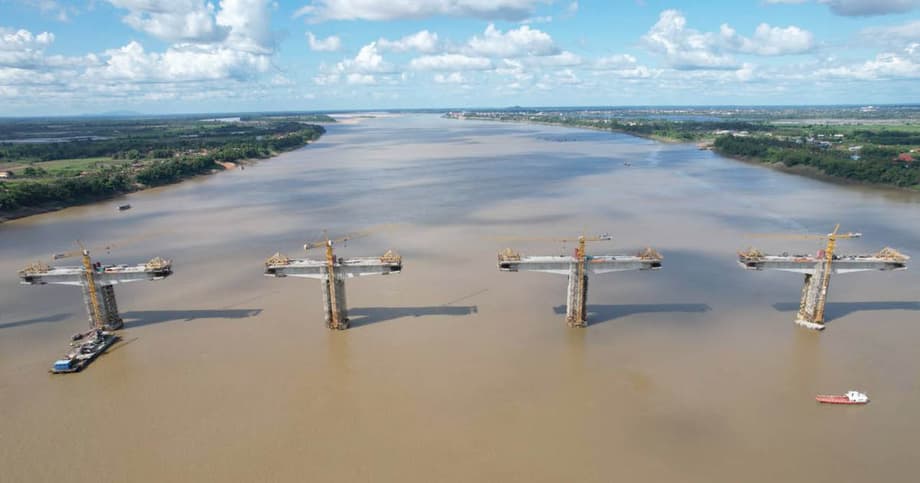
A new Mekong crossing reshapes daily life in Kratie
Across the Mekong River in Kratie province, a long awaited crossing is entering its final phase. The Cambodia China Mekong Kratie Friendship Bridge is now near completion after construction began in early 2023. When it opens, the bridge will connect Chetr Borei district with Prek Prasop district, replacing ferries that for years have shaped travel, trade and access to services on both banks.
The bridge measures 1,761 meters in length and 13.5 meters in width. It is being built by Shanghai Construction Group with support from a concessional loan from China as part of cooperation under the Belt and Road Initiative. The broader package includes extensive connecting roads so traffic can flow directly to the national highway network, not just to the riverbanks.
Residents expect faster trips, lower costs and safer travel after dark. Many reported paying about 1,000 to 2,000 riels per person for a ferry crossing, with similar charges for motorcycles, and often spent time waiting for a boat. Tourism operators in Kratie, known for freshwater Irrawaddy dolphins on the river near Kampi, also anticipate easier weekend visits and smoother itineraries for travelers.
Officials tie the crossing to larger links in Cambodia and the region. It will feed into National Road 7 and strengthen the interior network of the northeastern provinces. It also supports efforts to improve cross border movement within ASEAN and the Lancang Mekong subregion.
Where the project stands now
Progress has been steady. According to Cambodia’s Ministry of Public Works and Transport, crews reached about 96 percent of bridge works by late June 2025, and a ceremony in early July connected the final segment. By early November, the bridge structure was more than 98 percent complete, and remaining tasks focused on lighting, lane markings and approach roads. The full package of works, which includes the long connecting roads, stood at roughly 87 percent at that time.
Temporary access and full opening schedule
Authorities planned a temporary opening for motorcycles and family cars during the Pchum Ben holiday (Ancestor’s Day) in late September 2025 to ease seasonal travel. The permanent opening for public use is targeted for April 1, 2026, once finishing works and safety checks are done. Senior officials, including Deputy Prime Minister Sun Chanthol and Public Works and Transport Minister Peng Ponea, presided over key milestones as the bridge neared completion.
What the bridge will change for residents
For farmers, the change is immediate. Trucks will be able to move cassava, cashew, rubber and rice from villages near the river straight onto National Road 7 without detours or ferry schedules. Travel that once depended on daylight and river levels will shift to any time of day, which matters for medical emergencies, school commutes and small business deliveries.
For households, ferry fares and queues will end at this crossing. Journeys that involved waiting during peak hours or in rough weather will become predictable trips over a fixed deck. Families can ride across by motorbike for errands, studies or visits to hospitals and markets on the other side with less uncertainty.
From ferries to a fixed link
Ferries will still serve other stretches of the river, yet their role here is set to shrink. Seasonal interruptions, strong currents and mechanical limits have long constrained how many people and vehicles ferries could carry. A permanent bridge provides a clear path and includes a dedicated navigation section for boats below, so over river travel and river traffic can continue with fewer disruptions.
Design, size and road links
The main span stretches 1,761 meters, and the deck is 13.5 meters wide. Lanes are set aside for vehicles, bicycles and pedestrians. The structure rests on 36 piers and includes a navigation section 100 meters wide and 15 meters high, allowing boats to pass safely beneath the span along the Mekong.
The bridge is part of a larger corridor plan. The project adds about 31.69 kilometers of connecting roads. This includes a main link of about 15.49 kilometers and side roads totaling about 16.20 kilometers, which together tie the bridge into the surrounding road network.
Once finished, the corridor will link National Road 7 and National Road 60B, improving access to National Roads 6, 71 and 73. The new connection positions Kratie as a more direct waypoint between the central plains and the northeast, helping spread travel and commerce beyond river ferries.
Investment and construction
Funding for the project comes through a concessional loan from China of around 114 million dollars. Shanghai Construction Group is the main contractor, with technical supervision by Wanan Guangzhou Technical Consultant. The Ministry of Public Works and Transport oversees the works, which began with a groundbreaking on January 2, 2023 and run on a 42 month schedule.
The workforce blends Cambodian and Chinese teams. Several hundred Cambodian workers gained experience in welding, concrete placement and bridge assembly, along with training in site safety and quality control. National leaders and Kratie provincial authorities have treated the bridge as a major project for the province and an anchor for expansion of local transport services.
The crossing fits within the Belt and Road Initiative, which backs transport links across Asia. For Cambodia, such links include expressways, bridges and national road upgrades that aim to reduce travel times and attract investment. The new crossing is intended to support smoother movement within ASEAN and the Lancang Mekong subregion.
Economic impact for Kratie and beyond
Agriculture is likely to see the first gains. Faster access to markets reduces spoilage and trucking time. Farmers may be able to secure better farm gate prices when buyers can collect produce more easily. Cold chain investment becomes more attractive when reliable links exist across the river, improving prospects for fresh produce and higher value crops.
Local trade should also grow, from fuel and building materials to household goods. Bus and minivan operators can plan new routes. Freight carriers can route between Kampong Thom, Kratie and the Laos corridor with less backtracking, improving the economics of regular shipments.
Tourism prospects are strong. Kratie is known for river scenery and the freshwater Irrawaddy dolphins near Kampi. A dependable crossing can encourage more domestic visitors from Phnom Penh and Siem Reap, while international travelers exploring the Mekong can add Kratie to itineraries with fewer time constraints. Small businesses, from homestays to cafes and boat tours, stand to benefit from steadier visitor flows.
Regional connectivity
Beyond local effects, the bridge supports movement in the Greater Mekong. The Mekong is called the Lancang in China. Cooperation programs in the region and ASEAN transport plans seek smoother north south and east west routes. By tying the banks at Kratie into National Road 7 and other highways, the crossing contributes to a more continuous corridor that reaches Stung Treng and the Laos border to the north, and connects to the central network to the south.
Environment and river safety
River safety is built into the design. The navigation channel of 100 meters by 15 meters helps barges and tourist boats pass under the span. Markings, lighting and updated river charts will guide captains in high water and low water seasons. The piers include protection to manage scour and seasonal currents common on the Mekong.
Environmental considerations include fish movement, sediment transport and riverbank resilience. Cambodia’s transport authorities and the contractor report that construction methods are chosen to protect the river’s flow and ecology. Continued monitoring and maintenance will matter once the bridge opens, especially during the monsoon period when the Mekong rises and currents intensify.
On the roads, safety messages have been issued to drivers to follow traffic laws, avoid speeding and refrain from overloading vehicles. Good behavior reduces accidents and helps protect public assets for many years.
What remains before opening
Final tasks include bridge deck surfacing and sealing, expansion joint finishing, lane markings, lighting pole installation, guardrails, and the tie in works that connect approach roads to the deck. Drainage channels and protective barriers need to be completed, along with traffic signs and signals.
Load testing and safety audits are part of the final phase. Training for operations and maintenance crews will help keep the bridge in good condition. Authorities set April 1, 2026 for public opening, subject to the completion of works on the connecting roads. Once fully open, the crossing is expected to serve cars, motorcycles, bicycles and pedestrians.
Key Points
- Mekong Kratie Friendship Bridge is 1,761 meters long and 13.5 meters wide, with 36 piers and a navigation section 100 meters by 15 meters.
- Construction began in January 2023 and the final segment was connected in early July 2025.
- By November 2025, the bridge structure was over 98 percent complete; finishing works and approach roads continued.
- The project includes about 31.69 kilometers of connecting roads, linking the bridge to National Road 60B and improving access to National Roads 6, 7, 71 and 73.
- Built by Shanghai Construction Group under a Chinese concessional loan of about 114 million dollars, within Belt and Road cooperation.
- Authorities planned a temporary opening for small vehicles during Pchum Ben (September 2025) and set April 1, 2026 for full public opening.
- Expected benefits include faster travel, removal of ferry fares and queues, better access to schools and hospitals, smoother movement of farm goods and stronger tourism.
- The bridge supports ASEAN and Lancang Mekong connectivity and includes measures for river navigation and road safety.