The 120,000-Ton Question: China’s Near-Space Ambition Takes Shape
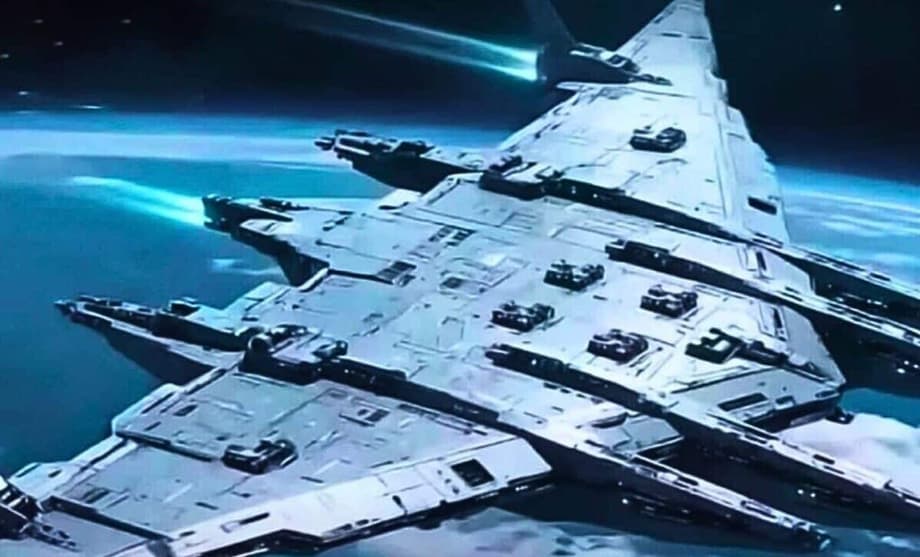
A flat grey triangle spanning 684 meters has emerged as the latest symbol of China’s aerospace ambitions, presenting specifications that blur the line between naval architecture and aviation engineering. The concept, known as Luanniao, envisions a near-space aircraft carrier weighing up to 120,000 tonnes at takeoff, designed to operate above conventional weather patterns and beyond the reach of most existing air defense systems. Chinese state media depict this platform not merely as an aircraft but as a mobile strategic base capable of deploying dozens of unmanned combat aircraft from the edge of Earth’s atmosphere.
The dimensions alone force a recalculation of what constitutes an airborne vessel. At 242 meters in length and 684 meters in width, the Luanniao would dwarf the USS Gerald R. Ford, currently the world’s largest operational aircraft carrier, by approximately 20% in weight despite being shorter in overall length. The triangular craft forms the centerpiece of the Nantianmen Project, an initiative launched by the Aviation Industry Corporation of China in 2017 that has recently shifted from science fiction speculation to state television programming and immersive public attractions.
What distinguishes this concept from previous experimental aircraft is its explicit targeting of strategic flashpoints. Chinese media presentations specifically reference Taiwan and the South China Sea as operational theaters where the carrier could position itself directly overhead, functioning as a persistent surveillance and strike platform that remains immune to surface-to-air missiles and interceptor aircraft. This geographic specificity transforms the Luanniao from an abstract technical exercise into a pointed strategic message, suggesting a future where altitude itself becomes the primary defensive armor.
From Science Fiction to State Television
The Nantianmen Project, whose name translates to “South Heavenly Gate,” has undergone a remarkable public relations transformation since its inception. According to coverage by the South China Morning Post, what began in 2017 as an aviation-themed immersive experience project has recently been repositioned by Chinese state broadcaster CCTV as attainable future technology rather than fantasy. A January 2026 program on CCTV’s military channel showcased photorealistic 3D animations of the Luanniao releasing space jets and firing weapons in orbit, accompanied by commentary suggesting these integrated space-air fighters represent the inevitable direction of aerospace development.
This media evolution reflects a deliberate strategy to blur the boundaries between speculative concept and military roadmap. The project draws heavily from Chinese mythology for its nomenclature, with the carrier named after the Luanniao, a mythical bird symbolizing peace, while its primary drone complement, the Xuan Nu, references a goddess of war. Additional conceptual elements include the Baidi (White Emperor) sixth-generation fighter and the Chengying mecha weapon system, creating a narrative ecosystem that merges cultural heritage with futuristic warfare.
The public-facing aspect of this initiative extends beyond broadcast media into physical infrastructure. China Daily reported that a 40,000-square-meter Nantianmen-themed attraction is under construction in Shanghai’s Lin-gang Special Area, with a fixed opening date of August 1, 2027. Zhou Yixiao, general manager of the Nantianmen Project’s Shanghai base, confirmed the timeline in official statements.
Major construction will be finished by year-end, allowing for internal testing. The public opening is fixed for August 1, 2027.
This theme park development indicates a dual-track approach where speculative military concepts feed into mass entertainment and public engagement, simultaneously inspiring domestic audiences and complicating foreign intelligence assessments of which technologies represent genuine procurement priorities.
The Physics of Impossibility
Once the Luanniao’s mass is taken literally, the concept collides with fundamental engineering constraints. Aviation specialists note that maintaining a 120,000-ton platform at near-space altitudes would require approximately 340 meganewtons of sustained thrust, a figure that forces uncomfortable comparisons with existing technology. The Antonov An-225 Mriya, the heaviest aircraft ever built at roughly 640 tons, would require scaling up by nearly 200 times to approach the Luanniao’s projected weight, yet even this comparison fails to address the energy requirements for sustained stratospheric hovering rather than simple atmospheric flight.
Current rocket technology offers no practical path to orbit for such a mass. SpaceX’s Starship, among the most powerful launch vehicles currently operational or in development, cannot deliver a 120,000-ton payload to orbit in any configuration, and modular assembly in space would confront insurmountable challenges regarding power supply, thermal management, debris protection, and orbital maneuvering. German diplomat and space analyst Heinrich Kreft characterized the project in comments to Deutsche Welle with direct skepticism.
From today’s perspective, the project is completely unrealistic.
Kreft labeled the concept “humbug” and “psychological warfare,” while cautioning against outright dismissal of Chinese aerospace ambitions. He noted that Beijing is actively pursuing multiple future weapons systems, including advanced laser technology where China may hold advantages over Western development.
Defense expert Peter Layton, visiting fellow at Australia’s Griffith Asia Institute, offered a conditional assessment that acknowledges the tactical advantages while questioning technical feasibility.
if successfully built, the craft would sit beyond the reach of almost all surface-to-air missiles, because it would operate outside the limits of weather and most existing defence systems.
Layton added that the technology required to make a 120,000-ton aircraft hover at the edge of Earth’s atmosphere simply does not exist today, suggesting the concept serves external messaging purposes by painting China as working on technology that regional competitors cannot aspire to match.
Arsenal of the Gods: Xuan Nu and Baidi
The operational value of the Luanniao concept rests on its proposed payload of 88 Xuan Nu unmanned stealth fighters, described in state media as highly maneuverable platforms capable of carrying hypersonic missiles. These drones represent a distinctly modern threat package built around volume, autonomy, and compressed warning time, functioning as the maneuvering combat edge while the carrier provides a stable high-altitude host platform. The naming convention continues the mythological theme, with Xuan Nu referencing a Chinese goddess associated with warfare and strategic advantage.
Beyond the Xuan Nu, the Nantianmen portfolio includes the Baidi aerospace fighter, which appeared as a life-sized mockup at the 2024 Zhuhai Airshow. This sixth-generation concept is designed for operations close to the edge of space, featuring delta-style wings and canards for supersonic maneuverability. Chinese sources describe the Baidi Type B variant as incorporating artificial intelligence-driven data fusion for situational awareness, modular construction for maintenance efficiency, and an enlarged internal weapons bay for heavy air-to-ground munitions while preserving stealth characteristics.
Additional conceptual elements include the Zihuo vertical takeoff and landing fighter equipped with autonomous decision-making capabilities, electromagnetic guns for infantry use, and even particle accelerator cannons for space combat. While these weapons remain firmly in the realm of digital rendering, their inclusion in official media presentations suggests a comprehensive vision for multi-domain warfare that integrates near-space operations with traditional atmospheric combat.
The separation of roles implied by this architecture, where a heavy carrier provides sustainment and rapid deployment while lighter unmanned systems execute tactical missions, mirrors developments in naval aviation but attempts to transpose that model into the stratosphere. Whether this represents genuine operational innovation or narrative convenience remains a subject of debate among defense analysts.
Propaganda or Prototype? The Psyop Debate
The most contentious aspect of the Luanniao concept concerns its fundamental purpose. Writing for The National Interest, analyst Brandon J. Weichert characterized the Nantianmen Project as part of a “wider propaganda push” designed to make Western defense planners nervous while potentially baiting the United States into overspending on countermeasures. This interpretation draws historical parallels to the Reagan administration’s Strategic Defense Initiative, which challenged the Soviet Union to compete technologically and contributed to economic strains that preceded the Soviet collapse.
Weichert argues that while the United States should not discount China’s genuine high-tech capabilities, falling for exaggerated claims could force Washington into budget-breaking investments with marginal military returns. The consensus among Western analysts holds that the Luanniao as currently specified will never advance beyond concept art, yet the underlying technologies, including hypersonic weapons, railguns, and sixth-generation fighter development, represent tangible threats requiring serious attention.
Heinrich Kreft reinforced this interpretation, suggesting the timing and messaging of the Luanniao reveal specifically targets the Taiwan situation.
To my ears, this sounds as if China has put something out into the world with Taiwan very much in mind, in order to leave a marker.
This perspective views the carrier concept as one in a series of spectacular Chinese “superweapon” announcements, ranging from advanced submarine-hunting systems to space-based platforms, that function as deterrents and markers of technological ambition regardless of actual construction timelines.
The credibility challenge inherent in such announcements creates a strategic dilemma for defense planners. Dismissing the concept entirely risks underestimating Chinese innovation, as past underestimates of Beijing’s aerospace progress have consistently proven unwise. Conversely, treating every conceptual animation as a developmental reality risks diverting resources from more probable threats. Juliana Süss, space security expert at the German Institute for International and Security Affairs, told Deutsche Welle that successful deterrence requires credibility, noting that the extent to which such an ambitious project is actually credible remains an open question.
The Strategic Horizon
China has maintained its position as the second-ranked space power behind the United States, investing substantial resources in lunar missions, satellite constellations, and manned orbital platforms. The Luanniao concept arrives within this broader context of accelerated space development, including the Chang’e-6 lunar sample return mission in 2024 and planned lunar base construction efforts targeting the 2030s. Beijing views space dominance as essential for military capabilities and national prestige, with near-space representing a contested domain where early positioning could yield strategic advantages.
The timing of the Luanniao reveal also coincides with American discussions of the “Golden Dome” missile defense concept, a multilayered network proposed during the Trump administration to protect against airborne threats through ground, sea, and potentially space-based interceptors. Chinese media presentations frame the Nantianmen Project as a response to these American initiatives, suggesting an emerging arms race in orbital and near-space defense systems.
Projected timelines for the Luanniao span 20 to 30 years, placing operational deployment around 2040 to 2050 if development proceeds according to official statements. This extended horizon allows Chinese industry to pursue incremental advances in propulsion, materials science, and autonomous systems while maintaining the long-term vision as a guiding narrative. Whether the specific triangular carrier ever materializes, the concept has already succeeded in generating international discussion and redirecting attention toward China’s aerospace capabilities.
As the Shanghai theme park prepares for its 2027 opening and state media continues broadcasting animated visions of stratospheric combat, the Luanniao remains suspended between aspiration and engineering reality. What is certain is China’s commitment to projecting power across multiple domains and its willingness to invest in imaginative concepts that force adversaries to consider possibilities beyond current technological limits.
What to Know
- The Luanniao concept envisions a 120,000-ton triangular aircraft carrier operating in near-space, measuring 242 meters long and 684 meters wide
- The platform is designed to deploy 88 Xuan Nu unmanned stealth fighters carrying hypersonic missiles, potentially positioned over Taiwan or the South China Sea
- Engineering analysis suggests the concept requires 340 meganewtons of sustained thrust and faces insurmountable payload challenges with current rocket technology
- The Nantianmen Project began in 2017 as a science fiction IP by AVIC but has been repositioned by CCTV as attainable future technology with a 20-30 year timeline
- A 40,000-square-meter Nantianmen theme park opens in Shanghai on August 1, 2027, creating a public entertainment infrastructure around the military concepts
- Western defense analysts interpret the concept primarily as propaganda designed to unsettle competitors and potentially bait the US into overspending on countermeasures
- Related developments include the Baidi sixth-generation fighter mockup displayed at the 2024 Zhuhai Airshow and ongoing Chinese advances in hypersonic weapons and laser systems