Historic Collapse: Seoul Records Worst Trading Day in History
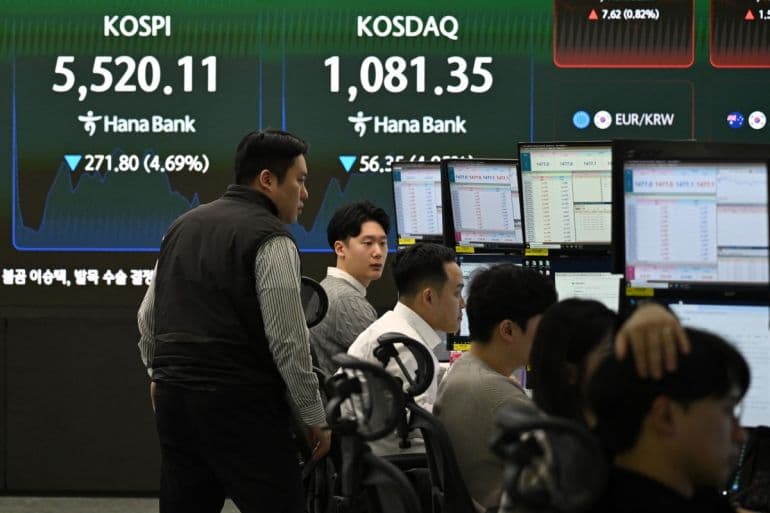
South Korea’s benchmark KOSPI index plummeted 12.06 percent on Wednesday, recording the steepest single-day decline in the market’s 46-year history and surpassing the previous record set during the September 11, 2001 terrorist attacks. The catastrophic drop triggered circuit breakers for the first time since August 2024, forcing a 20-minute trading halt after losses breached the 8 percent threshold required to pause exchange activity.
- Historic Collapse: Seoul Records Worst Trading Day in History
- From Boom to Bust: How Asia’s Hottest Market Unraveled
- The Energy Trap: Why Iran Conflict Devastated Korean Markets
- Tech Giants Tumble: AI Supercycle Meets Geopolitical Reality
- Margin Calls and Panic: Retail Traders Face Liquidation
- Regional Contagion: Asian Markets Buckle Under Pressure
- Authorities Respond: Stabilization Measures and Market Outlook
- The Bottom Line
The bloodbath extended a brutal two-day selloff that has erased approximately 817.6 trillion won ($553.82 billion) in market capitalization, representing nearly a fifth of the index’s total value. By the closing bell, the KOSPI had settled at 5,093.54, down 698.37 points from the previous session, with only 13 stocks advancing among 925 issues traded while 911 declined. The tech-heavy KOSDAQ index fared even worse in percentage terms, plunging roughly 14 percent as speculative favorites faced forced liquidations.
The violence of the selloff caught many investors off guard, coming just days after the market had reached all-time highs. Jessica Chung, a retail trader in Seongnam’s Pangyo technology district, described scenes of panic as workers huddled over smartphones during what should have been a bustling lunch hour. “I heard some of my colleagues gasping ‘What the hell?’ as the KOSPI’s losses widened past 8% in the morning,” Chung recounted. “I went to the bathroom to find a quiet corner to trade and, guess what, people were queuing outside.”
From Boom to Bust: How Asia’s Hottest Market Unraveled
The collapse marked a brutal reversal for what had been the world’s best-performing equity market. The KOSPI had surged more than 40 percent in the first two months of 2026 alone, far outpacing international peers and doubling over the past twelve months driven by an artificial intelligence-fueled rally in semiconductor stocks. This meteoric rise created conditions for extreme volatility, with crowded positioning among foreign funds and record-high margin debt among South Korea’s 14 million retail traders, known locally as “ants.”
Tuesday’s 7.24 percent drop, dubbed “Black Tuesday” by local media, should have served as a warning. Following a holiday closure on Monday for Independence Movement Day, the market opened to catch up with global developments, immediately shedding 452.22 points. Foreign investors dumped a net 5.17 trillion won worth of shares on Tuesday alone, targeting the very tech giants that had propelled the rally: Samsung Electronics, SK Hynix and Hyundai Motor Company.
The selling accelerated Wednesday as algorithmic trading systems and margin calls triggered cascading liquidations. Tareck Horchani, head of Prime Brokerage Dealing at Maybank Securities in Singapore, characterized the move as a rapid de-risking by institutional investors. “This looks more like a positioning unwind and risk reduction rather than a fundamental deterioration in earnings,” Horchani explained. “Korea had been one of the strongest markets globally. So positioning was crowded.”
Lorraine Tan, Asia director of equity research at Morningstar, pointed to structural factors that amplified the decline. “The decline in the KOSPI can broadly be attributable to the single-name concentration that we see in the Korean markets,” Tan noted. Samsung Electronics and SK Hynix together constitute nearly half of the index’s weighting, meaning movements in these stocks mechanically drag the broader market.
The Energy Trap: Why Iran Conflict Devastated Korean Markets
While global markets recoiled from the escalating war between the United States, Israel and Iran, South Korea faced unique vulnerabilities that transformed a geopolitical shock into a domestic financial crisis. The country imports approximately 98 percent of its fossil fuel needs, with roughly 70 percent of its oil supplies originating from the Middle East, making it the world’s fourth-largest oil importer and exceptionally sensitive to supply disruptions.
The Strait of Hormuz, which carries about one-fifth of global oil consumption, emerged as the primary flashpoint. Iranian threats to blockade this crucial chokepoint sent shipping and logistics stocks into freefall, with shares of Pan Ocean, HMM and KSS Line plummeting between 16 and 17 percent. The potential closure threatened to add $5 to $15 per barrel in insurance costs alone, according to energy analysts, creating a “war premium” that could persist even if military hostilities remained contained.
The currency markets reflected these anxieties, with the South Korean won breaching the psychological 1,500 level against the US dollar overnight for the first time in 17 years, touching 1,505.8 before recovering slightly to close at 1,485.7. The currency’s weakness compounds inflation risks for an economy heavily dependent on dollar-denominated energy imports. Nomura has flagged South Korea as particularly vulnerable to current account pressures, noting that net oil imports represent roughly 2.7 percent of the nation’s gross domestic product.
“When oil spikes and FX volatility jumps, especially for oil-importing markets like Korea and Japan, global funds tend to de-risk quickly from the most liquid index heavyweights.”
The contrast between energy importers and exporters played out in real time across Korean markets. While most sectors bled red, Daesung Energy, a liquefied natural gas provider, surged by the daily limit of 30 percent after Iran announced its blockade threats, highlighting the desperate scramble for energy security.
Tech Giants Tumble: AI Supercycle Meets Geopolitical Reality
The semiconductor sector, which had driven South Korea’s world-beating rally, suffered devastating losses as the intersection of AI enthusiasm and energy security fears created a perfect storm for profit-taking. Samsung Electronics shares collapsed 11.7 percent, falling below the 200,000 won threshold for the first time since late February, while SK Hynix tumbled 9.6 percent. Hyundai Motor suffered an even deeper 15.8 percent decline as investors priced in higher manufacturing costs and weakening consumer demand.
The selloff reflected growing concerns that the AI data center boom, which requires significantly higher energy consumption than traditional computing infrastructure, faces headwinds from soaring electricity and cooling costs. Morningstar’s Tan suggested the drop “implies growing concern that the AI datacenter adoption pace might slow due to its significantly higher energy costs than regular data centers.”
Foreign investors, who had chased the Korean tech trade with record inflows just weeks earlier, reversed course aggressively. The $16 billion iShares MSCI South Korea ETF had recorded over $1.2 billion in inflows in the week preceding the crisis, the most in the fund’s 25-year history, indicating just how crowded the positioning had become. As the Iran conflict intensified, these hot money flows reversed abruptly, with foreigners recording nine consecutive sessions of net selling before turning marginal buyers near Wednesday’s close.
Not all defensive plays performed as expected. Hanwha Aerospace, a defense contractor that had jumped 20 percent on Tuesday as investors sought shelter in military stocks, plunged 8 percent on Wednesday as valuation concerns overtook geopolitical hedging strategies.
Margin Calls and Panic: Retail Traders Face Liquidation
South Korea’s army of retail investors, who account for roughly one-third of daily trading volume, found themselves trapped between falling prices and broker demands for additional collateral. Margin debt in the Korean market had reached record highs in recent months as individual investors leveraged their positions to chase the AI rally. When prices dropped precipitously, forced liquidations exacerbated the downward spiral.
Despite attempts by retail traders to “defend” the market through net purchases totaling 5.8 trillion won on Tuesday alone, the selling pressure from foreign institutions and margin-driven liquidations overwhelmed these efforts. The VKOSPI, South Korea’s volatility index often called the “fear index,” surged to 62.98, its highest level in six years since the COVID-19 pandemic panic of March 2020.
The demographic profile of Korean retail traders, many of whom are young professionals who entered the market during the post-pandemic bull run, meant that many had never experienced a genuine bear market. The speed of the decline, with the KOSPI losing nearly 19 percent in just two sessions, provided a brutal introduction to volatility for this new generation of investors.
Charu Chanana, chief investment strategist at Saxo, described the selling as increasingly disorderly. “Asia’s sell-off is turning disorderly because markets are no longer treating this as a ‘one-week headline shock’,” Chanana stated. “The ‘sell what you can’ phase is spreading: Liquidity needs are pulling down even precious metals, which looks less like a clean rotation and more like deleveraging and margin-driven selling across asset classes.”
Regional Contagion: Asian Markets Buckle Under Pressure
The Korean crash served as the epicenter of a broader Asian market rout that demonstrated the region’s collective vulnerability to Middle East supply disruptions. Japan’s Nikkei 225 index dropped 3.6 percent on Wednesday, extending its weekly losses beyond 6 percent, while Taiwan’s Taiex shed 4.4 percent as semiconductor manufacturers faced similar energy cost concerns. Hong Kong’s Hang Seng fell 2 percent and Singapore’s Straits Times Index declined 2.1 percent.
The synchronized nature of the decline reflected Asia’s shared dependence on Gulf energy supplies. Japan maintains an estimated 254 days of oil stockpiles, and China holds significant domestic gas reserves, but these buffers provided little comfort to equity markets facing the prospect of prolonged supply disruptions and higher baseline energy costs.
Francis Lun, chief executive of Venturesmart Asia in Hong Kong, offered a grim assessment of the regional outlook. “I think the Iran situation is getting out of hand, and I think that US President Donald Trump miscalculated enormously,” Lun stated. “The situation is very grim.”
Dubai’s Financial Market General Index plummeted 4.9 percent upon reopening after holiday closures, with property and banking shares leading declines as investors repriced regional risk. Indian benchmarks fell more than 2 percent, with Goldman Sachs warning that a 20 percent rise in Brent crude could trim regional earnings by 2 percent. Natixis labeled Indian assets as “most at risk” among Asian markets due to heavy energy import dependence.
The divergence between Asian and American markets proved particularly striking. While Seoul burned, US stocks actually rose on Wednesday following stronger-than-expected payroll data and reports that Iran had indirectly approached the United States regarding potential negotiations. The S&P 500 advanced 0.8 percent and the Nasdaq Composite gained 1.3 percent, underscoring how the economic pain of the conflict was being concentrated in energy-importing nations rather than the combatants themselves.
Authorities Respond: Stabilization Measures and Market Outlook
South Korean financial authorities scrambled to contain the damage, with the Financial Services Commission announcing they would “actively utilise market stabilising programmes if needed to respond to excessive volatility.” The Bank of Korea issued a statement vowing to “closely watch if won exchange rates and bond yields deviate excessively from domestic fundamentals” and promised to respond to “herd-like behaviour” in currency markets.
Finance Minister Koo Yun-cheol confirmed authorities were monitoring foreign exchange markets closely, though analysts noted that with the dollar-won exchange rate having breached the 1,500 level, technical support had given way to potential further depreciation. President Lee Jae Myung had stated in January that the won was expected to strengthen toward 1,400 per dollar, a forecast that now appears distant given current conditions.
President Donald Trump attempted to calm energy markets by announcing that the United States would provide political risk insurance for maritime trade and that the US Navy would escort tankers through the Strait of Hormuz if necessary. However, shipping analysts cautioned that such measures would only partially mitigate risks, with insurance premiums already rising sharply.
Some market participants viewed the correction as a necessary cleansing of excesses built up during the year-long rally. Analysts at several major banks suggested that if the Iran conflict resolves quickly, markets could recover rapidly given that earnings fundamentals for Korean tech companies remain strong. However, if hostilities extend beyond the four-to-five week timeline suggested by President Trump, prolonged oil price elevation could force central banks to delay interest rate cuts, potentially triggering deeper economic contractions across Asia’s manufacturing economies.
The Bottom Line
- South Korea’s KOSPI index fell 12.06% on Wednesday, the worst single-day drop in the market’s history, surpassing the record set during the September 11, 2001 attacks.
- The two-day rout eliminated approximately $554 billion in market value, with the index dropping nearly 19% from recent all-time highs.
- South Korea’s extreme vulnerability stems from its dependence on Middle Eastern oil, importing 98% of fossil fuels with 70% originating from the Gulf region.
- Tech giants Samsung Electronics and SK Hynix, which comprise nearly half the KOSPI’s weighting, fell 11.7% and 9.6% respectively as AI trade positioning unwound.
- The South Korean won briefly touched a 17-year low of 1,505.8 against the US dollar before recovering slightly, reflecting severe currency stress.
- Regional markets including Japan, Taiwan, Singapore and Dubai suffered significant losses as Asian energy importers faced collective contagion risks.
- Circuit breakers halted trading for 20 minutes after losses breached 8%, while authorities promised intervention to stabilize excessive volatility.
- Shipping and logistics firms faced the steepest sector losses, with shares of Pan Ocean, HMM and KSS Line plunging 16-17% on Strait of Hormuz closure fears.