A Rural Community’s Unexpected Battle
In the quiet city of Asakura, located in southwest Japan’s Fukuoka Prefecture, residents found themselves thrust into an unexpected controversy that would capture national attention. What began as a routine development proposal quickly evolved into a heated debate about foreign investment, community identity, and the limits of local governance in an increasingly interconnected world.
- A Rural Community’s Unexpected Battle
- How Social Media Fueled the Controversy
- The Limits of Local Authority
- Broader Context: Foreign Investment in Japanese Real Estate
- The Paradox of Japan’s Housing Market
- Pattern of Similar Controversies
- The Economic Balancing Act
- Investment Risks and Regulatory Gaps
- The Path Forward
- The Essentials
The situation erupted when a property development company, headed by an individual residing in China, briefed local residents about plans to build condominiums specifically for foreigners. The initial proposal outlined two apartment buildings capable of housing 705 people on a plot adjacent to a golf course in the Kakibaru district. Future plans called for expanding to six buildings with a total capacity of 2,000 residents. The developer estimated that 40% of occupants would be Chinese, another 40% from Hong Kong and Taiwan, and the remaining 20% Japanese and South Koreans.
This announcement struck a nerve with the community. On September 16 last year, the Asakura Municipal Government’s urban development division received more than 70 calls in a single day. One city employee described the experience as being constantly on the phone, with callers expressing frustration and anger about the project.
“What the hell are you thinking with these foreigner-only condos?” yelled one caller to a city official.
How Social Media Fueled the Controversy
The situation escalated dramatically when it moved from community meetings to social media platforms. In April 2025, a post appeared online under the alarming title “Asakura is in peril.” The message claimed, “An apartment construction plan to allow the influx of 20,000 Chinese,” and suggested that Japan was under surveillance by 30,000 Chinese spies. This baseless figure of 20,000 Chinese residents spread rapidly online, far exceeding the actual planned capacity of 2,000 people.
The social media frenzy drew the attention of celebrities and conservative politicians, amplifying local concerns into a national conversation. A city councilor who addressed the issue during a June assembly session later faced disciplinary action, which further fueled online speculation. The councilor created a video explaining the situation, which initially received modest attention but spiked in views after being shared by accounts focused on foreigner policy following the July House of Councillors election.
The consequences extended beyond online discourse. Another city assembly member who supported the disciplinary motion became the target of slander, including a phone call to their home accusing them of accepting money from China. This incident highlighted how quickly local governance issues could become entangled with broader political narratives and accusations.
A turning point came in September 2025 when a resident launched an online signature drive against the construction. Her plea to “halt the project so we can pass down the positive aspects of Asakura to future generations with peace of mind” resonated widely. The petition gathered more than 50,000 signatures, demonstrating how effectively social media could mobilize opposition to local development projects.
The protest calls extended far beyond Asakura. City officials received complaints from across Japan, including from regions like Tohoku and Shikoku, with callers speaking various dialects. Even when officials explained that the city had neither granted permission nor promoted the project, some callers responded with hostility, stating that “social media tells the truth” and accusing officials of lying.
The Limits of Local Authority
Mayor Yuji Hayashi found himself in an increasingly difficult position. The intensity of the situation became evident when he canceled a scheduled speech at a summer festival on September 20, after observing social media exchanges suggesting people should “go there” and noting that “the mayor is coming.” This decision to avoid potential confrontation highlighted how local officials became caught between legal limitations and public sentiment.
The city government faced a fundamental challenge: it lacked authority to grant or deny development permits. This power rested with the Fukuoka Prefectural Government. When the developer applied for necessary certificates in July 2024, the process stalled due to incomplete documentation. However, false information claiming that “the prefecture issued permits” continued to circulate on social media, further confusing the public.
At a hastily arranged press conference on September 22, a prefectural official expressed bewilderment at the volume of calls interfering with government operations. The reality was that if the developer eventually submitted a compliant application, the prefecture would have difficulty rejecting the project solely because the units were designated for foreigners. Japanese law does not currently prohibit such developments.
“There are limits to what a local government alone can do in maintaining order or regulating when foreign companies enter the Japanese market. This is an issue that can arise in any municipality,” said Mayor Yuji Hayashi, calling for national leadership and legal frameworks.
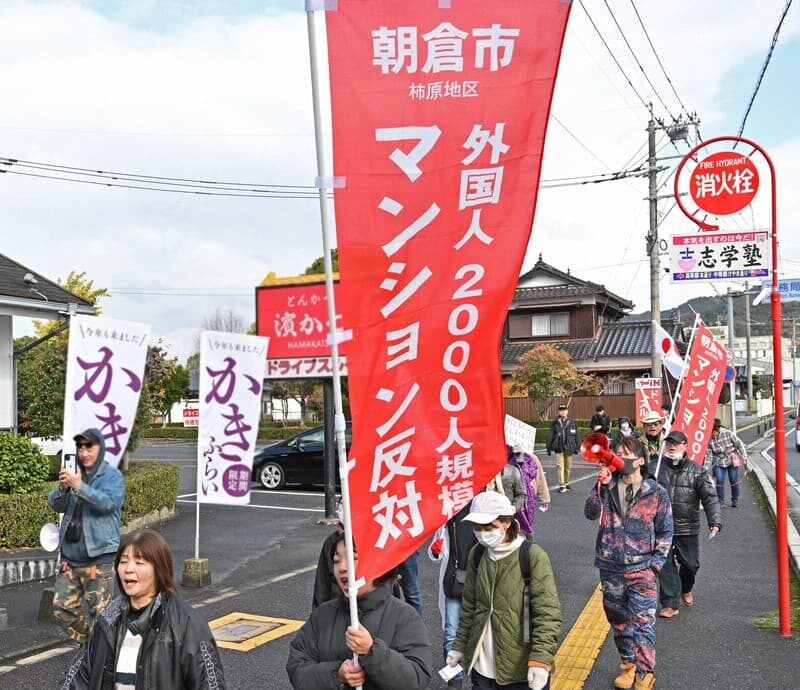
By November 2025, the city had received approximately 1,250 complaints. The situation appeared to reach a resolution in early December when the Japanese owner of the land indicated they would not cooperate with the developer’s plans. The municipal government announced on December 1 that the project was “expected to be brought back to square one.” However, some citizens remained skeptical, noting that no official announcement had come from the developer, and approximately 60 people took to the streets again on December 14 to demand clear explanations about potential impacts and the city’s response.
Broader Context: Foreign Investment in Japanese Real Estate
The Asakura controversy is not an isolated incident but rather part of a larger trend affecting Japanese communities. Japan’s real estate market has become increasingly attractive to foreign investors, particularly as the weak yen makes properties appear more affordable compared to major cities in Shanghai, Seoul, or Singapore. This dynamic has created tension between economic development and community preservation.
According to market analysis, foreign investment has flooded Japan’s luxury condominium market, much of it driven by price speculation. The average condominium sale price from major developer Mitsui Fudosan reached 122 million yen (approximately $825,000) in fiscal year 2025, representing a 20% increase from the previous year. In Tokyo’s prime wards of Chiyoda, Minato, and Shibuya, approximately 70% of developers reported that foreign buyers accounted for 20% or more of condominium sales.
What makes Japan unique among developed nations is its openness to foreign real estate ownership. Unlike Canada, Singapore, and Australia, which have implemented heavy stamp duties, outright bans, or minimum price thresholds to curb speculative foreign buying, Japan imposes no special taxes, reviews, or restrictions on foreign real estate purchases. This policy has attracted significant capital but has also sparked growing debate about whether regulations are needed to protect local interests.
The political landscape is shifting. What began as a fringe nationalist stance has moved toward mainstream policy discussion. Even centrist parties are considering some form of restriction, indicating a political consensus that was unimaginable five years ago. The right-wing Sanseito Party and the Democratic Party for the People have pushed for sweeping restrictions on real estate purchases by foreigners, arguing for measures to protect housing affordability for Japanese citizens.
This debate occurs against the backdrop of demographic challenges. Japan has 3.7 million foreign residents, a record high representing a 10.7% year-over-year increase and nearly 3% of the total population. This growth happens as the number of Japanese nationals falls for the 16th consecutive year, reaching 120.7 million. The contrast between these trends has fueled anxiety about cultural change and community identity in many areas.
The Paradox of Japan’s Housing Market
The Asakura case highlights a fundamental paradox in Japan’s housing market. While luxury properties in desirable urban areas experience bidding wars and price inflation, the country simultaneously grapples with more than 3.5 million abandoned homes, known as akiya, scattered across rural and shrinking towns.
These vacant properties rarely solve the affordability crisis because they typically suffer from poor condition, distance from employment centers, and significant renovation costs or zoning restrictions. The result is a split market: scarcity and competition in prime locations versus oversupply of unwanted properties in declining areas.
This dichotomy explains why foreign investment often focuses on new developments in attractive areas rather than renovating existing stock in depopulating regions. For investors seeking returns or personal use, properties near urban centers, in resort areas, or with specific amenities hold far more appeal than rural fixer-uppers.
The demographic context provided by economic research shows how Japan’s declining population and aging society impact housing demand. In many cities, shrinking populations create a surplus of houses, potentially driving down real estate values. This trend presents challenges for urban planning and infrastructure maintenance, requiring innovative solutions such as repurposing vacant buildings, promoting urban regeneration, and developing policies to encourage population growth in declining areas.
The aging population also shifts housing needs, with growing demand for specialized housing and care facilities. These demographic realities mean that developers must carefully assess which projects make long-term sense, balancing immediate demand with future population trends.
Pattern of Similar Controversies
The Asakura incident is not the first time foreign development proposals have sparked community backlash in Japan. Similar tensions have emerged in various contexts across the country, revealing a pattern of anxiety about external influences on local communities.
In the northern island of Hokkaido, the popular ski resort area of Niseko experienced its own difficulties with foreign-led development. A Chinese-affiliated company behind one of the largest resort developments in Niseko went bankrupt in April 2025, leaving a half-finished building covered in tarps. The project had planned to create Niseko’s largest accommodation facility with 219 guest rooms and five private villas. The collapse, with debt expected to reach billions of yen, raised concerns about the sustainability of rapid foreign-driven development and its impact on local communities.
Niseko had seen soaring land prices and labor costs driven by foreign investment, transforming the town dramatically. Residential land prices in the area rose 9.7% from the previous year, while commercial land prices around the main resort area exceeded 500,000 yen per square meter—more than double the rate from a decade earlier. The bankruptcy highlighted risks associated with relying heavily on foreign capital that might not always materialize as planned.
Another example of xenophobic backlash occurred when the Japan International Cooperation Agency (JICA) designated four Japanese cities as “Africa hometowns” for partner countries including Mozambique, Nigeria, Ghana, and Tanzania. This cultural exchange program triggered an ugly social media backlash after inaccurate reports suggested it would lead to a “flood of immigrants.”
The cities received thousands of complaints from confused residents who believed “hometown” status meant special permission for African nationals to live and work in their communities. One social media post claiming that Kisarazu city was “seriously considering handing over the city to Africans” attracted 4.6 million views. Officials spent entire days handling hundreds of phone calls and thousands of emails from alarmed residents.
“There are no plans to promote accepting immigrants or issue special visas,” clarified Japan’s Chief Cabinet Secretary Yoshimasa Hayashi, attempting to address the misinformation.
These cases demonstrate how quickly misunderstanding and fear can spread through social media channels, transforming innocent development proposals or cultural programs into perceived threats to community identity.
The Economic Balancing Act
Japan finds itself in a complex position regarding foreign investment and tourism. On one hand, inbound tourism has become a crucial economic driver. According to economic analysis, spending by foreign visitors in Japan reached an annualized 7.2 trillion yen between January and March 2024, making tourism the country’s second-largest export sector behind automobiles. The Japanese government has set a target of 15 trillion yen in inbound spending by 2030.
This tourism growth creates ripple effects throughout the economy, supporting businesses, creating jobs, and generating tax revenue. In tourist destinations like Niseko, foreign investment has helped develop world-class facilities that attract visitors from around the globe. The influx of foreign capital can revitalize areas that might otherwise struggle with economic stagnation.
However, this economic benefit comes with social costs. The same analysis shows that overtourism is becoming apparent in many Japanese destinations, impacting the daily lives of residents. Issues include crowded transportation, difficulty accessing public services, and rising living costs. Approximately 40% of residents in surveyed tourist cities express concern about the impact of tourism on their quality of life.
The challenge facing Japan is how to balance economic growth with community preservation. Other countries have attempted various approaches. Venice introduced a five-euro access fee for day-trippers on busy days, while Amsterdam has banned construction of new hotel buildings and plans to limit cruise ships. Barcelona announced intentions to ban short-term tourist rentals by 2028 to address housing affordability.
Japan has considered similar measures, including lodging taxes and dual pricing systems where foreigners pay more than locals. Himeji Castle proposed raising entrance fees for foreign visitors while lowering them for local citizens. These approaches aim to manage tourism flows while ensuring that economic benefits do not come at the expense of residents’ well-being.
Investment Risks and Regulatory Gaps
While the Asakura controversy focused on community concerns, it also highlights regulatory gaps that can affect foreign investors themselves. The Japanese real estate market, while open to foreign buyers, presents risks that may not be immediately apparent to international investors.
A case in Osaka demonstrated these vulnerabilities when 40 Hong Kong buyers fell victim to a property scam, resulting in losses estimated at nearly 100 million Hong Kong dollars. This incident underscored how foreign investors, unfamiliar with local regulations and business practices, can become targets for fraudulent schemes.
Additionally, the bankruptcy of the Chinese-backed resort project in Niseko revealed how development plans can collapse due to financial mismanagement, leaving unfinished projects and substantial debts. Such failures can damage local economies and create eyesores that detract from community appeal.
The lack of comprehensive regulations for foreign real estate purchases creates uncertainty for both communities and investors. Without clear guidelines about permitted developments, resident consultation requirements, or long-term ownership considerations, conflicts become more likely.
Some experts have suggested potential policy approaches, including residency requirements for property purchases, higher taxes on non-resident acquisitions, permit systems in designated zones, or minimum occupancy rules. However, such policies could potentially be circumvented through corporate ownership structures, nominee buyers, or reclassifying residential properties as commercial hospitality assets.
The Path Forward
The Asakura controversy has prompted discussions about appropriate policy responses. A government expert panel has urged the national government to conduct a fact-finding survey on foreign nationals’ condominium purchases in Japan. This survey would provide better data to inform potential policy decisions.
The proposed “Foreign Land Acquisition Regulation Bill” has emerged as a potential framework for addressing these concerns. Policy makers must determine how to handle loopholes such as purchasing through Japanese front companies and whether to adopt leasehold-only sales for foreigners, similar to practices in parts of Southeast Asia.
For local communities, the situation highlights the need for better communication and engagement processes. When the Asakura developer held its initial briefing in May 2024, the lack of follow-up discussions allowed misinformation to fill the vacuum. More structured community engagement might have addressed concerns earlier and prevented the escalation that occurred.
The role of social media in amplifying local disputes into national conversations also warrants attention. The rapid spread of exaggerated figures and unfounded claims created challenges for officials trying to provide accurate information. Finding ways to combat misinformation while respecting free expression remains a difficult balance.
Mayor Hayashi’s call for national leadership reflects the reality that local governments lack both the authority and resources to handle these complex issues effectively. The current legal framework was not designed with scenarios like mass foreign housing developments in mind, creating gaps that allow conflicts to develop.
As Japan continues to navigate its relationship with foreign investment and tourism, the challenge will be finding approaches that welcome economic opportunities while protecting community interests and maintaining social cohesion. The Asakura case serves as a cautionary tale about what can happen when these competing priorities collide without adequate preparation or communication.
The Essentials
- A proposed condominium development in Asakura, Fukuoka Prefecture, designed for 2,000 foreign residents sparked intense community opposition
- Social media misinformation exaggerated the project to 20,000 Chinese residents, far exceeding the actual plan
- Over 1,250 complaints flooded local government offices, and an online petition gathered 50,000+ signatures
- The project appears halted after the landowner refused cooperation, though no official cancellation announcement has been made
- Japan has no restrictions on foreign real estate ownership, unlike countries such as Canada, Singapore, and Australia
- Foreign investment has driven up luxury condominium prices in Tokyo, with average prices exceeding 100 million yen
- Similar controversies have occurred in Niseko regarding Chinese resort development and in cities designated as “Africa hometowns”
- Japan has 3.7 million foreign residents, a record high representing nearly 3% of the population
- Tourism has become Japan’s second-largest export sector, worth 7.2 trillion yen annually
- A government expert panel has recommended a fact-finding survey on foreign condominium purchases to inform potential policy