China’s Naval Evolution: From Conventional to Nuclear
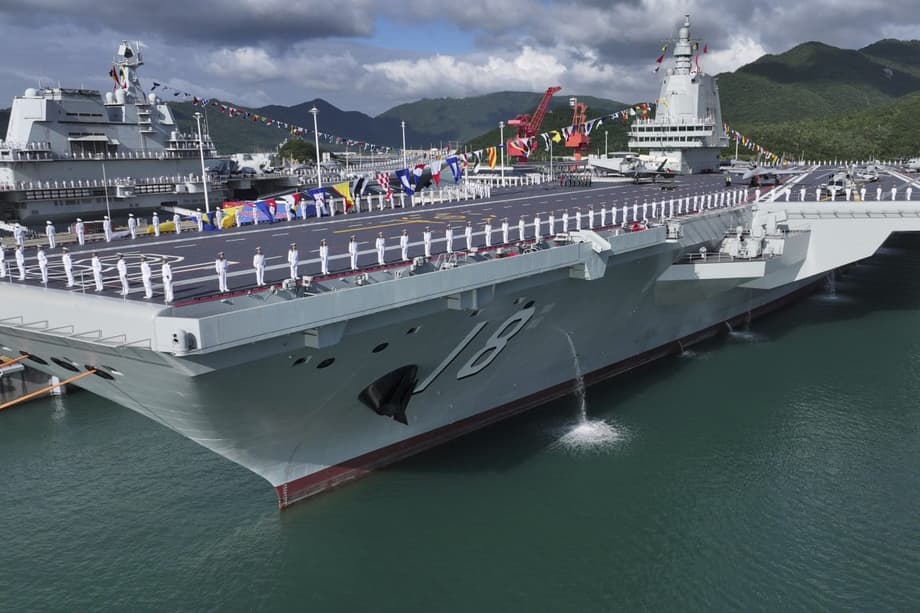
China’s newest aircraft carrier, the Fujian, represents a remarkable achievement in naval engineering. Commissioned in November, this 80,000-tonne vessel stands as the world’s largest conventional warship and the first non-American ship equipped with advanced electromagnetic catapults. Yet despite these technological milestones, military analysts have identified significant design limitations that could only be overcome through a fundamental shift in propulsion technology. According to the Shipborne Weapons Defence Review, the Fujian’s constraints point to an inevitable conclusion: China’s future aircraft carriers must be nuclear-powered to match the capabilities of their American counterparts.
- China’s Naval Evolution: From Conventional to Nuclear
- The Strategic Imperative for Nuclear Propulsion
- Concrete Evidence of Nuclear Development
- Satellite Imagery Reveals Construction Signs
- Technical Challenges and Strategic Questions
- Regional Security Implications
- The U.S.-China Carrier Competition
- Future Trajectories and Uncertainties
- The Bottom Line
The Fujian can carry a full spectrum of aircraft, ranging from fifth-generation stealth fighters and surveillance planes to drones, marking a dramatic departure from China’s earlier Soviet-inspired carriers. However, the most advanced American ships—the Gerald R. Ford class—boast three catapults compared with the Chinese ship’s two, making their launch process faster and more efficient. This disparity in launch capability underscores a broader challenge facing China’s naval ambitions as it seeks to transform from a regional power into a truly global maritime force.
The evolution of China’s carrier program has been rapid and deliberate. The first two Chinese carriers, Liaoning and Shandong, were based on Soviet-era designs employing ski-jump launch systems. The Fujian broke this pattern as China’s first indigenously designed carrier, incorporating electromagnetic catapults similar to those used by the U.S. Navy. Yet even this technological leap may prove insufficient for China’s long-term strategic goals, leading defense experts and officials to increasingly focus on nuclear propulsion as the next necessary step.
The Strategic Imperative for Nuclear Propulsion
Nuclear propulsion offers several critical advantages that align perfectly with China’s growing naval aspirations. Unlike conventional carriers, nuclear-powered vessels can operate for years without refueling, providing virtually unlimited endurance and range. This capability would enable Chinese carrier strike groups to maintain persistent presence far from Chinese shores, projecting power into the Western Pacific and beyond without the logistical burden of frequent refueling operations.
Tong Zhao, a senior fellow at the Carnegie Endowment for International Peace, explained the strategic significance of this transition. Nuclear-powered carriers would place China in the exclusive ranks of first-class naval powers, a group currently limited to the United States and France. For China’s leadership, such development would symbolize national prestige while fueling domestic nationalism and elevating the country’s global image as a leading power.
The practical benefits extend beyond symbolism. Nuclear propulsion frees up considerable space aboard the carrier that would otherwise be dedicated to fuel oil storage. This additional capacity can be used for aviation fuel and weapons, significantly extending the operational reach and combat power of the carrier’s air wing. Nick Childs, senior fellow for naval forces and maritime security at the International Institute for Strategic Studies, noted that nuclear power would eventually give China greater ability to run advanced systems such as electromagnetic launchers, radars, and new technology weapons.
“China’s growing force of aircraft carriers extend air defense coverage of deployed task groups beyond the range of land-based defenses, enabling operations farther from China’s shore,” the U.S. Defense Department stated in its most recent report to Congress on China’s military power.
This expanded operational envelope directly supports China’s stated strategic objectives. The country’s 2019 white paper on national defense indicated the Chinese navy was adjusting its strategic requirements by “speeding up the transition of its tasks from defense on the near seas to protection missions on the far seas.” Nuclear-powered carriers would be instrumental in executing this transition, particularly in contested regions along the First Island Chain, which includes Taiwan and various disputed territories in the South China Sea.
Concrete Evidence of Nuclear Development
Recent intelligence findings have provided compelling evidence that China is actively developing the nuclear propulsion technology necessary for future carriers. Researchers at the Middlebury Institute of International Studies in California concluded that China has built a land-based prototype nuclear reactor specifically designed for a large surface warship. Their analysis, based on satellite imagery and Chinese government documents, represents the first solid confirmation of Beijing’s advancement toward producing its first nuclear-powered aircraft carrier.
The project, dubbed the Longwei or Dragon Might Project, is located at a mountain site outside the city of Leshan in southwest China’s Sichuan province. The reactor prototype is housed at a facility known as Base 909, which already contains six other reactors in various states of operation. This site falls under the control of the Nuclear Power Institute of China, a subsidiary of the China National Nuclear Corporation tasked with reactor engineering research and testing.
Jeffrey Lewis, a professor at Middlebury and one of the researchers on the project, emphasized the significance of this discovery. The reactor prototype at Leshan constitutes the first solid evidence that China is, in fact, developing a nuclear-powered aircraft carrier. Operating such vessels is an exclusive club that China looks set to join, marking a major milestone in its naval modernization efforts.
The research team drew their conclusions from multiple sources, including project tenders, personnel files, environmental impact studies, and even a citizen’s complaint about noisy construction and excessive dust. Documents indicating that China’s 701 Institute, formally known as China Ship Research and Design Center, procured reactor equipment intended for installation on a large surface warship under the Nuclear Power Development Project helped confirm the reactor’s purpose.
Technical Specifications and Timeline
Contracts for steam generators and turbine pumps indicate the Leshan project involves a pressurized water reactor with a secondary circuit, a configuration consistent with naval propulsion reactors. An environmental impact report describes the Longwei Project as a national defense-related construction project classified as secret, underscoring its military significance.
Satellite images from 2020 to 2023 have documented the demolition of homes and construction of water intake infrastructure connected to the reactor site. These visible developments suggest the project is advancing steadily, with procurement documents indicating the reactor will soon be operational.
Jamie Withorne, an analyst at the Oslo Nuclear Project who reviewed the findings, described the argument as convincing. Sarah Laderman, a senior analyst with Open Nuclear Network, characterized the research as carefully conducted and thoroughly researched, noting that a compelling case exists that China is working toward building a nuclear propulsion system for naval surface ships, likely aircraft carriers.
However, the research does not provide clues about when a Chinese nuclear-powered carrier might be built and become operational. The development timeline remains uncertain, though some analysts speculate that China could begin producing two new carriers simultaneously—one conventional Type 003 like the Fujian and one nuclear-powered Type 004.
Satellite Imagery Reveals Construction Signs
Beyond the reactor prototype, additional evidence suggests China has begun actual construction of a nuclear-powered carrier. Satellite imagery analyzed by NBC News shows an engineering prototype of a module with two tracks or trenches at China’s Dalian shipbuilding facility in northeast China. These tracks appear related to catapult systems, leading five analysts to conclude the images suggest a new ship design unlike anything currently in the Chinese fleet.
Michael Duitsman, a researcher at the James Martin Center for Nonproliferation Studies, explained that these tracks likely represent testing equipment and layouts for the upcoming Type 04 carrier. The general consensus among analysts is that the new carrier will have four catapults, which would allow more planes to take off and match U.S. carriers like the USS Gerald R. Ford. To accommodate four catapults, the ship would need to be larger than the Fujian, matching American tonnage and powered by a nuclear reactor.
The two tracks seen in the latest satellite images run at convergent angles, matching the general configuration of American supercarriers that have four electromagnetic catapults—two running parallel on the bow and two on the waist. Due to space constraints on the flight deck, they do not run parallel but converge, a design detail that helps accommodate the electromagnetic systems.
Seth Hosford, another researcher at the James Martin Center, noted that prototype builds of specific sections are warranted when dealing with complex electromagnetic catapults. These catapults, first deployed by the United States on Ford-class carriers, attach to a plane’s nose and rapidly propel it forward using large magnets rather than steam pistons. The module seen in Dalian has two tracks quite close together, and Hosford warned that electromagnetic catapults intersecting could create various technical issues with magnetic fields.
Analysis by the Japan Institute for National Fundamentals (JINF) provides further corroboration. Their satellite imagery assessment suggests China has likely started constructing its first nuclear-powered aircraft carrier at the Dalian shipyard. Images showing the installation of keel blocks more than 270 meters long and internal frames measuring 16 meters in height and 14 meters in width resemble structures seen on nuclear-powered carriers currently under construction in the United States.
Technical Challenges and Strategic Questions
Despite the progress evidenced by reactor development and construction activity, significant challenges remain. Building a nuclear-powered aircraft carrier is vastly more complicated than constructing a conventional one. Nuclear propulsion affects the carrier’s weight, balance, internal layout, maintenance needs, training demands, and resupply logistics. The leap from conventional to nuclear propulsion represents a greater technological challenge than the transition from having no carriers to operating conventional ones.
The United States learned this lesson through decades of experience. Even with deep nuclear engineering expertise and an established industrial base, building and maintaining nuclear carriers has required monumental financial and logistical investment. China, despite its impressive shipbuilding prowess, has never built a nuclear-powered surface ship. While it operates nuclear-powered submarines, these remain a generation or more behind U.S. and Russian designs in noise reduction, reactor safety, and operational reliability.
Matthew Funaiole, senior fellow at the Center for Strategic and International Studies’ China Power Project, expressed skepticism about China’s immediate nuclear ambitions. He doubts China’s next carrier will be nuclear-powered, instead expecting the People’s Liberation Army Navy’s fourth carrier to focus on optimizing the existing Fujian design with incremental improvements.
Strategic questions also persist about whether nuclear carriers are even necessary for China’s current military objectives. China’s primary strategic focus remains the Indo-Pacific, particularly Taiwan, the South China Sea, and the East China Sea. For these regional theaters, conventionally powered carriers may be more than adequate. The Fujian, with its electromagnetic catapult system and large air wing, will be able to project power effectively across China’s immediate periphery once fully operational.
A Chinese military observer speaking to Newsweek on condition of anonymity noted that if China aimed to project power beyond the Western Pacific, a nuclear-powered aircraft carrier would not be the most critical factor. The logistical support required for a global navy far exceeds the fuel demands of the carrier itself, as escort ships and aircraft consume substantial amounts of fuel. China still lacks the vast, comprehensive logistical network in the region that the United States possesses, whose Navy can refuel ships on allied territory to support overseas missions.
The Economic and Training Burden
Nuclear-powered carriers carry breathtakingly expensive price tags. Even for the United States, the costs of building and operating a Ford-class carrier and its accompanying air wing and escorts are astronomical. For China, which faces economic challenges including slowing growth, demographic decline, and financial instability, investing hundreds of billions of dollars into nuclear supercarriers might not represent the wisest allocation of resources.
Manpower presents another significant challenge. The Chinese navy currently operates 12 nuclear-powered submarines, significantly fewer than the United States and Russia. This limited experience could impact the training of personnel for nuclear-powered aircraft carriers. Kitsch Liao, associate director of the Atlantic Council’s Global China Hub, noted that scaling up training pipelines to provide sufficient skilled personnel could become problematic, especially if China also plans to expand its nuclear-powered submarine fleet.
Some analysts suggest Beijing might pursue a smarter strategic path by investing in capabilities that complicate American power projection, such as anti-ship ballistic missiles, submarines, and cyberwarfare tools, rather than attempting to match American ship-for-ship. Nuclear-powered supercarriers might offer prestige value, but prestige does not always translate to strategic utility.
Regional Security Implications
The introduction of nuclear-powered aircraft carriers would significantly alter the security dynamics in the Indo-Pacific region. A nuclear-powered carrier equipped with a catapult system would remain deployed in the Pacific for longer periods than conventionally powered carriers such as the Fujian. This capability would enable more sustained operations around Japan and throughout the First and Second Island Chains.
Maki Nakagawa, a researcher at the Japan Institute for National Fundamentals, warned that while China’s aircraft carrier force still lags behind that of the U.S. military, the commissioning of a fourth nuclear-powered carrier could usher in more sustained operations around Japan. Such a shift would make surveillance and intelligence-gathering activities by the Self-Defense Forces and U.S. military more routine, effectively forcing Japan to adapt its response posture.
The implications for Taiwan are particularly significant. Nuclear-powered carriers would provide the Chinese military with greater flexibility and endurance to operate around strategic hotspots, especially along the First Island Chain where most territories disputed by China are located. In the event of a conflict over Taiwan, nuclear carriers could deploy aircraft in the Philippine Sea east of the island, potentially deterring and hindering American military intervention.
Zhao of the Carnegie Endowment explained that these carriers could extend Chinese operations deeper into the Western Pacific, further challenging the U.S. military’s ability to intervene in regional matters that China views as best resolved by countries from the region only. This expanded reach would complicate American defense planning and potentially alter the calculus of any future confrontation.
The Pentagon has expressed growing concern about China’s rapid modernization of its fleet, including the design and construction of new carriers. This development aligns with China’s growing emphasis on the maritime domain and increasing demands for its navy to operate at greater distances from mainland China.
The U.S.-China Carrier Competition
The United States maintains a substantial advantage in carrier capabilities, currently operating 11 nuclear-powered aircraft carriers. This fleet allows the U.S. Navy to keep multiple strike groups deployed around the world at all times, including in the Indo-Pacific. The Gerald R. Ford class represents the pinnacle of American carrier technology, with three electromagnetic catapults providing superior launch rates compared to China’s two-catapult system.
However, China’s shipbuilding capacity has become a source of concern for American defense planners. China’s shipyards are building hundreds of vessels each year, whereas the United States constructs five or fewer annually. This industrial advantage has enabled China to rapidly expand its fleet, which already numbers more than 370 ships and submarines, making it the world’s largest navy by vessel count.
The Pentagon’s annual China Military Power Report reveals ambitious Chinese expansion plans. According to the assessment, China aims to field a force of nine aircraft carriers by 2035, embarking on what would be the largest carrier build-up effort in the Indo-Pacific since World War II. This expansion would triple Beijing’s ability to deploy carrier strike groups within the next decade.
The report noted that China deployed its carriers in support of simulated Taiwan blockade operations during Joint Sword exercises. Alongside other Chinese warships and aircraft, the deployment of PLAN carriers presented a challenge to potential third-party access during a conflict. Such exercises demonstrate how China intends to leverage its growing carrier capabilities in regional contingencies.
Yet direct comparisons between American and Chinese carrier capabilities require nuance. As The Diplomat noted, describing China as the world’s largest navy based solely on hull count can be misleading. A 1,400-ton corvette constitutes one ship just as a 100,000-ton Ford-class carrier does, but their capabilities differ vastly. Other measures, such as tonnage or armament, provide more meaningful comparisons of naval power.
Future Trajectories and Uncertainties
The path forward for China’s carrier program remains subject to debate among analysts. Some experts, like Collin Koh of Singapore’s Institute of Defense and Strategic Studies, argue that China’s shift toward far-seas power projection beyond the first island chain makes a move to nuclear-powered aircraft carriers strategically sensible. Nuclear reactors would provide a stable and sustainable energy source for high-tempo operations, particularly important given China’s adoption of electromagnetic catapults that consume large amounts of power.
Others advocate for a more cautious approach. The National Security Journal suggests China might continue refining its conventional carrier fleet, fielding three to six conventional supercarriers over the next decade to dominate regional waters without assuming the burdens of nuclear propulsion. Alternatively, China might attempt a slow, cautious move into nuclear propulsion by building a single experimental nuclear-powered carrier sometime in the 2030s, learning by doing much as the United States did with the USS Enterprise in the 1960s.
Some analysts question whether the future belongs to giant carriers at all. Hypersonic missiles, drone swarms, and advanced undersea weapons threaten to make large surface ships increasingly vulnerable. In this context, China might decide that perfecting the weapons that can sink carriers rather than building more vulnerable floating cities represents the smarter strategic investment.
For the United States, the appropriate response remains a subject of debate. The National Security Journal argues for strategic patience and maritime restraint rather than panic or overreaction. China’s nuclear carrier program may prove to be a costly, risky, prestige-driven project that yields more symbolism than real combat power. The United States might benefit from conserving its strength and focusing on affordable, resilient, distributed maritime capabilities rather than matching China carrier-for-carrier.
Regardless of these uncertainties, one fact remains clear: China’s commitment to developing a world-class navy represents one of the most significant military developments of the 21st century. Whether nuclear-powered carriers emerge as the centerpiece of this strategy or prove too costly and complex to realize at scale, China’s naval transformation will continue reshaping the security architecture of the Indo-Pacific for decades to come.
The Bottom Line
- China’s Fujian carrier, though technologically advanced, has design flaws that nuclear propulsion could address
- Satellite imagery and documents confirm China is building a prototype naval reactor for large warships
- Construction activity at Dalian shipyard suggests work has begun on a nuclear-powered Type 004 carrier
- Nuclear propulsion would provide greater range, endurance, and capacity for aircraft fuel and weapons
- Technical challenges include reactor miniaturization, systems integration, and personnel training
- Strategic questions remain about whether nuclear carriers are necessary for China’s regional focus
- The Pentagon reports China aims to field nine aircraft carriers by 2035, a major expansion from current levels
- Nuclear carriers would significantly alter security dynamics around Taiwan and the First Island Chain
- The United States maintains 11 nuclear-powered carriers but faces growing competition from China’s shipbuilding capacity
- Future warfare technologies may reduce the strategic value of large carriers regardless of propulsion type